The Book I Wish I Had Written

The culture section of the Saturday edition of a major British newspaper runs a regular column in which celebrities in the arts are asked to identify subjects from their cultural life such as ‘The book I am currently reading’, ‘The instrument I wish I had learnt’ and ‘The last film that made me laugh/cry’. These lists are always fun to play along with but, while my answer to topics such as ‘My favourite piece of music’ has changed over the years, my answer to the regular question ‘The book I wish I had written’ has long remained the same: The Great War and Modern Memory by Paul Fussell.

Celebrity answers to this topic tends to be couched in terms of either a personally inspirational text or a best-seller that made the author a lot of money. In my case, the answer arises from a mixture of both. I first read The Great War and Modern Memory as a freshman, a first year undergraduate in my first semester at university. I thought at the time that I wanted to be an English major. By the end of the year, I knew that I would be a history major. This shift was only in part down to Fussell’s pivotal work of cultural history (Geoffrey Parker’s lecture on the possible role of sunspots in the development of early modern military strategy also had something to do with it), but what the book undoubtedly informed was my commitment to history that took fiction as one of its primary sources. This would shape not only my undergraduate module choices but the topic of my senior essay (an analysis of Ford Madox Ford’s Parade’s End tetralogy and R.H. Mottram’s The Spanish Farm trilogy as representations of the Western Front), but also my master’s and doctoral theses as well as almost every major work I have published since.

Of course, my view of Fussell’s work has evolved since then but that ‘heady mixture of literary criticism and cultural and historical analysis’ [1] remains deeply alluring as a point of reference not necessarily as a cultural history of the First World War, but as a pivotal moment in the cultural turn in First World War studies. As Ian Isherwood and Steven Trout argue in their excellent recent review article, ‘But It Still Goes On: Paul Fussell’s The Great War and Modern Memory at 50’, ‘the book is perhaps best approached as a an experimental study – a hybrid mixture … of  literary scholarship, cultural analysis, historical writing, and veiled autobiography.’ [2] This hybridity, if not Fussell’s argument about the centrality of irony to a Modernist paradigm shift in cultural expression, has gone on to inform the approach and ambition of major works in the field, including Samuel Hynes’ A War Imagined (1990) and Jay Winter’s Sites of Memory, Sites of Mourning (1995), as well as many of their students, among whose number I include myself. And, in ‘reigniting a debate from the late 1920s and early 1930s over literary treatments of the Great War and their portrayal of disillusionment supposedly shared by an entire generation’ [3], Fussell helped shape what we now define as the canon of British First World War literature as surely as any writer, publisher or critic of the ‘war books’ boom. We cannot understand not only how we in Britain and the US remember the First World War today, but how it is represented in contemporary cultural forms. Alice Winn’s almost constant references to Robert Graves’ Good-bye To All That in In Memoriam (2023) provides only the most recent testimony to Fussell’s historiographic influence.

It is, as Isherwood and Trout note, the representativeness of the authors selected by Fussell for analysis that lie at the heart of many of the critiques of his approach. Yet representativeness was never really the point: ‘Drawn … to highly literate, middle-class junior officers like himself (albeit members of a different army in a different war), he never intended to write a comprehensive study of British Firs World War literature or, for that matter, an exhaustive treatment of British culture before, during, and after the conflict.’ [4] But that debate, with its echoes of the critiques of Douglas Jerrold and Cyril Falls [5], highlights an issue that those of us who use fictional, semi-fictional and poetic sources in our research and analysis still grapple with today. No cultural history of the war can ever be comprehensive, either in breadth or depth, particularly when the conflict is considered in global rather than national terms. How do we choose which texts to focus on? How do we balance close reading of the symbolism of particular texts with broad claims about the culture in which they were produced and which they sought to shape?

It is here that Isherwood and Trout’s identification of the importance of autobiography to Fussell’s endeavour spoke most strongly to me. Unlike Fussell (or indeed Hynes), I am not trying to use my practice of cultural history to grapple with experiences as a former soldier. I make no claims to, as Fussell did, to sharing a bond of experience with the authors he selected for particular consideration. But I have always been aware of the extent to which my own personal preferences and youthful exposure to particular literary works has shaped the texts I have chosen to focus on (the work of Dorothy L. Sayers being the most obvious example), as well as my vulnerability to the critique levelled by Charles Carrington against Fussell, that the analysis of someone who wasn’t there can never be a true history of the war. Indeed, as a newly minted PhD, I was bluntly told by one ex-serviceman (himself too young to have served in the First World War), that my thesis on representations of wartime masculinities was worthless because I was not a man and had not myself served in the war. (My gender and age clearly trumped my nationality in this instance as my critic chose not to point out the fact that, like Fussell, I am an American.)

So I take comfort from Isherwood and Trout’s argument that ‘Fussell’s status as a cultural outsider … sharpened his insights … and emboldened him to say things that he might not have if he had been British…. [H]is distance from the war’s living memory enabled him to study the “troglodyte world” of the trenches and the mythology it produced with fresh eyes.’ [6]  Which is not to say that I necessarily take comfort from the text itself, which remains as challenging and provocative today in many ways as fifty years ago. For me today, the particular challenge of the autobiographical element is the most stimulating as I grapple with the ‘genealogical’ or ‘family history’ turn in social history, as exemplified by the work of Alison Light, Michael Roper and, most recently, Laura King. My family’s history doesn’t fit neatly with the history of the First World War, challenging cultural narratives of the war’s universality. But is this distance a handicap or a benefit? As I grapple with these questions as part of the process of writing my own book, The Great War and Modern Memory will continue to remain as much of an inspiration for my historical practice as it was when I first read it thirty years ago

[1] Ian Isherwood and Steven Trout, ‘But It Still Goes On: Paul Fussell’s The Great War and Modern Memory at 50’, The Journal of Military History, 89 (January 2025): 155-170 (160).

[2] Isherwood and Trout, ‘But It Still Goes On’, 158.

[3] Ibid., 160.

[4] Ibid., 160.

[5] Douglas Jerrold, The Lie About the War: A Note on Some Contemporary War Books (Faber & Faber, 1930); Cyril Falls, War Books: A Critical Guide (Peter Davies, Ltd, 1930)

[6] Isherwood and Trout, ‘But It Still Goes On’, 168
Unreal City

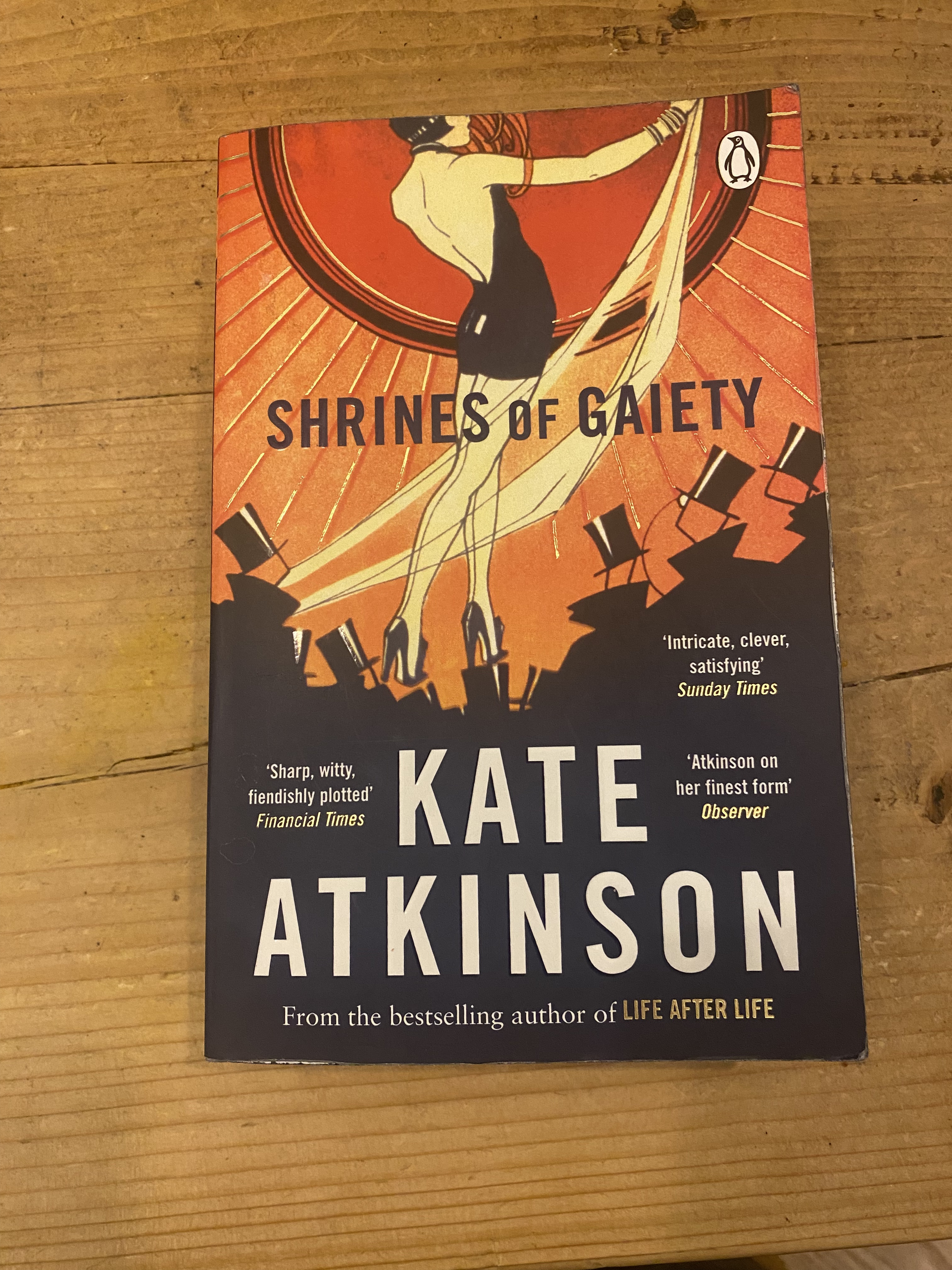
Kate Atkinson, Shrines of Gaiety

Having swallowed down Human Croquet and Normal Rules Don’t Apply in a gulp, I took a bit more time over Shrines of Gaiety, which is probably a good thing.  I enjoyed it – I think it is probably impossible for Atkinson to write a book that I don’t find totally immersive and enjoyable to read – but, in retrospect, I’m not sure it was as entirely wonderful as I had hoped. I don’t really expect anything to live up to the wonder of A God in Ruins, a book which speaks to so much that I love, am interested in and have dedicated my intellectual life to, or Life After Life, a literary and imaginative life raft which I clung to in the days after my mother died. But his is a book that had the potential to speak to me as strongly as either of these, a story of a time and people who are, in part, the subject of the (non-fiction) book I am writing at the moment, as well as being crime fiction-adjacent, touching on another of my great passions.

And there certainly were elements of this book that I loved. Nellie Coker, Gwendolen Keeling and Freda Murgatroyd (what a name!) are all wonderful creations – rich, complex, engaging women whose attitudes and actions I could deplore and root for in equal measure. I also loved the character of Niven Coker, a man shaped but not defined (except perhaps in the eyes of others) by his experiences of war. The ambiguity of the ending of his and Gwendolen’s story, so typical of Atkinson’s play with multiple narratives and possible outcomes, was one of the great pleasures of the novel for me.

And yet… And yet… I did not love this book the way I loved even Transmission, a novel that I know many critics struggled with. The problem for me was two-fold. In the first place, there were too many characters and storylines introduced, with the result that several of the plots and characters felt underdeveloped. Ramsey Coker in particular, who gets a considerable amount of space in the book, never came fully alive for me, and I never truly believed in his (strategically important) relationship with Freda. Similarly, the murdered girls whose disappearance I think is intended to be a central plot device, merged into one in my mind, which was a problem given the centrality of the moral imperative that drives Inspector Frobisher’s desire to name them individually. And to leave one major plot strand (the disappearance of Florence Ingram) entirely unexplained may be considered artistic license. For there to be a second (the murder of Vivian Quinn) feels like authorial carelessness.

Secondly, and relatedly, the book is weakened by the attempt to coral all 73 characters and their interlinking storylines into small a social and geographic space. There are any number of coincidences – Frobisher’s presence on the bridge when Freda goes into the river, Freda and Florence rooming in the house of the abortionist employed by Maddox, Niven Coker passing by when Gwendolen is mugged. One of these would work to help drive the plot but, like the unexplained plot points, their accumulation over the course of the novel feels contrived. The appearance of Gertie Bridges as a deus ex machina and virtual twin of a central character feels particularly in artistic, violating as it does the tenth of Ronald Knox’s commandments of detective fiction for the period. Having invoked Eliot and his unreal city, the imagery of the nameless crowd flowing over London Bridge, undone by death, is undermined by the boundaries these coincidences put in place.

Ultimately, then, this in really a novel about the aftermath and legacy of the First World War as I had hoped. The decadence of the clubland setting, with its corrupt police, violent gangsters and privileged patrons, could belong as easily to the fin de siècle, with Wilde rather than Eliot as muse. The experience of the horrors of war are part but not the entirety of the life the characters, something which does ring true, particularly in the case of Niven, but this raises questions about Atkinson’s stated inspiration for the novel, as discussed in the Author’s Note. Unlike her Second World War novels, which do so brilliantly, this one fails to fully capture the uniqueness of the historical moment of its setting. Possibly this is a specific problem of the interwar period, which does seem to have a certain ubiquity in historical novels, although Sarah Waters undoubtedly managed to capture the unique flavour of changing times and social mores in the period in The Paying Guest.

None of which is to say that I don’t recommend Shrines of Gaiety. Anything by Atkinson is worth reading and Nellie Coker is far too good a character to refuse introduction to. I am very glad I met her, and her elder son. But this novel won’t haunt me the way that A God in Ruins and Behind the Scenes at the Museum do, enriching my life and scholarship in the process. However, this slight disappointment certainly won’t keep me for eagerly anticipating the paperback publication of Death at the Sign of the Rook, Atkinson’s latest (and apparently last) Jackson Brodie detective novel, an homage to Golden Age detective fiction. I live in hope that it manages to capture the feeling of the interwar – this elusive, infuriating, enthralling period that continues to fascinate me as both a historian and reader of fiction. I do so in the certainty that even if it does not, it will still, like Shrines of Gaiety, be a great read.

Bullets and Bayonets

The Cornish Coast Murder (British Library Crime Classics)

Spoilers for The Cornish Coast Murder throughout.

One of the things that this extraordinary summer has allowed me to do has been to catch up on reading my way through my shelf of ‘to be read’ books. I don’t mean that the shelf has become emptier; I have been buying nearly as many books as I have read. Nonetheless, I have finally read all but one of the books that were waiting to be read when we moved house two and half years ago. (Wade Davies’ mammoth Into the Silence at over 600 pages is still proving too much of a challenge; I will tackle it eventually.) So last week I finally got around to reading John Bude’s The Cornish Coast Murder, one of several British Library Crime Classics editions that were given to me as a Christmas present several years ago.

The Cornish Coast Murder, first published in 1935, the same year that Dorothy L. Sayers published Gaudy Night, as Martin Edwards points out in his introduction, is very much a standard Golden Age detective novel of the puzzle variety. That is, the focus of the narrative is on the murder plot, with very little in the way of characterization. Indeed, the characters are such archetypes that the key players tend to be referred to as the Inspector, the Vicar or the Doctor (although we are given their names and some physical description). The interest and momentum of the book is generated by uncovering the method of the crime (including possibly the first description of the sort of forensic tracing of bullet trajectory popularised by early series of CSI), with contemplation of motives and morality reduced to an afterthought in the final few chapters. It thus fits well into Alison Light’s description of the interwar whodunit as ‘a literature of convalescence’, ‘as insensible to violence as it could be. … As many critics have noted (usually dismissively) it is the lack of emotional engagement in the detective fiction between the wars which matters.’ [1]

So no, The Cornish Coast Murder is not one of the great novels of the Golden Age. This is no The Nine Tailors (1934), The Beast Must Die (1938)or even And Then There Were None (1939). But it is of particular interest to a social and cultural historian of the First World War with an interest in detective fiction on two counts. Firstly, there are the various suspects and witnesses. Since writing my Phd, half of which looked at the figure of the wartime hero in interwar detective and crime fiction, I have been on the hunt for ex-servicemen, and particularly disabled ex-servicemen, in such fiction. The Cornish Coast Murder stands out for having not just one such character, but four. Two of them are said to be suffering from a psychological wound of war. Three of them are suspects, one a witness and one, ultimately, the murderer. The second, related, aspect of interest is the murder weapon, a service revolver, described in some detail. Indeed, as with ex-service characters, there is not merely one but a second which acts as a significant red herring for much of the novel.

Taken together, these two aspects of the novel mean that there is an awful lot of war and its legacy, for both individuals and society, in this book. This stands in direct contrast to Marzena Sokolowska-Paryz’s assertion that ‘In the interwar period, detective fiction retained its distinctive autonomy as a genre, refusing to embrace the subject matter of the war or its repercussions in the present.’ [2] In making her argument, Sokolowska-Paryz quotes John Scraggs’ assertion that ‘The Golden Age fixation with the upper class, or the upper middle class, is further compounded in British fiction of the period by the fact that the physical and social settings are so isolated from the postwar depression that it is as if the Great War never happened.’ [3]

These are pretty extraordinary assertions. One only has to have even a passing acquaintance with the works of Dorothy L. Sayers to take issue with both of them. The war and its legacy for the present are central to her novels, whether in the form of her shell-shocked ex-service detective (Whose Body? (1923)and passim), plots which turn on the ex-service status of suspects and victims (The Unpleasantness at the Bellona Club (1928), The Nine Tailors (1934)), or passing references to social impacts such as the refugee crisis and ex-service employment or lack thereof (Whose Body?, Clouds of Witness (1926), The Unpleasantness at the Bellona Club, Gaudy Night). Sayers, to be sure, is something of an outlier within the genre, both in the sophistication of her novels as socially reflexive literature and the extent to which the war is referenced throughout, but she is certainly not alone. Examples of war reference can be found in the work of Ngaio March (Enter a Murderer (1935)) and, of course, both Hercule Poirot and Captain Hastings have wartime backgrounds. Like these, what Bude’s plethora of ex-service characters demonstrates is the extent to which the war underpinned everything in interwar society. It did not need to be made the explicit subject of interwar detective fiction (although it could be); its violent legacy, including moral panics over both the brutalisation of ex-servicemen by war service and, conversely, the psychological damage inflicted by war which might lead them to lose control which forms the definition of Ronald Hardy’s shellshock in Bude’s novel, is always there, emerging at various times and in various ways, as it must have done off the page as well as on.

Sokolowska-Paryz and Scraggs’ arguments, and indeed Light’s, can thus be read as an interesting manifestation of the debate about what makes for an ‘authentic’ depiction of the war by post-war fictions. This debate has been going on since at least 1919, and not solely in relation to literary fiction. As Mark Connelly has argued, for the film critic Annie Winifred Ellerman, who wrote under the pseudonym Bryher, ‘realism about the war could mean one thing – only its horrors and miseries. This ideological position then categorically denied that chivalry, honour, or bravery were part of the reality of war. Alternatively, if they were accepted, they were either wasted in such an ignoble pursuit and/or such a tiny component of war as to be irrelevant. In turn, this meant that any depiction that foregrounded these qualities was inherently flawed, and worse still, fundamentally immoral.’ [4] Conversely, Cyril Falls, the literary critic and ex-serviceman, complained in 1959 that ‘The flood of anti-militarist literature, for the greater part fiction, which poured from the presses, deriding the leadership from top to bottom, treating patriotism as a vice when not a fraud, as it was bathed in blood and rolled in mud, was astonishing. It was far from being representative’.[5] While two sides to the debate of what constitutes an ‘authentic’ representation of the war clearly emerged in the interwar period, it is interesting that the Bryher position seems to have come so clearly to dominate contemporary criticism of the detective genre. If it isn’t brutally realist and violent, then it is not, by Sokolowska-Paryz, Scraggs or Light’s argument, a depiction of or reference to the war and its social legacy in Britain. While Sokolowska-Paryz does discuss the more heroic representation of the war in Anne Perry’s Joseph Reavley novels in her analysis of contemporary detective fictions about the war, these form only one of the five series she examines, with all the others adhering to the disillusionment narrative.

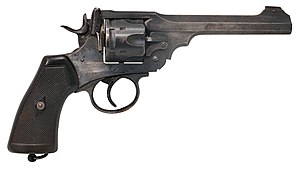
Webley Mk IV Revolver

Which brings us to the second interesting element of The Cornish Coast Murder, namely the service revolver. In Bude’s novel, the revolver (or rather the two revolvers, one belonging to the shell-shocked suspect Ronald Hardy and one belonging to the murderer) is the subject of much discussion and description. Both are Webley .45s, the standard issue service revolver during the war, with the Mark VI replacing the Mark IV and V from 1915. Issued to officers, pipers, range takers, airmen, naval crews, trench raiders, machine-gun teams and tank crews, service revolvers were not carried by every serviceman but nor were they reserved solely for the officer corps. Thus while Hardy’s monogrammed revolver reflects his former rank as a junior officer and his social status as a middle-class author, the murderer, a manual labourer, ‘scrounged [his] in France, before being demobbed in ’19, and several rounds of ammunition.’ [6] One of the suspects, Cowper, the groundsman at Greylings, served as a Lance Corporal in an undisclosed regiment but never handled a revolver during his service.

While two service revolvers in one novel is slightly unusual, these weapons appear with some regularity in interwar detective fiction. Christie, who as a pharmacists during the war, knew more about poisons than guns, tended to label the pistols that appeared in her novels as ‘army service revolvers’. Sayers, meanwhile, has the murdered in The Unpleasantness at the Bellona Club shoot himself in the head. The type of gun used is not specified, but given the setting of a serivemen’s club (and the themes of the war and its legacy which are central to this book in particular), the reader might easily conclude that the weapon was a service revolver.

What is interesting is the extent to which in more contemporary detective fiction with a wartime or interwar setting, the service revolver has, in large part, been displaced by the bayonet as a weapon with wartime associations. [7] On my recent rewatching of Miss Fisher’s Murder Mysteries, for example, I was interested to note that bayonets were used twice, once as a murder weapon in Dead Weight (2013) and once by a disabled ex-serviceman when confronted with evidence of drug theft from a medical clinic in Blood and Money (2015). Sokolowska-Paryz points to the symbolic significance of the bayonet as the murder weapon in Rennie Airth’s Rivers of Darkness (1999), noting that the ‘sexual overtones of the killings is made apparent through the psychoanalytic meaning of the bayonet’ as a substitute penis. [8]

The symbolism of the bayonet, however, goes beyond its Freudian overtones. As Paul Hodges has argued, it was a weapon fetishized during the war and after as one of masculine aggression and face-to-face combat in ways which led to its use in wartime atrocities such as the killing of prisoners of war and the wounded. [9] Used in infantry training to instill aggression in the private soldier, its use as a weapon in modern industrialised warfare was generally perceived by servicemen as futile, a throwback to an earlier age. It is thus the symbolic inverse of the service revolver, a middle-class officer’s weapon associated with duty and honour and fired from a distance. Even when duty leads to violence and the taking of life, there is always an explicable motive, including the defense of the domestic, a common justification for war service. The distance between murder and victim, meanwhile, is particularly emphasized in The Cornish Coast Murder by the fact that the murderer fires from a boat, requiring three widely spaced shots to hit his target. The revolver, therefore, comes closer to wartime artillery as a fatal force, a distanced and almost random form of killing.

The service revolver and the bayonet can thus be read as emblematic of the two interpretations of the war at the heart of the debate over authenticity – the technologically advanced form associated with honourable (or at least explicable) motivations and the middle-class officer corps and the brutal, apparently futile form associated with psychopathy and men damaged physically or psychologically by war. It is interesting to note that there appears to have been a decisive shift from one to the other as the symbolic weapon of the war between detective fictions of the interwar period and those of the past quarter century which have the war as its setting. As I start to think about the wider implications of this shift for understandings of the war and its legacy, I would be interested in hearing about appearances of both weapons in other fictions, both then and now. I promise not to wait as long to read them as I did with The Cornish Coast Murder.

[1] Alison Light, Forever England: Femininity, Literature and Conservatism Between the Wars (London: Routledge, 1991), p.70.

[2] Marzena Sokolowska-Paryz, ‘The Great War in Detective Fiction’ in The Great War: From Memory to History, ed. by Kellen Kurschinski, et. al. (Waterloo, Ontario: Wilfred Laurier University Press, 2015), p.84.

[3] John Scraggs, Crime Fiction (London: Routledge, 2005), p.48.

[4] Mark Connelly, ‘The Battles of Coronel and Falkland Islands (1927) and the Struggle for the Cinematic Image of the Great War’ in The Great War, ed. by Kurschinski, et. al., p. 317.

[5] Cyril Falls, The Great War (New York: Putnam, 1959), p. 421, quoted in Ian Andrew Isherwood, Remembering the Great War: Writing and Publishing the Experiences of World War I (London: Bloomsbury Academic, 2017), p. 160.

[6] John Bude, The Cornish Coast Murder (London: The British Library, 2014; first published London: Skeffington & Son, 1935), p. 275.

[7] By bayonet I mean here the rifle bayonet; interestingly, the Webley Mk VI could be modified to take a small bayonet as well.

[8] Sokolowska-Paryz, ‘The Great War in Detective Fiction’, p. 94.

[9] Paul Hodges, ‘They Don’t Like It Up ‘Em!’: Bayonet fetishization in the British Army during the First World War’, Journal of War & Culture Studies, 1:2 (2008), 123-138, DOI: 10.1386/jwcs.1.2.123_1.