I have a very bad habit of picking up any novel with a First World War or immediate post-war setting when I come across them in a second-hand book sale. My husband grumbles about my bringing yet more books into the house while, in my heart of hearts, I know that, more likely than not, I will spend most of the time I am reading them getting annoyed by inauthentic, not to say inaccurate, portrayals of the war which rely heavily on clichés. Yet I carry on doing it, in part in forlorn hope that I may encounter an original (and thus enjoyable) new author or series, and in part to remind myself of all the pitfalls to avoid when writing my own war-set fictions.
As painful as most of these are to read, in general I find there is enough to them, in terms of plot, characterisation or, very occasionally, setting, to keep me reading until the final pages. Certainly, I did manage to do this with Carola Dunn’s Die Laughing, in spite of its many short comings, and with Sulari Gentil’s A Few Right Thinking Men, which erred to much towards the thriller side of crime fiction for my taste, as including random fictional press clippings in a way that I found deeply confusing and off-putting. However, this cannot be said for my most recent acquisition, Caroline Dunford’s A Death in the Hospital (2020), which I picked up for 50 p. at our local National Trust property second-hand bookstall and which I abandoned about a quarter of the way through.
I had been vaguely hopeful about this novel, the 15th book in the Euphemia Martin series, which appears to still be going strong, with A Death at Christmas due out this year. After all, the war hospital setting was right up my street in terms of areas of historical interest, although this did risk a more than usual number of snorts at clichés about VADs and misuse of the term ‘field hospital’. What I didn’t expect, however, was a historical setting so inaccurate as to suggest that Dunford is not even familiar with Vera Brittain’s Testament of Youth, let alone any less ubiquitous representation of the British military medical services in the war. It was at the point where a hospital where the central character had gone undercover as a trainee nurse (not, apparently a VAD, although it remained entirely unclear what the character who made this distinction thought a VAD role entailed) was described as the first hospital of its type ‘since the Boer War or possibly the Crimean War’ that I gave up entirely. For the setting to have any meaning or interest, I did need to have evidence of some basic plausibility for the institution that formed that setting, including the awareness that the auxiliary hospital (which I think was what this one was supposed to be) was only one type of medical institution in Britain during the war. As well as the permanent military hospitals which treated the Regular army throughout the second half of the 19th and into the 20th century, at the outbreak of war, military hospitals were rapidly set up across Britain, usually in commandeered institutions. Where country houses were donated, these became auxiliary units, specialising in rehabilitation after initial treatment at a general hospital. The institution in A Death in the Hospital did not seem like any of these.
Which brings me to the second aspect that precluded my enjoyment of this book. In addition to the ahistorical setting, the question of timing made any suspension of disbelief I might have had impossible. The novel is, apparently, set in August 1914. Even if we assume that the book starts at the end of the month, in at most three weeks there has, apparently, been time for some sort of voluntary hospital to be set up and filled with wounded servicemen including at least one volunteer servicemen, although he just may have been a Territorial. It is also strongly implied that the military effort had achieved statis along the Western Front, although this wasn’t the case until the winter of 1914. In other words, the author attempts to invoke the war as historical context through clichés that ignore the somewhat atypical reality of the opening months of the war. This sort of telescoping of events is not just bad writing, it is terrible history.
I do like to think that I have a pretty high tolerance for inauthenticity in genre fiction set in the First World War, of which there is a remarkable amount. Yes, as I say, I do grumble about inappropriate uses of terms like ‘field hospital’ and conscientious objector, or assumptions about the incidence and understanding of executions and shellshock. But while reiterating worn tropes is boring and, for a historian, frustrating, I am aware that I bring a level of specialist knowledge to reading this type of fiction which gives me an unfair perspective. Where there is some evidence of basic historical research, some attempt to get to grips with the historic specificity of the world being depicted, I can usually suspend enough disbelief to at least finish the book. Here there was no evidence of any historicization, with events, ideas and innovations from at least three major conflicts mashed together in an ahistorical mess labelled ‘The First World War’ in a completely implausible time frame. It is the sort of historical fiction that makes me wish there were a way to certify an author’s credentials as a historical research before they are allowed to publish. Indeed, the only excuse for this sort of book, in my view, is the case it makes through absence for history, including that which informs creative products (films, television, art and games as well as literature) as an intellectual discipline that requires skill and rigour, not just a vague idea that the past is another country which might make for a romantic setting.
So A Death in the Hospital will return to the second-hand book sale table via my local charity shop, where I should clearly have left it in the first place.
Having reflected on the recovery of the past year on New Year’s Eve, the start of the new year seems a good time to revisit and report back on the plans I made a year ago. I have also updated with some plans for the coming year.
Writing:
Reviews: I completed and submitted both book reviews due in early 2024, and both have been published. I now have a review (over)due that was supposed to be written by September, but I didn’t receive the book until October. This will be completed in the next couple of weeks.
Conference papers: I had to pull out of the conference on military welfare history as my injured knee made travel too complicated. The paper at the Academic Archers conference was well received, and I am contemplating proposing a follow-up (although not for this year’s on-line conference, sadly). I gave papers at a different conference on military history and, joyously, at the Dorothy L. Sayers Society annual symposium and helped organise a conference on military welfare history. In the coming year, I am already scheduled to give public lectures in February, June and November, and a conference keynote in February. I am also hoping to get to Austria for the Military Welfare History Network conference and to Greece for the International Society for First World War Studies conference, although I am not sure what, if anything, I will be writing for either.
The big one: The book. Definitely did not get finished this year. In fact, I have made very little progress, with the one chapter that I have worked on significantly currently is a state of chaos that terrifies me. I have done some initial work on other chapters, and do have a clearer sense of what I am trying to do, but I need more space to sit with this work than I have at the moment or am likely to until the summer at least. Work continues.
And the new project: The article on ambulance drivers never materialised, but in the spring I was approached by a publisher interested in a global history of masculinity and warfare. I have written a proposal and received encouraging feedback. I will be redrafting the proposal in the coming month. Should it be accepted, writing this will be the focus of my forthcoming research leave.
Knitting:
The cardigan that I started as a lockdown project still doesn’t have button bands, but I have bought the required wool from the supplier. It is next on the knitting project list. This may require another ball of wool from the supplier.
Three family sweaters were all completed in 2024, although my son’s was finished in a huge rush on 27th December. Only my husband received Christmas wool this year, as he has requested a replacement sweater for one he has worn to death. I have already made a start on this and am making good progress as I still can’t ski due to the knee injury.
And the new projects: I still haven’t come up with a project for the reclaimed wool from the baby blanket, but I have just offered to make a non-knitting friend a cable sweater. I will be knitting some swatches to test the gauge when I get home, and hoping she likes the colour. If not, I have a large stash of other colours, hopefully something suitable will be found. I also bought myself a copy of Margery Allingham’s Mysterious Knits(coincidentally by the same designer as my friend’s requested sweater) for my birthday and have bought myself a Christmas present of wool for one of the sweater patterns. So it looks to be a year of Kate Davies knits for me this year.
Quilting:
Autumnal quilt. I have not touched this this year.
Alice’s Wonderland quilt: Completed, long arm quilted, bound and given to its intended recipient. I am enormously proud of myself and of it.
Aurora Stars Tricolour quilt: Last year’s new project. I haven’t quite completed the quilt top, but hope to be able to do so in the next couple of months, having just ordered the backing and binding fabrics. However, there are…
The new projects: Instead of wool, this year I gave my children the materials for their quilts, a full kit for my son, a BOM for my daughter. I have also built up enough of a fabric stash to start compiling the materials needed for my nephew’s quilt top. I will have a significant period to focus on these during my period of recovery from surgery, which will hopefully happen in the spring, but we will have to see how far I get with these.
In the kitchen, the garden and the house:
As ever, the annual events of the kitchen and garden recur.
Marmalade.Successfully made, in spite of my impairment. The kits for this year’s batch are on order.
Germination: One of the great achievements of last year was the completion of two big house renovation projects, an update to the family bathroom and the complete redesign of the utility room and office, a project that involved replacing the roof over that part of the house. This has given us not only a lovely space to work in (with, miraculously, enough shelf space for all our books!) but also a large space for potting and germinating. As the greenhouse still doesn’t exist, this will do for now.
The front bed has been dug over, although too late to plant the intended bulbs. I will be putting in shrubs, including a gift from an old family friend, in the spring, Then I need to work out what to do with all the rocks that I removed as part of the process.
Plant-based baking: The cinnamon rolls never did happen. I may try again this year.
And the new project: Having completed the bathroom and office space, the next challenge is redecorating the rest of the house. I am hoping my husband will get around to laying the wood floor in the living room. My goal is to paint the front hallway so that we can finally hang the artwork that is currently occupying a corner of the spare room.
As with last year, these are ambitious goals which will not be completed, but I fully intend that this year shall be different in terms of the pattern and pacing of my work across the different categories. There will be changes this year, some them scary, but all, I think, necessary to enable me to tackle the goals outlined above.
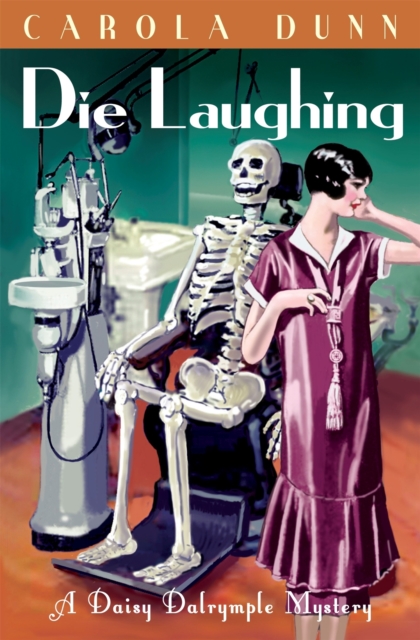
After several months (indeed years) of accumulation, over the summer I decided to make one of my periodic concerted efforts at putting a dent in my to-be-read shelf, which then stood at thirty-five books and counting. I started with wth collection of second-hand books from part way through various contemporary series that that have been recommended to me but which I have been motivated to buy unless I came across a used copy. I haven’t been entirely successful in completing this endeavour (a volumen of Sulari Gentil’s Rowland Sinclair mysteries is next on my list), but I did manage a couple of volumes from Louise Penny’s Armand Garmache series and a Daisy Dalrymple mystery by Carola Dunn.
The Dunn series is one that has been hovering at the edge of my consciousness for a number of years now. When I was reading my way through Frances Brodie’s Kate Shackleton series and Jacqueline Winspear’s Maisie Dobbs series (recommended to me by the late, great Dennis Showalter, who knew whereof he spoke), Daisy Dalrymple regularly popped up in my on-line recommendations. So it was with interest, although not necessarily great expectations, that I started Die Laughing, the tenth book in the series. Unfortunately, these expectations were definitely not exceeded. One of the blurbs on my copy states that the book is ‘For lovers of Dorothy L. Sayers’, but like so many so-called ‘cosy’ crime novels with a British interwar setting, the only Sayers-like attribute that the book has is the fact that the detective (or at least one of them) is an aristocrat (although we are told multiple times that her title is ‘only’ an honorary one).
The problem is that the novel doesn’t work as either a classic detective novel, with a focus on the puzzle element, or as the sort of social reflection that makes Sayers (and many of the other classic queens of Golden Age detective fiction) such good source material for the social historian. By splitting the detective work between an amateur who doesn’t really want to be detecting and her professional husband and his team, the novel rejects the structural formality of classic detective fiction storytelling. Sherlock Holmes explaining his reasoning to Watson and Japp or Poirot collecting the suspects in the drawing room for the unveiling of the criminal may be the stuff of cliché, but such scenes work to construct a narrative with tension by making the unravelling the work of a single intelligence. Even where the sidekick or professional assistant makes as great a contribution to that unravelling as the detective, the sharing of information needs to be integral to both the plot and laying the evidence before the reader. For a masterclass in the approach, you only have to look at the conversations between Peter and Harriet in Have His Carcase (1932), which are used to convey any facts gathered separately as well as interpret them as part of the satisfying working out of the mystery. Not so in the world of Daisy Dalrymple and Alec Fletcher where each undertakes their own investigations and the sharing of clues is perfunctory, with little reference to either the plot or the character developments
So much for the structural form of the detective story. What about the novel as a reflection of society in the interwar period? Dunn has clearly done a certain amount of research into the period, but her representation of class is clumsy to the point of farce. The middle classes are almost uniformly snobbish and racist, with the exception of Daisy’s two female friends, who are only distinguishable from each other by the fact that one is Indian (and therefore the victim of racist prejudice). The working-class characters are distinguishable by their entirely generic vernacular, with a Scots policeman apparently speaking in almost exactly the same way as a Cockney charwoman. The theme of the ‘servant problem’ is shoe-horned into the book, with little relevance to the central crime or its investigation, and drawing on debates from the late nineteenth century, rather than those being articulated in 1924. The result is that, while the reader is told multiple times that the war changed class relationships, but we are never effectively shown this. I finally lost patience with the representation of a character, introduced to late in the book to be fully fleshed out, as a Second World War-style spiv, whose service with the Army Service Corps was used as shorthand for his not having served overseas during the war. Given the the extensive work of men of this unit as motor ambulance and lorry drivers on all fighting fronts, this misrepresentation smacked, like far too much else in this book, of superficial research and lazy historical cliché.
So I will not be seeking out any more of the Dalrymple series. I am, however, more ambivalent about Penny’s Gamache series, although I can’t say I was overly enamoured of either of the two volumes I read. I know many people love this but, like Elly Griffith’s equally loved Ruth Galloway series, I found the tone too knowingly whimsical for my taste. These series are, apparently, part of a genre now marketed as ‘character-led’ mysteries (presumably as opposed to action-led thrillers) but, for me, the characters were oddly flat. The reader is told, over and over, who these people are, and even what they are thinking, but this is rarely matched by them then acting in psychologically convincing ways. The criminal in one of the stories barely registers as a character in their own right, and certainly not as the magnetic character that we are informed they are. There is also a dissonance in tone between, for instance, constant references to an aged, sweary, alcoholic poet who keeps a pet duck and is loved (inexplicably) by her neighbours, and plotlines around the distribution of carfentenil and its brutalising effects on the homeless population of Montreal, that is jarring to say the least.
Penny’s writing is good enough to make me mildly curious about how she introduced her recurring characters in the first novel in the series, Still Life (2005). However, I can’t say I feel compelled to read any more, certainly not at the moment when unregulated holiday browsing in second-hand bookshops has my to-be-read shelf to closer to forty volumes. I am glad that I finally gave these popular series a go, but equally glad that neither captured me to the extent that I will now be adding any more of their work to that shelf.
The Cornish Coast Murder (British Library Crime Classics)
Spoilers for The Cornish Coast Murder throughout.
One of the things that this extraordinary summer has allowed me to do has been to catch up on reading my way through my shelf of ‘to be read’ books. I don’t mean that the shelf has become emptier; I have been buying nearly as many books as I have read. Nonetheless, I have finally read all but one of the books that were waiting to be read when we moved house two and half years ago. (Wade Davies’ mammoth Into the Silence at over 600 pages is still proving too much of a challenge; I will tackle it eventually.) So last week I finally got around to reading John Bude’s The Cornish Coast Murder, one of several British Library Crime Classics editions that were given to me as a Christmas present several years ago.
The Cornish Coast Murder, first published in 1935, the same year that Dorothy L. Sayers published Gaudy Night, as Martin Edwards points out in his introduction, is very much a standard Golden Age detective novel of the puzzle variety. That is, the focus of the narrative is on the murder plot, with very little in the way of characterization. Indeed, the characters are such archetypes that the key players tend to be referred to as the Inspector, the Vicar or the Doctor (although we are given their names and some physical description). The interest and momentum of the book is generated by uncovering the method of the crime (including possibly the first description of the sort of forensic tracing of bullet trajectory popularised by early series of CSI), with contemplation of motives and morality reduced to an afterthought in the final few chapters. It thus fits well into Alison Light’s description of the interwar whodunit as ‘a literature of convalescence’, ‘as insensible to violence as it could be. … As many critics have noted (usually dismissively) it is the lack of emotional engagement in the detective fiction between the wars which matters.’ [1]
So no, The Cornish Coast Murder is not one of the great novels of the Golden Age. This is no The Nine Tailors (1934), The Beast Must Die (1938)or even And Then There Were None (1939). But it is of particular interest to a social and cultural historian of the First World War with an interest in detective fiction on two counts. Firstly, there are the various suspects and witnesses. Since writing my Phd, half of which looked at the figure of the wartime hero in interwar detective and crime fiction, I have been on the hunt for ex-servicemen, and particularly disabled ex-servicemen, in such fiction. The Cornish Coast Murder stands out for having not just one such character, but four. Two of them are said to be suffering from a psychological wound of war. Three of them are suspects, one a witness and one, ultimately, the murderer. The second, related, aspect of interest is the murder weapon, a service revolver, described in some detail. Indeed, as with ex-service characters, there is not merely one but a second which acts as a significant red herring for much of the novel.
Taken together, these two aspects of the novel mean that there is an awful lot of war and its legacy, for both individuals and society, in this book. This stands in direct contrast to Marzena Sokolowska-Paryz’s assertion that ‘In the interwar period, detective fiction retained its distinctive autonomy as a genre, refusing to embrace the subject matter of the war or its repercussions in the present.’ [2] In making her argument, Sokolowska-Paryz quotes John Scraggs’ assertion that ‘The Golden Age fixation with the upper class, or the upper middle class, is further compounded in British fiction of the period by the fact that the physical and social settings are so isolated from the postwar depression that it is as if the Great War never happened.’ [3]
These are pretty extraordinary assertions. One only has to have even a passing acquaintance with the works of Dorothy L. Sayers to take issue with both of them. The war and its legacy for the present are central to her novels, whether in the form of her shell-shocked ex-service detective (Whose Body? (1923)and passim), plots which turn on the ex-service status of suspects and victims (The Unpleasantness at the Bellona Club (1928), The Nine Tailors (1934)), or passing references to social impacts such as the refugee crisis and ex-service employment or lack thereof (Whose Body?, Clouds of Witness (1926), The Unpleasantness at the Bellona Club, Gaudy Night). Sayers, to be sure, is something of an outlier within the genre, both in the sophistication of her novels as socially reflexive literature and the extent to which the war is referenced throughout, but she is certainly not alone. Examples of war reference can be found in the work of Ngaio March (Enter a Murderer (1935)) and, of course, both Hercule Poirot and Captain Hastings have wartime backgrounds. Like these, what Bude’s plethora of ex-service characters demonstrates is the extent to which the war underpinned everything in interwar society. It did not need to be made the explicit subject of interwar detective fiction (although it could be); its violent legacy, including moral panics over both the brutalisation of ex-servicemen by war service and, conversely, the psychological damage inflicted by war which might lead them to lose control which forms the definition of Ronald Hardy’s shellshock in Bude’s novel, is always there, emerging at various times and in various ways, as it must have done off the page as well as on.
Sokolowska-Paryz and Scraggs’ arguments, and indeed Light’s, can thus be read as an interesting manifestation of the debate about what makes for an ‘authentic’ depiction of the war by post-war fictions. This debate has been going on since at least 1919, and not solely in relation to literary fiction. As Mark Connelly has argued, for the film critic Annie Winifred Ellerman, who wrote under the pseudonym Bryher, ‘realism about the war could mean one thing – only its horrors and miseries. This ideological position then categorically denied that chivalry, honour, or bravery were part of the reality of war. Alternatively, if they were accepted, they were either wasted in such an ignoble pursuit and/or such a tiny component of war as to be irrelevant. In turn, this meant that any depiction that foregrounded these qualities was inherently flawed, and worse still, fundamentally immoral.’ [4] Conversely, Cyril Falls, the literary critic and ex-serviceman, complained in 1959 that ‘The flood of anti-militarist literature, for the greater part fiction, which poured from the presses, deriding the leadership from top to bottom, treating patriotism as a vice when not a fraud, as it was bathed in blood and rolled in mud, was astonishing. It was far from being representative’.[5] While two sides to the debate of what constitutes an ‘authentic’ representation of the war clearly emerged in the interwar period, it is interesting that the Bryher position seems to have come so clearly to dominate contemporary criticism of the detective genre. If it isn’t brutally realist and violent, then it is not, by Sokolowska-Paryz, Scraggs or Light’s argument, a depiction of or reference to the war and its social legacy in Britain. While Sokolowska-Paryz does discuss the more heroic representation of the war in Anne Perry’s Joseph Reavley novels in her analysis of contemporary detective fictions about the war, these form only one of the five series she examines, with all the others adhering to the disillusionment narrative.
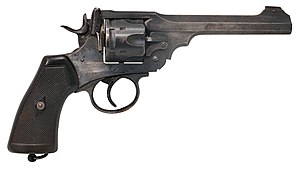
Webley Mk IV Revolver
Which brings us to the second interesting element of The Cornish Coast Murder, namely the service revolver. In Bude’s novel, the revolver (or rather the two revolvers, one belonging to the shell-shocked suspect Ronald Hardy and one belonging to the murderer) is the subject of much discussion and description. Both are Webley .45s, the standard issue service revolver during the war, with the Mark VI replacing the Mark IV and V from 1915. Issued to officers, pipers, range takers, airmen, naval crews, trench raiders, machine-gun teams and tank crews, service revolvers were not carried by every serviceman but nor were they reserved solely for the officer corps. Thus while Hardy’s monogrammed revolver reflects his former rank as a junior officer and his social status as a middle-class author, the murderer, a manual labourer, ‘scrounged [his] in France, before being demobbed in ’19, and several rounds of ammunition.’ [6] One of the suspects, Cowper, the groundsman at Greylings, served as a Lance Corporal in an undisclosed regiment but never handled a revolver during his service.
While two service revolvers in one novel is slightly unusual, these weapons appear with some regularity in interwar detective fiction. Christie, who as a pharmacists during the war, knew more about poisons than guns, tended to label the pistols that appeared in her novels as ‘army service revolvers’. Sayers, meanwhile, has the murdered in The Unpleasantness at the Bellona Club shoot himself in the head. The type of gun used is not specified, but given the setting of a serivemen’s club (and the themes of the war and its legacy which are central to this book in particular), the reader might easily conclude that the weapon was a service revolver.
What is interesting is the extent to which in more contemporary detective fiction with a wartime or interwar setting, the service revolver has, in large part, been displaced by the bayonet as a weapon with wartime associations. [7] On my recent rewatching of Miss Fisher’s Murder Mysteries, for example, I was interested to note that bayonets were used twice, once as a murder weapon in Dead Weight (2013) and once by a disabled ex-serviceman when confronted with evidence of drug theft from a medical clinic in Blood and Money (2015). Sokolowska-Paryz points to the symbolic significance of the bayonet as the murder weapon in Rennie Airth’s Rivers of Darkness (1999), noting that the ‘sexual overtones of the killings is made apparent through the psychoanalytic meaning of the bayonet’ as a substitute penis. [8]
The symbolism of the bayonet, however, goes beyond its Freudian overtones. As Paul Hodges has argued, it was a weapon fetishized during the war and after as one of masculine aggression and face-to-face combat in ways which led to its use in wartime atrocities such as the killing of prisoners of war and the wounded. [9] Used in infantry training to instill aggression in the private soldier, its use as a weapon in modern industrialised warfare was generally perceived by servicemen as futile, a throwback to an earlier age. It is thus the symbolic inverse of the service revolver, a middle-class officer’s weapon associated with duty and honour and fired from a distance. Even when duty leads to violence and the taking of life, there is always an explicable motive, including the defense of the domestic, a common justification for war service. The distance between murder and victim, meanwhile, is particularly emphasized in The Cornish Coast Murder by the fact that the murderer fires from a boat, requiring three widely spaced shots to hit his target. The revolver, therefore, comes closer to wartime artillery as a fatal force, a distanced and almost random form of killing.
The service revolver and the bayonet can thus be read as emblematic of the two interpretations of the war at the heart of the debate over authenticity – the technologically advanced form associated with honourable (or at least explicable) motivations and the middle-class officer corps and the brutal, apparently futile form associated with psychopathy and men damaged physically or psychologically by war. It is interesting to note that there appears to have been a decisive shift from one to the other as the symbolic weapon of the war between detective fictions of the interwar period and those of the past quarter century which have the war as its setting. As I start to think about the wider implications of this shift for understandings of the war and its legacy, I would be interested in hearing about appearances of both weapons in other fictions, both then and now. I promise not to wait as long to read them as I did with The Cornish Coast Murder.
[1] Alison Light, Forever England: Femininity, Literature and Conservatism Between the Wars (London: Routledge, 1991), p.70.
[2] Marzena Sokolowska-Paryz, ‘The Great War in Detective Fiction’ in The Great War: From Memory to History, ed. by Kellen Kurschinski, et. al. (Waterloo, Ontario: Wilfred Laurier University Press, 2015), p.84.
[3] John Scraggs, Crime Fiction (London: Routledge, 2005), p.48.
[4] Mark Connelly, ‘The Battles of Coronel and Falkland Islands (1927) and the Struggle for the Cinematic Image of the Great War’ in The Great War, ed. by Kurschinski, et. al., p. 317.
[5] Cyril Falls, The Great War (New York: Putnam, 1959), p. 421, quoted in Ian Andrew Isherwood, Remembering the Great War: Writing and Publishing the Experiences of World War I (London: Bloomsbury Academic, 2017), p. 160.
[6] John Bude, The Cornish Coast Murder (London: The British Library, 2014; first published London: Skeffington & Son, 1935), p. 275.
[7] By bayonet I mean here the rifle bayonet; interestingly, the Webley Mk VI could be modified to take a small bayonet as well.
[8] Sokolowska-Paryz, ‘The Great War in Detective Fiction’, p. 94.
[9] Paul Hodges, ‘They Don’t Like It Up ‘Em!’: Bayonet fetishization in the British Army during the First World War’, Journal of War & Culture Studies, 1:2 (2008), 123-138, DOI: 10.1386/jwcs.1.2.123_1.



 armsandthemedicalman