This post forms the second of three related posts on questions about historical methodologies arising from conferences I have recently attended. The first of these can be found here.
I hadn’t intended to start this post this way. This was (and eventually will be) a reflection on the Passions of War workshops I attended in February. But, in a lovely example of the utility of blogging to academic practice, my previous post on interdisciplinarity has sparked a fascinating and detailed response from Jeanne de Montbaston, making the case for the value of reading sexual subtexts in historic literature from a contemporary perspective. And it is a strong case (although I’m afraid Dr Allen and I are going to have to agree to disagree about finding Sir Impey a convincing object of Wimsey’s desire). Reading ‘against the grain’ in this way can be an intellectually valid, not to say illuminating, exercise when done rigorously [1] and with the awareness that such readings tell us as much if not more about the reader and their cultural context than about the text itself.
What concerns me about such readings is not that they are amateur or uninformed but that their perfectly defined ’21st-century strobe lighting’, while illuminating particular facets of the text will, in turn, obscure others. Because I worry that in defining Peter Wimsey as bisexual we run the risk of losing the full historical complexity of same-sex desires and relationships in late nineteenth and early twentieth century Britain, complexity which historian such as John Tosh, Joanna Bourke and, most recently, Helen Smith have all addressed. [2] The contemporary category of bisexuality appears to me (and I am very willing to be corrected on this) to limit rather than expand our perceptions of relationships, both physical and emotional, that were, in reality fluid and multi-faceted. Tosh might argue that ‘Emotionally intense and physically demonstrative friendship between men was not new [to the Victorian era] – in fact in most historical periods it has been taken for granted.’ [3] He goes on, however, to discuss the historical contingency of interpretations of such friendships in the late nineteenth century, a historical contingency which surely equally effects our own more legally tolerant age.
Which brings me, in a rather roundabout way, to the original point of this post, the consideration of the problems, as well as the benefits, of doing gender history across time. This was sparked, as I say, by discussions at the Passions of War workshops held at the University of Leicester on 19th-20th February this year. Part of an on-going series of AHRC-funded workshops, the Passions of War network is interdisciplinary, including scholars of literature, history, sociology and political science, and international, being organised by the University of Leicester, Ghent University, Dr. Guislain Museum and the National Army Museum, as well spanning a time frame from the 17th to the 21st centuries.
I have written previously about how inspiring the diversity of this workshop series has been to me. My primary reflection on this occasion, however, was the ways in which scholars of a range of historical periods spoke to and with each other. On several occasions I found myself mentioning the women, gender and sexuality reading group run by two enterprising postgraduates here at Leeds which deliberately selects an article by a medievalist and one by a modern historian for discussion at each session. Just as at Leicester, where the panel on ‘Tender Encounters’ during the Napoleonic, American Civil and Crimean Wars had me revising and reevaluating my arguments about medical intimacy in the First World War, these groups have been illuminating for the historical continuities in understandings of gender they have uncovered. And yet, that question of historical contingency and specificity haunted our discussions as well. As Rachel Bates demonstrated, our readings of Victorian images of wounded servicemen need to made in light of our knowledge of technological limitations and the social import of the fact that they were made for Queen Victoria’s private collection. Their fundamental differences from, say, newspaper photographs of cheerful First World War limbless soldiers may tell us as much about their significance as their superficial similarities.
How, then, do we do history effectively across time? Can we make comparisons between a medieval world shaped by religious and social understandings of sex, gender and the body which may see alien to us, and a Victorian world in which some forms of (particularly female) sexuality and bodily experience were so taboo that they could not be spoken of openly? Is it simply a matter of applying similar tools of analysis across periods to uncover or fill in the archival silences? Or are there wider experiential truths which transcend our contemporary attempts at periodisation? How do we balance the insight that the probing if narrow brilliance of the strobe of light of contemporary perspective with the the wider, more shadowy world uncovered by historical context?
When people ask me what I do professionally, I tend to provide an answer that defines my work periodically – I am a First World War historian. And yet, the joy of attending workshops like the Passions of War, of participating in the women, gender and sexuality reading group, of engaging with those such as Jeanne de Montbaston who are grappling with related questions in provocative and interesting ways, is the realization that the questions I am dealing with cannot and must not be confined by period. As John Arnold and Sean Brady argued in their defense of long durée histories of masculinity, we need to ‘look beyond the confines of historical periodization, context, evidence and discipline, to provide new insights and challenges in questions of the relational qualities of gender’. [4] Doing so is not always comfortable or easy, but it can be immensely stimulating. I look forward to more such discussions, on line, in reading groups and in the final Passions of War workshop, due to take place in September.
[1] On this point I will continue quibbling about Sir Impey’s flushed face which, in my copy of the novel occurs a page before Wimsey enters the witness box and three pages before his poetic mockery of ‘Biggy and Wiggy’. The text itself, rather than a literal reading of it, would seem to preclude association, innuendo-laden or otherwise, between the two instances.
[2] John Tosh, A Man’s Place: Masculinity and the Middle-Class Home in Victorian England (New Haven: Yale University Press, 1999), 185; Joanna Bourke, Dismembering the Male: Men’s Bodies, Britain and the Great War (London: Reaktion, 1996), Chapter 3; Helen Smith, Masculinity, Class and Same-Sex Desire in Industrial England, 1895-1957 (Basingstoke: Palgrave Macmillan, 2015).
[3] Tosh, A Man’s Place, 185.
[4] John H. Arnold and Sean Brady, ‘Introduction’ in John H. Arnold and Sean Brady (eds.), What is Masculinity: Historical Dynamics from Antiquity to the Contemporary World (Basingstoke: Palgrave Macmillan, 2011), 14.
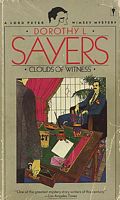 To begin with the actual evidence deployed by Allen which is drawn from the second novel in the series, Clouds of Witness, and relies entirely on the relationship between Wimsey and the barrister Sir Impey Biggs, QC. There can be little doubt that, as a character, Sir Impey is coded as gay for all the reasons that Allen lays out. What is more problematic is the reading of Sir Impey as Wimsey’s ‘good friend and oftentimes colleague’. There may be a friendship between the two men to be read in their episodic encounters but, in the two novels and one short story where Sir Impey actually appears (rather than simply being referred to in conversation) their professional relationship is not that of colleagues. In both Clouds of Witness and Strong Poison Wimsey is in the position of a pseudo-client, with deep emotional attachments to the accused whom Sir Impey is defending as well as that of detective. But Sir Impey is not a fellow detective, or even a legal detective in the mould of Anthony Gilbert’s Arthur G. Crook or, later, John Mortimer’s Horace Rumpole. Indeed, in both novels, Wimsey’s detective work actively conflicts with Biggs’s legal interests, leading to professional, if not necessarily personal breaches between the two men. If Wimsey does have a good male friend and colleague in the novels, it is not Biggs, but Detective Inspector Charles Parker, with whom he gets incapably, childishly drunk at the end of Clouds of Witness. But Parker is a figure of such rigid petit-bourgeois social and sexual respectability that he ends up marrying Peter’s sister – after a long struggle with whether even asking her to marry him is a socially appropriate thing to do.[1]
 So no, I don’t think that even by innuendo can Wimsey’s relationships with Sir Impey or, indeed, any of the other male characters who are presented recurrently as his friends, be read as hinting at bisexual desire. Which is not to say that Wimsey’s mas culinary and sexuality in the novels is unproblematic. Far from it. Throughout the novels he is characterised by others as sexually and morally dubious. Henry Weldon, in Have His Carcase, for instance, implies that Wimsey is ‘exploiting his mother for my private ends and probably sucking up to her for her money’, or, in other words, behaving in precisely the same way as the gigolo Paul Alexis (and later M. Antoine) behave towards her. [2]
 The issue of Wimsey’s sexuality is, unsurprisingly, made most explicit in Gaudy Night, a novel whose overarching theme is the question of sex and relationships between the sexes. It is Reggie Pomfret, an undergraduate infatuated with Harriet Vane, who demands:
 armsandthemedicalman