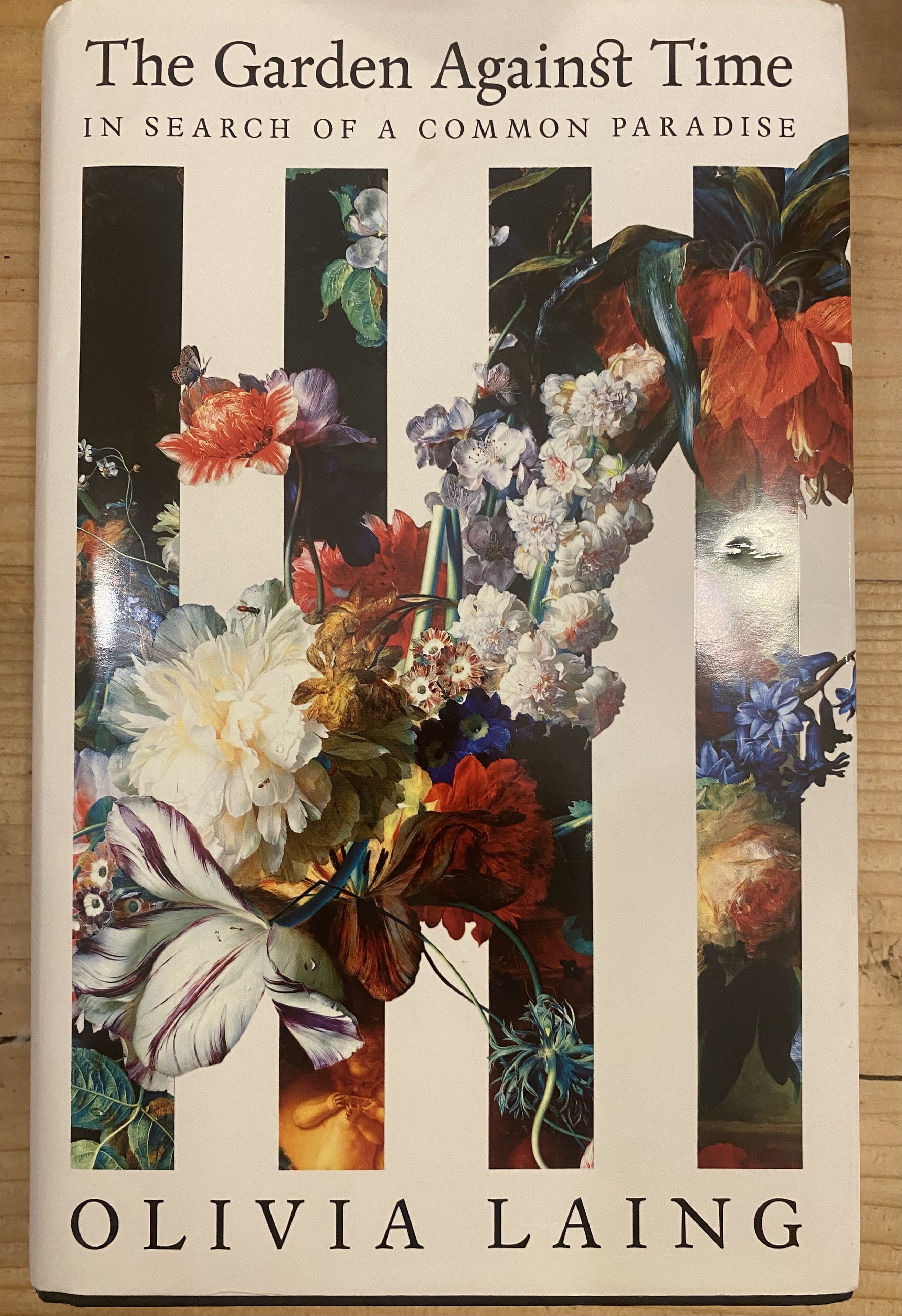

Several months ago a package arrived from Amazon containing a book. This is not an entirely unusual occurance in our household, although when we do buy books on line, it is more likely to be from bookshop.org or World of Books (my husband is a sucker for an ex-library edition). This package, however, was not an impulsive or accidentally overlooked purchase, but rather an unexpected un-birthday present from my stepmother, a copy of Olivia Laing’s much-praised The Garden Against Time. A few months later my husband gave me, as an actual birthday present and at my request, a copy of Penelope Lively’s even more critically acclaimed Life in the Garden.
Although I read them separated by several months, these two volumes have worked together in my head as part of a single genre of literary garden reflections. Both Laing and Lively write as both gardeners and writers, using the act of hands-on cultivation as a jumping-off point for reflections on the representational significance of gardens in predominantly Western, mostly British, culture. Both are erudite and both are beautiful objects (even the ex-library paperback edition of Life in the Garden), illustrated by a similary style of woodcut horticultural illustration.
Laing’s book is ostensibly structured by the story of her acquisition and reconstruction of a historic Suffolk garden, a process disrupted by the Covid-19 pandemic and its aftermath. Lively’s volume is, at least superficially, more academic than biographical, formed of series of essays on themes ranging from ‘Reality and Metaphor’ to ‘Time, Order and the Garden’. Yet it is Laing who spends signficant space in detailed analyses of John Milton’s Paradise Lost, W.G. Sebald’s The Rings of Saturn and the life and poetry of John Clare in terms which would not be out of place in an academic essay. Lively, meanwhile, ranges more widely in her references, with less critical depth but with a lightness of tone and analytic incisiveness that gives the book an immediatcy that is immensely engaging. As a result, I could see Lively’s Oxfordshire garden, created with her husband Jack, and the Egyptian garden of her childhood memories in ways that I could not with Laing’s restored greenhouse and pond. Although perhaps it was Lively’s early (and entirely accurate) identification of Tom’s Midnight Garden as one of the great works of 20th-century children’s literature that informed my sense of recognition and familiarity with her world and world view in ways that Laing’s work, for all its accomplishment never achieved. I have never read Sebald, and have only engaged episodically with Milton and Clare, whereas some of my most cherished memories of my mother revolve around her reading Tom’s Midnight Garden to me, first as a bed-time story and then on to audiotape, a process that, in the 1980s, was a true labour of love and dedication. I still have those tapes, the audio now preserved in digital form by my husband, although even now, over six years after her death, I am still not ready to listen to them and hear my mother’s voice reading to me again.
Nor are the intellectual contexts of the two books the only key differences which shaped my enjoyment. I found Lively’s writing much funnier than Laing’s, and was constantly reading out snippets of Life in the Garden to my husband. At no point was I tempted to do this with Laing, who also has a distancing literary tic of listing plants, many of them unfamiliar to a less-experienced gardener, without providing enough context to make them visible or meaningful to the reader. I think the idea is to evoke the poetry of gardening as well as the garden, but ultimate they just left me bored and confused. Laing’s discussion of John Clare’s life and work as a rural poet at the cusp of the industrial revolution was far more moving and effective, and has prompted me to seek out the poet’s autobiography, just as my husband, who read The Garden Against Time after I did, has purchased a (inevitably second-hand) copy of The Rings of Saturn.
I’m not a great reader of gardening books, and I read enough non-fiction for work that I tend to avoid such books as leisure reading, even when the genre overlaps with my own leisure interests. There is inevitably a lot of cultural history, often relevant to my own research, which precludes using such work as a way of fully switching off. But I am glad that I read both these books, not least for their many seredipties, and will certainly be dipping into Lively again, although I not so sure about Laing. In the meantime, with the snow falling outside, I will use them less as inspiration for the garden than for further reading, not only John Clare but also Lively’s fiction.
 armsandthemedicalman