It may have been a mistake, saving my stash of Kate Atkinsons to take with me on holiday over the summer. Not because they are not wonderful; they absolutely are. Reading Human Croquet, which I did in a day, gulping it down in a way I haven’t done with a book since the height of the pandemic, was a joy, an immersion in language and characterisation and intricately intersecting plot lines that took me to another place as only a great book can.
But oh! they are so rich! Coming to the end of the book after a day spent reading like that felt a bit like getting up from the table after an overly rich meal, or waking up with a hangover. It was almost too much, to the point where I felt lethargic and slightly headachy. So following such overindulgence with more of the same may, as I say, have been a mistake. Yes, Normal Rules Don’t Apply was, as a collection of short stories, briefer and lighter, but the collection of linking characters, locations and storylines required work, the language was just as intoxicating and the emotions evoked were, if anything, even more quietly devastating.
To recover, I gave myself a palate cleanser of Georgette Heyer’s The Quiet Gentleman, which was light and funny and straightforward in terms of plotlines and the emotions aroused, although not, perhaps, overly memorable. But it did leave me slightly out of time to tackle Shrines of Gaiety, which I had been keeping to savour,before the end of our stay in the US. I was left with the choice of starting it on the plane ride home or saving it for the long weekend trip to Scotland scheduled for the week after we returned. The former option risked my staying up all night reading, followed by jetlagged exhaustion on arrival. That was how I read Life After Life, but I wouldn’t have slept on that flight anyway, In the depths of grief following my mother’s death the week before, that book saved me from going mad, a life raft in the ocean of suspended time that flying back to my family in the UK entailed. This time I anticipated no such need, just the prospect of houseguests to prepare for, making the prospect of exhaustion compounded by jetlag a less than enticing prospect.
Saving it for Scotland, meanwhile, would give me something to look forward too when my husband and son headed off to climb Ben Nevis without me, a challenge to far for my torn ACL, which had been playing up even in the slightly less strenuous context of the hills of Western Massachusetts. So that is was I decided to do, planning to balance the intensity of Atkinson’s rich literary vision of 1920s London with the anticipated jeu d’esprit of Juno Dawson’s Hebden Bridge-set witchcraft novels.
After several months (indeed years) of accumulation, over the summer I decided to make one of my periodic concerted efforts at putting a dent in my to-be-read shelf, which then stood at thirty-five books and counting. I started with wth collection of second-hand books from part way through various contemporary series that that have been recommended to me but which I have been motivated to buy unless I came across a used copy. I haven’t been entirely successful in completing this endeavour (a volumen of Sulari Gentil’s Rowland Sinclair mysteries is next on my list), but I did manage a couple of volumes from Louise Penny’s Armand Garmache series and a Daisy Dalrymple mystery by Carola Dunn.
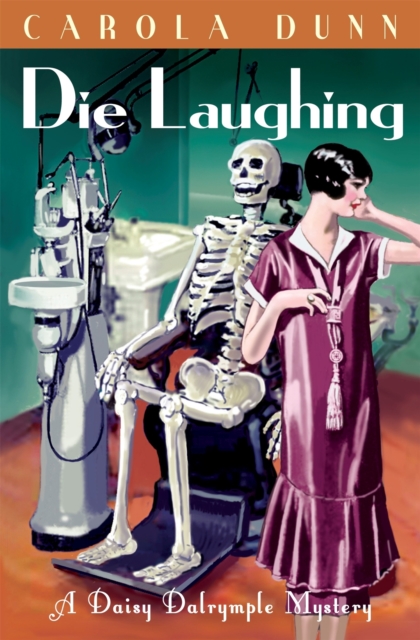
The Dunn series is one that has been hovering at the edge of my consciousness for a number of years now. When I was reading my way through Frances Brodie’s Kate Shackleton series and Jacqueline Winspear’s Maisie Dobbs series (recommended to me by the late, great Dennis Showalter, who knew whereof he spoke), Daisy Dalrymple regularly popped up in my on-line recommendations. So it was with interest, although not necessarily great expectations, that I started Die Laughing, the tenth book in the series. Unfortunately, these expectations were definitely not exceeded. One of the blurbs on my copy states that the book is ‘For lovers of Dorothy L. Sayers’, but like so many so-called ‘cosy’ crime novels with a British interwar setting, the only Sayers-like attribute that the book has is the fact that the detective (or at least one of them) is an aristocrat (although we are told multiple times that her title is ‘only’ an honorary one).
The problem is that the novel doesn’t work as either a classic detective novel, with a focus on the puzzle element, or as the sort of social reflection that makes Sayers (and many of the other classic queens of Golden Age detective fiction) such good source material for the social historian. By splitting the detective work between an amateur who doesn’t really want to be detecting and her professional husband and his team, the novel rejects the structural formality of classic detective fiction storytelling. Sherlock Holmes explaining his reasoning to Watson and Japp or Poirot collecting the suspects in the drawing room for the unveiling of the criminal may be the stuff of cliché, but such scenes work to construct a narrative with tension by making the unravelling the work of a single intelligence. Even where the sidekick or professional assistant makes as great a contribution to that unravelling as the detective, the sharing of information needs to be integral to both the plot and laying the evidence before the reader. For a masterclass in the approach, you only have to look at the conversations between Peter and Harriet in Have His Carcase (1932), which are used to convey any facts gathered separately as well as interpret them as part of the satisfying working out of the mystery. Not so in the world of Daisy Dalrymple and Alec Fletcher where each undertakes their own investigations and the sharing of clues is perfunctory, with little reference to either the plot or the character developments
So much for the structural form of the detective story. What about the novel as a reflection of society in the interwar period? Dunn has clearly done a certain amount of research into the period, but her representation of class is clumsy to the point of farce. The middle classes are almost uniformly snobbish and racist, with the exception of Daisy’s two female friends, who are only distinguishable from each other by the fact that one is Indian (and therefore the victim of racist prejudice). The working-class characters are distinguishable by their entirely generic vernacular, with a Scots policeman apparently speaking in almost exactly the same way as a Cockney charwoman. The theme of the ‘servant problem’ is shoe-horned into the book, with little relevance to the central crime or its investigation, and drawing on debates from the late nineteenth century, rather than those being articulated in 1924. The result is that, while the reader is told multiple times that the war changed class relationships, but we are never effectively shown this. I finally lost patience with the representation of a character, introduced to late in the book to be fully fleshed out, as a Second World War-style spiv, whose service with the Army Service Corps was used as shorthand for his not having served overseas during the war. Given the the extensive work of men of this unit as motor ambulance and lorry drivers on all fighting fronts, this misrepresentation smacked, like far too much else in this book, of superficial research and lazy historical cliché.
So I will not be seeking out any more of the Dalrymple series. I am, however, more ambivalent about Penny’s Gamache series, although I can’t say I was overly enamoured of either of the two volumes I read. I know many people love this but, like Elly Griffith’s equally loved Ruth Galloway series, I found the tone too knowingly whimsical for my taste. These series are, apparently, part of a genre now marketed as ‘character-led’ mysteries (presumably as opposed to action-led thrillers) but, for me, the characters were oddly flat. The reader is told, over and over, who these people are, and even what they are thinking, but this is rarely matched by them then acting in psychologically convincing ways. The criminal in one of the stories barely registers as a character in their own right, and certainly not as the magnetic character that we are informed they are. There is also a dissonance in tone between, for instance, constant references to an aged, sweary, alcoholic poet who keeps a pet duck and is loved (inexplicably) by her neighbours, and plotlines around the distribution of carfentenil and its brutalising effects on the homeless population of Montreal, that is jarring to say the least.
Penny’s writing is good enough to make me mildly curious about how she introduced her recurring characters in the first novel in the series, Still Life (2005). However, I can’t say I feel compelled to read any more, certainly not at the moment when unregulated holiday browsing in second-hand bookshops has my to-be-read shelf to closer to forty volumes. I am glad that I finally gave these popular series a go, but equally glad that neither captured me to the extent that I will now be adding any more of their work to that shelf.
Somehow, it is the August bank holiday weekend, and thus almost the end of summer. I am back at work (which means hundreds of emails and frantic lecture writing and lesson planning for a month before teaching starts) on Wednesday and the kids are back at school the following week. This summer seems to have gone by in a blur, over before it barely began, but it has seen two important developments, at least as far as this blog is concerned.
In the first place, I have managed to to a lot more fiction reading this summer than I have for the past couple of years. Returning to immersion in fiction as a space for relaxation and recuperation has been a joy, and I hope to carry on with this habit even as the busyness of the academic year accelerates. My-to-be read shelf has not noticeably contracted, as holiday travels have involved many bookshops and and I appear constitutionally unable to enter a bookshop without purchasing something, particularly second-hand bookshops, and there is also the list of things I want to read but haven’t quite got around (or found a good excuse) to purchase yet.
The second development of the summer was my decision (along with many others) to finally cut ties with the social media site formally know as Twitter and move my micro-blogging onto Threads, where I go by @thehistorianskitchengarden. As I originally joined Twitter to publicise this blog, in the days when there was a 180-character limit, this transition feels like a good excuse to revive and revise what I am doing on here.
My initial enrolment with Threads was due to the fact that I have an Instagram account, where I mainly post pictures of my cooking and gardening endeavours, as well as views from my morning runs and holiday walks. However, I have also been intermittently involved with the #bookstagram hashtag, primarily through posting stacks of books prompted by a theme. However, I also enjoy reading reviews of books posted on the site, and have considered posting my own, thwarted only by the incovenience of writing a detailed review on my phone keypad. Given the regularity with which I post typos due either to fat fingers or the vagaries of auto-correct as it is, attempting this on a regular basis seemed like a bad idea.
I did flirt with the idea of launching a Substack, something I may do in the future depending on the direction my writing career develops in the future, but adding an additional platform at this stage, when I already have this one at my disposal. So how I will be using this blog will change over the next few months. In addition to publicising my posts on Threads, I will be posting more (and hopefully more regular) book reviews. These will mainly be fiction, moving this site away from its focus on the First World War, although there will be some non-fiction reviews as well.
I don’t want to move entirely away from the role that this site has played as a research diary, not least because I am now working on not one but two book, a history of men and war in the modern period and a history of the returning British servicemen of the First World War. Both of these are now at the proposal stage and starting to have both argument and form. All that is lacking is sufficient time for me to write them. I will be trying to carve this out over the next year and the practice of working through ideas on this blog can only help make the process more efficient. Again, I will use Threads to help disseminate my writing, highlighting the historian as much as the kitchen and the garden of my handle.
So there will be quite a lot going on on here, I hope, and I will be updating the look of this site as part of that. There will be separate pages for the reviews and the two book projects, as well as an updated profile. There will be more photographs integrated into my posts, reflecting how I have developed my use of Threads in conjunction with Instagram. There may be some publicity for my other project, the podcast on the intersections of the First World War with popular culture, that I co-present, although I am not clear what form this will take. Finally, there will, I hope, be more scope for comment and discussion both on here and on social media, particularly relating to the book reviews. All of this may take some time, not least because, as of next week, my priority will be writing and creating the presentation slides for the eleven lectures I am due to deliver in the current term. But there will be reviews of at least some of the books I have read this summer before then, and before the start of the new year catches up to me.
Having noted in my last post that I ended 2023 with a number of unfinish projects, I thought I would start the new year listing those that I hope to make progress with if not actually complete over the coming year. This is not a resolution (I’m possibly a bit late for that on Epiphany), but rather a hope to the point of intention.
Writing:
Janaury/February: Two book reviews. I’ve read both books and have a good sense of what I want to say, but I have negotiated a bit more time for both of these as I know that I will get very little writing done once marking and postgraduate studentship applications come in in a couple of weeks.
April: Two conference presentations.
Discussant on a panel in military welfare history as a sub-field. My contribution will be considering intersections with histories of disability and gender.
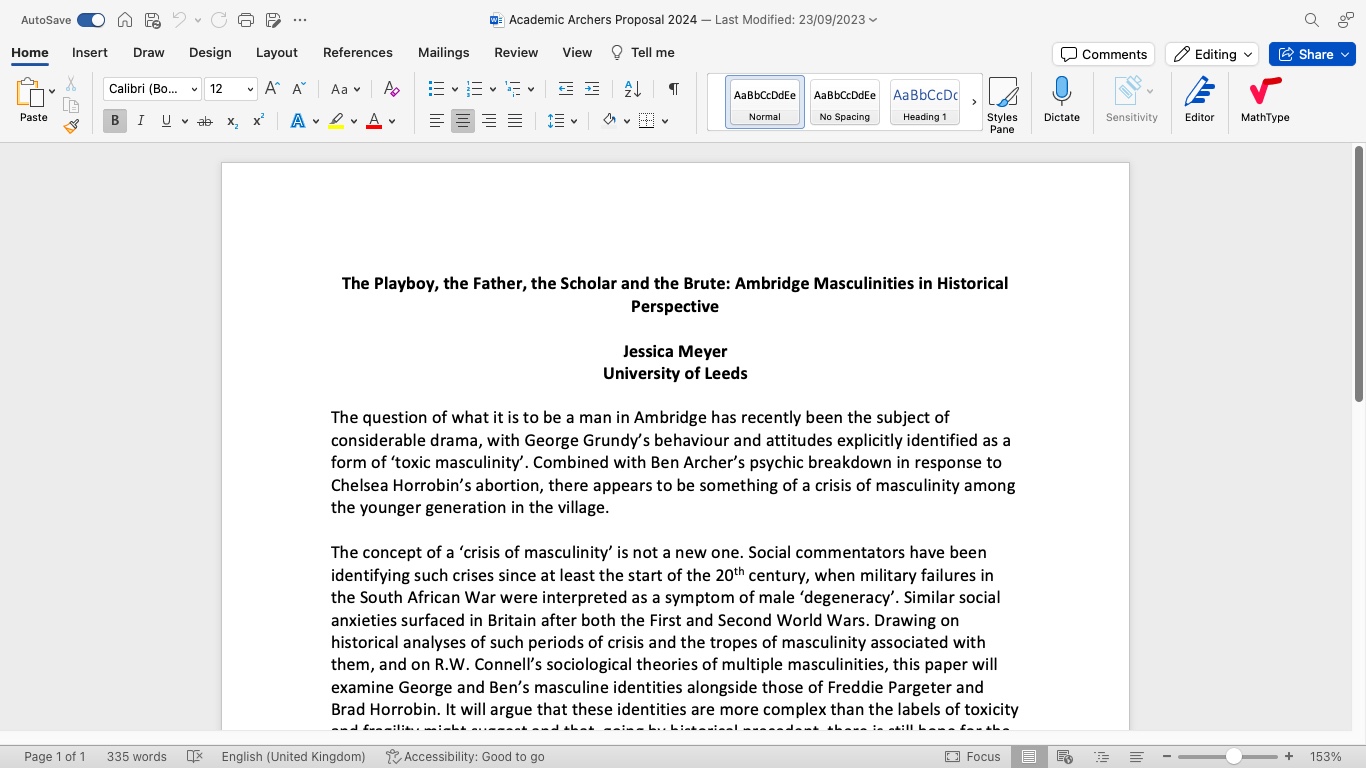
‘The Playboy, the Father, the Scholar and the Brute: Ambridge Masculinities in Historical Perspective’ for the 2024 Academic Archers conference. I am very excited about this one, and can’t wait to start writing this properly. It has been a couple of years since I last attended an AA conference, which are some of the most fun out there.
The big one: The book. This will definitely not get finished this year, but the goal is to end the year with at least a couple of full chapters in place, and possibly even an agent for it.
And the new project: One of the books I’ve been reading for review has inspired me to think again about the status of ambulance drivers and non-combattant care-givers (or not). I think there may be a journal article in this, drawing together some of the material that I was only able to mention in passing in An Equal Burden.
Knitting:
The cardigan that I started as a lockdown project. I have finally built up the courage to steek it (successfully, I think), but now have to complete the button bands and grafting. This may require another ball of wool from the supplier.
Three family sweaters. Every year for Christmas I give my husband and two children the wool for a new sweater, which I then knit for them. This year I began my husband’s before Christmas, intending it for his birthday, after last year’s effort ended up far too tight in the arms and chest due to a miscalculation. However, as I have chosen an extremely complicated fair isle pattern, it is taking considerably longer than anticipated. Thankfully, the children’s sweaters should be more straight forward, so I may actually complete these before the weather gets too warm to wear them this year.
And the new project: Today’s clearout of the bathroom cupboards in advance of the builders arriving tomorrow disclosed the sad fact that the baby blanket my mother made when my son was born had fallen victim moths. So I spent an hour today unravelling it, ending up with approximately six 50g balls of lovely, soft DK wool which, for sentimental reasons, I would like to make into something new. I’m not sure what yet, but all suggestions will be gratefully accepted.
Quilting:
Autumnal quilt. My first full-sized bed quilt which I am very, very slowly hand quilting. Not one that I can see getting completed this year, but I would like to make more progress on it than I have done in the past 12 months.
Alice’s Wonderland quilt: A Block of the Month project from Alice Caroline which I started in January 2022. All that remains is to attach the final four borders, after which I will take it to be long-arm quilted at my local quilt store. It is intended as a gift and I am not yet confident enough at hand quilting to take this aspect on (nor to do I have the time if it is to go to its recipient – currently age 4 – before they leave home for university).
And the new project: Because I clearly can’t resist the siren call of the new project, I have signed up for another Alice Caroline BoM project this year. Hopefully this one will be a little bit quicker, now that I am more confident of my technique.
In the kitchen and the garden:
These are less unfinished projects from last year than annual events which come around every year. Nonetheless, they fall under the heading of projects, and very enjoyable ones, too.
Marmalade. The making of this year’s batch will be made more interesting by my current temporary impairment relating to my knee injury, which requires brace and crutches and means I am only partially mobile.
Germination: We still don’t have a greenhouse (a very long-term unfinished project), so some time in the next few months the window sills will start to play host to pots of seeds in anticipation of one of the summer’s main garden projects, the veg patch.
The front bed: Yet another project that is now several years old. Having removed a hugely overgrown berberis, I now need to finish digging out all the stones to replant with a callicarpa and bulbs. This one, however, will have to wait until the weather improves.
And the new project: For Christmas, my husband asked for and received a cookbook about plant-based baking. I may have rashly agreed to try making plant-based cinnamon rolls at some point…
As I say, I won’t complete all of these projects, but I hope to finish some and at least make progress with the rest. Whatever else it turns out to be, 2024 looks to be a busy year.
This end-of-year reflection was originally going to be titled ‘The Half-finished Year’, a reference not only to my ever-expanding folder of started but unfinished blog posts and the 2500 words of my next book, but also the two sweaters and three quilts that I am currently working on, as well as the unpainted front hallway and bathtub sitting in the living room that await attention when I get home. But, as I sit in a hotel room in Italy with my leg in a brace while the rest of my family is out skiing, I have come to realise that the reason that this year has been shaped so profoundly by the unfinished is because of the time that ill health has taken from me.
The year started with a minor but mortifying facial disfigurement in the form of a failed dental implant. It is ending in a broken ACL, the aforementioned brace, and uncertainty about how long recovery will take and what it will mean for all the activities and projects I have planned so far for the coming year. In between came multiple trips to the dentist, the doctor and the hospital, diagnosis of three conditions, two chronic, one temporary, the consequent prescriptions (including two attempts for the chronic conditions which resulted in distressing and painful side effects) and more blood tests than I would wish on my worst enemy.
Through all of this, I have not taken time off of work. I have continued my roles as wife and monther and have kept reassuring friends and family that I am fine, or at least managing. And in many ways I am lucky. The dental work has provided me with a successful prosthetic for the lost tooth. The three of the four medications I am taking are preventative rather than therapeutic. None of the conditions I suffer are life threatening. And while my current physical impairment is disabling, it is also temporary, even if rehabilitation is going to be counted in months at minimum, not weeks as I might wish. As someone who both works in the fields of disability and medical history, and has lived through the terminal illnesses of both parents, I know how fortunate I am that my various forms of ill health are identifiable, relatively painless and highly treatable, and that I live in a country and society where I have ready access to the care and treatment I need, as well as a support network of family and friends.
But while resilience may be an admirable quality in some ways, not least in providing a sense of continuity which is itself therapeutic, it cannot be a permanent state of being, as any old rubber band will show. Something, somewhere had to give in this year that has done its best to break me, physically and psychologically. It may not have succeeded entirely, but it does seem to have robbed me of significant amounts of time and, with it, my ability to complete projects, particularly those related to writing.
Which is not to say that this hasn’t been a year of progress in some ways. Indeed, I am managing, with this post, to publish more than one post for this blog this year, an improvement on my output for 2022. I now have a very clear idea of both the shape and content of my next book, although the form will require the sort of concentrated writing time that I definitely haven’t had this year and probably won’t in the coming year. I will even have new publications in the new year, in the form of a book chapter which fell victim to Covid delays and at least one book review. And I have managed to steek a cardigan for the first time, a terrifying technique in knitting that involves taking scissors to a piece of work knitted in the round to create an opening.
These achievements, small as they are, remind me that, unlike an old rubber band, I may be damaged but I am not yet broken. But, as I enter the new year in a damaged state, I do so with the knowledge that I cannot simply bounce back to a state of full productivity, as much as I might wish to do so. I need time and space both to heal what has broken this year and, when I am strong enough, to give my many unfinished projects the attention they deserve. So I will start this new year not with resolutions but with the hope that I will be able to find or make the time and space for convalescence and recuperation and with them the ability and courage complete some, if not all, of my half-finished projects.
I wish you all a healthy, contented and hope-fulfilled new year.
Last week I attended the Social History Society annual conference, held this year in Essex. It was the first time I attended this conference since 2013, when it was held in Leeds and where I presented my first paper on what would eventually become An Equal Burden. This time, I presented not-quite-the-first paper on what I intend to be my next book, on the social history of demobilization after the First World War in Britain.
It was an enjoyable, if hot and exhausting, few days. The Essex Business School in built on the precepts of a tropical glass house and, despite a torrential downpour which deafened us on the first day, the humidity remained a noticeable factor throughout. And there were a lot of papers to cram in, particularly on the final day when I spent a fair amount of time dashing around the building, trying to hear as much as possible. But it was lovely to catch with old friends and colleagues, some of whom I hadn’t seen in person since well before the pandemic, and hear about exciting new research, particularly from postgraduate research students. Honor Morris and Mandy Barrie, both writing about working-class women’s experiences of feminism at either end of the 20th century, produced engaging and intriguing analyses which makes me excited to read more of their work. Clare Tebbut’s paper on a complicated story of a trans(?) marriage in the interwar years, and Jessamy Carlson’s discussion of child protection in the same period, both chimed with my own work, prompting me to rethink the significance of my arguments about the time frame of developments in the entangled relationships between the domestic and state welfare provision.
The highlight of the panels I attended, however, was the final session on Friday, when Julia Laite, Cath Feely, Laura King and Lucinda Matthews-Jones discussed their uses of their own family histories in their historical work. Separately, the four papers were fascinating studies in their own right; together, they suggest important new methodologies for those of us who work on histories of emotions, material objects and the everyday. This was, in fact, the second event on the topic that I had attended in as many weeks, following the roundtable discussion hosted by the IHR’s Contemporary British History Seminar, where Julia and Laura spoke alongside Michael Roper and Matt Houlbrook, both of whom have written or are writing histories which included consideration of their own families. That so many important historians in fields related to my own (and who I have had the honour of working with over the years) should be developing practice in this area suggests that this is an approach I need to consider exploring in my own work. Certainly listening to Cath’s discussion of the ways in which her great-grandfather’s death was mythologised through his First World War service, and how the wider historical context and her expertise as a local historian shaped her research into the story, suggested a number of questions about the returning soldier and the legacy of the First World War that I want to pursue further in my own work.
But that work won’t be through my own family history and Friday’s panel, in combination with the IHR seminar, has forced me to think about why not. After all, I have my mother’s archive, including both her own papers and the research she conducted into her parents’ histories in the final years of her life, sitting in my spare room in half a dozen boxes. Why not use them as a springboard for my discussion of 20th century domesticities, or integrate the information they contain into my analysis? No, the connections between my family’s history and the First World War are not obvious, but I am, at least in part, a historian of the everyday in time of war. There may be relevant stories of the quotidian in my own family’s experiences of the war. And, even if there are not, I do not need to be defined solely as a First World War historian for my entire career, even if this is how I predominantly see myself. Indeed, my current project is not about the war itself but about its resonance through the lives of those who lived through it throughout the rest of the 20th century. Surely there will be members of my family whose lives can help me explore the process. If not, there must be other stories they can tell of 20th century British social history, from the intimate variation on the special relationship that was my parents’ marriage to the changing nature of women’s employment across at least two generations. Why should I not think about exploring these?
And yet I still find I cannot. My mother’s archive sits in the spare room unexamined, as it has done for four and half years now. There is always something more urgent to do, either professionally or privately, than opening those boxes and exploring their contents. And the reason for this avoidance is that the emotions that such research would evoke are still too powerful for me face in order to do this work.
In the discussion session following Friday’s panel, Michael Roper asked about the role of grief in the work each of the panelists were undertaking, pointing to the ways in which his own work on his family’s history, incorporated into his new book, Afterlives of War, formed part of the process of grieving for his late father. And maybe someday I will be able to use my mother’s archive to work through my grief over losing her too early at 73. But the primary emotion I feel when contemplating those boxes and the work that they represent, both that done already by my mother and that which I would need to do to integrate them into my historical practice, is fear.
I am still working out what, precisely, I am so frightened of. It has, I am sure, something to do with the anger I still feel about my mother’s death, an anger that swells every time I read of another celebrity dying of pancreatic cancer. But there is also the fact that the history contained in the files is that of my mother as much as that of my more distant ancestors. As I noted in my own question to the panel, none of them were working directly on histories of family members more proximate than grandparents. I asked if they thought too-close generational proximity makes the work of integrating family history and academic history harder. As the discussion touched on, proximity brings into focus the fact that family histories are, in the end, emotional histories and these emotions, as Laura King argued in her paper, are a direct challenge to the idea of the pre-eminence of objectivity in professional historical practice.
I am, among other things, a historian of emotion, something I was reminded of listening to Julie-Marie Strange’s tribute to Joanna Bourke on her retirement earlier this week. I am one of the many heirs and beneficiaries to Joanna’s pioneering work in the field, which has and continues to profoundly shape the questions I ask, the sources I explore, the arguments I make. And I do not merely analyse historical emotions but engage emotionally with the past. I regularly respond to the grief of wartime loss or the anger of injustice in the treatment of the disabled or dispossessed when reading archival sources. But when asked to consider my family history, I do not know how to manage the emotions it makes (or threaten to make) me feel. Even contemplating the boxed archive feels overwhelming and, to protect myself, I continue to turn away.
Citing Richard White’s Remembering Ahanagran, Laura spoke of the cruelty inherent in intimate histories of subjectivity and emotion which rely on the analysis of the stories that individuals tell about themselves. I am all too aware of this, having provoked fury on the part of one descendant of a man whose diaries I quoted in my first book, who felt that my interpretation was an insult to his ancestor. This is also a point that has been made in relation to personal essayists and authors of autofiction, such as Rachel Cusk, who use (exploit, even) their intimate relationships – with parents, with partners, with children – to produce work for publication. This was a discussion that my mother herself was familiar with. Her own writing, principally her MFA dissertation, explored her complex relationship with her father, but was only written after his death. Her diaries, which she asked to be burnt without reading after her own death, almost certainly grappled with her feelings about motherhood, including reflections on her perceptions on her relationships with us, her three children. Telling the stories of interpersonal relationships, whether in the past or the present, has immense power, the power to enlighten, inspire, even comfort, but also the power to disrupt and harm.
So the fear I feel when faced with my mother’s archive is, at least in part, fear of the damage I will do – to myself and to others, not least my two siblings, my children and theirs – by trying to negotiate the boundaries between subjectivity and objectivity that the process of doing family history as an academic historian demands of us. I agree with Laura’s central argument that we need to challenge the reification of objectivity in academic history, and that family history can help us to do this. But, at least for now, I cannot participate to this methodological project through the doing of family history. I can, however, contribute through the process of thinking about and exploring the emotions that prevent me. There is, I believe, a story to tell in not doing family history as well.
This was the year that I was going to write every day. Just a little, to get into the habit. I failed (as this blog provides clear evidence). In fact, I have written less this year, either for work or my own amusement, than ever before. No, I do not count emails. I end the year continuing to battle what feels like ever-growing writer’s block, an unfinished article mocking me from my drafts file, while my book tantalizes me with exciting ideas that I never manage to get down on paper. I keep reminding myself that the excitement is worth the struggle – to make the time, to think hard, to find the order of words that satisfies. Maybe in the coming year I will find a way to make such reminders a reality.
This was the year I was going to run a bit further than I ran last year. Just a little, maintaining the distance I had achieved over a few more days. I failed, running just over half the distance I covered in 2021. I try to excuse myself by pointing out that I caught Covid, rapidly followed by a truly dreadful non-Covid cold. But it is an excuse; my distance was well down on the previous year by the point I fell ill. A combination of the ridiculous summer temperatures, a return to travel which saw me attend two conferences overseas and visit my family in the US three times and an insanely busy autumn term all conspired to throw me off course. All I can do is try again next year.
This was the year I achieved a significant professional milestone and have come the closest I have ever been to simply walking away from my job. The academic environment is increasingly unpleasant to work in, with the space for the aspects of the job that I love (the research, the writing) ever more squeezed by demands of bureaucracy which take no account of disciplinary norms or the level of expertise that academics bring to the job. For the moment, I am committed to my students, my colleagues, my collaborators. But I am coming to recognize that this is unsustainable for me personally and I need to find an exit strategy in the near-to-medium, rather than the distant future.
This was the year that I swam – in the North Sea, off the south coast, in rivers in Colorado and the Lake District. I swam with friends, with family, on my own. Each swim brought me a moment of solace missing from the rest of my year. I will write about them soon.
This was the year that I read less than I hoped, but what I did read was, more often than not, what I needed. Two series in particular – Sarah Moss’s trilogy of Night Waking, Bodies of Light and Sign for Lost Children, and Ali Smith’s Seasonal Quartet – spoke to me in the moment that I read them in ways they could have done at no other point in my life. My only sadness is not to have been able to share the joy of Smith’s novels with my mother, a Dickens scholar. She would have loved them. With a to-be-read shelf now topping the 30-book mark, I am determined to make more time for reading. Of all my identities, I have been a reader longest, something I perhaps forgot at points this year. I will try to remember it in the coming year.
This was the year I found the greatest joy in making and creating. Most of my projects are yet to be finished. The quilt for my niece, pieced together at a rate of 10 patchwork blocks a month still remains without its five borders, backing or sashing. A cardigan I have been working on for myself continues to grow but slowly towards the neck and the terrifying challenge of steeking. But I won first prize for both my bread and my marmalade at the village fete this year, undoubtedly my proudest achievement of the 12 months. I will continue to make time for this work in the coming year.
This has been an odd, confusing year of extremes, of weather, of emotion, of accomplishment. I end the year in as hard a place as I have ever been, but there is promise for the future. I do not know what sort of year next year will be. I can only hope there will be more writing, more running, more swimming, more reading, more making.
Wishing you and yours a happy and healthy new year.
Every year since 2013 I have posted a reflective blog post at some point between Christmas and New Year. I posted throughout my chidren’s early childhoods, when Christmastime was a welter of preparation and lack of sleep. I posted through my parents’ illness and in the wake of their deaths. I posted the year I caught a stomach bug and spent much of the holiday feeling extremely sorry for myself.
But not last year. Somehow, there didn’t seem much to say last year, after a year of anxiety and restrictions, with yet another lockdown (and its attendant home-schooling-while-full-time-teaching-on-line stresses) on the horizon. And that failure to post seems to have set the tone for this past year, a year in which I have failed to write.
I don’t mean that entirely literally. I have written syllabi, reports, and many, many comments on students’ work. I have drafted an article (currently under review following a revise-and-resubmit) and wrote three new talks on my research. I even submitted a short story to a competition over the summer (it didn’t get long-listed, so no feedback). And yet it has still been a year when I have felt blocked in my writing, when nothing has flowed, when I have struggled to find my voice on the page.
It is not just that I have not posted on this blog since July 2020. Having entered the pandemic with ideas for three major pieces of writing, all of them have stalled. The proposal for the monograph based on the research from Men, Women and Care remains unwritten. I have done nothing about the trade history beyond speaking to a couple of possible literary agents. And the novel I started so blithely remains stubbornly stuck at 25,000 words.
There are, of course, good, explicable reasons for this lack of writing productivity. The above-mentioned home-schooling-plus-on-line-teaching absorbed much of the start of the year. The hybrid return to campus in the autumn, along with the resumption of my children’s extra-curricular schedules (choir, rugby, drama, riding) brought its own set of stresses and challenges. As for the summer … I’m not actually sure what happened to the summer this year. Whatever it was did not involve putting pen to paper (or fingers to keyboard).
Writing in a pandemic is hard, and I am trying my hardest to be kind to myself and not to berate myself over the lack of progress. But the fact is that reflecting on this writing block makes me feel sad and anxious in a way that is different from the sadness and anxiety I have felt (and often felt acutely) in past years.
I need to write. I need get the ideas in my head on paper (or a screen). I need to make mistakes, cross things out, find the perfect phrase, delete whole paragraphs and then rewrite them. And I have plenty to write. In addition to the monograph, trade history and novel, there is a blog post on the White Feather campaign I want to write, an article with a deadline next month and the character I have left in limbo in an incomplete AO3 story. Those three new talks should, I hope, form the basis of monograph chapters and there is a call for papers for an edited collection which could give me scope for exploring a key angle to emerge from Men, Women and Care.
So, for the first time in many years I am making a specific New Year’s resolution, one which I intend to hold myself accountable for. Every day for the next 365 days, I will write for a minimum of half an hour. It doesn’t matter what it is – a blog post, fiction, a draft chapter, a proposal. It doesn’t matter when in the day it is, although I do know I write best in the mornings. It doesn’t matter if I am working that day or on holiday, at home or traveling (as I hope to be doing come the spring). For half an hour every day I will write in the hope of getting my writing muscles working again, just as I have this past year sought to get my running muscles working again.
So there is the marker I am placing in 2022. Given the current state of the world, I have no confidence in making any predictions for what the new year may bring, but I will enter it with some hope that there will, at least, be a few more posts on this blog than last year, and maybe even a draft book (or two) by its end. I can but hope.
So I will close this piece of end-of-the-year writing by wishing you all a hopeful, health and happy new year.
The Cornish Coast Murder (British Library Crime Classics)
Spoilers for The Cornish Coast Murder throughout.
One of the things that this extraordinary summer has allowed me to do has been to catch up on reading my way through my shelf of ‘to be read’ books. I don’t mean that the shelf has become emptier; I have been buying nearly as many books as I have read. Nonetheless, I have finally read all but one of the books that were waiting to be read when we moved house two and half years ago. (Wade Davies’ mammoth Into the Silence at over 600 pages is still proving too much of a challenge; I will tackle it eventually.) So last week I finally got around to reading John Bude’s The Cornish Coast Murder, one of several British Library Crime Classics editions that were given to me as a Christmas present several years ago.
The Cornish Coast Murder, first published in 1935, the same year that Dorothy L. Sayers published Gaudy Night, as Martin Edwards points out in his introduction, is very much a standard Golden Age detective novel of the puzzle variety. That is, the focus of the narrative is on the murder plot, with very little in the way of characterization. Indeed, the characters are such archetypes that the key players tend to be referred to as the Inspector, the Vicar or the Doctor (although we are given their names and some physical description). The interest and momentum of the book is generated by uncovering the method of the crime (including possibly the first description of the sort of forensic tracing of bullet trajectory popularised by early series of CSI), with contemplation of motives and morality reduced to an afterthought in the final few chapters. It thus fits well into Alison Light’s description of the interwar whodunit as ‘a literature of convalescence’, ‘as insensible to violence as it could be. … As many critics have noted (usually dismissively) it is the lack of emotional engagement in the detective fiction between the wars which matters.’ [1]
So no, The Cornish Coast Murder is not one of the great novels of the Golden Age. This is no The Nine Tailors (1934), The Beast Must Die (1938)or even And Then There Were None (1939). But it is of particular interest to a social and cultural historian of the First World War with an interest in detective fiction on two counts. Firstly, there are the various suspects and witnesses. Since writing my Phd, half of which looked at the figure of the wartime hero in interwar detective and crime fiction, I have been on the hunt for ex-servicemen, and particularly disabled ex-servicemen, in such fiction. The Cornish Coast Murder stands out for having not just one such character, but four. Two of them are said to be suffering from a psychological wound of war. Three of them are suspects, one a witness and one, ultimately, the murderer. The second, related, aspect of interest is the murder weapon, a service revolver, described in some detail. Indeed, as with ex-service characters, there is not merely one but a second which acts as a significant red herring for much of the novel.
Taken together, these two aspects of the novel mean that there is an awful lot of war and its legacy, for both individuals and society, in this book. This stands in direct contrast to Marzena Sokolowska-Paryz’s assertion that ‘In the interwar period, detective fiction retained its distinctive autonomy as a genre, refusing to embrace the subject matter of the war or its repercussions in the present.’ [2] In making her argument, Sokolowska-Paryz quotes John Scraggs’ assertion that ‘The Golden Age fixation with the upper class, or the upper middle class, is further compounded in British fiction of the period by the fact that the physical and social settings are so isolated from the postwar depression that it is as if the Great War never happened.’ [3]
These are pretty extraordinary assertions. One only has to have even a passing acquaintance with the works of Dorothy L. Sayers to take issue with both of them. The war and its legacy for the present are central to her novels, whether in the form of her shell-shocked ex-service detective (Whose Body? (1923)and passim), plots which turn on the ex-service status of suspects and victims (The Unpleasantness at the Bellona Club (1928), The Nine Tailors (1934)), or passing references to social impacts such as the refugee crisis and ex-service employment or lack thereof (Whose Body?, Clouds of Witness (1926), The Unpleasantness at the Bellona Club, Gaudy Night). Sayers, to be sure, is something of an outlier within the genre, both in the sophistication of her novels as socially reflexive literature and the extent to which the war is referenced throughout, but she is certainly not alone. Examples of war reference can be found in the work of Ngaio March (Enter a Murderer (1935)) and, of course, both Hercule Poirot and Captain Hastings have wartime backgrounds. Like these, what Bude’s plethora of ex-service characters demonstrates is the extent to which the war underpinned everything in interwar society. It did not need to be made the explicit subject of interwar detective fiction (although it could be); its violent legacy, including moral panics over both the brutalisation of ex-servicemen by war service and, conversely, the psychological damage inflicted by war which might lead them to lose control which forms the definition of Ronald Hardy’s shellshock in Bude’s novel, is always there, emerging at various times and in various ways, as it must have done off the page as well as on.
Sokolowska-Paryz and Scraggs’ arguments, and indeed Light’s, can thus be read as an interesting manifestation of the debate about what makes for an ‘authentic’ depiction of the war by post-war fictions. This debate has been going on since at least 1919, and not solely in relation to literary fiction. As Mark Connelly has argued, for the film critic Annie Winifred Ellerman, who wrote under the pseudonym Bryher, ‘realism about the war could mean one thing – only its horrors and miseries. This ideological position then categorically denied that chivalry, honour, or bravery were part of the reality of war. Alternatively, if they were accepted, they were either wasted in such an ignoble pursuit and/or such a tiny component of war as to be irrelevant. In turn, this meant that any depiction that foregrounded these qualities was inherently flawed, and worse still, fundamentally immoral.’ [4] Conversely, Cyril Falls, the literary critic and ex-serviceman, complained in 1959 that ‘The flood of anti-militarist literature, for the greater part fiction, which poured from the presses, deriding the leadership from top to bottom, treating patriotism as a vice when not a fraud, as it was bathed in blood and rolled in mud, was astonishing. It was far from being representative’.[5] While two sides to the debate of what constitutes an ‘authentic’ representation of the war clearly emerged in the interwar period, it is interesting that the Bryher position seems to have come so clearly to dominate contemporary criticism of the detective genre. If it isn’t brutally realist and violent, then it is not, by Sokolowska-Paryz, Scraggs or Light’s argument, a depiction of or reference to the war and its social legacy in Britain. While Sokolowska-Paryz does discuss the more heroic representation of the war in Anne Perry’s Joseph Reavley novels in her analysis of contemporary detective fictions about the war, these form only one of the five series she examines, with all the others adhering to the disillusionment narrative.
Webley Mk IV Revolver
Which brings us to the second interesting element of The Cornish Coast Murder, namely the service revolver. In Bude’s novel, the revolver (or rather the two revolvers, one belonging to the shell-shocked suspect Ronald Hardy and one belonging to the murderer) is the subject of much discussion and description. Both are Webley .45s, the standard issue service revolver during the war, with the Mark VI replacing the Mark IV and V from 1915. Issued to officers, pipers, range takers, airmen, naval crews, trench raiders, machine-gun teams and tank crews, service revolvers were not carried by every serviceman but nor were they reserved solely for the officer corps. Thus while Hardy’s monogrammed revolver reflects his former rank as a junior officer and his social status as a middle-class author, the murderer, a manual labourer, ‘scrounged [his] in France, before being demobbed in ’19, and several rounds of ammunition.’ [6] One of the suspects, Cowper, the groundsman at Greylings, served as a Lance Corporal in an undisclosed regiment but never handled a revolver during his service.
While two service revolvers in one novel is slightly unusual, these weapons appear with some regularity in interwar detective fiction. Christie, who as a pharmacists during the war, knew more about poisons than guns, tended to label the pistols that appeared in her novels as ‘army service revolvers’. Sayers, meanwhile, has the murdered in The Unpleasantness at the Bellona Club shoot himself in the head. The type of gun used is not specified, but given the setting of a serivemen’s club (and the themes of the war and its legacy which are central to this book in particular), the reader might easily conclude that the weapon was a service revolver.
What is interesting is the extent to which in more contemporary detective fiction with a wartime or interwar setting, the service revolver has, in large part, been displaced by the bayonet as a weapon with wartime associations. [7] On my recent rewatching of Miss Fisher’s Murder Mysteries, for example, I was interested to note that bayonets were used twice, once as a murder weapon in Dead Weight (2013) and once by a disabled ex-serviceman when confronted with evidence of drug theft from a medical clinic in Blood and Money (2015). Sokolowska-Paryz points to the symbolic significance of the bayonet as the murder weapon in Rennie Airth’s Rivers of Darkness (1999), noting that the ‘sexual overtones of the killings is made apparent through the psychoanalytic meaning of the bayonet’ as a substitute penis. [8]
The symbolism of the bayonet, however, goes beyond its Freudian overtones. As Paul Hodges has argued, it was a weapon fetishized during the war and after as one of masculine aggression and face-to-face combat in ways which led to its use in wartime atrocities such as the killing of prisoners of war and the wounded. [9] Used in infantry training to instill aggression in the private soldier, its use as a weapon in modern industrialised warfare was generally perceived by servicemen as futile, a throwback to an earlier age. It is thus the symbolic inverse of the service revolver, a middle-class officer’s weapon associated with duty and honour and fired from a distance. Even when duty leads to violence and the taking of life, there is always an explicable motive, including the defense of the domestic, a common justification for war service. The distance between murder and victim, meanwhile, is particularly emphasized in The Cornish Coast Murder by the fact that the murderer fires from a boat, requiring three widely spaced shots to hit his target. The revolver, therefore, comes closer to wartime artillery as a fatal force, a distanced and almost random form of killing.
The service revolver and the bayonet can thus be read as emblematic of the two interpretations of the war at the heart of the debate over authenticity – the technologically advanced form associated with honourable (or at least explicable) motivations and the middle-class officer corps and the brutal, apparently futile form associated with psychopathy and men damaged physically or psychologically by war. It is interesting to note that there appears to have been a decisive shift from one to the other as the symbolic weapon of the war between detective fictions of the interwar period and those of the past quarter century which have the war as its setting. As I start to think about the wider implications of this shift for understandings of the war and its legacy, I would be interested in hearing about appearances of both weapons in other fictions, both then and now. I promise not to wait as long to read them as I did with The Cornish Coast Murder.
[1] Alison Light, Forever England: Femininity, Literature and Conservatism Between the Wars (London: Routledge, 1991), p.70.
[2] Marzena Sokolowska-Paryz, ‘The Great War in Detective Fiction’ in The Great War: From Memory to History, ed. by Kellen Kurschinski, et. al. (Waterloo, Ontario: Wilfred Laurier University Press, 2015), p.84.
[3] John Scraggs, Crime Fiction (London: Routledge, 2005), p.48.
[4] Mark Connelly, ‘The Battles of Coronel and Falkland Islands (1927) and the Struggle for the Cinematic Image of the Great War’ in The Great War, ed. by Kurschinski, et. al., p. 317.
[5] Cyril Falls, The Great War (New York: Putnam, 1959), p. 421, quoted in Ian Andrew Isherwood, Remembering the Great War: Writing and Publishing the Experiences of World War I (London: Bloomsbury Academic, 2017), p. 160.
[6] John Bude, The Cornish Coast Murder (London: The British Library, 2014; first published London: Skeffington & Son, 1935), p. 275.
[7] By bayonet I mean here the rifle bayonet; interestingly, the Webley Mk VI could be modified to take a small bayonet as well.
[8] Sokolowska-Paryz, ‘The Great War in Detective Fiction’, p. 94.
[9] Paul Hodges, ‘They Don’t Like It Up ‘Em!’: Bayonet fetishization in the British Army during the First World War’, Journal of War & Culture Studies, 1:2 (2008), 123-138, DOI: 10.1386/jwcs.1.2.123_1.
I was in Cambridge on 11th September, 2001, but I went home to New York City for the Christmas holiday that year. My memory of that holiday is dominated two experiences: first seeing the city skyline without the domination of the Twin Towers as the cab drove me from JFK to Manhattan, and sitting for days at a time on the sofa in my father’s tiny apartment on 79th and Broadway reading the obituaries of those who died in the New York Times. Every day the paper included several pages of these, brief biographies, some accompanied by photographs, of the cross-section of New Yorkers and Americans who had lost their lives so inexplicably and suddenly. I found my old babysitter and a girl I had studied history of art there; I was introduced to firemen and cleaners, bankers and parents, real people with real lives cut brutally short.
On Sunday, the New York Times again placed a list of the dead at the heart of its publication, this time a list of those who lost their lives to Covid-19 as the number of pandemic fatalities in the US neared 100,000, over 30 times the number who died on 9/11. This time there was no space for pictures, even the short life stories of the 9/11 obituaries. Instead the front page lists names, ages, place of residence and, for most, a brief phrase describing something which made that person unique. These descriptions range from the banal through the humorous to the startling. They capture working lives, domesticities, private passions. They help to illustrate the claim of the sub-heading that these ‘were not simply names on a list. They were us.’
In all, the front page, and the continuation on page 12, lists 1,000 names, 1% of the marked death toll. It is, for me, as for so many others, profoundly moving in its personalisation of the loss that this pandemic is causing, not just in the US but across the world. But does it, as my cousin, who specialises in the visualisation of enormous numbers, asked, really convey the scale of this loss? Remembering these people as individuals is important, he implied, but in doing we lose a sense of the enormity of what 100,000 deaths really looks like.
The tension that my cousin is flagging here is one that has shaped commemorative practice for over a century, at least in the Anglophone world. While epidemic and pandemic illness have shaped society through extensive and profound loss of life for centuries, the First World War (and the ‘flu pandemic which followed it) brought this tension into focus as concentrated mass death occurred for the first time in a world of the nation state and global communication. Each death in and of itself was a personal tragedy and a loss to a community, but it was also, in the case of the deaths in war service, a death in the service of the state and thus required a more public marking. In Britain, this came in the form of casualty lists, published initially daily in the press, and later, as the numbers grew, weekly. Visually, these lists bear a startling resemblance to the New York Times cover, although they include none of the personalising details, only name, rank and unit of service.
It was after the war, however, that the process of naming the dead as a way of remembering them as individuals rather than as part of a mass truly came into its own in Britain. The decision not to repatriate the dead meant that traditional forms of naming on gravestones were precluded for all who died overseas. The loss of bodies meant that, for many, even a corner of a foreign field was an impossibility. Instead the names themselves became the markers and the memorials, both at home and overseas. It is impossible to travel around Britain without encountering a memorial listing the names of the dead – churches and churchyards, in schools and universities, on railway station concourses and street corners. The pattern is repeated in memorials overseas, most notably Lutyen’s monumental arches at Thiepval, with their overwhelming list of the 73,000 names of the missing of the Somme.
Panel of names, Thiepval Memorial, Thiepval
Thiepval seems, one way, to illustrate the problem of naming as a way of commemorating the enormity of mass death through naming. The scale of the memorial is such that it is impossible to see some of the names in its highest reaches from the ground. The names of the dead on my local village war memorial may mean little to me as an incomer of three years’ standing, but I can still read each and acknowledge them as individuals in a way that the sheer scale of Thiepval precludes. Unlike Maya Lin’s Vietnam Memorial, which most notably took on the tradition of naming as commemorative practice in the US, those visiting Thiepval cannot touch the names, as those visiting Washington often do. Sensory connection, whether of eye or fingertip, seem to be denied. The visitor to Thiepval risks being overwhelmed by the size, the number, the enormity of so many names who cannot be comprehended as individuals.
Blackshaw Head War Memorial
And yet Thiepval remains one of the most profoundly moving memorials to British war losses, inspiration for at least two generations of historians and cultural critics. The invocation of names, with their assertion of an individuality, and individual loss, mirrored in the gravestones of the Commonwealth War Cemeteries across the world, aids our perception of the scale of loss, rather than distracting from it. Smaller local war memorials can have a similar effect, particularly once one is aware of their prevalence. The relentlessness of encounter wherever one travels in Britain serves to bring home the sheer number of dead as profoundly as any weekly gazette of casualties or daily listing of obituaries. The dead are many, but they are not numbers. They are names – of soldiers, students, workers, congregation members, parents, children, siblings. This, then, is the power that the mass listing of names has in commemorative practice, to bridge the gap between the unknown individual and the incomprehensible scale of loss. Names make not just the dead but the meaning of their deaths as one of many known to us. They never were just names on a list, then or now. They were, they are us.







 armsandthemedicalman