In the Garden

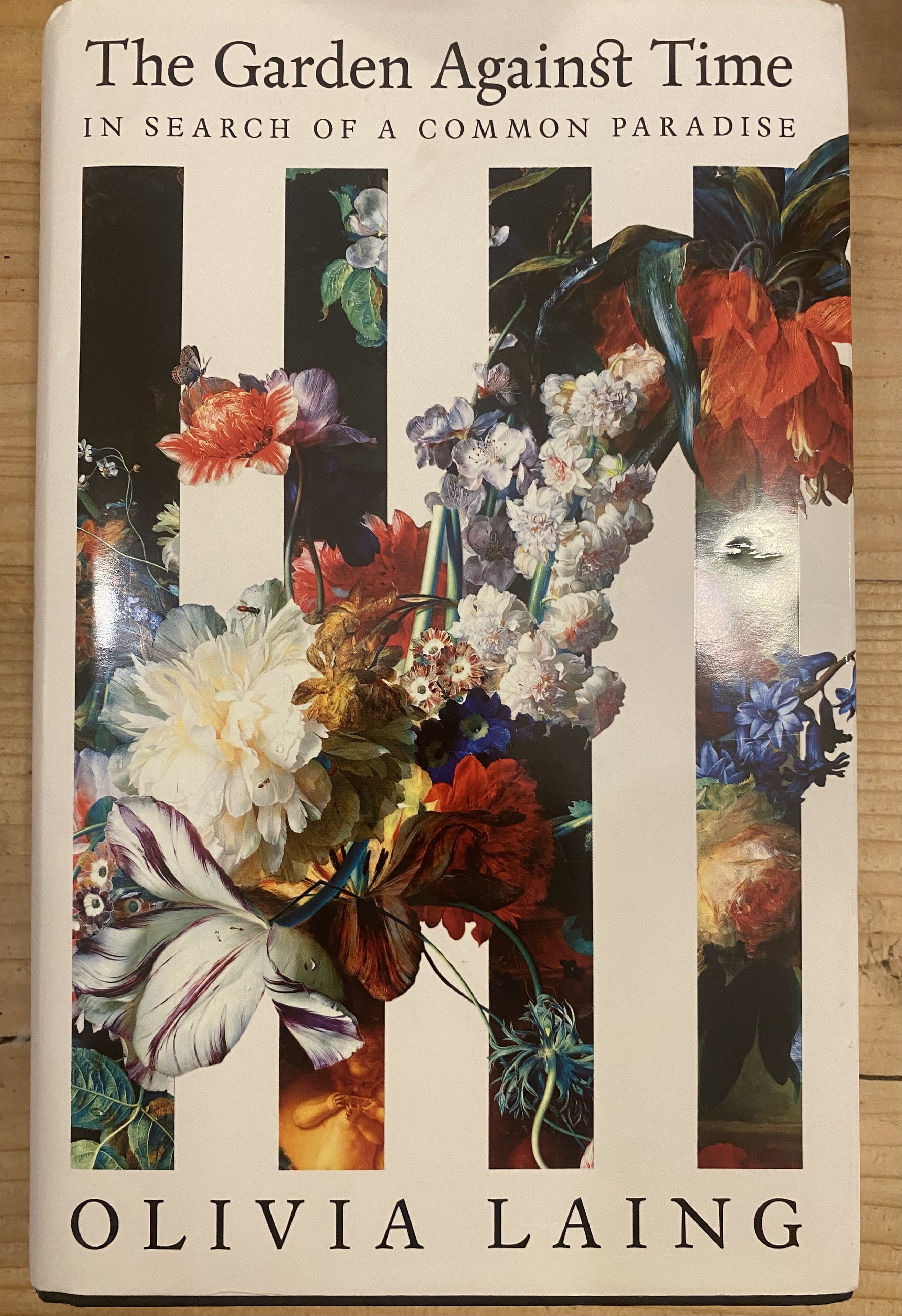
Several months ago a package arrived from Amazon containing a book. This is not an entirely unusual occurance in our household, although when we do buy books on line, it is more likely to be from bookshop.org or World of Books (my husband is a sucker for an ex-library edition). This package, however, was not an impulsive or accidentally overlooked purchase, but rather an unexpected un-birthday present from my stepmother, a copy of Olivia Laing’s much-praised The Garden Against Time. A few months later my husband gave me, as an actual birthday present and at my request, a copy of Penelope Lively’s even more critically acclaimed Life in the Garden.

Although I read them separated by several months, these two volumes have worked together in my head as part of a single genre of literary garden reflections. Both Laing and Lively write as both gardeners and writers, using the act of hands-on cultivation as a jumping-off point for reflections on the representational significance of gardens in predominantly Western, mostly British, culture. Both are erudite and both are beautiful objects (even the ex-library paperback edition of Life in the Garden), illustrated by a similary style of woodcut horticultural illustration.

Laing’s book is ostensibly structured by the story of her acquisition and reconstruction of a historic Suffolk garden, a process disrupted by the Covid-19 pandemic and its aftermath. Lively’s volume is, at least superficially, more academic than biographical, formed of series of essays on themes ranging from ‘Reality and Metaphor’ to ‘Time, Order and the Garden’. Yet it is Laing who spends signficant space in detailed analyses of John Milton’s Paradise Lost, W.G. Sebald’s The Rings of Saturn and the life and poetry of John Clare in terms which would not be out of place in an academic essay. Lively, meanwhile, ranges more widely in her references, with less critical depth but with a lightness of tone and analytic incisiveness that gives the book an immediatcy that is immensely engaging. As a result, I could see Lively’s Oxfordshire garden, created with her husband Jack, and the Egyptian garden of her childhood memories in ways that I could not with Laing’s restored greenhouse and pond. Although perhaps it was Lively’s early (and entirely accurate) identification of Tom’s Midnight Garden as one of the great works of 20th-century children’s literature that informed my sense of recognition and familiarity with her world and world view in ways that Laing’s work, for all its accomplishment never achieved. I have never read Sebald, and have only engaged episodically with Milton and Clare, whereas some of my most cherished memories of my mother revolve around her reading Tom’s Midnight Garden to me, first as a bed-time story and then on to audiotape, a process that, in the 1980s, was a true labour of love and dedication. I still have those tapes, the audio now preserved in digital form by my husband, although even now, over six years after her death, I am still not ready to listen to them and hear my mother’s voice reading to me again.

Nor are the intellectual contexts of the two books the only key differences which shaped my enjoyment. I found Lively’s writing much funnier than Laing’s, and was constantly reading out snippets of Life in the Garden to my husband. At no point was I tempted to do this with Laing, who also has a distancing literary tic of listing plants, many of them unfamiliar to a less-experienced gardener, without providing enough context to make them visible or meaningful to the reader. I think the idea is to evoke the poetry of gardening as well as the garden, but ultimate they just left me bored and confused. Laing’s discussion of John Clare’s life and work as a rural poet at the cusp of the industrial revolution was far more moving and effective, and has prompted me to seek out the poet’s autobiography, just as my husband, who read The Garden Against Time after I did, has purchased a (inevitably second-hand) copy of The Rings of Saturn.

I’m not a great reader of gardening books, and I read enough non-fiction for work that I tend to avoid such books as leisure reading, even when the genre overlaps with my own leisure interests. There is inevitably a lot of cultural history, often relevant to my own research, which precludes using such work as a way of fully switching off. But I am glad that I read both these books, not least for their many seredipties, and will certainly be dipping into Lively again, although I not so sure about Laing. In the meantime, with the snow falling outside, I will use them less as inspiration for the garden than for further reading, not only John Clare but also Lively’s fiction.

Oh Dear

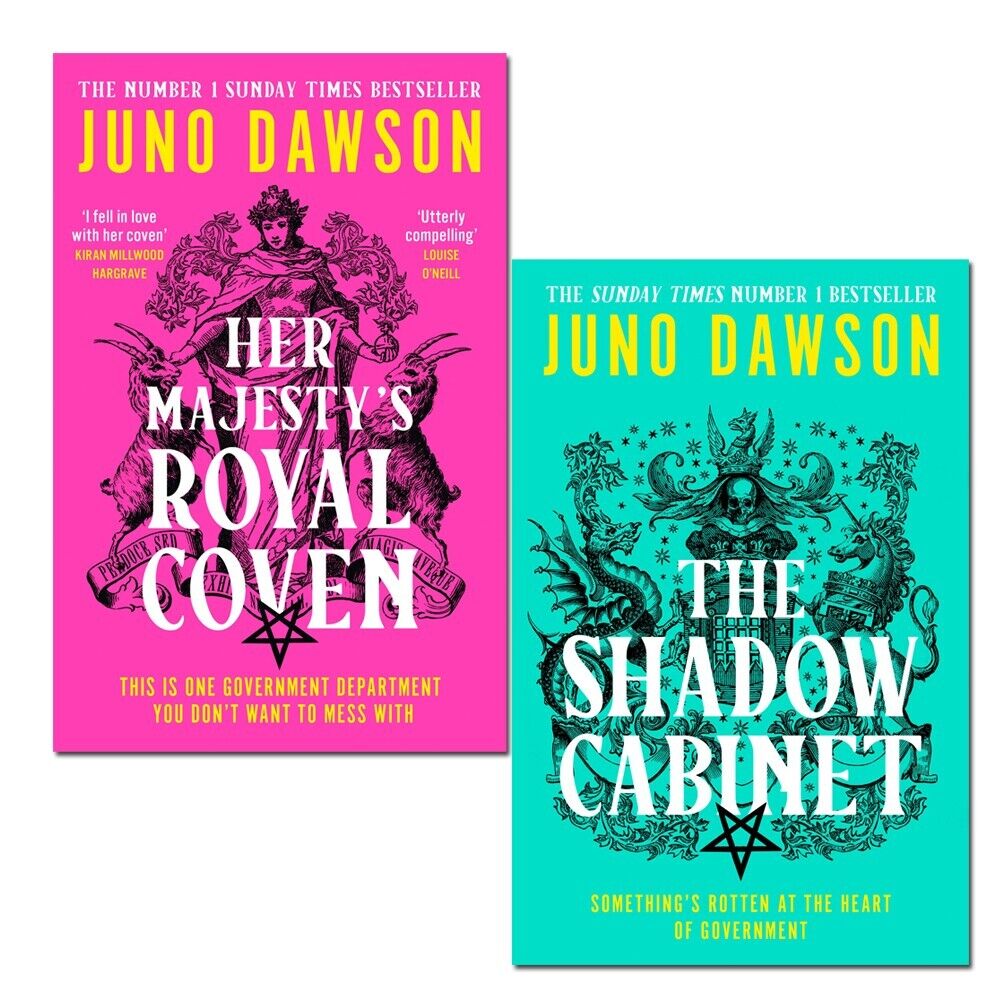
I was so looking foward to Juno Dawson’s Her Majesty’s Royal Coven. Modern witchcraft set in Hebden Bridge, which came highly recommended by both a friend whose taste I trust and the local bookstore that sold it to me? What could be better as escapist reading? In fact, I anticipated enjoying it so much that I bought the sequel before I even started the first volume and savoured my anticipation of losing myself in the West Yorkshire equivalent of Deborah Harkness’s All Souls series (recommened by another friend whose taste I trust and which I enjoy enormously).

So it is with great regret that I must inform you that Her Majesty’s Secret Coven is the lastest of my very rare ‘did not finishes’, and this was after I got over 150 pages in. Usually if I make it past page 50, I will keep going with a book, even if only out of pure bloody-mindedness. This, however, felt like too much of a slog. The characterisation was remarkably flat, particularly of the women who were portrayed as archetypes rather than indivuals. Given that this is a story predominantly about women, with a plot centring on female identity, this is a serious problem, one reinforced by a confusing plot with gaping holes in it. I spent most of the time struggling to understand what was happening or why characters were choosing to act in the ways described.

But the biggest disappointment was the aspect I had been anticipating most eagerly – the setting. As a Hebden Bridge resident, I freely admit to being an ‘offcumbden’. But the town and its surrounding villages have a unique enough personality for me to feel, even after only seven years of residence, that I know them at least a little bit. And they are definitely not the town depicted in this book. Yes, they form a small pocket of liberalism, not to say radicalism, enfolded by the Calder Valley in the more generally conservative rural West Yorkshire. And yes, the 1960s hippie vibe which is central to the town’s identity is being diluted by an influx of the professional middle classes (of which I freely admit to being one). Sitting halfway between Leeds and Manchester, even the vaguaries of Northern Rail cannot detract from the attraction of the town to commuters. But for all that, Hebden Bridge is still very much Happy Valley, not Nappy Valley. I don’t recall ever meeting a yummy mummy, as asserted in one description of a local café, and this is after five years of schoolgate attendance. Dawson appears to see Hebden Bridge as a version of Brighton in the north, which it is not. It is its own distinct place, with its own unique, often contradictory, always fascinating character, one which Dawson fails to capture.

The geography also doesn’t make sense. The book is full of descriptions of characters’ homes, but I was unable to locate any of them in my mental map of the area. The actual map that forms the frontispiece is no help, drawing as it does on the imagery of maps in fantasy novels. By the time I gave up, I found I was lost, not in the story but rather in confusion. I kept longing to find my way back tot he real world, rather than continue to make my way through a fantastical vision of the placy I call home, peopled by unreal phantasms, not people with recognisable conflicts and motivations. My recommendation is, if you want to discover the complex magic of Hebden Bridge through fiction, try the work of Sally Wainright rather than Juno Dawson. Happy Valley is on iPlayer and Riot Girls is due for broadcast this year. Or better yet, come visit, and experience this darkly enchanting place for yourself.

Accountability Revisted

Having reflected on the recovery of the past year on New Year’s Eve, the start of the new year seems a good time to revisit and report back on the plans I made a year ago. I have also updated with some plans for the coming year.

Writing:

  1. Reviews: I completed and submitted both book reviews due in early 2024, and both have been published. I now have a review (over)due that was supposed to be written by September, but I didn’t receive the book until October. This will be completed in the next couple of weeks.
  2. Conference papers: I had to pull out of the conference on military welfare history as my injured knee made travel too complicated. The paper at the Academic Archers conference was well received, and I am contemplating proposing a follow-up (although not for this year’s on-line conference, sadly). I gave papers at a different conference on military history and, joyously, at the Dorothy L. Sayers Society annual symposium and helped organise a conference on military welfare history. In the coming year, I am already scheduled to give public lectures in February, June and November, and a conference keynote in February. I am also hoping to get to Austria for the Military Welfare History Network conference and to Greece for the International Society for First World War Studies conference, although I am not sure what, if anything, I will be writing for either.
  3. The big one: The book. Definitely did not get finished this year. In fact, I have made very little progress, with the one chapter that I have worked on significantly currently is a state of chaos that terrifies me. I have done some initial work on other chapters, and do have a clearer sense of what I am trying to do, but I need more space to sit with this work than I have at the moment or am likely to until the summer at least. Work continues.
  4. And the new project: The article on ambulance drivers never materialised, but in the spring I was approached by a publisher interested in a global history of masculinity and warfare. I have written a proposal and received encouraging feedback. I will be redrafting the proposal in the coming month. Should it be accepted, writing this will be the focus of my forthcoming research leave.

Knitting:

  1. The cardigan that I started as a lockdown project still doesn’t have button bands, but I have bought the required wool from the supplier. It is next on the knitting project list. This may require another ball of wool from the supplier.
  2. Three family sweaters were all completed in 2024, although my son’s was finished in a huge rush on 27th December. Only my husband received Christmas wool this year, as he has requested a replacement sweater for one he has worn to death. I have already made a start on this and am making good progress as I still can’t ski due to the knee injury.
  3. And the new projects: I still haven’t come up with a project for the reclaimed wool from the baby blanket, but I have just offered to make a non-knitting friend a cable sweater. I will be knitting some swatches to test the gauge when I get home, and hoping she likes the colour. If not, I have a large stash of other colours, hopefully something suitable will be found. I also bought myself a copy of Margery Allingham’s Mysterious Knits (coincidentally by the same designer as my friend’s requested sweater) for my birthday and have bought myself a Christmas present of wool for one of the sweater patterns. So it looks to be a year of Kate Davies knits for me this year.

Quilting:

  1. Autumnal quilt. I have not touched this this year.
  2. Alice’s Wonderland quilt: Completed, long arm quilted, bound and given to its intended recipient. I am enormously proud of myself and of it.
  3. Aurora Stars Tricolour quilt: Last year’s new project. I haven’t quite completed the quilt top, but hope to be able to do so in the next couple of months, having just ordered the backing and binding fabrics. However, there are…
  4. The new projects: Instead of wool, this year I gave my children the materials for their quilts, a full kit for my son, a BOM for my daughter. I have also built up enough of a fabric stash to start compiling the materials needed for my nephew’s quilt top. I will have a significant period to focus on these during my period of recovery from surgery, which will hopefully happen in the spring, but we will have to see how far I get with these.

In the kitchen, the garden and the house:

As ever, the annual events of the kitchen and garden recur.

  1. Marmalade. Successfully made, in spite of my impairment. The kits for this year’s batch are on order.
  2. Germination: One of the great achievements of last year was the completion of two big house renovation projects, an update to the family bathroom and the complete redesign of the utility room and office, a project that involved replacing the roof over that part of the house. This has given us not only a lovely space to work in (with, miraculously, enough shelf space for all our books!) but also a large space for potting and germinating. As the greenhouse still doesn’t exist, this will do for now.
  3. The front bed has been dug over, although too late to plant the intended bulbs. I will be putting in shrubs, including a gift from an old family friend, in the spring, Then I need to work out what to do with all the rocks that I removed as part of the process.
  4. Plant-based baking: The cinnamon rolls never did happen. I may try again this year.
  5. And the new project: Having completed the bathroom and office space, the next challenge is redecorating the rest of the house. I am hoping my husband will get around to laying the wood floor in the living room. My goal is to paint the front hallway so that we can finally hang the artwork that is currently occupying a corner of the spare room.

As with last year, these are ambitious goals which will not be completed, but I fully intend that this year shall be different in terms of the pattern and pacing of my work across the different categories. There will be changes this year, some them scary, but all, I think, necessary to enable me to tackle the goals outlined above.

The Recovering Year

I started 2024 in a hotel room in Italy in a full-leg brace, unable to walk. I am ending it in a hotel room in Colorado, still unable to ski and with an aching arm due to what I think may be tennis elbow. In between, I have swum 5 kilometers very slowly, spent more time in hospital than I really wanted, failed to make significant progress with my book projects and lost the ability to sleep through the night.

So no, 2024 has not been an easy year. Much of it has felt wildly out of balance with long periods when I felt like the Red Queen in Alice in Through the Looking-Glass, running very fast to remain in one place offset by some blissful periods of doing very little other than reading Georgette Heyer novels. But it has been a year of recovery. This recovery has been physical. I am now back on both feet and even running again. It has taken a lot of physiotherapy on my ham string to get me there, with a lot more in prospect as I am now due to have surgery to repair my ACL in the spring.

But there have been other things that I have recovered as well this year. One of them, thanks in part to those period of reading Heyer (among others), is my enjoyment of reading for its own sake. I never fully lost this, but this year I recovered the ability to read for pleasure without feeling guilty about all the other things I could or should be doing with the time. As the year has progressed, I have found more time for reading outside of holiday periods. This has been a gift, helping me to restore some of that balance that I have lost over the past few years.

The other thing I have recovered, somewhat to my surprise, is my desire to write. Granted, I have done less writing for the books than I might have hoped. But in the final third of the year I wrote 60,000 words of lectures, an intense and oddly energizing project, particularly in retrospect. I wrote, and started to rewrite a book proposal, and wrote and submitted an ultimately unsuccessful fellowship application. Combined with the reviews I have been writing for this site (which I will post in the new year), I have started to feel as if I have found my voice again after a prolonged period of not being sure if I had anything to say, if I had the ability to say it, or if anyone would listen if I did.

Those doubts do still assail me, particularly at 2 am and in relation to the big book project. The process of recovery is not complete, any more than the process of recovery for my knee is. It may never be, fully, but here, at the end of 2024, it does feel at least that I can see the direction I need to head. The current level of imbalance is unsustainable, just as the continuing instability of my knee is for the sort of life I want to live. There will have to be some big changes in the coming year to ensure that my recovery, physical and psychological, continues. These still feel a bit tentative. I am waiting for the exact date of my surgery and my other plans will have to wait until after that, probably for the second half of the year. But changes there will be in 2025, that I can promise.

So here is to the recovered year just gone and a year of change and progress to come. Wishing you and yours all health and happiness for whatever the new year may bring.

Unreal City

Kate Atkinson, Shrines of Gaiety

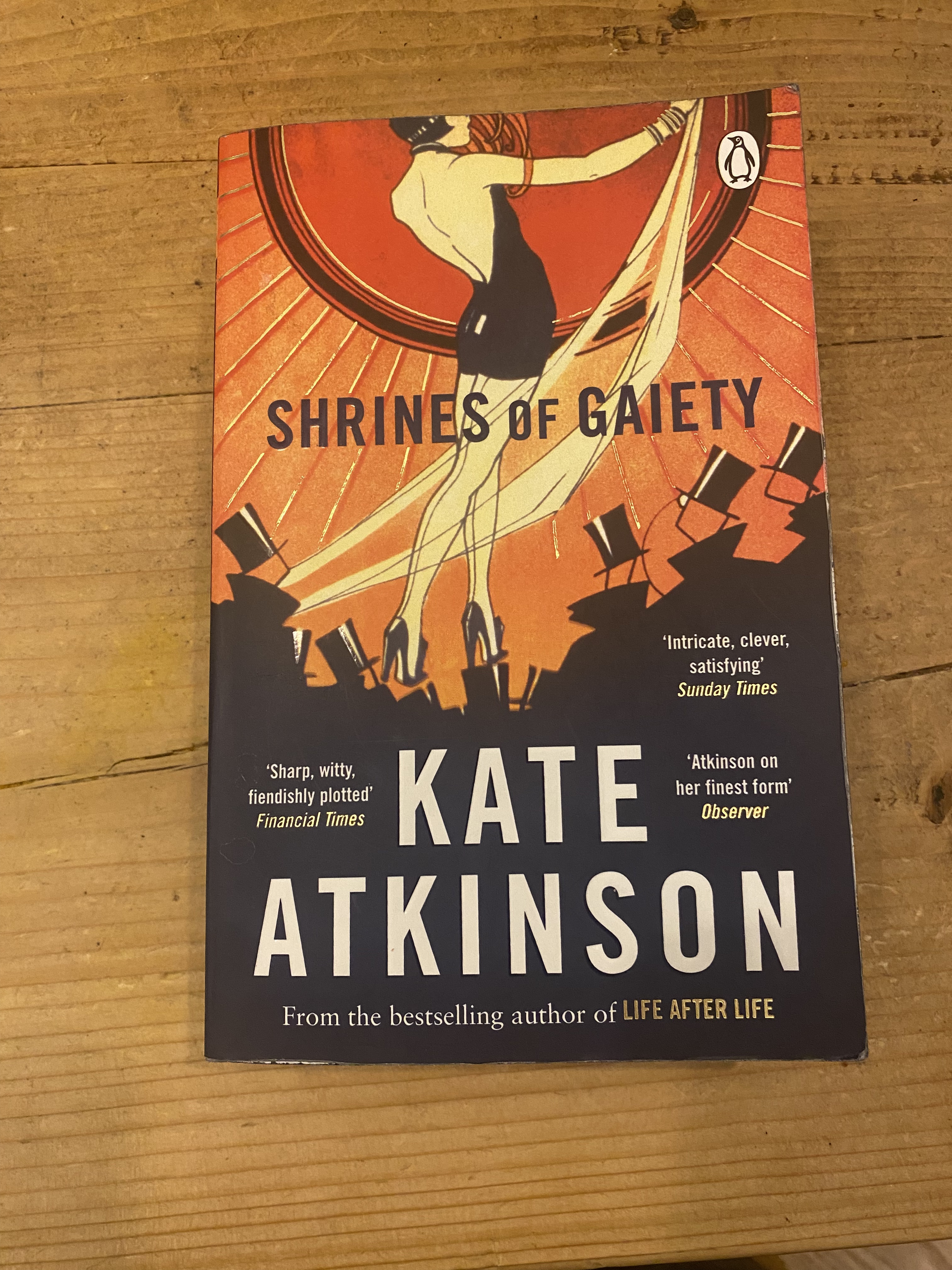
Having swallowed down Human Croquet and Normal Rules Don’t Apply in a gulp, I took a bit more time over Shrines of Gaiety, which is probably a good thing.  I enjoyed it – I think it is probably impossible for Atkinson to write a book that I don’t find totally immersive and enjoyable to read – but, in retrospect, I’m not sure it was as entirely wonderful as I had hoped. I don’t really expect anything to live up to the wonder of A God in Ruins, a book which speaks to so much that I love, am interested in and have dedicated my intellectual life to, or Life After Life, a literary and imaginative life raft which I clung to in the days after my mother died. But his is a book that had the potential to speak to me as strongly as either of these, a story of a time and people who are, in part, the subject of the (non-fiction) book I am writing at the moment, as well as being crime fiction-adjacent, touching on another of my great passions.

And there certainly were elements of this book that I loved. Nellie Coker, Gwendolen Keeling and Freda Murgatroyd (what a name!) are all wonderful creations – rich, complex, engaging women whose attitudes and actions I could deplore and root for in equal measure. I also loved the character of Niven Coker, a man shaped but not defined (except perhaps in the eyes of others) by his experiences of war. The ambiguity of the ending of his and Gwendolen’s story, so typical of Atkinson’s play with multiple narratives and possible outcomes, was one of the great pleasures of the novel for me.

And yet… And yet… I did not love this book the way I loved even Transmission, a novel that I know many critics struggled with. The problem for me was two-fold. In the first place, there were too many characters and storylines introduced, with the result that several of the plots and characters felt underdeveloped. Ramsey Coker in particular, who gets a considerable amount of space in the book, never came fully alive for me, and I never truly believed in his (strategically important) relationship with Freda. Similarly, the murdered girls whose disappearance I think is intended to be a central plot device, merged into one in my mind, which was a problem given the centrality of the moral imperative that drives Inspector Frobisher’s desire to name them individually. And to leave one major plot strand (the disappearance of Florence Ingram) entirely unexplained may be considered artistic license. For there to be a second (the murder of Vivian Quinn) feels like authorial carelessness.

Secondly, and relatedly, the book is weakened by the attempt to coral all 73 characters and their interlinking storylines into small a social and geographic space. There are any number of coincidences – Frobisher’s presence on the bridge when Freda goes into the river, Freda and Florence rooming in the house of the abortionist employed by Maddox, Niven Coker passing by when Gwendolen is mugged. One of these would work to help drive the plot but, like the unexplained plot points, their accumulation over the course of the novel feels contrived. The appearance of Gertie Bridges as a deus ex machina and virtual twin of a central character feels particularly in artistic, violating as it does the tenth of Ronald Knox’s commandments of detective fiction for the period. Having invoked Eliot and his unreal city, the imagery of the nameless crowd flowing over London Bridge, undone by death, is undermined by the boundaries these coincidences put in place.

Ultimately, then, this in really a novel about the aftermath and legacy of the First World War as I had hoped. The decadence of the clubland setting, with its corrupt police, violent gangsters and privileged patrons, could belong as easily to the fin de siècle, with Wilde rather than Eliot as muse. The experience of the horrors of war are part but not the entirety of the life the characters, something which does ring true, particularly in the case of Niven, but this raises questions about Atkinson’s stated inspiration for the novel, as discussed in the Author’s Note. Unlike her Second World War novels, which do so brilliantly, this one fails to fully capture the uniqueness of the historical moment of its setting. Possibly this is a specific problem of the interwar period, which does seem to have a certain ubiquity in historical novels, although Sarah Waters undoubtedly managed to capture the unique flavour of changing times and social mores in the period in The Paying Guest.

None of which is to say that I don’t recommend Shrines of Gaiety. Anything by Atkinson is worth reading and Nellie Coker is far too good a character to refuse introduction to. I am very glad I met her, and her elder son. But this novel won’t haunt me the way that A God in Ruins and Behind the Scenes at the Museum do, enriching my life and scholarship in the process. However, this slight disappointment certainly won’t keep me for eagerly anticipating the paperback publication of Death at the Sign of the Rook, Atkinson’s latest (and apparently last) Jackson Brodie detective novel, an homage to Golden Age detective fiction. I live in hope that it manages to capture the feeling of the interwar – this elusive, infuriating, enthralling period that continues to fascinate me as both a historian and reader of fiction. I do so in the certainty that even if it does not, it will still, like Shrines of Gaiety, be a great read.

Enough is as Good as a Feast

Kate Atkinson, Human Croquet

Kate Atkinson, Normal Rules Don’t Apply

It may have been a mistake, saving my stash of Kate Atkinsons to take with me on holiday over the summer. Not because they are not wonderful; they absolutely are. Reading Human Croquet, which I did in a day, gulping it down in a way I haven’t done with a book since the height of the pandemic, was a joy, an immersion in language and characterisation and intricately intersecting plot lines that took me to another place as only a great book can.

But oh! they are so rich! Coming to the end of the book after a day spent reading like that felt a bit like getting up from the table after an overly rich meal, or waking up with a hangover. It was almost too much, to the point where I felt lethargic and slightly headachy. So following such overindulgence with more of the same may, as I say, have been a mistake. Yes, Normal Rules Don’t Apply was, as a collection of short stories, briefer and lighter, but the collection of linking characters, locations and storylines required work, the language was just as intoxicating and the emotions evoked were, if anything, even more quietly devastating.

To recover, I gave myself a palate cleanser of Georgette Heyer’s The Quiet Gentleman, which was light and funny and straightforward in terms of plotlines and the emotions aroused, although not, perhaps, overly memorable. But it did leave me slightly out of time to tackle Shrines of Gaiety, which I had been keeping to savour,before the end of our stay in the US. I was left with the choice of starting it on the plane ride home or saving it for the long weekend trip to Scotland scheduled for the week after we returned. The former option risked my staying up all night reading, followed by jetlagged exhaustion on arrival. That was how I read Life After Life, but I wouldn’t have slept on that flight anyway, In the depths of grief following my mother’s death the week before, that book saved me from going mad, a life raft in the ocean of suspended time that flying back to my family in the UK entailed. This time I anticipated no such need, just the prospect of houseguests to prepare for, making the prospect of exhaustion compounded by jetlag a less than enticing prospect.

Saving it for Scotland, meanwhile, would give me something to look forward too when my husband and son headed off to climb Ben Nevis without me, a challenge to far for my torn ACL, which had been playing up even in the slightly less strenuous context of the hills of Western Massachusetts. So that is was I decided to do, planning to balance the intensity of Atkinson’s rich literary vision of 1920s London with the anticipated jeu d’esprit of Juno Dawson’s Hebden Bridge-set witchcraft novels.

Catching Up

Carola Dunn, Die Laughing, 2003

Louise Penny, The Long Way Home, 2014

Louise Penny, Kingdom of the Blind, 2018

After several months (indeed years) of accumulation, over the summer I decided to make one of my periodic concerted efforts at putting a dent in my to-be-read shelf, which then stood at thirty-five books and counting. I started with wth collection of second-hand books from part way through various contemporary series that that have been recommended to me but which I have been motivated to buy unless I came across a used copy. I haven’t been entirely successful in completing this endeavour (a volumen of Sulari Gentil’s Rowland Sinclair mysteries is next on my list), but I did manage a couple of volumes from Louise Penny’s Armand Garmache series and a Daisy Dalrymple mystery by Carola Dunn.

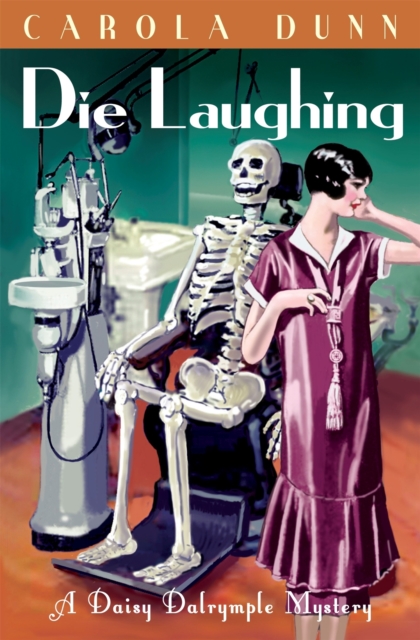
The Dunn series is one that has been hovering at the edge of my consciousness for a number of years now. When I was reading my way through Frances Brodie’s Kate Shackleton series and Jacqueline Winspear’s Maisie Dobbs series (recommended to me by the late, great Dennis Showalter, who knew whereof he spoke), Daisy Dalrymple regularly popped up in my on-line recommendations. So it was with interest, although not necessarily great expectations, that I started Die Laughing, the tenth book in the series. Unfortunately, these expectations were definitely not exceeded. One of the blurbs on my copy states that the book is ‘For lovers of Dorothy L. Sayers’, but like so many so-called ‘cosy’ crime novels with a British interwar setting, the only Sayers-like attribute that the book has is the fact that the detective (or at least one of them) is an aristocrat (although we are told multiple times that her title is ‘only’ an honorary one).

The problem is that the novel doesn’t work as either a classic detective novel, with a focus on the puzzle element, or as the sort of social reflection that makes Sayers (and many of the other classic queens of Golden Age detective fiction) such good source material for the social historian. By splitting the detective work between an amateur who doesn’t really want to be detecting and her professional husband and his team, the novel rejects the structural formality of classic detective fiction storytelling. Sherlock Holmes explaining his reasoning to Watson and Japp or Poirot collecting the suspects in the drawing room for the unveiling of the criminal may be the stuff of cliché, but such scenes work to construct a narrative with tension by making the unravelling the work of a single intelligence. Even where the sidekick or professional assistant makes as great a contribution to that unravelling as the detective, the sharing of information needs to be integral to both the plot and laying the evidence before the reader. For a masterclass in the approach, you only have to look at the conversations between Peter and Harriet in Have His Carcase (1932), which are used to convey any facts gathered separately as well as interpret them as part of the satisfying working out of the mystery. Not so in the world of Daisy Dalrymple and Alec Fletcher where each undertakes their own investigations and the sharing of clues is perfunctory, with little reference to either the plot or the character developments

So much for the structural form of the detective story. What about the novel as a reflection of society in the interwar period? Dunn has clearly done a certain amount of research into the period, but her representation of class is clumsy to the point of farce. The middle classes are almost uniformly snobbish and racist, with the exception of Daisy’s two female friends, who are only distinguishable from each other by the fact that one is Indian (and therefore the victim of racist prejudice). The working-class characters are distinguishable by their entirely generic vernacular, with a Scots policeman apparently speaking in almost exactly the same way as a Cockney charwoman. The theme of the ‘servant problem’ is shoe-horned into the book, with little relevance to the central crime or its investigation, and drawing on debates from the late nineteenth century, rather than those being articulated in 1924. The result is that, while the reader is told multiple times that the war changed class relationships, but we are never effectively shown this. I finally lost patience with the representation of a character, introduced to late in the book to be fully fleshed out, as a Second World War-style spiv, whose service with the Army Service Corps was used as shorthand for his not having served overseas during the war. Given the the extensive work of men of this unit as motor ambulance and lorry drivers on all fighting fronts, this misrepresentation smacked, like far too much else in this book, of superficial research and lazy historical cliché.

So I will not be seeking out any more of the Dalrymple series. I am, however, more ambivalent about Penny’s Gamache series, although I can’t say I was overly enamoured of either of the two volumes I read. I know many people love this but, like Elly Griffith’s equally loved Ruth Galloway series, I found the tone too knowingly whimsical for my taste. These series are, apparently, part of a genre now marketed as ‘character-led’ mysteries (presumably as opposed to action-led thrillers) but, for me, the characters were oddly flat. The reader is told, over and over, who these people are, and even what they are thinking, but this is rarely matched by them then acting in psychologically convincing ways. The criminal in one of the stories barely registers as a character in their own right, and certainly not as the magnetic character that we are informed they are. There is also a dissonance in tone between, for instance, constant references to an aged, sweary, alcoholic poet who keeps a pet duck and is loved (inexplicably) by her neighbours, and plotlines around the distribution of carfentenil and its brutalising effects on the homeless population of Montreal, that is jarring to say the least.

Penny’s writing is good enough to make me mildly curious about how she introduced her recurring characters in the first novel in the series, Still Life (2005). However, I can’t say I feel compelled to read any more, certainly not at the moment when unregulated holiday browsing in second-hand bookshops has my to-be-read shelf to closer to forty volumes. I am glad that I finally gave these popular series a go, but equally glad that neither captured me to the extent that I will now be adding any more of their work to that shelf.

Summer Reading and Future Plans

Somehow, it is the August bank holiday weekend, and thus almost the end of summer. I am back at work (which means hundreds of emails and frantic lecture writing and lesson planning for a month before teaching starts) on Wednesday and the kids are back at school the following week. This summer seems to have gone by in a blur, over before it barely began, but it has seen two important developments, at least as far as this blog is concerned.

In the first place, I have managed to to a lot more fiction reading this summer than I have for the past couple of years. Returning to immersion in fiction as a space for relaxation and recuperation has been a joy, and I hope to carry on with this habit even as the busyness of the academic year accelerates. My-to-be read shelf has not noticeably contracted, as holiday travels have involved many bookshops and and I appear constitutionally unable to enter a bookshop without purchasing something, particularly second-hand bookshops, and there is also the list of things I want to read but haven’t quite got around (or found a good excuse) to purchase yet.

The second development of the summer was my decision (along with many others) to finally cut ties with the social media site formally know as Twitter and move my micro-blogging onto Threads, where I go by @thehistorianskitchengarden. As I originally joined Twitter to publicise this blog, in the days when there was a 180-character limit, this transition feels like a good excuse to revive and revise what I am doing on here.

My initial enrolment with Threads was due to the fact that I have an Instagram account, where I mainly post pictures of my cooking and gardening endeavours, as well as views from my morning runs and holiday walks. However, I have also been intermittently involved with the #bookstagram hashtag, primarily through posting stacks of books prompted by a theme. However, I also enjoy reading reviews of books posted on the site, and have considered posting my own, thwarted only by the incovenience of writing a detailed review on my phone keypad. Given the regularity with which I post typos due either to fat fingers or the vagaries of auto-correct as it is, attempting this on a regular basis seemed like a bad idea.

I did flirt with the idea of launching a Substack, something I may do in the future depending on the direction my writing career develops in the future, but adding an additional platform at this stage, when I already have this one at my disposal. So how I will be using this blog will change over the next few months. In addition to publicising my posts on Threads, I will be posting more (and hopefully more regular) book reviews. These will mainly be fiction, moving this site away from its focus on the First World War, although there will be some non-fiction reviews as well.

I don’t want to move entirely away from the role that this site has played as a research diary, not least because I am now working on not one but two book, a history of men and war in the modern period and a history of the returning British servicemen of the First World War. Both of these are now at the proposal stage and starting to have both argument and form. All that is lacking is sufficient time for me to write them. I will be trying to carve this out over the next year and the practice of working through ideas on this blog can only help make the process more efficient. Again, I will use Threads to help disseminate my writing, highlighting the historian as much as the kitchen and the garden of my handle.

So there will be quite a lot going on on here, I hope, and I will be updating the look of this site as part of that. There will be separate pages for the reviews and the two book projects, as well as an updated profile. There will be more photographs integrated into my posts, reflecting how I have developed my use of Threads in conjunction with Instagram. There may be some publicity for my other project, the podcast on the intersections of the First World War with popular culture, that I co-present, although I am not clear what form this will take. Finally, there will, I hope, be more scope for comment and discussion both on here and on social media, particularly relating to the book reviews. All of this may take some time, not least because, as of next week, my priority will be writing and creating the presentation slides for the eleven lectures I am due to deliver in the current term. But there will be reviews of at least some of the books I have read this summer before then, and before the start of the new year catches up to me.

Accountability

Having noted in my last post that I ended 2023 with a number of unfinish projects, I thought I would start the new year listing those that I hope to make progress with if not actually complete over the coming year. This is not a resolution (I’m possibly a bit late for that on Epiphany), but rather a hope to the point of intention.

Writing:

  1. Janaury/February: Two book reviews. I’ve read both books and have a good sense of what I want to say, but I have negotiated a bit more time for both of these as I know that I will get very little writing done once marking and postgraduate studentship applications come in in a couple of weeks.
  2. April: Two conference presentations.
    • Discussant on a panel in military welfare history as a sub-field. My contribution will be considering intersections with histories of disability and gender.
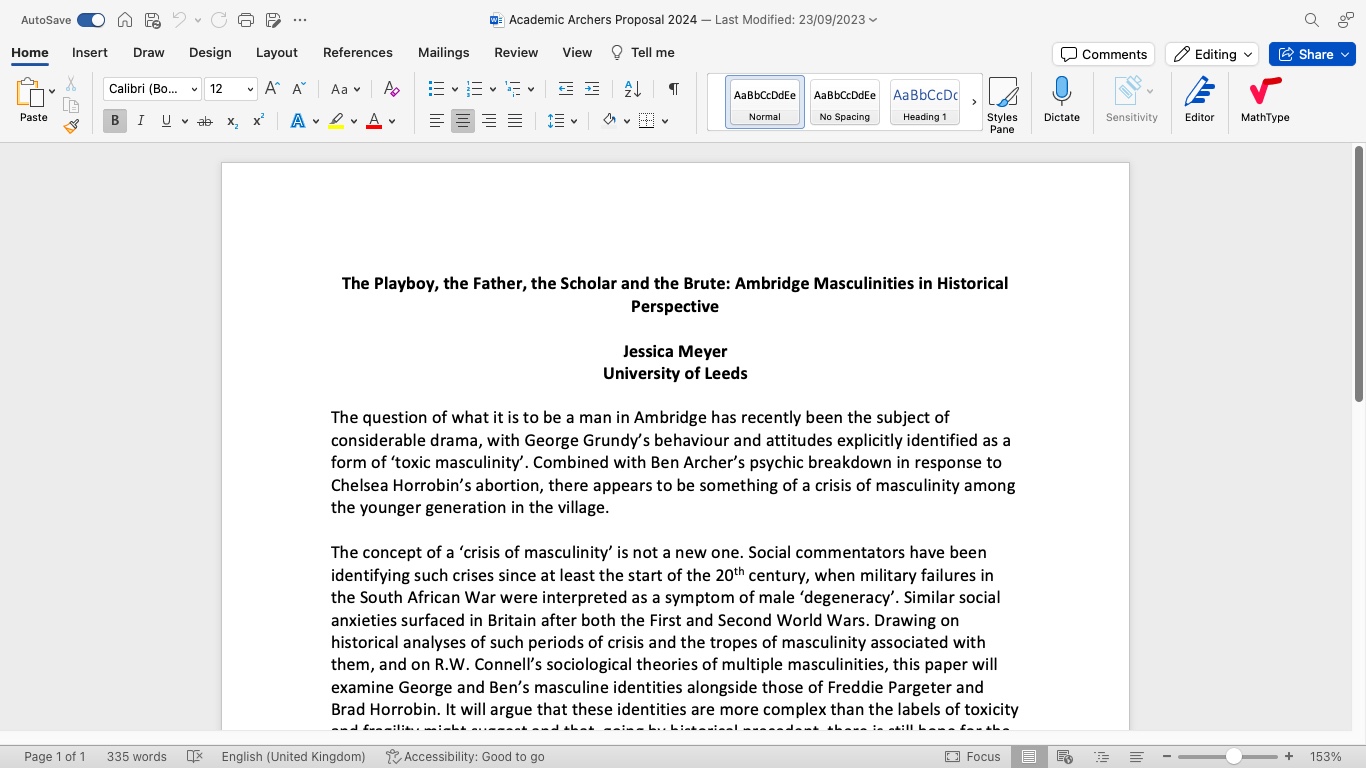
    • ‘The Playboy, the Father, the Scholar and the Brute: Ambridge Masculinities in Historical Perspective’ for the 2024 Academic Archers conference. I am very excited about this one, and can’t wait to start writing this properly. It has been a couple of years since I last attended an AA conference, which are some of the most fun out there.
  3. The big one: The book. This will definitely not get finished this year, but the goal is to end the year with at least a couple of full chapters in place, and possibly even an agent for it.
  4. And the new project: One of the books I’ve been reading for review has inspired me to think again about the status of ambulance drivers and non-combattant care-givers (or not). I think there may be a journal article in this, drawing together some of the material that I was only able to mention in passing in An Equal Burden.

Knitting:

  1. The cardigan that I started as a lockdown project. I have finally built up the courage to steek it (successfully, I think), but now have to complete the button bands and grafting. This may require another ball of wool from the supplier.
  2. Three family sweaters. Every year for Christmas I give my husband and two children the wool for a new sweater, which I then knit for them. This year I began my husband’s before Christmas, intending it for his birthday, after last year’s effort ended up far too tight in the arms and chest due to a miscalculation. However, as I have chosen an extremely complicated fair isle pattern, it is taking considerably longer than anticipated. Thankfully, the children’s sweaters should be more straight forward, so I may actually complete these before the weather gets too warm to wear them this year.
  3. And the new project: Today’s clearout of the bathroom cupboards in advance of the builders arriving tomorrow disclosed the sad fact that the baby blanket my mother made when my son was born had fallen victim moths. So I spent an hour today unravelling it, ending up with approximately six 50g balls of lovely, soft DK wool which, for sentimental reasons, I would like to make into something new. I’m not sure what yet, but all suggestions will be gratefully accepted.

Quilting:

  1. Autumnal quilt. My first full-sized bed quilt which I am very, very slowly hand quilting. Not one that I can see getting completed this year, but I would like to make more progress on it than I have done in the past 12 months.
  2. Alice’s Wonderland quilt: A Block of the Month project from Alice Caroline which I started in January 2022. All that remains is to attach the final four borders, after which I will take it to be long-arm quilted at my local quilt store. It is intended as a gift and I am not yet confident enough at hand quilting to take this aspect on (nor to do I have the time if it is to go to its recipient – currently age 4 – before they leave home for university).
  3. And the new project: Because I clearly can’t resist the siren call of the new project, I have signed up for another Alice Caroline BoM project this year. Hopefully this one will be a little bit quicker, now that I am more confident of my technique.

In the kitchen and the garden:

These are less unfinished projects from last year than annual events which come around every year. Nonetheless, they fall under the heading of projects, and very enjoyable ones, too.

  1. Marmalade. The making of this year’s batch will be made more interesting by my current temporary impairment relating to my knee injury, which requires brace and crutches and means I am only partially mobile.
  2. Germination: We still don’t have a greenhouse (a very long-term unfinished project), so some time in the next few months the window sills will start to play host to pots of seeds in anticipation of one of the summer’s main garden projects, the veg patch.
  3. The front bed: Yet another project that is now several years old. Having removed a hugely overgrown berberis, I now need to finish digging out all the stones to replant with a callicarpa and bulbs. This one, however, will have to wait until the weather improves.
  4. And the new project: For Christmas, my husband asked for and received a cookbook about plant-based baking. I may have rashly agreed to try making plant-based cinnamon rolls at some point…

As I say, I won’t complete all of these projects, but I hope to finish some and at least make progress with the rest. Whatever else it turns out to be, 2024 looks to be a busy year.

The breaking year

This end-of-year reflection was originally going to be titled ‘The Half-finished Year’, a reference not only to my ever-expanding folder of started but unfinished blog posts and the 2500 words of my next book, but also the two sweaters and three quilts that I am currently working on, as well as the unpainted front hallway and bathtub sitting in the living room that await attention when I get home. But, as I sit in a hotel room in Italy with my leg in a brace while the rest of my family is out skiing, I have come to realise that the reason that this year has been shaped so profoundly by the unfinished is because of the time that ill health has taken from me.

The year started with a minor but mortifying facial disfigurement in the form of a failed dental implant. It is ending in a broken ACL, the aforementioned brace, and uncertainty about how long recovery will take and what it will mean for all the activities and projects I have planned so far for the coming year. In between came multiple trips to the dentist, the doctor and the hospital, diagnosis of three conditions, two chronic, one temporary, the consequent prescriptions (including two attempts for the chronic conditions which resulted in distressing and painful side effects) and more blood tests than I would wish on my worst enemy.

Through all of this, I have not taken time off of work. I have continued my roles as wife and monther and have kept reassuring friends and family that I am fine, or at least managing. And in many ways I am lucky. The dental work has provided me with a successful prosthetic for the lost tooth. The three of the four medications I am taking are preventative rather than therapeutic. None of the conditions I suffer are life threatening. And while my current physical impairment is disabling, it is also temporary, even if rehabilitation is going to be counted in months at minimum, not weeks as I might wish. As someone who both works in the fields of disability and medical history, and has lived through the terminal illnesses of both parents, I know how fortunate I am that my various forms of ill health are identifiable, relatively painless and highly treatable, and that I live in a country and society where I have ready access to the care and treatment I need, as well as a support network of family and friends.

But while resilience may be an admirable quality in some ways, not least in providing a sense of continuity which is itself therapeutic, it cannot be a permanent state of being, as any old rubber band will show. Something, somewhere had to give in this year that has done its best to break me, physically and psychologically. It may not have succeeded entirely, but it does seem to have robbed me of significant amounts of time and, with it, my ability to complete projects, particularly those related to writing.

Which is not to say that this hasn’t been a year of progress in some ways. Indeed, I am managing, with this post, to publish more than one post for this blog this year, an improvement on my output for 2022. I now have a very clear idea of both the shape and content of my next book, although the form will require the sort of concentrated writing time that I definitely haven’t had this year and probably won’t in the coming year. I will even have new publications in the new year, in the form of a book chapter which fell victim to Covid delays and at least one book review. And I have managed to steek a cardigan for the first time, a terrifying technique in knitting that involves taking scissors to a piece of work knitted in the round to create an opening.

These achievements, small as they are, remind me that, unlike an old rubber band, I may be damaged but I am not yet broken. But, as I enter the new year in a damaged state, I do so with the knowledge that I cannot simply bounce back to a state of full productivity, as much as I might wish to do so. I need time and space both to heal what has broken this year and, when I am strong enough, to give my many unfinished projects the attention they deserve. So I will start this new year not with resolutions but with the hope that I will be able to find or make the time and space for convalescence and recuperation and with them the ability and courage complete some, if not all, of my half-finished projects.

I wish you all a healthy, contented and hope-fulfilled new year.