A Tale of the Unexpected

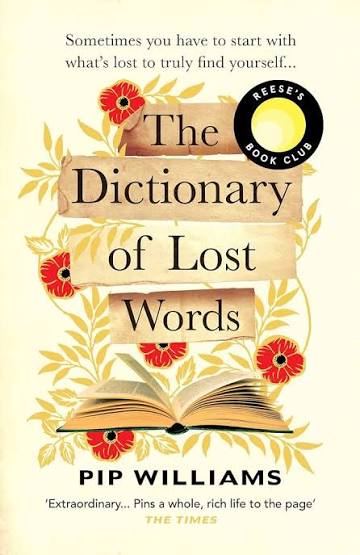
The Dictionary of Lost Words by Pip Williams

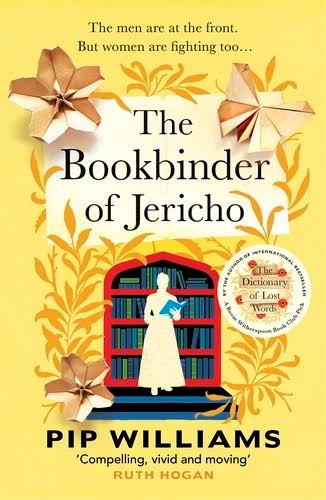
The Bookbinder of Jericho by Pip Williams

I am writing this review sitting in my brother’s living room in Conway, Massachusetts, where I have come on a whirlwind holiday, using the flight credits from a trip I was supposed take in April which had to be postponed when my husband fell ill. It was supposed to be a trip of pure indulgence after a summer focussed on work and family caregiving, with upgraded flights, tickets to a concert by one of my favourite groups, and a chance to spend time with friends and family members who I haven’t seen in far too long. The concert and the family time have or are going to plan; the meteorological gods, however, decided that I was not to be allowed a stress-free start to my trip. Thunderstorms over the north of England delayed the first leg of my flight so badly that I had to be rebooked for the second leg. As a result, rather than sitting at the end of an empty row, I was placed at the end of a full row, next to a woman who, for most of the seven hour flight, was reading Pip William’s The Dictionary of Lost Words.

It has been quite a while since I read The Dictionary of Lost Words and its sequel, The Bookbinder of Jericho, but this serendipitous moment of reencounter reminded me of how much I wanted to do so. Because, slightly against expectations, I adored these books. To be more precise, I thoroughly enjoyed The Dictionary of Lost Words, enough to go out and buy The Bookbinder of Jericho which I then proceeded to fall completely in love with.

Williams’ novels are both excellent examples of historical feminine middlebrow fiction, a genre which itself has a history going back for over a century, but which has recently had something of a flourishing. In particular, a number of excellent novels by and about women set in the late 19th and early 20th century have appeared over the last decade, from Sara Moss’s late-19th century-set Bodies of Light and Songs for Lost Children through Lissa Evans’ Second World War novels and The Whalebone Theatre by Joanna Quinn to Kate Atkinson’s playful experiments with temporality across the first half of the twentieth century.

The Dictionary of Lost Words, which tells the story of Esme, a young women involved, through her father, with the publication of the Oxford English Dictionary, starts at the end of the 19th century and runs through the First World War, so I approached it with some trepidation. And if the book has weakness, it is the section written as correspondence from a young man at the front just misses the tone of actual frontline correspondence. As with so many fictional attempts at this literary form, there is too much hindsight and to little emotional complexity in both the story told and the mode of telling. But this forms only a tiny fraction of the book which, in its treatment of the suffrage movement that forms the bulk of the narrative, demonstrates a subtle and moving understanding of the gender and class dynamics of the period. Williams’ writing style, which combines an ability to create distinctive and engaging narrative voices and characters with the ability to tell a compelling story ensured that, in spite of the break in my suspension of disbelief caused by the wartime correspondence, I thoroughly enjoyed the book and wanted to read more of her work.

I was, therefore, looking forward to an enjoyable read when I picked up The Bookbinder of Jericho, but I hadn’t expected to love it as much as I did. In this volume, not quite a sequel, but set in the same world of the OED as The Dictionary of Lost Words, with overlapping characters and events, the war is far more central to the narrative. Yet it is treated with far more originality than in either Williams’ previous work or many other novels with similar temporal settings. The aspirations of the protagonist, Peggy, are shaped but not defined by the war. Similarly, the war is shown creating new opportunities for women of all classes, but also new barriers. This is not a simple story of war as female opportunity in opposition to the confinement and destruction of masculinity.[1] Williams includes Belgian refugees in her representation of wartime home front society, and shows that women’s wartime work, both paid and voluntary, went beyond the Red Cross and the munitions factory. It is these less familiar stories of the war that enable her to create a credible world populated by believable characters. It also helped that I found Peggy a more engaging and sympathetic character than Esme. I loved spending time with her and was sorry when her story came to an end, even if it was in a satisfying way.

I didn’t ask my neighbour on the flight if she was planning to read The Bookbinder of Jericho, but I hope she does as it is well worth the time. As for me, I have finally got hold of the paperback of Joanna Miller’s The Eights, which I am hoping will make another enjoyable addition to my collection of historical female middlebrow novels. The language of the publicity blurb makes me slightly nervous, but I am hopeful of an engaging read, even if it can’t match the unexpected originality and emotional depth of The Bookbinder of Jericho.

[1] This forms the classic ‘double-helix’ model of wartime gender relations identified by Margaret and Patrice Higonnet and reflected in the influential analytic work of Elaine Showalter and Sandra Gilbert. See Higonnet, et. al. (eds.), Behind the Lines: Gender and the Two World Wars, Yale University Press, 1987.

The Recovering Year

I started 2024 in a hotel room in Italy in a full-leg brace, unable to walk. I am ending it in a hotel room in Colorado, still unable to ski and with an aching arm due to what I think may be tennis elbow. In between, I have swum 5 kilometers very slowly, spent more time in hospital than I really wanted, failed to make significant progress with my book projects and lost the ability to sleep through the night.

So no, 2024 has not been an easy year. Much of it has felt wildly out of balance with long periods when I felt like the Red Queen in Alice in Through the Looking-Glass, running very fast to remain in one place offset by some blissful periods of doing very little other than reading Georgette Heyer novels. But it has been a year of recovery. This recovery has been physical. I am now back on both feet and even running again. It has taken a lot of physiotherapy on my ham string to get me there, with a lot more in prospect as I am now due to have surgery to repair my ACL in the spring.

But there have been other things that I have recovered as well this year. One of them, thanks in part to those period of reading Heyer (among others), is my enjoyment of reading for its own sake. I never fully lost this, but this year I recovered the ability to read for pleasure without feeling guilty about all the other things I could or should be doing with the time. As the year has progressed, I have found more time for reading outside of holiday periods. This has been a gift, helping me to restore some of that balance that I have lost over the past few years.

The other thing I have recovered, somewhat to my surprise, is my desire to write. Granted, I have done less writing for the books than I might have hoped. But in the final third of the year I wrote 60,000 words of lectures, an intense and oddly energizing project, particularly in retrospect. I wrote, and started to rewrite a book proposal, and wrote and submitted an ultimately unsuccessful fellowship application. Combined with the reviews I have been writing for this site (which I will post in the new year), I have started to feel as if I have found my voice again after a prolonged period of not being sure if I had anything to say, if I had the ability to say it, or if anyone would listen if I did.

Those doubts do still assail me, particularly at 2 am and in relation to the big book project. The process of recovery is not complete, any more than the process of recovery for my knee is. It may never be, fully, but here, at the end of 2024, it does feel at least that I can see the direction I need to head. The current level of imbalance is unsustainable, just as the continuing instability of my knee is for the sort of life I want to live. There will have to be some big changes in the coming year to ensure that my recovery, physical and psychological, continues. These still feel a bit tentative. I am waiting for the exact date of my surgery and my other plans will have to wait until after that, probably for the second half of the year. But changes there will be in 2025, that I can promise.

So here is to the recovered year just gone and a year of change and progress to come. Wishing you and yours all health and happiness for whatever the new year may bring.

#am(not)reading

tumblr_ncgkryMwuc1s1zlzoo1_500I miss reading.

That may sound like an odd thing for an academic to say.  After all, I read all the time.  Within the past few weeks I have read 10 2000-word essays, two articles for discussion in a reading group, a draft of a colleague’s article, a draft of an other colleague’s grant proposal, three pieces of work written by postgraduate students, bits and pieces of roughly two dozen books that I am using to write a book chapter, half of a review book plus an unnumbered number of articles, blog posts, twitter conversations, emails and other forms of writing that historians of the future may class as ‘ephemera’.  Next week I will read over a dozen research proposals, another piece of postgraduate writing, some more of the review book and yet more articles, blog posts, twitter conversations and emails.

My job is based on reading and reading occupies a huge portion of my time. So what do I mean when I say I miss reading?

What I really mean, of course, is that I miss reading uncritically.  Everything I read for work requires me at some level to think about it, evaluate the ideas it contains and make judgements based on those evaluations.  Some judgements are superficial or easily made. Deciding whether or not to attend the range of seminars that emails regularly invite me to falls into this category.  Others are more time and energy consuming.  Fully grasping the way a student has grappled with complex ideas of masculine hegemony or the sophisticated arguments of 250-page academic monograph requires attention and focus.  The former is a necessary aspect of daily life, the management of communication.  The latter can be hugely satisfying, reflecting achievements in communicating and comprehending complex ideas.  But both are forms of reading as work, reading in which the self is always present, bringing to bear critical faculties on the text.

What I miss, what I really miss is the sort of reading that entails the loss of self within the story, where the act of reading is enough, where judgement is not necessarily suspended but not the ultimate definition of the interaction between reader and text.  I miss reading for pleasure, a loss to the multiple demands on my time that I become ever more acutely aware of as my six-year-old son makes the transition from reading as learning to reading for self-satisfaction.  Watching him make that journey is wonderfully exciting, opening up new worlds of books that I can offer him to lose himself in.  But it is also a poignant reminder of how little time I spend doing such losing myself. There are books on my ‘to read’ shelf that have been there since he was born – and the pile still grows, a testament to the power of hope (and good intentions) over experience.  I will read these book someday, I know I will.

On the positive side, not only does my son’s growing discovery of the pleasures of reading for pleasure provide me with greater opportunities to read myself (although he still loves being read to, a joy I hope he never loses, as I have never done), but the Christmas holidays are nearly upon us, with their eternal promise of time to read.  The past few years have been dominated by grant deadlines which have eaten in to any time not already committed to festive preparations and family celebrations.  But this year I am determined to carve out some time to finish the novel I haven’t looked at since September, and maybe even one or two others besides. Because if I am to retain the ability to read critically, as I must do, I need allow myself the space read uncritically as well, to lose myself in the written word as a way of finding myself again.

Looking Ahead

Happy New Year! I hope you have all had very merry and happy holiday seasons. Mine was lovely, marred only by sickness which struck on Boxing Day and has affected one or other member of my household ever since. Still, sore throats notwithstanding, we KBO.

Today is my first back at work since the holidays, although given the silence in the corridors, most of my colleagues have decided that this half a week is a bit pointless and have sensibly stayed away. With only one day in the office, I have mainly been concentrating on clearing my desk in preparation for the new year and, having almost succeeded (there is one proposal still to draft that is proving so intractable that I think yet another cup of tea will be needed to crack it), I thought this would a good opportunity to take a look ahead at what 2013 has to offer.

Firstly we have a great line-up of speakers for the Legacies of War seminar series. Final confirmation of titles is pending (and the full list will be posted in a week or so), but Adrian Gregory and Santanu Das have both agreed to speak, on ‘Did God Survive the Somme’ (!) and on ‘India, Empire and the First World War’. Both should be fascinating.

Before then I will be heading off to London, to the Wellcome Library where I will be on the hunt for memories of and about medical orderlies. Having had my proposal on the experiences of orderlies accepted for the Social History Society’s annual conference in March (see here for details), I am now looking for material to support the conclusions I have been drawing from reading Ward Muir’s Observations of an Orderly.  There is at least one orderly memoir at the Wellcome, plus a long list of potential manuscript sources, so it will be a busy.  I am also hoping to attend the IHR conference on open access, The Finch Report, open access and the historical community while I am there (there is a waiting list).

Also coming up is a meeting at the Imperial War Museum North for academics across the North of England to discuss plans for the centenary commemorations and I will be taking the opportunity to go round the ‘Saving Lives’ exhibition while I am there.

There are also a couple of long term plans that are starting to take shape – workshop for the autumn on the history of medicine and warfare, a journal special issue that I have been putting together for years now that hopefully will find a suitable home this year, plans for a primary school class on First World War medicine that may or may not include an accurate reproduction of a stretcher and work with some of the All Our Stories projects relating to Leeds hospitals during the war that have received funding.

And in the interim there will be reading and writing – lots of both.  There is the article on voluntary medical services and their relation to the military that I have been trying to write for a couple of months now, and the stack of books on the Territorial Army sitting seductively on my desk which will, hopefully, inform it.  There is the aforementioned conference paper on medical orderlies and the related research.  There is a beautiful (literally – the cover image is gorgeous) book from Ashgate to review.  And there is the ever-growing reading list, not including the ten books sitting disconsolate on my ‘to read’ shelf awaiting my attention.

So all in all it looks as if this will be a very busy and hopefully productive year in the annals of Arms and the Medical Man.  I will, of course, keep you updated as I go along.  I hope you enjoy the ride as much as I think I will.