Not about Arnold Loosemore

I was in the US two weeks ago, staying with my mother on my way to give a paper about Sgt. Arnold Loosemore at the North American Conference for British Studies, held this year in Washington, D.C.  Loosemore, a V.C. who lost his leg in the war and died of TB in 1924, is a fascinating character, whose life and death contain more information to be analysed than I can possible cover in a 20-minute conference paper or, indeed, the 8,000-word book chapter I am currently turning that paper into.  So I planned to write a post about the treatment Loosemore received from the British government and his local community in the aftermath of the war, and about the ambiguity of the word ‘pension’ in interwar society.

Except that I was in the US two weeks ago and two weeks ago, on the night of my 39th birthday, the US, and with it the world, changed.

I, like millions of others, have been trying to come to terms with what a Trump presidency will mean for me, for those I love, for the communities I was raised and live in, for those I work alongside, for my fellow countrymen and women, for my fellow citizens of the world.  But doing so is incredibly hard, not least because I, like many others, have been here before.  On 24th June I posted on here, without comment, W.H. Auden’s September 1st, 1939On the morning of 9th November, I posted a link to the same poem via Twitter, this time pulling out the lines ‘The habit-forming pain/ Mismanagement and grief:/ We must suffer them all again’, although to be quite honest, many, many other lines from the ‘The windiest militant trash/ Important persons shout/ is not so crude as our wish’ to ‘The lie of Authority/ Whose buildings grope the sky’ seemed just as apposite.  In fact, in the week that followed I read and passed on to friends and loved ones quite a lot of Auden, including his mocking description of ogres and his far from funny poem, Epitaph on a Tyrant.

This last may seem like the most inappropriate.  Trump appears a buffoon, a spoiled child, not the subtle manipulator of human folly described by Auden.  And yet the terror of the last two lines is palpably in the air in both the US and Britain.  Trump himself is offensive, but what is far more frightening are those to whom he gives succor and entitlement.  And this has only become more true as the weeks have gone.  Initially the thought of a cabinet made up of Rudy Gulliani, Newt Gingrich and John Bolton was horrifying enough – a return to the hatred and prejudice of a past age, a rule by gerontocracy that brought with it whiffs of Weimar.  What we have seen since – the appointment of Steve Bannon, the celebrations of the far-right, the smug bravado of Nigel Farage as he ignores all modern standards of international diplomacy in his effort to peddle influence – has been worse.

Do I, as a historian, think this is the return of fascism to political dominance?  No, although it would be interesting, if it were possible to gain any scholarly detachment, to compare contemporary America to Weimar Germany, not least the men of the so-called ‘alt-right’ to those analysed by Klaus Theweleit in his two-volume gender history of the rise of fascism in Germany, Male Fantasies.  But scholarly detachment about this is something I am finding next to impossible.  Who I am, as a scholar, an ‘expert’ even, a woman, a liberal (with heart proudly bleeding on my sleeve), and everything I have been taught to value – compassion, education, kindness, community, generosity, solidarity , the value of women as more than their bodies, the human value of all people, whatever their colour, creed, sexuality or gender – feels under attack.  All the small gains my grandparents fought for in war and my parents worked for in peace may not have been enough but they now look to be undone and I don’t know what I can do to help heal the rents being torn in the societies I felt so secure in.  For two weeks I have been paralysed by exhaustion and a sense of hopelessness in face of this social unraveling, a tiny frail individual caught in the current of history that is bearing us all backwards.  These are not emotions that lend themselves to calm, clear-eyed analysis of the contemporary events in light of the past.

But, in the end, I come back again, inevitably, to Auden.  ‘All I have is voice/ To undo the folded lie’.  Tomorrow I will write about Sgt. Arnold Loosemore, V.C.

Women, work and academia

I am never quite sure where October goes.  At the end of September I felt as I was looking out on vast swathes of time in which to complete the first draft of the next chapter of the book.  I am doing minimal teaching this semester and most of it, or so I thought, was concentrated in November, which I have also filled with two trips (one abroad).  And now, here I sit, on the last day of the school half term, with not a word of said chapter written (although a very clear idea of what it needs to say) and facing a series of looming deadlines for funding and articles which I have promised to complete.

Which is not to say October hasn’t been productive.  I’ve done a lot more postgraduate teaching than I anticipated, all of it hugely energising.  There can be few things more exciting than sitting with a PhD or MA student as they start to work through their ideas for their thesis – unless it is perhaps supporting those students as they complete the final stages of three or four years of intense work, and realise that they have independently produced something unique and important.  I have also been doing a remarkable amount of administrative work, not least because I now lead a new research cluster in Women, Gender and Sexuality.  Setting this up, and working with colleagues as we think through as a community how issues of gender and sexuality shape our working lives within a university setting has been thought-provoking, at times troubling, at others life-affirming – and remarkably time consuming.

Which is why it is only now that I have the opportunity to write up and reflect on one of the events partly related to the WGS cluster (we provided tea and coffee for the post-workshp social event) which occurred over two weeks ago now.  This was a workshop organised in conjunction with the Katrina Honeyman Lecture, this year given with immense panache by Professor Selina Todd.  (The lecture itself deserves its own blog post, but I am still trying to find the time and space to think through all its implications properly, so will defer the pleasure of reporting on it at present.)

The two-hour workshop which preceded the evening lecture took the form of a facilitated discussion among a range of academic women of experiences of gender discrimination and harrassment in the academic workplace.  Two panels of speakers, the first made up of three academics from universities outside of Leeds, the second of three academics from Leeds different stages in the academic life cycle, were given three questions to respond to in turn, followed by a more general discussion.

The first panel, which included Helen Smith (Lincoln), Julie-Marie Strange (Manchester) and Selina Todd (Oxford) were first asked to introduce themselves and explain the work they were undertaking around gender equality, experiences which ranged from organizing an Athena Swan bronze award application through experiences of the Aurora leadership programme and its influence on running a department to the development of a new initiative, Women in the Humanities.

They were than asked about the labour involved in equalities work. Much of the response was about the Athena Swan scheme, both critically and constructively.  On the one hand, panelists spoke of the labour involved in applying for the scheme, which often goes unrecognised in workloads and those in authority, the risk it runs of reducing action on equalities to a tick-box exercise, and the tendency of university hierarchies to assume that women would undertake such work.  It was also pointed out that equalities work is not only time-consuming but brings and emotional burden, given the sensitivity of the subject, and that the labour is not limited to the application itself but, if the award is to be more than a tick-box exercise, involves commitment to change going forward.  On the other hand, it was pointed out that Athena Swan and similar schemes are needed, and will increasingly be needed, by university management structures as markers of best practice.  This gives them the power to serve as a conduit for examining and possibly changing institutional structures by adding to the indespensibility of those who provide the labour of recognition.  Both Julie-Marie and Selina pointed out that if the application process embodies and enacts the aims of the award, through for instance ensuring workload recognition for those organising the award, then such applications can act as a driving force for structural change.  For this to happen, there had to be wider acknowledgement, either through sympathetic leadership or through the pressure of collective action, what Selina termed the posse within the discipline, although she also argued that we needed to reach out in solidarity across departmental boundaries, particular in recognising HR as a resource for bringing an external perspective to the examination of institutional structures, if only through their knowledge of equalities legislation.

This discussion led directly into the final question for the panel on how we can go about putting pressure on our institutions to change.  Here the responses were about both individual behaviour – calling out bad behaviour when we see it, naming our own experience and claiming it as experience rather than anecdote, taking up training and coaching opportunities to strengthen our ability to give voice our experiences and to support others who might feel more vulnerable voicing theirs – and group behaviour, with a particular call for unionization as a way to make our voices heard within structures that universities understand and which attract allies, not least our own students. Selina in particular reminded us that, as individuals we can only ever expect to take small steps towards changing institutional structures and none of us can fight every battle all of the time – we need to be strategic about our time and emotional resources.  But lots of small steps, taken together, can, in the end, bring about institutional change.

This was followed by a discussion in which points were raised about who is responsible for calling out bad behaviour, particularly that which is observed, relative vulnerability and security, where gender intersects with class, age and location within the professional academic life cycle, the influence of Athena Swan on research practice and how to overcome institutionally constructed divisions between academic and support staff.  Throughout these discussions the need for inclusion and solidarity to effect structural change was central, although the importance of those with job security in recognising their privilege and using it responsibly to call out bad behaviour and identify patterns of abuse was acknowledged.

The second panel was made up of Professor Emilia Jamroziak, Dr Laura King and Ms Nicola Ginsburgh.  Asked first to reflect on issues that specifically affect women in the academic workplace, Emilia pointed to the changing nature of academic careers, with an increasing focus on management, particularly at a senior level.  This, she pointed out, often comes with little training, which is problematic not simply for women seeking these more senior roles, but also for the ways in which women are managed.  Lack of effective training for all academic managers increases the likelihood of a culture of silence around bad behaviour, which is too often ignored and not effectively disciplined when called out.  Laura pointed to the pressures on women relating both to lack of job security and to the biases which shape the academic job market.  She suggested that while universities are increasingly talking a good game around implicit bias and training for its recognition, this too often masks broader institutional problems, displacing the identification of discriminatory behaviour onto individual subconsciousnesses, rather than seeking ways to alter structures to eliminate such behaviours.  Nicola picked up on this last point, noting that there were a number of structural assumptions which attached themselves to postgraduate students in particular, such as those around the desire to pursue an academic career.  She also pointed to the distinctiveness of the student experience as more isolated than that of the academic, making it harder for postgraduate women to form an effective posse.  This was further reinforced by the assumptions of the temporary nature of student status within the school, affecting students’ ability to complain.  The fact that the student might not be present in the institution in the long term but the person whose behaviour might be complained about might be, due to holding a permanent position, shaped decisions about whether to make a complaint.

The panel was then asked for suggestions as to how these challenges might be addressed.  The answers echoed the earlier discussion, with Emilia arguing that women needed to work together to build the sort of alliances that, she suggested, men all too often use to silence discussion.  Echoing Selina, she argued that cultural and structural change can be achieved through engagement and the sharing of information to challenge the definitions of institutions hierarchies which are not absolute truths. Laura supported this, suggesting that we need to change the definition of female discussions to define them as discussions and the sharing of information, not gossip.  Nicola finally suggested that we need to not only contribute to but also place demands on representative organisations such as the unions (including the student unions), to reflect the particular challenges faced by women in the academic workplace.

The discussion element following this panel turned more to reflection, a facet of the audience also being part of the institution under discussion.  A particularly fruitful discussion took place around the question teaching practice, and the need to shape the curriculum to more fully reflect diversity.  Problems were identified in relation to this, not least in terms of the additional labour required to diversify modules options and reading lists, labour which all too often fell to those already under pressure of time as hourly-paid or early career teachers.  However, the potential for such diversification to effect structural change was also discussed, through the potential for creating new areas of power linked to appointments and the allocation of scholarships, and that offered by co-teaching as a way of creating space for discussion and solidarity.  The potential for incorporating the equalities agenda into already recognised systems, such as departmental and staff reviews (which are required of everyone) was also put forward.  This point, about building change into existing structures was also raised in comment about the gendered labour of documentation and the privileging of the quantitative decision-making.  The answer, which Selina suggested was true across academic systems and beyond, may lie in the need, already noted, to take ownership of the value of qualitative data, claiming experience as such, rather than anecdote, and using it as evidence for our claims to be heard.

As is inevitable with any discussion involving a diverse group of passionate, intelligent participants and tackling a subject as large and complex as gender within the academy, there was much left unfinished and several points which I questioned.  Is ‘amplification’, whereby colleagues repeat a point that is attempting to be silenced until it is acknowledged, a useful tactic, or does it run the risk of entrenching the attitudes expressed in this well-known cartoon?:
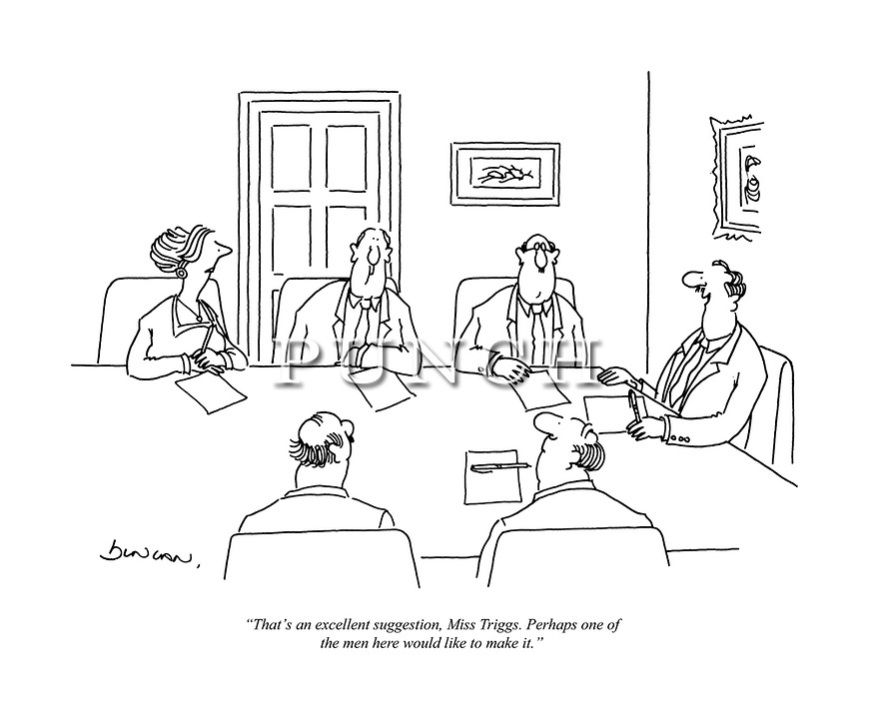
office-sexism-women-business-relationships-cartoons-punch-magazine-riana-duncan-1988-01-08-11How many of the pressures experienced by post-graduate and hourly-paid teachers are a facet specifically of gender and how many of wider problems with academic employment structures?  How do we incorporate men, and particularly men in senior positions, into our discussions without constructing them as a potentially alienating other?  How do we, as individuals, effect small changes as individuals without getting overwhelmed by the challenges of effecting wider structural changes, challenges which have the power to undermine our subjective integrity as academic workers?

There are no easy answers, but for two hours two weeks ago a large group of women and men attempted to put some of our ambitions for change into practice, sharing experience and proposing strategies.  And these conversations will continue, through the WGS cluster and other venues, and through future organised events, not least a conference that will take place in March in the School of History at Leeds which will explore care both in history and in the academy.  More details to follow – once my colleagues and I manage to carve out the time to organise the next steps.

Reviewing the Reviewers

So I’ve been pondering a question for the last few days that, hopefully, someone out there may be able to help me with (all comments gratefully accepted).  When submitting a book manuscript for review, is it standard practice to include the names and contact details of people you would think would be suitable referees?  I ask because of three things that happened recently:

  1. I submitted my book proposal to a publisher, including the names of two people whose fields of expertise made them, in my opinion, suitable commentators on the strengths and weaknesses of my work.  I submitted the proposal as PDF files (a habit I developed when, as an independent scholar I did my word processing on Open Office, a format that almost no one else seemed able to work with) and promptly received a request from the editor that I resubmit the proposal with the names of my two suggested readers omitted. Both the readers I suggested were women. (The relevance of this will become clear in a minute.)
  2. I was asked by another publisher to review a book proposal for a book in my field.  The proposal included the names of four suggested reviewers.  None of them was mine, not least because all four suggestions were men.
  3. Suzannah Lipscomb published an article in History Today about sexism in academic history which, among other things, suggests that the process of academic review is inherently gender biased.

All of which has got me wondering about the role of gender in the academic review process.  And here it is important to make the distinction between journal articles, which are double-blind, with neither review nor author knowing the identity of the other, and book manuscript reviewing, where the reviewer remains anonymous, but is informed of the identity of the author, usual to enable them to comment on the author’s suitability to undertake the proposed project (a similar process to that involved in grant proposal reviewing).  Because while, as Lipscomb suggests, the gender of the author may influence considerations where known, the gender of the reviewer seems to me to be an equally valid variable in our understanding of the gender dynamics of the review process.

This is not to suggest that female reviewers are necessarily less likely to have their opinions of a piece of work shaped by sexist assumptions about the author.  We all have implicit biases by the nature of being socially constructed actors, and many of those are gender-related in ways that have the power to make us extremely uncomfortable.  But I do wonder if the view that young female historians are inherently disadvantaged by the review system isn’t making some assumptions of its own about the make up of the community of reviewers – namely that it is a privileged community, so more likely to be older, white and, above all, male.

I’m not sure that this is the case, as demonstrated by both my suggestion of two female readers and the fact that I, as a woman and a subject specialist, was asked to review a proposal over a list of men with higher name recognition.  Subject specialism is the necessary ingredient here, rather than notability within the field, but the other key variable seems to me the willingness of reviewers to actually undertake reviews.  I have absolutely no evidence to assert that women are more likely to agree to act as reviewers – an act of collegiality even in the case of book proposals, which often bring with them a small honorarium in the form of cash or double the value in books from the relevant publisher.  But there is evidence, as noted in the Royal Historical Society report on gender equality, that women tend to be expected to take on roles of pastoral care, mentoring or outreach – in other words roles that enhance collegiality but bring relatively low reward in terms of recognition. My suspicion is that women are more likely to agree to act as reviewers than men, particular in circumstances where they will receive little or no recognition for this role.

As far as I am aware, there is no data available on the gender breakdown of reviewers for either journal articles or book proposals in historical subjects.  It would be fascinating to know this information, although the nature of anonymous review means that it would take considerable input from journal and commissioning editors to be compile any sort of usable data.  Perhaps there are colleagues in publishing out there who may be able to point me in the right direction?

In the meantime, assuming that the standard for book proposals is for authors to continue making suggestions of appropriate readers, in an attempt to challenge gender bias in the discipline, both implicit and explicit, perhaps it behooves us all to interrogate who we consider appropriate reviewers of our work – and why.

Doing history in public

Last week I met with a woman who wanted to know more about the history of her great-uncle, an ex-serviceman from the First World War who suffered from shell shock. I had an email correspondence about plans for a future workshop on visible and invisible wounds that I might offer to a group of primary school students who I worked with over the summer. I began putting together the PowerPoint presentation for a talk I am giving to a local professional association next week. And I proposed two potential posts for a national research blog on the history of the First World War.

This wasn’t, of course, all I did.  I worked on my current book chapter, met with four postgraduate students to discuss their work, put the finishing touches on the reading list for the seminar on gender and medicine I’m teaching this term and completed two book reviews (one of which the editor kindly complimented as being ‘jargon-free’).  But the work I did that might be classified as engagement or outreach or even, at a pinch, impact (to descend into academic jargon for a moment) seemed particularly pertinent, occurring as it did in the context of the Twitterstorm over Rebecca Rideal’s promotional interview for her new book, 1666: Plague, War and Hellfire.  I have no intention of recapping the  ins and outs of this particular squabble, not least because it showcased an extraordinary level of bad behaviour on all sides of the debate, except to gently point out to my fellow Twitterstorians on all sides of the debate that subtweeting is rude, whatever your level of professional seniority, and that I don’t care how justifiably angry you believe yourself to be, there is no excuse for sexist comments.

In spite of all the unpleasantness, however, there does appear to be a small silver lining appearing in the form of blog posts responding to the issues raised about who is defined as a ‘historian’ and, more specifically, how a ‘public historian’ might be distinguished from an ‘academic historian’. Catherine Fletcher was one of the first off the blocks, arguing that historians who ‘do public history’ are misunderstood by ‘academic historians’ who are defensive about the boundaries of professional definition  and therefore engaging in ‘occupational closure’, to use sociological terminology.  Yesterday, Graham Smith issued a call via the Historians for History blog for historians, ‘irrespective of where they work or what they work on, to collaborate on projects in a spirit of shared authority.’ Doing so, he suggests, would be a step away from internal squabbles over resources in which boundaries of period, approach and discipline are mobilised via exclusionary and demarcatory strategies. (Yes, I have been reading rather a lot of historical sociology as part of that book chapter I am writing.)

At one level, I have no problem with the overarching argument that both Fletcher and Smith are putting forward, namely that those who do history (and can therefore be defined as historians) often practice outside the limits of the formal academy and that it is incumbent upon those working within those limits to engage with those outside them, whether via projects of ‘shared authority’ (which I think refers to what I know as ‘co-produced research’) or via engagement with the media of public dissemination (television, radio, trade publishing, blog posts, podcasts, museum exhibitions). What I do take issue with, however, is the implication of both posts that a) the boundaries between ‘public’ and ‘academic’ history are fixed and impermeable and b) that the fixing of these boundaries has come solely from one side of the discussion.

As far as the first of these implications is concerned, Fletcher’s own positioning of herself as an academic actively engaging in public history (via her role as an AHRC/BBC New Generation Thinker and the publication of a well-received trade history) demonstrates that this is not the case.  Nor is she exceptional, except possibly in the level of her public profile.  Every academic I know engages at some level in communicating their history publicly, whether through publication or presentation.  For most of us that means giving lunchtime talks to thirty-odd pensioners at our local library rather than broadcasting on national radio. It means acting as an uncredited advisor to a local drama group rather than a talking head on a national documentary. It means convincing our publisher to run a paperback edition of our monograph rather than pitching to a literary agent in order to get our research read.  But all of us, as I have argued before, are fundamentally motivated by our desire to communicate our research to others, and many of us are extremely creative in how we do so, well beyond the sometimes rather narrow definitions of what constitutes ‘public history’.

Which brings me to my second point, that the ‘gate-keeping’ of the boundaries of professional definition works both ways.  Not all of us are given access to the audiences provided by schemes such as New Generation Thinkers (a project with a fairly rigorous competitive selection process).  Some of us work in field where the competition in trade titles comes from Jeremy Paxman and Katie Adie (backed by the BBC), making a pitch to an agent that much more complex.  And those who control the channels of public communication at the national level in particular bring their own knowledge and assumptions to the table, shaping their willingness to hear and broadcast potentially challenging ideas (something that has shaped much of the criticism by historians of the national commemorations of the First World War centenary as produced by the Department for Culture, Media and Sport and the BBC).

This is not to suggest that lack of access should be used as an excuse by those within the academy for retreating into an inward-looking discussion, or to express resentment of those who do gain access, which they will have worked hard to achieve, through unfair or unwarranted criticism.  Rather it is a call for two things: firstly, a little more self-awareness by those producing widely distributed forms of public history that they have privileges of their own, some of which may come through leveraging their association with academia but which are not necessarily available to all their colleagues.  A permanent academic position is, as has quite rightly been pointed out, not the be-all and end-all of historical authority; nor is it a position of infinite security and privilege. We need to treat all our colleagues, however they practice their craft, with civility and respect, which includes not throwing unwarranted accusations from either side.

Secondly, this post is a call for a greater acknowledgement of the full range of public history being undertaken by historians across the spectrum, from the HLF-funded co-produced project through artistic collaborations to the Christmas best-seller.  Increasingly this form of historical practice is being expected of academic historians by funding bodies and univesity administrations, in addition to (rather than in place of) depth and breadth of engagement with subject knowledge and methodological practice.  Those of us with academic positions (or aspirations to such) are becoming increasingly adept at code-switching in response to the variety of audiences we address, so having it assumed that our writing will be full of jargon or our public presentations too abstruse simply because we hold or are working towards a higher academic degree is deeply dispiriting (as well as not a little patronising to our intended audiences). We are also, as Fletcher and Smith both beautifully demonstrate, engaging in a huge range of creative public practices, starting from our classrooms, where increasingly ‘public history’ is an academic subject and ‘engagement’ an aim, and encompassing a huge range of creative co-productions, both formal and informal, funded and not.

The Rideal Twitterstorm initially began with a complaint about the lack of acknowledgement for historical work already undertaken.  How we acknowledge such work within the ever-growing sphere of public history in ways that satisfy the demands of a media landscape where novelty is all remains an important discussion.  But if we are to lift the professional barriers that seem only to bring out the worst of history’s insularity, we all need to acknowledge both that a range of practitioners are historians, and a range of practices make up public history.

24th June, 2016

I sit in one of the dives
On Fifty-second Street
Uncertain and afraid
As the clever hopes expire
Of a low dishonest decade:
Waves of anger and fear
Circulate over the bright
And darkened lands of the earth,
Obsessing our private lives;
The unmentionable odour of death
Offends the September night.

Accurate scholarship can
Unearth the whole offence
From Luther until now
That has driven a culture mad,
Find what occurred at Linz,
What huge imago made
A psychopathic god:
I and the public know
What all schoolchildren learn,
Those to whom evil is done
Do evil in return.

Exiled Thucydides knew
All that a speech can say
About Democracy,
And what dictators do,
The elderly rubbish they talk
To an apathetic grave;
Analysed all in his book,
The enlightenment driven away,
The habit-forming pain,
Mismanagement and grief:
We must suffer them all again.

Into this neutral air
Where blind skyscrapers use
Their full height to proclaim
The strength of Collective Man,
Each language pours its vain
Competitive excuse:
But who can live for long
In an euphoric dream;
Out of the mirror they stare,
Imperialism’s face
And the international wrong.

Faces along the bar
Cling to their average day:
The lights must never go out,
The music must always play,
All the conventions conspire
To make this fort assume
The furniture of home;
Lest we should see where we are,
Lost in a haunted wood,
Children afraid of the night
Who have never been happy or good.

The windiest militant trash
Important Persons shout
Is not so crude as our wish:
What mad Nijinsky wrote
About Diaghilev
Is true of the normal heart;
For the error bred in the bone
Of each woman and each man
Craves what it cannot have,
Not universal love
But to be loved alone.

From the conservative dark
Into the ethical life
The dense commuters come,
Repeating their morning vow;
‘I will be true to the wife,
I’ll concentrate more on my work,’
And helpless governors wake
To resume their compulsory game:
Who can release them now,
Who can reach the dead,
Who can speak for the dumb?

All I have is a voice
To undo the folded lie,
The romantic lie in the brain
Of the sensual man-in-the-street
And the lie of Authority
Whose buildings grope the sky:
There is no such thing as the State
And no one exists alone;
Hunger allows no choice
To the citizen or the police;
We must love one another or die.

Defenseless under the night
Our world in stupor lies;
Yet, dotted everywhere,
Ironic points of light
Flash out wherever the Just
Exchange their messages:
May I, composed like them
Of Eros and of dust,
Beleaguered by the same
Negation and despair,
Show an affirming flame.

W.H. Auden, September 1, 1939

Working in Mud Time

I am on strike today.  As a member of the UCU, I am neither manning an open day drop-in session nor attending a classification meeting in an attempt to get across to university management that the gender pay gap in academic salaries (over £7500 at Leeds) and the ever-increasing casualisation of academic labour (51% on temporary contracts at Leeds) are things that really matter and need to be addressed to ensure sustainability of the sector.  To my third-year students, I apologise. You have worked hard and deserve to have your scholarly achievements properly ratified and acknowledged.  But nothing can take away from these achievements and, if we collectively learned anything from studying men and masculinities in Britain in the nineteenth and twentieth centuries, it is that gender hegemonies need to be challenged at all levels.  To prospective students, I am sorry if you feel if you had a wasted journey, but there will still be time for you to judge for yourselves if Leeds is the right place for you to study, knowing that it can only be a better place to do so if those who are teaching you are fairly rewarded for their labour and don’t suffer from the vagaries of job insecurity.

So instead of sitting in foyers and meeting rooms, I am sitting in the garden typing this.  As urged by my union rep, I am staying away from the university, not answering emails, not preparing for next week’s Somme 100 commemoration events, or the talk I am giving in mid-July, or reading applications for the two jobs that I am on the shortlisting panels for.  But on the table beside me is the chapter of my book which I am going to spend the afternoon editing in preparation for sending it to a publisher for consideration.

But surely that is doing academic work, you say.  This book is Research, the result of work done as an employee of the university (and only able to be done because I was a university employee).  If published in good time and of sufficient quality it will be submitted for the REF, by which the university as my employer will be judged.  Working on it today is, must be, strike breaking.

Which is one way of looking at it, but there is, inevitably another perspective.  Because this book as a product of my labour is mine and not my employers, however much my colleagues might have contributed, however important an office and official email were for getting the research done.  All books are, as Matt Houlbrook has noted, co-written or collaborations, but once published this book will be in my name.  It will be my calling card for the rest of my life.  If I leave the university, I will take that credit with me to wherever I go next.  The value of the book as a product accrues to me (and to my putative publisher) not to my employer.

It can be easy to forget this fact under the pressure of meeting deadlines and hitting targets.  It is even easier to forget, in the welter of work created by teaching and public engagement, that writing this book, shaping my original research into a form that communicates both the data and my analysis of it clearly , accurately and engagingly, is what I do best and why I do what I do.  I was able to come back to academia because of good fortune and the support of others, but I chose to come back because  I could not not write history and doing so in an academic setting made the most sense.  While working in publishing I spent large parts of my ‘leisure’ editing a collection of essays, writing articles and finishing my first book.  Writing history wasn’t my job, but it was my work, and it will remain so whatever paid employment I have in the future.

Such a sense of vocation is not uncommon in academia and it is, of course, dangerously exploitable by employers who use can use it to excuse poor rates of pay and exploitative contracts.  Yet just because it can be used this way does not mean it can be denied either.  To fail to acknowledge love of one’s work, to view its value solely as reflected by the pay levels and working conditions it attracts is to cede the value of the labour to the paymaster.

So this afternoon, after months of attempting to fit my writing around all my other work, both paid and unpaid, I will be reclaiming the value of my work not for my employer but for me, because this is who I am and this is what I do.  The same applies to the work of my colleagues; our work has value for the university but also for us and it deserves to be acknowledged as something more than the purely instrumental.  Fair pay and working conditions would be a decent place to start, although only a start.

Serendiptously, I reread Robert Frost’s poem ‘Two Tramps in Mud Time’ this morning (I was sidetracked in my hunt for ‘Mending Walls’ in an attempt to demonstrate the dangers of quoting out of context in political debate).  Frost’s eloquent anthem to the joys of manual labour (and Vermont weather) acknowledges the priority of claims to work for pay over labouring for love but nonetheless concludes:

But yield who will to their separation

My object in living is to unite

My avocation and my vocation

As my two eyes make one in sight.

Only where love and need are one,

And the work is play for mortal stakes,

Is the deed ever really done

For Heaven and the future’s sake.

In giving into the impulse of love on a day when the claims of need are being so strongly asserted, I am seeking, like Frost, not to dismiss the priority of that need but rather to unite with it in hope for a better future.

Conference Report – Resistance to War

Following on (rather belatedly) from my last post, one of the conferences I was only able to attend partially in March was the Resistance to War conference, held in Leeds on 18th-20th March.  In addition to Twitter, an important, and more established, way of keeping up with conferences that one can’t attend in person is via conference reports.  It gives me great pleasure to publish a report of the Resistance to War conference written by Charlotte Tomlinson, a former undergraduate and current MA student in the School of History, University of Leeds, and founder of the HUll Blitz Trail project (which can be followed on Twitter @hullblitztrail).  My thanks to Charlotte for taking the time to write and reflect on what sounds like a fascinating few days.

As the centenary of the First World War has come upon us in the last two years, scholars across fields have turned their attention to the conflict and offered new ways to look at it. As well as encouraging commemoration and highlighting traditional narratives, the anniversary has inspired fresh perspectives and uncovered previously untold (or at least under-told) stories. One such strand of new thought was recently celebrated at the Resistance to War conference, held in Leeds March 18th-20th. It was a truly international event, with speakers visiting from stretches as far as Auckland, and covered an equally diverse scope of subjects relating to resistance to war. Inevitably then, the conference encouraged consideration of a less traditional approach to the First World War. However, as all papers seem to, the event had me thinking more broadly about how we, and I, approach histories of war.

The event began with a series of panels exploring different aspects of war resistance. I decided upon one which explored resistance and gender through the lens of wartime literature in France (Philippa Read), Germany (Corinne Painter) and Britain (Sabine Grimshaw and Sarah Hellawell). After four extremely interesting talks, and a few books added to my ever-growing summer reading list, it was a question on how these works were received at the time that really peaked my interest. Not in the answer, but in that it made me contemplate how we use literature in history more widely. As happens so often lately, I found myself pondering the representation vs reception debate, comparing the cultural and social approaches to sources such as those discussed. While our own readings of literature are insightful, and were hugely fascinating to listen to, the panel left me with more questions about my own research than theirs.

The following day, another question of how we approach history left me a little more excited. In a fascinating talk on two ‘gender dissidents’ of the early twentieth century, Conscientious Objectors and Suffragettes, Lois Bibbings argued for a more complex understanding of how the two groups used gender in their resistance. In doing so, she highlighted how Emmeline Pankhurst’s WSPU used fashion as a method of resistance, how suffragettes ‘consciously played on gender’ by maintaining a prim and proper appearance in order to defend their femininity, and oppose media representations of them as unruly and manly. In a later conversation, we discussed how the loss of control over appearance was also central to the suffragette prison experience. It was encouraging to see how the issue of fashion, so often overlooked as a trivial matter, could be integrated into an analysis of war resistance and I was left feeling quite uplifted about the potential for this research to be taken further in the future.

Another talk inspired a less encouraging but equally interesting reflection, on how collective histories continue to shape how researchers approach resistance to war. The huge success of the conference showed how far we have embraced less typically-glorified narratives of the conflict which do not place the volunteer soldier suffering in the trench as the quintessential war narrative. Benjamin Ziemann’s keynote paper, on German soldiers who refused to fight from July 1918 onwards and how these have been remembered in Germany since, did however cause me to consider how we approach war resisters who were not pacifists. Crucially, a point was raised about the likelihood that a similar project would be undertaken on British so-called ‘cowards’. While popular opinions of war resisters has undoubtedly altered in past decades and become more positive, it was rightly argued that our changing cultural memory in Britain of heroic fighters or brave COs has not yet allowed a shift that adequately acknowledges our ‘cowards’ too.

It is hardly surprising that Cyril Pearce’s paper proved thoroughly inspiring. His work continues to influence scholarly thought on conscientious objectors and encourage new work. It was not his insights into war resistance here that had me thinking though, but his approach. In using statistics and maps to explore the pattern of conscientious war resistance in Britain, the paper was undeniably unique in a historical conference. Outside of economic histories, it is perhaps unsettling for many of us to deal with such mathematically presented ideas, but by mapping COs it was easy to highlight resistance hotspots and identify interesting communities that require further study. Ultimately, it was refreshing and inspiring to see an approach many researchers, myself included, would usually shy away from and provided a visual exploration of COs that really brought the issue to life.

Finally, a paper on the infamous Alice Wheeldon left me thinking about the significance of new perspectives on war resistance beyond the weekend conference, and beyond academia. A moving paper was given by Nick Hiley and Wheeldon’s great granddaughter, Chloe Mason on how the conviction of her family for conspiring to murder the then Prime Minister Lloyd George should be overturned. Hiley and Mason unpacked the case and highlighted the secrecy surrounding it, explaining how they are now appealing for the conviction to be quashed. In doing this, rather than reflecting on war resistance as much of the other papers had, the paper reminded us that our memory of war and war resistance remains a contemporary issue that touches lives today.

Driving home after a long couple of days, my (non-academic) dad asked me, ‘so what’s the point in a conference?’ What followed was a lengthy answer which I don’t think he was quite expecting. In the first instance, the papers given offered interesting insights into many areas of resistance to the First World War, some related to my own research, some not. But more importantly, the papers, as always, left me with a number of questions and points to reflect upon, a few of which I have briefly discussed here. These relate above all to how both I, and we, approach history. So more than just gaining knowledge and enjoying papers from across the globe in a celebration of centenary research, I left the conference with a greater self-awareness of myself as a researcher. Once again I was reminded that no matter the topic, there is always something to be learned in hearing about another’s work.

Doing history across space

This forms the third of a three-part series of posts reflecting on conferences I am have attended in recent months.  The previous posts in this series can be found here and here.

I am writing this on a train on my way to London where, tomorrow, I will attend a workshop before meeting with a potential collaborator.  I have done this journey in one day, getting up to catch the 6 am train and arriving home, bone weary at some time after the rest of my family is in bed.  The second half of the programme will remain the same this trip, but I am taking advantage of having the opportunity to stay with my cousin overnight, which should mean I get at least an hour’s more sleep (although possibly not more, given that she lives in Dulwich and I need to be in central London by 9).

Although this trip feels as if I have found the right balance between productivity and calm, it is nonetheless undertaken with a bit of regret.  In an ideal world, I would have been on this train two days ago, preparing to spend yesterday at a study day on First World War nursing held at the Wellcome Collection. The demands of family life meant, however, that I instead had to follow what looked like a fascinating series of talks, delivered by a number of colleagues whom I hold in very high regard via Twitter.

The dilemmas that this weekend has presented me with are something of a distillation of my experiences of travelling for work and conference attendance over the past few months.  In both February and March I dedicated a week to traveling to conferences, attending two or three within a seven-day period, a schedule which while exciting and often inspiring, was also exhausting and occasionally confusing.  While staying within Britain, I moved intellectually around contintal Europe and the British empire, as well as travelling from the seventeenth to the 21st centuries.

And even as I did all of this, absorbing and communicating information and ideas, I was still missing out. I did not go to Valencia, where what felt like the entirety of my Twitter feed spent a sun-drenched week at the European Social Science History Conference, nor, for the second year running, did I make is to the Social History Society Conference the wee before.  The latter took place at the same time as other conferences I had committed to; the former during a week when my young children desperately needed me around to remind them that they have a mother as well as a father to care for them and help structure their lives.

Such conflicts are, of course, an embarrassment of riches.  It is exciting to have so many possibilities for intellectual contact and cross-fertilisation available.  But there are drawbacks too.  Modern technologies, particularly Twitter and podcasting, mean that conference papers can be communicated and followed from a distance, but this is reliant on the good will, dedication and skill of presenters and live tweeters whose interests and priorities may or may not overlap with your own. In addition, following a Twitter hashtag or a podcast requires a certain amount of time and concentration on the part of both  the reader/listener and the communicator.  Trying to follow one conference while attending another, I have found, is incredibly difficult, while if I am live tweeting a panel, I have given up on taking my own notes, relying on my tweets as a form of note-taking.  Also tough is trying to follow a conference while getting a four-year-old’s lunch.  And ‘attending’ a conference at a distance does not allow for discussion, whether the back-and-forth of a question and answer session or the potential serendipities of coffee and lunch break discussions.  This last point was brought home to me when a live tweeter pointed out to his followers that he coudn’t actually put any of their questions to the panellists.

Then there is the question of cost.  I am in the fortunate position of being able to pay for conference attendance out of my current grant, but even that is not limitless, any more than the departmental budgets available to colleagues are.  For students and early careers researchers, the situation is even more parlous. Even when organisers try their hardest to keep registration costs reasonable (and not all do), travel and accommodation costs can make attendance at even one, let alone multiple events impossible.

Despite these problems, the sheer amount of intellectual activity happening around history, particularly the various types of history which I do (First World War, gender, social, cultural, British), is, as I say, immensely exciting and stimulating.  Which brings me to one of those conferences that I did manage to jam into my week of March madness, the Globalising and Localisng the Great War Graduate Conference on Stories, Spaces & Societies in Oxford. (I also attended the final day of the Resistance to War 1914-1924 conference in Leeds that weekend. A report on second day of that conference will be posted next week.) The scope for this conference, as the title indicates, was immense, and in terms of approach the two days covered military, social and cultural history in a truly interdisciplinary fashion.  Casualty statistics were deployed alongside diary entries and poetry, and discussion was enlightening and enlivening.  For my own part, I came away with a number of nascent ideas, two concrete references to follow up on, and the hope of recruiting another member to my research team at some point in the future.

One of the most interesting sessions was the roundtable discussion which concluded the first day during which current Oxford postgraduates reflected on their explicitly transnational approaches to researching the First World War, before discussion broadened out to a wider discussion of the transnational history of the war in the centenary period.  What struck me was the extent to which definitions of the transnational were defined, in the British context, by the British empire and dominions.  While the subjects of historical study were extra-European, the identity of historical actors from India, Africa, Canada, Australia, was inevitably intimately bound up with their understandings of themselves as imperial subjects, so that studies of these varying cultures and their participation in and memory of the war remain rooted in British history in complicated ways. This paradox was further reflected in the wider discussion, particularly Jane Potter’s point about the difficulties of editing a scholarly handbook of First World War poetry.  With all the good will in the world towards including as many national and supranational cultural perspectives as possibles, the limits of space, expertise and time, as well as the complexities of intellectual debate around definitions, inevitably mean that ambitions for comprehensiveness have to be reigned in, usually at the cost of the lesser known national literatures.

What the discussion highlighted for me is the extent to which we remain bounded by space in our work, whether analytically or physically.  Transnational history is shaped by historically constituted definitions of the nation, itself defined by borders both concrete and ephemeral. Location shapes our perspective, what archives we have access to, which scholars we encounter who influence our own scholarship, who we talk to and in what language.  Collaboration is, of course, a route to transcending boundaries, which are in turn enabled and enhanced by modern technologies.  But, as with conference attendance (that prime space for the development of collaborations), modern technologies cannot overcome every barrier or make space immaterial to the way in which we work.  As frustrating as the limits of space (and the inability to be in two places at once) may be, reflecting on them may, in a small way, help us in our understanding of the significance of space and its limits in the past.

Doing history across time

This post forms the second of three related posts on questions about historical methodologies arising from conferences I have recently attended.  The first of these can be found here.

I hadn’t intended to start this post this way.  This was (and eventually will be) a reflection on the Passions of War workshops I attended in February.  But, in a lovely example of the utility of blogging to academic practice, my previous post on interdisciplinarity has sparked a fascinating and detailed response from Jeanne de Montbaston, making the case for the value of reading sexual subtexts in historic literature from a contemporary perspective.  And it is a strong case (although I’m afraid Dr Allen and I are going to have to agree to disagree about finding Sir Impey a convincing object of Wimsey’s desire).  Reading ‘against the grain’ in this way can be an intellectually valid, not to say illuminating, exercise when done rigorously [1] and with the awareness that such readings tell us as much if not more about the reader and their cultural context than about the text itself.

What concerns me about such readings is not that they are amateur or uninformed but that their perfectly defined ’21st-century strobe lighting’, while illuminating particular facets of the text will, in turn, obscure others. Because I worry that in defining Peter Wimsey as bisexual we run the risk of losing the full historical complexity of same-sex desires and relationships in late nineteenth and early twentieth century Britain, complexity which historian such as John Tosh, Joanna Bourke and, most recently, Helen Smith have all addressed. [2]  The contemporary category of bisexuality appears to me (and I am very willing to be corrected on this) to limit rather than expand our perceptions of relationships, both physical and emotional, that were, in reality fluid and multi-faceted.  Tosh might argue that ‘Emotionally intense and physically demonstrative friendship between men was not new [to the Victorian era] – in fact in most historical periods it has been taken for granted.’ [3]  He goes on, however, to discuss the historical contingency of interpretations of such friendships in the late nineteenth century, a historical contingency which surely equally effects our own more legally tolerant age.

Which brings me, in a rather roundabout way, to the original point of this post, the consideration of the problems, as well as the benefits, of doing gender history across time.  This was sparked, as I say, by discussions at the Passions of War workshops held at the University of Leicester on 19th-20th February this year.  Part of an on-going series of AHRC-funded workshops, the Passions of War network is interdisciplinary, including scholars of literature, history, sociology and political science, and international, being organised by the University of Leicester, Ghent University, Dr. Guislain Museum and the National Army Museum, as well spanning a time frame from the 17th to the 21st centuries.

I have written previously about how inspiring the diversity of this workshop series has been to me.  My primary reflection on this occasion, however, was the ways in which scholars of a range of historical periods spoke to and with each other.  On several occasions I found myself mentioning the women, gender and sexuality reading group run by two enterprising postgraduates here at Leeds which deliberately selects an article by a medievalist and one by a modern historian for discussion at each session.  Just as at Leicester, where the panel on ‘Tender Encounters’ during the Napoleonic, American Civil and Crimean Wars had me revising and reevaluating my arguments about medical intimacy in the First World War, these groups have been illuminating for the historical continuities in understandings of gender they have uncovered. And yet, that question of historical contingency and specificity haunted our discussions as well.  As Rachel Bates demonstrated, our readings of Victorian images of wounded servicemen need to made in light of our knowledge of technological limitations and the social import of the fact that they were made for Queen Victoria’s private collection.  Their fundamental differences from, say, newspaper photographs of cheerful First World War limbless soldiers may tell us as much about their significance as their superficial similarities.

How, then, do we do history effectively across time?  Can we make comparisons between a medieval world shaped by religious and social understandings of sex, gender and the body which may see alien to us, and a Victorian world in which some forms of (particularly female) sexuality and bodily experience were so taboo that they could not be spoken of openly?  Is it simply a matter of applying similar tools of analysis across periods to uncover or fill in the archival silences? Or are there wider experiential truths which transcend our contemporary attempts at periodisation? How do we balance the insight that the probing if narrow brilliance of the strobe of light of contemporary perspective with the the wider, more shadowy world uncovered by historical context?

When people ask me what I do professionally, I tend to provide an answer that defines my work periodically – I am a First World War historian.  And yet, the joy of attending workshops like the Passions of War, of participating in the women, gender and sexuality reading group, of engaging with those such as Jeanne de Montbaston who are grappling with related questions in provocative and interesting ways, is the realization that the questions I am dealing with cannot and must not be confined by period.  As John Arnold and Sean Brady argued in their defense of long durée histories of masculinity, we need to ‘look beyond the confines of historical periodization, context, evidence and discipline, to provide new insights and challenges in questions of the relational qualities of gender’. [4] Doing so is not always comfortable or easy, but it can be immensely stimulating.  I look forward to more such discussions, on line, in reading groups and in the final Passions of War workshop, due to take place in September.

[1] On this point I will continue quibbling about Sir Impey’s flushed face which, in my copy of the novel occurs a page before Wimsey enters the witness box and three pages before his poetic mockery of ‘Biggy and Wiggy’.  The text itself, rather than a literal reading of it, would seem to preclude association, innuendo-laden or otherwise, between the two instances.

[2] John Tosh, A Man’s Place: Masculinity and the Middle-Class Home in Victorian England (New Haven: Yale University Press, 1999), 185; Joanna Bourke, Dismembering the Male: Men’s Bodies, Britain and the Great War (London: Reaktion, 1996), Chapter 3; Helen Smith, Masculinity, Class and Same-Sex Desire in Industrial England, 1895-1957 (Basingstoke: Palgrave Macmillan, 2015).

[3] Tosh, A Man’s Place, 185.

[4] John H. Arnold and Sean Brady, ‘Introduction’ in John H. Arnold and Sean Brady (eds.), What is Masculinity: Historical Dynamics from Antiquity to the Contemporary World (Basingstoke: Palgrave Macmillan, 2011), 14.

An importunate post

A little unusually, I am writing this post not as a wife, mother or historian, but rather as a daughter.

Last year I wrote a post about the medical issues facing members of my family in which I did not identify the actual people involved or their relationship to me.  Since then, things have moved on and I now feel it is right to make public the fact that two of the three people mentioned in that post are, in fact, my parents.  My father suffers from Frontotemporal Dementia (FTD), with a number of related and exacerbated physical conditions.  My mother recently found out that the ampullary cancer for which she received treatment for most of last year has returned to her lungs.  These illnesses are very different but share two similarities: 1) they are rare (in my mother’s case extremely rare) forms of wider conditions (dementia and cancer respectively and 2) while they can be controlled to a greater or lesser extent, neither is now curable.

So why go public now?  Because in this post I am asking for your help.  In this difficult period, where these illnesses, and my distance from my parents who both live in the US, have added to a number of other stresses affecting my life, one of the few things that have kept me sane is running.  I started running seriously two years ago.  Last year I ran the Leeds 10k to prove to myself that I could do it.  This year I am running the Leeds Half Marathon in aid of Cancer Research UK and Alzheimer’s Research UK.  While there is nothing that can be done at this stage to cure either of my parents, I hope the money I raise for research will, in some small way, contribute to better understanding and treatments to alleviate these devastating conditions.  Turning the relative calm I have found in my morning runs to practical purpose is the very least I can do in the circumstances.

I know we all have many claims on our purses, and many calls from charities for support.  If you can spare even a very little to support my fundraising efforts by clicking on the link below, I will be enormously grateful.

Thank you.

JESSICA DAWS’S FUNDRAISING PAGE