What counted as knowledge before the First World War?

One of the questions that has been raised during the massive open on-line course (MOOC) on World War I: Changing Faces of Heroism that I am teaching on is the extent to which working class men would have had knowledge of ideas of classical heroism in the years before the war.  A second-year PhD student here at the University of Leeds, Claire Martin, is working on the subject of the circulation of medical knowledge among working-class women in Yorkshire in this period. While not directly related to the First World War, Claire has kindly agreed to write a summary of some of the relevant historical discussions relating to the subject  of class and education, demonstrating just how complex and important questions of class, culture and education are to our understanding of the era.

If you ever read autobiographies and oral interviews of British working-class people who lived in the late nineteenth and early twentieth centuries, you might notice a somewhat unsettling recurring feature. Systematically, the authors or respondents insist on the ordinariness of their lives and experiences, as they are being recorded. They are telling you that their stories are not remarkable, that they are not important. They are surprised that anyone would be interested in them. Interestingly, you don’t tend to find such disclaimers in autobiographies left by their contemporaries of the upper classes. There the authors seem on the contrary quite confident in asserting who they are, and what they did. (Gagnier, 1991: p.13) When you compare the two, it feels as if at that time your social status determined whether or not your story was worth being told, or indeed whether or not you could claim to have a story to tell at all. As I was reading these stories, it became clear to me that class shaped these people’s conception of what and who was important and worth being remembered. In other words, class shaped people’s ideas of what counts as knowledge.

To understand this, we need to look at the cultural context of Britain at that time. The second half of the nineteenth century was marked by a cultural revolution, inspired by the ideals of the enlightenment, and which promoted individualism. Free public libraries were opened throughout the country in an attempt to make knowledge accessible to all. In parallel, changes in education legislation meant that, by the 1870s, most people in the country were literate. The idea behind all this was to enable anyone, regardless of their background, to develop independent judgement. This was also a way to include people who had long been excluded from the traditional intellectual life by simultaneously enabling them to acquire knowledge and telling them that their stories and experience qualified as objects of knowledge too. (Joyce, 1999: p.39) Wonderful as it sounds on paper, however, the reality was quite different. The importance of education for all was increasingly recognised and access to it was certainly made easier, but working-class knowledge and experience were not so readily validated by contemporaries of the upper classes. During that period, the working classes remained the object of much contempt, more often than not described as a mass of uncultured, vulgar people by middle-class observers. They were not expected to think much or know their classics, if you will. The truth is, of course they did, but middle-class people would not recognise the validity of their cultural practices.

One of the main reasons for this was because working-class culture was based on practices which were fundamentally at odds with middle-class ideology. There was a real cultural clash, a collision between two completely different approaches to knowledge and its transmission. In working-class communities, knowledge was traditionally transmitted orally: working-class people were culturally used to asking their relatives and peers for answers to their questions rather than to open a book. (Rose, 2001: p.220) Besides, knowledge was seen as something to be shared with the community, and not selfishly kept or pursued for one’s own interest. In opposition to this, people from the upper classes relied essentially on writings and academic accreditation, and completely dismissed informal practices and oral tradition. So on the one hand you had intellectual practices based on long-lasting traditions of orality and mutuality, and on the other hand an equally deep-rooted culture dominated by writings and individualism. British intellectual life at that time was suffused with middle-class values, and the imposition of this cultural model was institutionalised: schools for instance promoted competition, and individual learning and achievement. What counted as knowledge was entirely defined by bourgeois ideology, and working-class knowledge and cultural practices were dismissed.

It would be wrong – and incredibly condescending – to think that working-class people did not engage with classical culture at all, and that their knowledge was essentially trade-specific or practical. Working-class culture was extremely diverse, both in terms of content and practices. Education was very much a collective activity, which happened in everyday informal settings, in a fairly unstructured way. We know that working-class girls for instance disliked being taught domestic science at school, and preferred learning directly from their mothers or other female relatives instead. (Roberts, 1984: pp.30-34) In his autobiography, Arthur Gill, the son of a Leeds shoe repairer, recalls the daily political debates between customers in his father’s shop. (Gill, 1969: pp.144-46) Most people read the newspapers, and discussed the news at work. People might not have had the means to buy or possess books of their own, but they would borrow them, club together to buy copies, or listen to public readings. In fact, reading aloud was a widespread practice, and for long a prime form of working-class education: people would read aloud in their homes, and listen to public readings on the street, in the pub, in various clubs, or in factories. (Rose, 2001: p.58)

In his extensive study of British working-class intellectual life at that period, Jonathan Rose provides a fascinating account of working-class attitudes to knowledge and its transmission, and calls our attention to mutual improvement societies. In the second half of the nineteenth century, working-class people founded a number of cooperative education groups and mutual improvement societies based on their own cultural traditions. People would meet in various interest clubs, Sunday schools, and friendly societies, to listen to papers and debate ideas on a variety of topics – from politics to economics, literature, religion, history, or philosophy. (Rose, 2001: p.58) Cooperative education represented an alternative to dominant cultural practices and their middle-class bias. There was no hierarchy for instance, as you would find in a school with the teacher being the one who knows and speaks: everyone was on an equal footing. (Well, men were, that is – but that’s another story…) Considering that these people, owing to their social status, knew from experience the fundamentally oppressive nature of all hierarchies, this is hardly surprising.

In fact, working-class self-education was a form of cultural class struggle, based on the idea that knowledge is power – an attractive prospect for people who had long been denied both. Not everyone embraced this pursuit of knowledge though, and some working-class people resented what they saw as an accommodation to middle-class ideology. One example that illustrates very well how these tensions could translate in practice is that of working-class students who performed well at school and secure scholarships to go to university. These students ended up in a very awkward position, simultaneously ostracised both by their own community, who were suspicious of their selfish (because non collective) learning, and by a system that denied the validity of their experience and that functioned on values diametrically opposed to their own. (Rose, 2001: p.88)

What this means for the social historian or indeed anyone interested in working-class culture at that time, is that we need to look beyond classical and institutional knowledge alone, and to be aware of the erasure of working-class knowledge and experience by bourgeois practices and ideology. Contemporary social commentaries will tell you what middle-class observers thought of working-class people. School curriculums will tell you what kind of knowledge was deemed important according to middle-class ideology. What working-class people knew or enjoyed, what they read, what they discussed, how they acquired and engaged with knowledge – all this is absent from such records; and just as working-class knowledge and cultural practices are dismissed, so too are working-class people. Good thing some of them decided to record their own stories and experiences, unremarkable as they thought they were.

References:

Gagnier, Regenia, Subjectivities: a History of Self-Representation in Britain, 1832-1920 (Oxford: Oxford University Press, 1991)

Gill, Arthur, I remember! Reminiscences of a Cobbler’s Son (1969), Burnett Archive of Working-Class Autobiographies, Brunel University Library

Joyce, Patrick, “The Politics of the Liberal Archive”, History of the Human Sciences, 12 (2) (1999), pp.35-49

Roberts, Elizabeth, A Woman’s Place: An Oral History of Working-Class Women, 1890-1940 (Oxford: Blackwell, 1984)

Rose, Jonathan, The Intellectual Life of the British Working Classes (New Haven: Yale University Press, 2001)


Images of Heroism

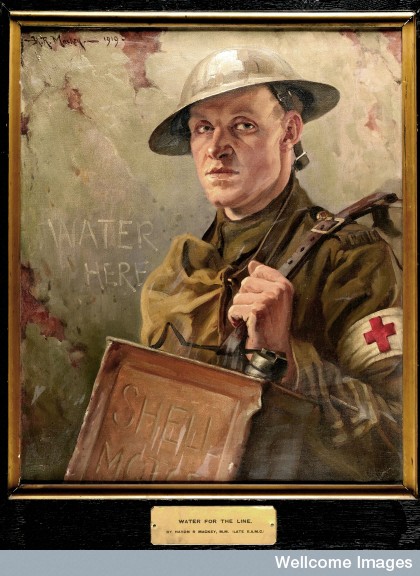
An image of an RAMC serviceman carrying water. This painting forms part of the small exhibition of images I have collated for the MOOC World War I: Changing Faces of Heroism which I am teaching on at the moment. If you would like to know more, please join the course at https://www.futurelearn.com/courses/ww1-heroism.

L0034643 World War I: an R.A.M.C. bearer supplying water to theHaydn Reynolds Mackey,

‘An R.A.M.C. bearer supplying water to the front line’, 1919

Wellcome Library, London

We interrupt this programme…

Before I start, please may I assure regular followers (hi, Mum!) that I am contemplating a post on the new seasons of Downton Abbey and Peaky Blinders and what they have to tell us about bereavement, survival and disability in the wake of the First World War.  In the meantime,  however, I will be spending the next three weeks teaching on this:

WW1_4words


Changing Face of Heroism


If you haven’t already signed up, please do so.  If you have, please let anyone you think might be interested know about it.  It is completely free to register and join and you can take the course entirely at a pace that suits you.

As part of this course, our wonderful learning mentors, Chris Phillips and Philippa Read, will, I hope, be writing guest posts for this blog on aspects of heroism relating to their research, respectively wartime transport logistics (trains and canals) and classical references in French wartime culture and memory.  This is a new approach on the part of this blog, but one that I hope will lead to contributions by other students and colleagues who work in fields related to my research.  I hope you will make them all welcome.

And a final piece of publicity. The Legacies of War seminar series got off to a strong start in its third year with an excellent paper from Professor Roy MacLeod on ‘The Scientists Go To War’.  Our next meeting takes place on Thursday, 30th October at 5:15 in the Grant Room (Michael Sadler 3.11) at the University of Leeds when Dr Richard Smith (Goldsmiths) will be speaking on ‘Recovering West Indian Memories of the First World War’. Full details can be found here.  Please do join us if you are able to. All are welcome.

On being a woman and a war historian

This one has been a long time coming. I began writing it back in March, in response to the BBC’s multi-platform debate over Niall Ferguson’s The Pity of War. I had been invited to take part, rather late in the day, but was unable to go as I had to prepare for my son’s fifth birthday party the following day. But, in between icing a castle cake and preparing knightly party bags, I tried to follow the Twitter discussion. I didn’t manage to engage with all, or indeed a great amount of it, but one thread of commentary did catch my attention. Someone commented on the lack of women on the television panel, starting a discussion which led eventually to the comment that, even if women had been invited to participate in the discussion, they would have been asked to speak about ‘women’s issues’.

This discussion got me thinking about the question of the place of female historians of the First World War in the public commemorations of the war. Because, despite efforts to the contrary (and yes, I have been invited to take place in broadcasts because the producers were looking for a female voice), the impression has certainly been given that female expertise is either to be ignored or to confined to seemingly appropriate ‘women’s’ topics. The most egregious example of this was the throw-away comment made by Kate Adie while publicizing her television programme on women’s roles in the war about the lack of female historians of the war other than Barbara Tuchman. But it was also reflected in the panel assembled for a debate chaired by Nicky Campbell where the only two women were Bonnie Greer (not a historian but clearly brought in to give a non-European and ethnic minority perspective) and Professor Maggie Andrews, brought in to speak about women and the home front.

Kate Adie was, of course, wrong, deeply and profoundly wrong. There are a huge number of superb female historians in Britain and across the world, within the academy and without, researching, writing and teaching about the First World War. Indeed, such is the breadth and depth of expertise that I was able to put together an entire day-and-a-half-long workshop on a relatively niche subject last year with only one male speaker. But Professor Andrews’ presence on The Big Question panel, while it helps to demonstrate the inaccuracy of Adie’s comment, is also misleasding. Yes, women work on nurses (such as Alison Fell, Christine Hallett) and the home front (Karen Hunt, Susan Grayzel). But the leading naval historian of the war of my generation is a woman (Laura Rowe) and there are women working on the memory of the war in Australia (Jenny Macleod), the international history of the war (Heather Jones, Elizabeth Greenhalgh, Margaret Macmillan) and operational history (Aimee Fox-Godden), to name just a very small selection. Outside of the academy, women such as Kate Vigurs and Jo Hook are working as battlefield tour guides, introducing a new generation to the landscape and material culture of the war as effectively as any of their male counterparts.

And what of my own field? Gender history is notoriously female-dominated, unsurprisingly perhaps given its intellectual and political origins in women’s history. It might seem the archetypal ‘women’s’ subject. Yet key theorists and practitioners in the history of masculinity, particularly in relation to the nineteenth and twentieth centuries have often been men. In terms of the first world war, Michael Roper’s work remains a hugely important reference point for my own. Similarly, in social history, Catriona Pennell and Adrian Gregory have both written excellent and important books on British society during the war. The gender of the scholar is beside the point and limiting our reading of a particular approach to one set of voices can only serve to diminish debate and, ultimately understanding.

So dividing facets of the history of the war into men’s and women’s history is a pointless exercise. Both men and women are writing excellent history on all aspects of the war, both those seen as traditionally male spheres and those more often associated with female scholars. Yet the tendency to thinking in this dichotomous way remains. The assumption is that gender brings a particular perspective to understandings of the history of war in particular. All historians bring their own personal history to their research and practice, reflected in the stories of why they became historians in the first place – because they were fascinated by the grandparents’ stories of the past, because they visited a castle and were fascinated by what they saw. What is interesting is the number of stories of male historians which relate to childhood practices of gender construction, more specifically playing war games, of which this blog is only the most recent example in relation to the First World War. Graham Dawson and Dan Todman, for instance, have both written about how their boyhood experiences of the pleasure culture of war shaped their interest and approach to the subject.

Interestingly, I have yet to come across a female historian who has made the same connection to their own upbringing. Certainly, growing up in the United States in the 1980s, in a culture dominated as much by GI Joe as by Barbie, I don’t recall engaging in war games and if I did it wasn’t a spur to my interest in the history of the war. At risk of buying in to gender essentialism, does this matter? Am I less able to fully engage in the history of war because I did not engage with a particular form of gendered acculturation as a child due to being of the other sex? On the surface, the answer to these questions is obviously ‘no’, but I was once told by a former soldier that I couldn’t write about the history of masculinity in war because I wasn’t male and I had never been in the military. While the first point has the merit of being accurate (I am not male), the second seems besides the point. Most male scholars of the First World War today have not been in the military, yet they may be judged as experts in their subject. On the flip side, there also seems to be a powerful cultural assumption that (some) women will have a particular relationship to the history of war through their role as mothers of sons, as illustrated in Lisa Jardine’s recent ‘A Point of View’ essay on BBC Radio 4, a position which sidelines women who aren’t either mothers or who are mothers of daughters (I can think of several examples of both who are very fine historians of the First World War.)

So what does it mean to be a woman and a war historian? The honest answer is I don’t really know. Perhaps I can bring a dispassion to the subject unavailable to scholars whose approach is shaped, however subliminally, by their memories of playing soldiers as children. Or maybe I bring the emotional heft of imagining how I would feel if it were my small son who might one day have to fight. What I do know is that these perspective complement those of colleagues who can imagine that they, or their younger selves, might have been called on to face the guns due to their sex, or who can analyse with greater dispassion the impact that large numbers of grieving mothers might have on society.

As I say, we all bring our own histories, including our subjective constructions of gender, to our historical practice. Which is why it is important not only that we note and acknowledge that women have written and are writing the history of the First World War, but also that we don’t categorise their writing simply as a category of ‘other’. How I embed this in my own practice as a woman writing the history of the First World War is something I am still working on and probably will be for the rest of my professional life. As I say, this post has been a long time in coming.

Remembering Robert Fentiman

I started this month with two frantic weeks of research, paper presentation and working at the Great Yorkshire Show.  By the time the last event, a two-day conference on the emotional history of war at the British Academy, came around, I was exhausted, sick of train travel and worried that my children no longer knew who I was.  I seriously considered giving it a miss; I wasn’t giving a paper and wasn’t sure how emotional history might be significant for my work on RAMC servicemen.

However, I had booked a hotel room and paid for my train ticket, so I packed my bag and headed back to London.  And boy am I glad I went!  Not only was it a conference attended by many of the most notable historians of the cultural history of war (walking into the room where coffee was served felt a bit like seeing large parts of my PhD bibliography made flesh), but it forced me to rethink the nature of my work as a form of emotional history.  In fact, the ideas about emotional labour and the archiving of emotion that I took away from those two days have made me completely rethink the structure of the book proposal I am in the process of writing.

I still have a huge amount of work to do sorting out how my work is located in the history of emotions, but I’ve been thinking about one idea in particular over the past couple of weeks.  During the round table session which closed the conference, one point was made three times, in three different ways, namely how do we, as historians, research and write about emotions that make us feel uncomfortable.  The conference was divided into sessions on love, fear and grief.  None of these are comfortable emotions, of course, and the evoke strong reactions in us as historians and in those who read what we write.  But there are other emotions felt by participants in war that we didn’t discuss directly, skirting around or mentioning only in relation to other emotions: anger, joy, relief, pride, shame.  These are emotions that don’t necessarily fit into the narratives we want to tell ourselves about war.  They highlight the power of war not only to traumatise, creating victims of its participants, but also to brutalise, even dehumanise, the perpetrators of violence.  But they are as important a part of the historical narratives of war as an emotional experience as those easier, possibly more acceptable emotions.

Which brings me to Robert Fentiman.  Robert Fentiman is one of the central characters in Dorothy L. Sayers’s 1928 novel, The Unpleasantness at the Bellona Club. Like his brother, George, another key character, Robert served in the war.  Unlike George, who was gassed and suffers from shell shock throughout the novel, Robert, is described as ‘frightfully hearty – a regular army type.’ [1]  Indeed, he chooses to remain in the army after the war.  Throughout the novel, the differences between himself and his brother are emphasised.  Where George has a fit of hysterics upon the discovery of his grandfather’s corpse, Robert [spoiler alert], laughs with humour when recalling using the two-minute silence to hide the body in order to commit fraud. Neither is a particularly attractive character.  George is depicted as bullying his wife while Robert is described as ‘thick-skinned; the regular unimaginative Briton. I believe Robert would cheerfully go through another five years of war and think it all a very good rag. … I remember Robert, at that ghastly hole at Carency, where the whole ground was rotten with corpses–ugh!–potting those swollen great rats for a penny a time, and laughing at them. Rats. Alive and putrid with what they’d been feeding on. Oh, yes, Robert was thought a damn good soldier.’ [2]

Neither George nor Robert is particularly emblematic of how we like to construct our image of veterans of the First World War today.  As I have argued before, our culture wants to smooth out the image of shell-shock sufferer, to remove the violence and ugliness in order to create the image of a victim we can pity without qualms.  But, even in this bowdlerized form, the shell-shock sufferer retains an important place in our cultural memory, indeed an increasingly important place as the definition of shell shock expands to encompass an increasing number of men.  By comparison, we seem to have little cultural memory of the Robert Fentimans of the war, the men who went through it phlegmatically, found an acceptable niche for themselves in post-war society, and displayed little or no sentiment about publically commemorating the dead, however much they privately honoured their comrades.

Some might argue that such men did not exist, that even if they did appear to display resilience in public, the psychic wounds that war inflicted on them were repressed, to echo down the generations and that, to this extent, all men who had been under a rolling barrage, as Robert Graves and Alan Hodge asserted in 1940, suffered from shell shock. [3] Yet Graves and Hodge go on to assert that what they called shell shock was a temporary condition. The resilient, even thick-skinned war veteran was certainly a common enough cultural figure for Sayers to place him in direct, antithetical comparison to the equally emblematic shell-shock sufferer in a popular novel that sold well in the interwar years.  George and Robert Fentiman are two sides of the same coin, and would almost certainly have been recognised as such at the time, yet today we only remember one of them.

As I say, it is not easy to write about men like Robert Fentiman.  They aren’t particularly likable or sympathetic.  They do not fit into our definitions of heroes.  But these men too fought the war; they too must form part of our history.  The challenge that War: An Emotional History set me was how to write about these men whose emotions I struggle to recognise and respond to in a way that is honest and does them the honour they deserve.  I will be grappling with this over the next couple of months.  If you would like to hear how I get on, I will be giving a lecture on The Fentiman Brothers at War: Shell Shock, Emotional Resilience and the Cultural Memory of the First World War at the Freud Museum in London on 2nd October. Do join me.

[1] Dorothy L. Sayers, The Unpleasantness at the Bellona Club, New English Library Paperback edition (London: Hodder & Stoughton, 2003), 14.

[2] Sayers, 99-100.

[3] Robert Graves and Alan Hodge, The Lond Week-End: A Social History of Great Britain 1918-1939 (New Yorkk: W.W. Norton and Company, 1940), 16.

Letter to an Unknown Soldier

A couple of months ago, I wrote a post about the 1418Now project, Letter to an Unknown Soldier. Since then the project has been running and, as of my writing this, over 15,000 letters have been received, with more than two weeks left to run.  In my previous post, I said I was going to write my own letter.  Here it is.

Dear Bill, or is it David?

It could be either, couldn’t it: ol’ Bill, still and stoical in his endurance of all the laughable horrors that war throws at him; young David, so beautiful in his youth and ‘all the glory of his joy’ and sacrifice. You might be either, or indeed both.

Is that too simplistic, asking you to stand for two figures emblematic in their own right? How can we ask you to embody the experiences of 5 million men, the rich and the poor, the educated and the ignorant, those who served on the front lines and those who worked behind them, those who survived and those who didn’t? As has been pointed out to me, and as I fully acknowledge, speaking of the men of this war only in terms of unity can never be a full reflection of the huge variety of the experiences encompassed by so many men over four and more years of a world war.

And yet… And yet, after a decade and a half reading the words you wrote, in letters, in diaries, in memoirs, some intended for public consumption but most written only for the loving, private eyes of friends and family, your voice speaks to me in tones at once both varied and familiar. Each fragile sheet, telling its unique story, does so in a voice so completely of its time that I could not mistake it for anything else, that I recognise it the moment I see it, scribbled in indelible pencil, poorly typed on flimsy forms, etched in elegant ink penmanship. Its tones, by turns mundane, flippant, horror and grief struck, or simply relieved, groping for words to describe the previously indescribable or relishing the simple pleasures of life as only young men can, has invaded my own, shaping my thinking and my writing as surely as the images described have shaped my understanding of war and how it was experienced.

I do not always like you. You are, inevitably, of your time, with all the attitudes towards women, class, empire that this implies. But for every statement of belief in a eugenicist solution to a predicted post-war crisis or casual patronising of those not of your class, there have been twice as many to remind me of your common humanity, your youth, your idealism, your sensitivities to sight and smell and taste, your artistic impulses, your lust for adventure, for experience, for life. You have made me laugh and made me cry, yes, even in the public space of the archive. You have moved me beyond measure and you continue to do so.

I would like to believe that, after all this time, these 15 years in which you have become my profession as well as my obsession, that I know you. Or at least that I know you better than most. I have read the counter-examples to the clichés, can cite the exceptions to any generalisation about you or your experience, even as I try to pin you down by making generalisations of my own.

Yet that sense of knowledge is as much a myth as any, isn’t it? I can never know you any more than you would understand me and my interest in your story. You remain standing there, aloof and ultimately impenetrable, leaving me, as always, with more questions than answers.

And still I long to know. Who were you? What was it like? How did war shape you and through you the society you left behind or, for the majority of you, in which you had to carry on living? These are the questions that define me as a historian, and my search for the answers, hidden in your millions of words, in those stories that made it home to the attic and the archive, waiting to be uncovered, has helped define me as a person, too. I have been shaped and changed by all that I have read and heard, by all that I now think I know. I hope it is for the better; I believe it cannot be for the worse than I might have become in other circumstances. I may not know you, but you have made me and will continue to do so until the day I stop asking questions. And for that knowledge, for all that you have done for me and continue to do, for all the inspiration you have granted me, the tears you have provoked, the insight into men and mankind that you have provided, for all the lessons you have taught me, I thank you.

Yours, with affection and gratitude,

Jessica Meyer

Enduring War: A review

So I am currently in London, part way through the first of a mad pair of weeks encompassing a meeting, two conferences, a couple of days in the archives and two days with the BBC at the Great Yorkshire Show. To ease myself in, I began Monday morning with a wander around the Enduring War exhibition at the British Library.

This is an ambitious exhibition, given the size of the space it occupies. Divided in to six sections, from the ‘The Call to Arms’ to ‘Grief and Memory’, the exhibition not only tries to tell a complete story of the war, but as a contributing partner in the Europeana 1914-1918 project, attempts to do it from an international perspective. Inevitably, some things are missed, while others are under-analysed. For instance, the caption to one photograph ends with the statement ‘There was an increase in Protestant church attendance in Britain in the first weeks of the war but, for a number of reasons, this was not sustained.’ There is no indication as to possible reasons why church attendance was not sustained, leaving this viewer with a sense of incompleteness.

In fact, the section on ‘Faith Under Fire’ is possibly the least satisfactory of the six. The claim about the prevalence of protective charms and rituals is never really demonstrated, in part because the use of the library’s resources places limits on what is available for display. The original manuscript of Ruper Brooke’s ‘The Soldier’ in the first section is extraordinarily moving, but there is no equivalent of, say, Adolphus, the mascot who has become the face of the Liddle Collection at the University of Leeds. Excellent use is made of posters, particularly in illustrating the Russian perspective, and the use of ANZAC trench journals makes a double point with an elegant lightness of touch. Nonetheless, the material on display does not consistently feel capable of carrying the full breadth of the story that the exhibition is attempting to tell. Indeed, so broad is the narrative that it isn’t always evident what the curators understood by the exhibition’s subtitle, ‘Grief, Grit and Humour’.  All three elements are addressed episodically but don’t really feel as if they are the central thread of a coherent narrative.

Having entered the exhibition from the side, and followed the chronological path to the dead end around a corner in the separate space that houses the section on ‘Grief and Morning’, I ended my visit by deliberately walking back around to look at the audiovisual displays at the front entrance. And here the exhibition managed to produce what was for me its most powerful and moving display through its series of video booths of montages of postcards from the front, the accompanying audio just the messages scrawled on each one. Very simple, yet entirely mesmeric, the displays demonstrate the art of the everyday that, as much as the war poets, artists and musicians whose work is, once again, presented throughout the exhibition, defined the First World War as a profound cultural experience in Britain and across Europe.

‘Men whose minds the dead have ravished’

A new public sculpture was unveiled in Seaham, Co. Durham on 29th May.  Entitled 1101, the piece, by the sculptor Ray Lonsdale, shows a 9.5 foot soldier in First World War uniform sitting at rest and is intended to reflect a moment of contemplation in the immediate aftermath of the conflict.  It is also, apparently, supposed to represent ‘what is now known as Post Traumatic Street Syndrome [sic] (PTSD) which many faced as they returned from the battlefields.’ [1]  Even ignoring the typos, this interpretation worries me for two reasons.

The first has to do with the fact that I don’t think we should retrospectively diagnose soldiers of the First World War with a psychiatric condition which was not fully defined until 1980 and which remains contentious today.  This is not to say that First World War servicemen didn’t suffer from psychological wounds; many most certainly did.  But, as I have explained in more detail here, shell shock (and or indeed hysteria, neurasthenia, disordered action of the heart or any of the other names given to psychological disability during and after the war) is not same thing as PTSD.

Setting the question of labeling aside, however, I still have serious reservations about this work of art as a representation of psychological war disability, whatever name we give it.  It shows the soldier as calm, contemplative, tired perhaps, maybe even sad, but seemingly in control of body and mind. There can be few adjectives further from the experiences of shell-shocked servicemen, as depicted in the literature and art of the time, than ‘calm’, ‘contemplative’ or ‘controlled’.  These were men whose bodies jerked and twitched, who woke screaming from nightmares, who leaped violently at sudden noises, who stuttered, struggled physically to overcome hysterical mutism or groped blindly through hysterical blindness. They had lost control of both mind and body, a condition that was fearful both to experience and behold. These men were not calm or contemplative about their condition.

The pain of psychological wounding comes across viscerally in some of the great literature and art of the period.  Wilfred Owen’s ‘Mental Cases’ is powerfully physical in its description and the disgust and pity it evokes.  The art of Otto Dix is agonizing to look at.

Dix Shell Shock 127-otto-dix-verwundeter-map-der-krieg-jpgThe viewer recoils from the pain and violence of the images.  This is how psychological disability was experienced by many First World War servicemen and those who lived with them – as pain, fear, disgust and violence. To represent the condition through a generic image of a soldier, as something calm and totalizing, runs the risk of whitewashing from history the individual subjective pain suffered by many that made their condition as disabling as any physical wound or amputation.  Too many shell-shocked ex-servicemen suffered stigma and poor treatment throughout their lives.  I would hate to see the very real pain they suffered written out of history because it is too painful for us to contemplate today.

[1] ‘New World War One statue for Seaham seafront’, Sunderland Echo, 22nd May, 2014, http://www.sunderlandecho.com/what-s-on/new-world-war-one-statue-for-seaham-seafront-1-6630051, last accessed 25th June, 2014.

2 for 1

I realise it has been a long time since I have posted anything.  I am still writing a lot – conference papers, a journal article, an introduction and a couple of guest posts on other blogs.  I have just been gifted a bit of time today, so I am hoping there will be a new post later this morning.

In the meantime, in case you missed them, my guest posts on disability and masculinity and the medical evacuation process can be found here and here.

#writing

I haven’t been posting on here recently because I have been doing so much writing.  Quite a bit of it is still in process, but you can read some of it here.  More to come in the near future, I hope.