I have a very bad habit of picking up any novel with a First World War or immediate post-war setting when I come across them in a second-hand book sale. My husband grumbles about my bringing yet more books into the house while, in my heart of hearts, I know that, more likely than not, I will spend most of the time I am reading them getting annoyed by inauthentic, not to say inaccurate, portrayals of the war which rely heavily on clichés. Yet I carry on doing it, in part in forlorn hope that I may encounter an original (and thus enjoyable) new author or series, and in part to remind myself of all the pitfalls to avoid when writing my own war-set fictions.
As painful as most of these are to read, in general I find there is enough to them, in terms of plot, characterisation or, very occasionally, setting, to keep me reading until the final pages. Certainly, I did manage to do this with Carola Dunn’s Die Laughing, in spite of its many short comings, and with Sulari Gentil’s A Few Right Thinking Men, which erred to much towards the thriller side of crime fiction for my taste, as including random fictional press clippings in a way that I found deeply confusing and off-putting. However, this cannot be said for my most recent acquisition, Caroline Dunford’s A Death in the Hospital (2020), which I picked up for 50 p. at our local National Trust property second-hand bookstall and which I abandoned about a quarter of the way through.
I had been vaguely hopeful about this novel, the 15th book in the Euphemia Martin series, which appears to still be going strong, with A Death at Christmas due out this year. After all, the war hospital setting was right up my street in terms of areas of historical interest, although this did risk a more than usual number of snorts at clichés about VADs and misuse of the term ‘field hospital’. What I didn’t expect, however, was a historical setting so inaccurate as to suggest that Dunford is not even familiar with Vera Brittain’s Testament of Youth, let alone any less ubiquitous representation of the British military medical services in the war. It was at the point where a hospital where the central character had gone undercover as a trainee nurse (not, apparently a VAD, although it remained entirely unclear what the character who made this distinction thought a VAD role entailed) was described as the first hospital of its type ‘since the Boer War or possibly the Crimean War’ that I gave up entirely. For the setting to have any meaning or interest, I did need to have evidence of some basic plausibility for the institution that formed that setting, including the awareness that the auxiliary hospital (which I think was what this one was supposed to be) was only one type of medical institution in Britain during the war. As well as the permanent military hospitals which treated the Regular army throughout the second half of the 19th and into the 20th century, at the outbreak of war, military hospitals were rapidly set up across Britain, usually in commandeered institutions. Where country houses were donated, these became auxiliary units, specialising in rehabilitation after initial treatment at a general hospital. The institution in A Death in the Hospital did not seem like any of these.
Which brings me to the second aspect that precluded my enjoyment of this book. In addition to the ahistorical setting, the question of timing made any suspension of disbelief I might have had impossible. The novel is, apparently, set in August 1914. Even if we assume that the book starts at the end of the month, in at most three weeks there has, apparently, been time for some sort of voluntary hospital to be set up and filled with wounded servicemen including at least one volunteer servicemen, although he just may have been a Territorial. It is also strongly implied that the military effort had achieved statis along the Western Front, although this wasn’t the case until the winter of 1914. In other words, the author attempts to invoke the war as historical context through clichés that ignore the somewhat atypical reality of the opening months of the war. This sort of telescoping of events is not just bad writing, it is terrible history.
I do like to think that I have a pretty high tolerance for inauthenticity in genre fiction set in the First World War, of which there is a remarkable amount. Yes, as I say, I do grumble about inappropriate uses of terms like ‘field hospital’ and conscientious objector, or assumptions about the incidence and understanding of executions and shellshock. But while reiterating worn tropes is boring and, for a historian, frustrating, I am aware that I bring a level of specialist knowledge to reading this type of fiction which gives me an unfair perspective. Where there is some evidence of basic historical research, some attempt to get to grips with the historic specificity of the world being depicted, I can usually suspend enough disbelief to at least finish the book. Here there was no evidence of any historicization, with events, ideas and innovations from at least three major conflicts mashed together in an ahistorical mess labelled ‘The First World War’ in a completely implausible time frame. It is the sort of historical fiction that makes me wish there were a way to certify an author’s credentials as a historical research before they are allowed to publish. Indeed, the only excuse for this sort of book, in my view, is the case it makes through absence for history, including that which informs creative products (films, television, art and games as well as literature) as an intellectual discipline that requires skill and rigour, not just a vague idea that the past is another country which might make for a romantic setting.
So A Death in the Hospital will return to the second-hand book sale table via my local charity shop, where I should clearly have left it in the first place.
The culture section of the Saturday edition of a major British newspaper runs a regular column in which celebrities in the arts are asked to identify subjects from their cultural life such as ‘The book I am currently reading’, ‘The instrument I wish I had learnt’ and ‘The last film that made me laugh/cry’. These lists are always fun to play along with but, while my answer to topics such as ‘My favourite piece of music’ has changed over the years, my answer to the regular question ‘The book I wish I had written’ has long remained the same: The Great War and Modern Memory by Paul Fussell.
Celebrity answers to this topic tends to be couched in terms of either a personally inspirational text or a best-seller that made the author a lot of money. In my case, the answer arises from a mixture of both. I first read The Great War and Modern Memory as a freshman, a first year undergraduate in my first semester at university. I thought at the time that I wanted to be an English major. By the end of the year, I knew that I would be a history major. This shift was only in part down to Fussell’s pivotal work of cultural history (Geoffrey Parker’s lecture on the possible role of sunspots in the development of early modern military strategy also had something to do with it), but what the book undoubtedly informed was my commitment to history that took fiction as one of its primary sources. This would shape not only my undergraduate module choices but the topic of my senior essay (an analysis of Ford Madox Ford’s Parade’s End tetralogy and R.H. Mottram’s The Spanish Farm trilogy as representations of the Western Front), but also my master’s and doctoral theses as well as almost every major work I have published since.
Of course, my view of Fussell’s work has evolved since then but that ‘heady mixture of literary criticism and cultural and historical analysis’ [1] remains deeply alluring as a point of reference not necessarily as a cultural history of the First World War, but as a pivotal moment in the cultural turn in First World War studies. As Ian Isherwood and Steven Trout argue in their excellent recent review article, ‘But It Still Goes On: Paul Fussell’s The Great War and Modern Memory at 50’, ‘the book is perhaps best approached as a an experimental study – a hybrid mixture … of literary scholarship, cultural analysis, historical writing, and veiled autobiography.’ [2] This hybridity, if not Fussell’s argument about the centrality of irony to a Modernist paradigm shift in cultural expression, has gone on to inform the approach and ambition of major works in the field, including Samuel Hynes’ A War Imagined (1990) and Jay Winter’s Sites of Memory, Sites of Mourning (1995), as well as many of their students, among whose number I include myself. And, in ‘reigniting a debate from the late 1920s and early 1930s over literary treatments of the Great War and their portrayal of disillusionment supposedly shared by an entire generation’ [3], Fussell helped shape what we now define as the canon of British First World War literature as surely as any writer, publisher or critic of the ‘war books’ boom. We cannot understand not only how we in Britain and the US remember the First World War today, but how it is represented in contemporary cultural forms. Alice Winn’s almost constant references to Robert Graves’ Good-bye To All That in In Memoriam (2023) provides only the most recent testimony to Fussell’s historiographic influence.
It is, as Isherwood and Trout note, the representativeness of the authors selected by Fussell for analysis that lie at the heart of many of the critiques of his approach. Yet representativeness was never really the point: ‘Drawn … to highly literate, middle-class junior officers like himself (albeit members of a different army in a different war), he never intended to write a comprehensive study of British Firs World War literature or, for that matter, an exhaustive treatment of British culture before, during, and after the conflict.’ [4] But that debate, with its echoes of the critiques of Douglas Jerrold and Cyril Falls [5], highlights an issue that those of us who use fictional, semi-fictional and poetic sources in our research and analysis still grapple with today. No cultural history of the war can ever be comprehensive, either in breadth or depth, particularly when the conflict is considered in global rather than national terms. How do we choose which texts to focus on? How do we balance close reading of the symbolism of particular texts with broad claims about the culture in which they were produced and which they sought to shape?
It is here that Isherwood and Trout’s identification of the importance of autobiography to Fussell’s endeavour spoke most strongly to me. Unlike Fussell (or indeed Hynes), I am not trying to use my practice of cultural history to grapple with experiences as a former soldier. I make no claims to, as Fussell did, to sharing a bond of experience with the authors he selected for particular consideration. But I have always been aware of the extent to which my own personal preferences and youthful exposure to particular literary works has shaped the texts I have chosen to focus on (the work of Dorothy L. Sayers being the most obvious example), as well as my vulnerability to the critique levelled by Charles Carrington against Fussell, that the analysis of someone who wasn’t there can never be a true history of the war. Indeed, as a newly minted PhD, I was bluntly told by one ex-serviceman (himself too young to have served in the First World War), that my thesis on representations of wartime masculinities was worthless because I was not a man and had not myself served in the war. (My gender and age clearly trumped my nationality in this instance as my critic chose not to point out the fact that, like Fussell, I am an American.)
So I take comfort from Isherwood and Trout’s argument that ‘Fussell’s status as a cultural outsider … sharpened his insights … and emboldened him to say things that he might not have if he had been British…. [H]is distance from the war’s living memory enabled him to study the “troglodyte world” of the trenches and the mythology it produced with fresh eyes.’ [6] Which is not to say that I necessarily take comfort from the text itself, which remains as challenging and provocative today in many ways as fifty years ago. For me today, the particular challenge of the autobiographical element is the most stimulating as I grapple with the ‘genealogical’ or ‘family history’ turn in social history, as exemplified by the work of Alison Light, Michael Roper and, most recently, Laura King. My family’s history doesn’t fit neatly with the history of the First World War, challenging cultural narratives of the war’s universality. But is this distance a handicap or a benefit? As I grapple with these questions as part of the process of writing my own book, The Great War and Modern Memory will continue to remain as much of an inspiration for my historical practice as it was when I first read it thirty years ago
[1] Ian Isherwood and Steven Trout, ‘But It Still Goes On: Paul Fussell’s The Great War and Modern Memory at 50’, The Journal of Military History, 89 (January 2025): 155-170 (160).
[2] Isherwood and Trout, ‘But It Still Goes On’, 158.
[3] Ibid., 160.
[4] Ibid., 160.
[5] Douglas Jerrold, The Lie About the War: A Note on Some Contemporary War Books (Faber & Faber, 1930); Cyril Falls, War Books: A Critical Guide (Peter Davies, Ltd, 1930)
[6] Isherwood and Trout, ‘But It Still Goes On’, 168
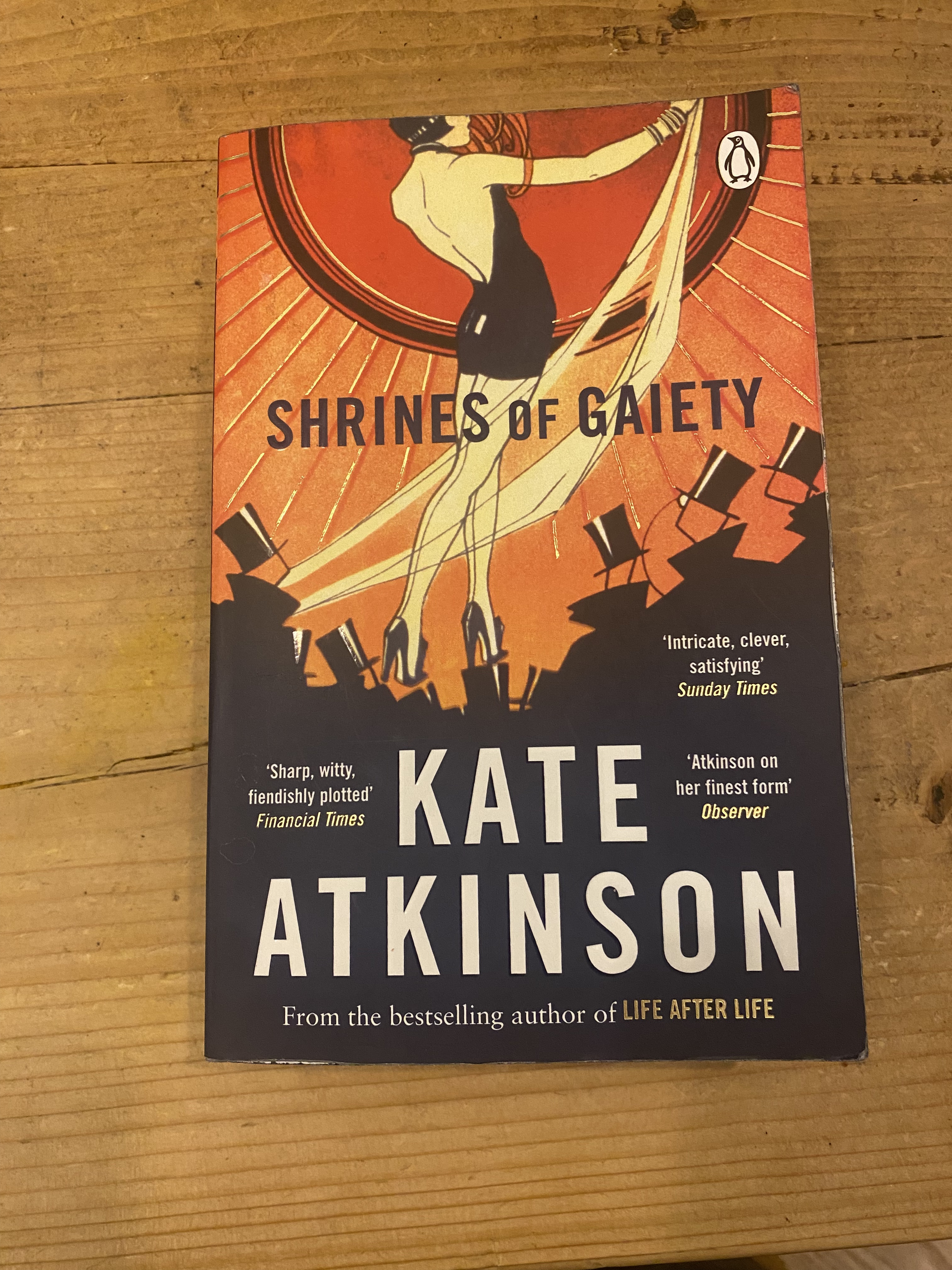
Having swallowed down Human Croquet and Normal Rules Don’t Apply in a gulp, I took a bit more time over Shrines of Gaiety, which is probably a good thing. I enjoyed it – I think it is probably impossible for Atkinson to write a book that I don’t find totally immersive and enjoyable to read – but, in retrospect, I’m not sure it was as entirely wonderful as I had hoped. I don’t really expect anything to live up to the wonder of A God in Ruins, a book which speaks to so much that I love, am interested in and have dedicated my intellectual life to, or Life After Life, a literary and imaginative life raft which I clung to in the days after my mother died. But his is a book that had the potential to speak to me as strongly as either of these, a story of a time and people who are, in part, the subject of the (non-fiction) book I am writing at the moment, as well as being crime fiction-adjacent, touching on another of my great passions.
And there certainly were elements of this book that I loved. Nellie Coker, Gwendolen Keeling and Freda Murgatroyd (what a name!) are all wonderful creations – rich, complex, engaging women whose attitudes and actions I could deplore and root for in equal measure. I also loved the character of Niven Coker, a man shaped but not defined (except perhaps in the eyes of others) by his experiences of war. The ambiguity of the ending of his and Gwendolen’s story, so typical of Atkinson’s play with multiple narratives and possible outcomes, was one of the great pleasures of the novel for me.
And yet… And yet… I did not love this book the way I loved even Transmission, a novel that I know many critics struggled with. The problem for me was two-fold. In the first place, there were too many characters and storylines introduced, with the result that several of the plots and characters felt underdeveloped. Ramsey Coker in particular, who gets a considerable amount of space in the book, never came fully alive for me, and I never truly believed in his (strategically important) relationship with Freda. Similarly, the murdered girls whose disappearance I think is intended to be a central plot device, merged into one in my mind, which was a problem given the centrality of the moral imperative that drives Inspector Frobisher’s desire to name them individually. And to leave one major plot strand (the disappearance of Florence Ingram) entirely unexplained may be considered artistic license. For there to be a second (the murder of Vivian Quinn) feels like authorial carelessness.
Secondly, and relatedly, the book is weakened by the attempt to coral all 73 characters and their interlinking storylines into small a social and geographic space. There are any number of coincidences – Frobisher’s presence on the bridge when Freda goes into the river, Freda and Florence rooming in the house of the abortionist employed by Maddox, Niven Coker passing by when Gwendolen is mugged. One of these would work to help drive the plot but, like the unexplained plot points, their accumulation over the course of the novel feels contrived. The appearance of Gertie Bridges as a deus ex machina and virtual twin of a central character feels particularly in artistic, violating as it does the tenth of Ronald Knox’s commandments of detective fiction for the period. Having invoked Eliot and his unreal city, the imagery of the nameless crowd flowing over London Bridge, undone by death, is undermined by the boundaries these coincidences put in place.
Ultimately, then, this in really a novel about the aftermath and legacy of the First World War as I had hoped. The decadence of the clubland setting, with its corrupt police, violent gangsters and privileged patrons, could belong as easily to the fin de siècle, with Wilde rather than Eliot as muse. The experience of the horrors of war are part but not the entirety of the life the characters, something which does ring true, particularly in the case of Niven, but this raises questions about Atkinson’s stated inspiration for the novel, as discussed in the Author’s Note. Unlike her Second World War novels, which do so brilliantly, this one fails to fully capture the uniqueness of the historical moment of its setting. Possibly this is a specific problem of the interwar period, which does seem to have a certain ubiquity in historical novels, although Sarah Waters undoubtedly managed to capture the unique flavour of changing times and social mores in the period in The Paying Guest.
None of which is to say that I don’t recommend Shrines of Gaiety. Anything by Atkinson is worth reading and Nellie Coker is far too good a character to refuse introduction to. I am very glad I met her, and her elder son. But this novel won’t haunt me the way that A God in Ruins and Behind the Scenes at the Museum do, enriching my life and scholarship in the process. However, this slight disappointment certainly won’t keep me for eagerly anticipating the paperback publication of Death at the Sign of the Rook, Atkinson’s latest (and apparently last) Jackson Brodie detective novel, an homage to Golden Age detective fiction. I live in hope that it manages to capture the feeling of the interwar – this elusive, infuriating, enthralling period that continues to fascinate me as both a historian and reader of fiction. I do so in the certainty that even if it does not, it will still, like Shrines of Gaiety, be a great read.
Last week I attended the Social History Society annual conference, held this year in Essex. It was the first time I attended this conference since 2013, when it was held in Leeds and where I presented my first paper on what would eventually become An Equal Burden. This time, I presented not-quite-the-first paper on what I intend to be my next book, on the social history of demobilization after the First World War in Britain.
It was an enjoyable, if hot and exhausting, few days. The Essex Business School in built on the precepts of a tropical glass house and, despite a torrential downpour which deafened us on the first day, the humidity remained a noticeable factor throughout. And there were a lot of papers to cram in, particularly on the final day when I spent a fair amount of time dashing around the building, trying to hear as much as possible. But it was lovely to catch with old friends and colleagues, some of whom I hadn’t seen in person since well before the pandemic, and hear about exciting new research, particularly from postgraduate research students. Honor Morris and Mandy Barrie, both writing about working-class women’s experiences of feminism at either end of the 20th century, produced engaging and intriguing analyses which makes me excited to read more of their work. Clare Tebbut’s paper on a complicated story of a trans(?) marriage in the interwar years, and Jessamy Carlson’s discussion of child protection in the same period, both chimed with my own work, prompting me to rethink the significance of my arguments about the time frame of developments in the entangled relationships between the domestic and state welfare provision.
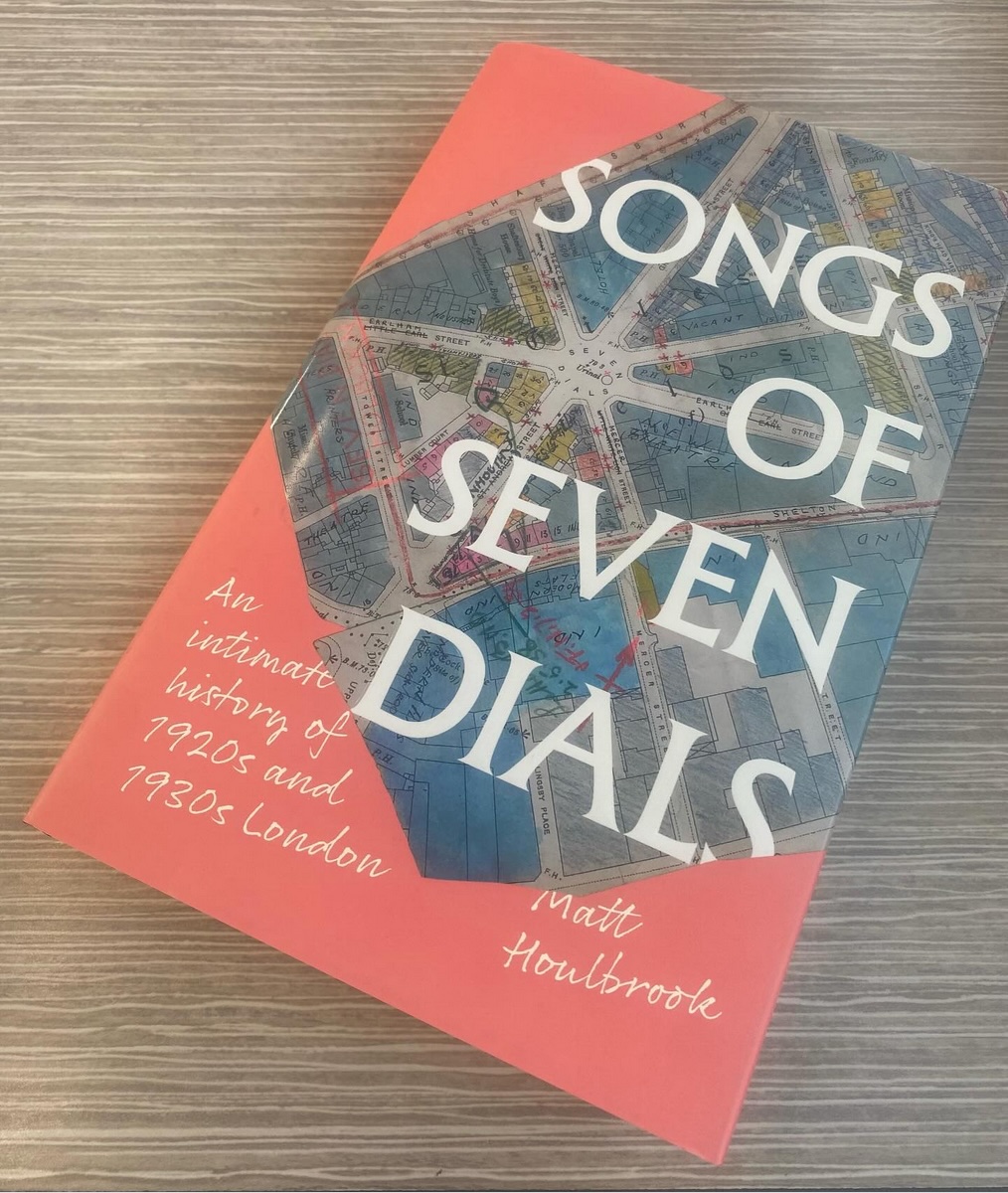
The highlight of the panels I attended, however, was the final session on Friday, when Julia Laite, Cath Feely, Laura King and Lucinda Matthews-Jones discussed their uses of their own family histories in their historical work. Separately, the four papers were fascinating studies in their own right; together, they suggest important new methodologies for those of us who work on histories of emotions, material objects and the everyday. This was, in fact, the second event on the topic that I had attended in as many weeks, following the roundtable discussion hosted by the IHR’s Contemporary British History Seminar, where Julia and Laura spoke alongside Michael Roper and Matt Houlbrook, both of whom have written or are writing histories which included consideration of their own families. That so many important historians in fields related to my own (and who I have had the honour of working with over the years) should be developing practice in this area suggests that this is an approach I need to consider exploring in my own work. Certainly listening to Cath’s discussion of the ways in which her great-grandfather’s death was mythologised through his First World War service, and how the wider historical context and her expertise as a local historian shaped her research into the story, suggested a number of questions about the returning soldier and the legacy of the First World War that I want to pursue further in my own work.
But that work won’t be through my own family history and Friday’s panel, in combination with the IHR seminar, has forced me to think about why not. After all, I have my mother’s archive, including both her own papers and the research she conducted into her parents’ histories in the final years of her life, sitting in my spare room in half a dozen boxes. Why not use them as a springboard for my discussion of 20th century domesticities, or integrate the information they contain into my analysis? No, the connections between my family’s history and the First World War are not obvious, but I am, at least in part, a historian of the everyday in time of war. There may be relevant stories of the quotidian in my own family’s experiences of the war. And, even if there are not, I do not need to be defined solely as a First World War historian for my entire career, even if this is how I predominantly see myself. Indeed, my current project is not about the war itself but about its resonance through the lives of those who lived through it throughout the rest of the 20th century. Surely there will be members of my family whose lives can help me explore the process. If not, there must be other stories they can tell of 20th century British social history, from the intimate variation on the special relationship that was my parents’ marriage to the changing nature of women’s employment across at least two generations. Why should I not think about exploring these?
And yet I still find I cannot. My mother’s archive sits in the spare room unexamined, as it has done for four and half years now. There is always something more urgent to do, either professionally or privately, than opening those boxes and exploring their contents. And the reason for this avoidance is that the emotions that such research would evoke are still too powerful for me face in order to do this work.
In the discussion session following Friday’s panel, Michael Roper asked about the role of grief in the work each of the panelists were undertaking, pointing to the ways in which his own work on his family’s history, incorporated into his new book, Afterlives of War, formed part of the process of grieving for his late father. And maybe someday I will be able to use my mother’s archive to work through my grief over losing her too early at 73. But the primary emotion I feel when contemplating those boxes and the work that they represent, both that done already by my mother and that which I would need to do to integrate them into my historical practice, is fear.
I am still working out what, precisely, I am so frightened of. It has, I am sure, something to do with the anger I still feel about my mother’s death, an anger that swells every time I read of another celebrity dying of pancreatic cancer. But there is also the fact that the history contained in the files is that of my mother as much as that of my more distant ancestors. As I noted in my own question to the panel, none of them were working directly on histories of family members more proximate than grandparents. I asked if they thought too-close generational proximity makes the work of integrating family history and academic history harder. As the discussion touched on, proximity brings into focus the fact that family histories are, in the end, emotional histories and these emotions, as Laura King argued in her paper, are a direct challenge to the idea of the pre-eminence of objectivity in professional historical practice.
I am, among other things, a historian of emotion, something I was reminded of listening to Julie-Marie Strange’s tribute to Joanna Bourke on her retirement earlier this week. I am one of the many heirs and beneficiaries to Joanna’s pioneering work in the field, which has and continues to profoundly shape the questions I ask, the sources I explore, the arguments I make. And I do not merely analyse historical emotions but engage emotionally with the past. I regularly respond to the grief of wartime loss or the anger of injustice in the treatment of the disabled or dispossessed when reading archival sources. But when asked to consider my family history, I do not know how to manage the emotions it makes (or threaten to make) me feel. Even contemplating the boxed archive feels overwhelming and, to protect myself, I continue to turn away.
Citing Richard White’s Remembering Ahanagran, Laura spoke of the cruelty inherent in intimate histories of subjectivity and emotion which rely on the analysis of the stories that individuals tell about themselves. I am all too aware of this, having provoked fury on the part of one descendant of a man whose diaries I quoted in my first book, who felt that my interpretation was an insult to his ancestor. This is also a point that has been made in relation to personal essayists and authors of autofiction, such as Rachel Cusk, who use (exploit, even) their intimate relationships – with parents, with partners, with children – to produce work for publication. This was a discussion that my mother herself was familiar with. Her own writing, principally her MFA dissertation, explored her complex relationship with her father, but was only written after his death. Her diaries, which she asked to be burnt without reading after her own death, almost certainly grappled with her feelings about motherhood, including reflections on her perceptions on her relationships with us, her three children. Telling the stories of interpersonal relationships, whether in the past or the present, has immense power, the power to enlighten, inspire, even comfort, but also the power to disrupt and harm.
So the fear I feel when faced with my mother’s archive is, at least in part, fear of the damage I will do – to myself and to others, not least my two siblings, my children and theirs – by trying to negotiate the boundaries between subjectivity and objectivity that the process of doing family history as an academic historian demands of us. I agree with Laura’s central argument that we need to challenge the reification of objectivity in academic history, and that family history can help us to do this. But, at least for now, I cannot participate to this methodological project through the doing of family history. I can, however, contribute through the process of thinking about and exploring the emotions that prevent me. There is, I believe, a story to tell in not doing family history as well.
The Cornish Coast Murder (British Library Crime Classics)
Spoilers for The Cornish Coast Murder throughout.
One of the things that this extraordinary summer has allowed me to do has been to catch up on reading my way through my shelf of ‘to be read’ books. I don’t mean that the shelf has become emptier; I have been buying nearly as many books as I have read. Nonetheless, I have finally read all but one of the books that were waiting to be read when we moved house two and half years ago. (Wade Davies’ mammoth Into the Silence at over 600 pages is still proving too much of a challenge; I will tackle it eventually.) So last week I finally got around to reading John Bude’s The Cornish Coast Murder, one of several British Library Crime Classics editions that were given to me as a Christmas present several years ago.
The Cornish Coast Murder, first published in 1935, the same year that Dorothy L. Sayers published Gaudy Night, as Martin Edwards points out in his introduction, is very much a standard Golden Age detective novel of the puzzle variety. That is, the focus of the narrative is on the murder plot, with very little in the way of characterization. Indeed, the characters are such archetypes that the key players tend to be referred to as the Inspector, the Vicar or the Doctor (although we are given their names and some physical description). The interest and momentum of the book is generated by uncovering the method of the crime (including possibly the first description of the sort of forensic tracing of bullet trajectory popularised by early series of CSI), with contemplation of motives and morality reduced to an afterthought in the final few chapters. It thus fits well into Alison Light’s description of the interwar whodunit as ‘a literature of convalescence’, ‘as insensible to violence as it could be. … As many critics have noted (usually dismissively) it is the lack of emotional engagement in the detective fiction between the wars which matters.’ [1]
So no, The Cornish Coast Murder is not one of the great novels of the Golden Age. This is no The Nine Tailors (1934), The Beast Must Die (1938)or even And Then There Were None (1939). But it is of particular interest to a social and cultural historian of the First World War with an interest in detective fiction on two counts. Firstly, there are the various suspects and witnesses. Since writing my Phd, half of which looked at the figure of the wartime hero in interwar detective and crime fiction, I have been on the hunt for ex-servicemen, and particularly disabled ex-servicemen, in such fiction. The Cornish Coast Murder stands out for having not just one such character, but four. Two of them are said to be suffering from a psychological wound of war. Three of them are suspects, one a witness and one, ultimately, the murderer. The second, related, aspect of interest is the murder weapon, a service revolver, described in some detail. Indeed, as with ex-service characters, there is not merely one but a second which acts as a significant red herring for much of the novel.
Taken together, these two aspects of the novel mean that there is an awful lot of war and its legacy, for both individuals and society, in this book. This stands in direct contrast to Marzena Sokolowska-Paryz’s assertion that ‘In the interwar period, detective fiction retained its distinctive autonomy as a genre, refusing to embrace the subject matter of the war or its repercussions in the present.’ [2] In making her argument, Sokolowska-Paryz quotes John Scraggs’ assertion that ‘The Golden Age fixation with the upper class, or the upper middle class, is further compounded in British fiction of the period by the fact that the physical and social settings are so isolated from the postwar depression that it is as if the Great War never happened.’ [3]
These are pretty extraordinary assertions. One only has to have even a passing acquaintance with the works of Dorothy L. Sayers to take issue with both of them. The war and its legacy for the present are central to her novels, whether in the form of her shell-shocked ex-service detective (Whose Body? (1923)and passim), plots which turn on the ex-service status of suspects and victims (The Unpleasantness at the Bellona Club (1928), The Nine Tailors (1934)), or passing references to social impacts such as the refugee crisis and ex-service employment or lack thereof (Whose Body?, Clouds of Witness (1926), The Unpleasantness at the Bellona Club, Gaudy Night). Sayers, to be sure, is something of an outlier within the genre, both in the sophistication of her novels as socially reflexive literature and the extent to which the war is referenced throughout, but she is certainly not alone. Examples of war reference can be found in the work of Ngaio March (Enter a Murderer (1935)) and, of course, both Hercule Poirot and Captain Hastings have wartime backgrounds. Like these, what Bude’s plethora of ex-service characters demonstrates is the extent to which the war underpinned everything in interwar society. It did not need to be made the explicit subject of interwar detective fiction (although it could be); its violent legacy, including moral panics over both the brutalisation of ex-servicemen by war service and, conversely, the psychological damage inflicted by war which might lead them to lose control which forms the definition of Ronald Hardy’s shellshock in Bude’s novel, is always there, emerging at various times and in various ways, as it must have done off the page as well as on.
Sokolowska-Paryz and Scraggs’ arguments, and indeed Light’s, can thus be read as an interesting manifestation of the debate about what makes for an ‘authentic’ depiction of the war by post-war fictions. This debate has been going on since at least 1919, and not solely in relation to literary fiction. As Mark Connelly has argued, for the film critic Annie Winifred Ellerman, who wrote under the pseudonym Bryher, ‘realism about the war could mean one thing – only its horrors and miseries. This ideological position then categorically denied that chivalry, honour, or bravery were part of the reality of war. Alternatively, if they were accepted, they were either wasted in such an ignoble pursuit and/or such a tiny component of war as to be irrelevant. In turn, this meant that any depiction that foregrounded these qualities was inherently flawed, and worse still, fundamentally immoral.’ [4] Conversely, Cyril Falls, the literary critic and ex-serviceman, complained in 1959 that ‘The flood of anti-militarist literature, for the greater part fiction, which poured from the presses, deriding the leadership from top to bottom, treating patriotism as a vice when not a fraud, as it was bathed in blood and rolled in mud, was astonishing. It was far from being representative’.[5] While two sides to the debate of what constitutes an ‘authentic’ representation of the war clearly emerged in the interwar period, it is interesting that the Bryher position seems to have come so clearly to dominate contemporary criticism of the detective genre. If it isn’t brutally realist and violent, then it is not, by Sokolowska-Paryz, Scraggs or Light’s argument, a depiction of or reference to the war and its social legacy in Britain. While Sokolowska-Paryz does discuss the more heroic representation of the war in Anne Perry’s Joseph Reavley novels in her analysis of contemporary detective fictions about the war, these form only one of the five series she examines, with all the others adhering to the disillusionment narrative.
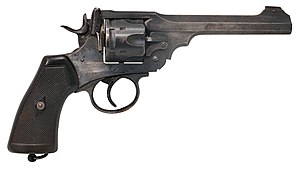
Webley Mk IV Revolver
Which brings us to the second interesting element of The Cornish Coast Murder, namely the service revolver. In Bude’s novel, the revolver (or rather the two revolvers, one belonging to the shell-shocked suspect Ronald Hardy and one belonging to the murderer) is the subject of much discussion and description. Both are Webley .45s, the standard issue service revolver during the war, with the Mark VI replacing the Mark IV and V from 1915. Issued to officers, pipers, range takers, airmen, naval crews, trench raiders, machine-gun teams and tank crews, service revolvers were not carried by every serviceman but nor were they reserved solely for the officer corps. Thus while Hardy’s monogrammed revolver reflects his former rank as a junior officer and his social status as a middle-class author, the murderer, a manual labourer, ‘scrounged [his] in France, before being demobbed in ’19, and several rounds of ammunition.’ [6] One of the suspects, Cowper, the groundsman at Greylings, served as a Lance Corporal in an undisclosed regiment but never handled a revolver during his service.
While two service revolvers in one novel is slightly unusual, these weapons appear with some regularity in interwar detective fiction. Christie, who as a pharmacists during the war, knew more about poisons than guns, tended to label the pistols that appeared in her novels as ‘army service revolvers’. Sayers, meanwhile, has the murdered in The Unpleasantness at the Bellona Club shoot himself in the head. The type of gun used is not specified, but given the setting of a serivemen’s club (and the themes of the war and its legacy which are central to this book in particular), the reader might easily conclude that the weapon was a service revolver.
What is interesting is the extent to which in more contemporary detective fiction with a wartime or interwar setting, the service revolver has, in large part, been displaced by the bayonet as a weapon with wartime associations. [7] On my recent rewatching of Miss Fisher’s Murder Mysteries, for example, I was interested to note that bayonets were used twice, once as a murder weapon in Dead Weight (2013) and once by a disabled ex-serviceman when confronted with evidence of drug theft from a medical clinic in Blood and Money (2015). Sokolowska-Paryz points to the symbolic significance of the bayonet as the murder weapon in Rennie Airth’s Rivers of Darkness (1999), noting that the ‘sexual overtones of the killings is made apparent through the psychoanalytic meaning of the bayonet’ as a substitute penis. [8]
The symbolism of the bayonet, however, goes beyond its Freudian overtones. As Paul Hodges has argued, it was a weapon fetishized during the war and after as one of masculine aggression and face-to-face combat in ways which led to its use in wartime atrocities such as the killing of prisoners of war and the wounded. [9] Used in infantry training to instill aggression in the private soldier, its use as a weapon in modern industrialised warfare was generally perceived by servicemen as futile, a throwback to an earlier age. It is thus the symbolic inverse of the service revolver, a middle-class officer’s weapon associated with duty and honour and fired from a distance. Even when duty leads to violence and the taking of life, there is always an explicable motive, including the defense of the domestic, a common justification for war service. The distance between murder and victim, meanwhile, is particularly emphasized in The Cornish Coast Murder by the fact that the murderer fires from a boat, requiring three widely spaced shots to hit his target. The revolver, therefore, comes closer to wartime artillery as a fatal force, a distanced and almost random form of killing.
The service revolver and the bayonet can thus be read as emblematic of the two interpretations of the war at the heart of the debate over authenticity – the technologically advanced form associated with honourable (or at least explicable) motivations and the middle-class officer corps and the brutal, apparently futile form associated with psychopathy and men damaged physically or psychologically by war. It is interesting to note that there appears to have been a decisive shift from one to the other as the symbolic weapon of the war between detective fictions of the interwar period and those of the past quarter century which have the war as its setting. As I start to think about the wider implications of this shift for understandings of the war and its legacy, I would be interested in hearing about appearances of both weapons in other fictions, both then and now. I promise not to wait as long to read them as I did with The Cornish Coast Murder.
[1] Alison Light, Forever England: Femininity, Literature and Conservatism Between the Wars (London: Routledge, 1991), p.70.
[2] Marzena Sokolowska-Paryz, ‘The Great War in Detective Fiction’ in The Great War: From Memory to History, ed. by Kellen Kurschinski, et. al. (Waterloo, Ontario: Wilfred Laurier University Press, 2015), p.84.
[3] John Scraggs, Crime Fiction (London: Routledge, 2005), p.48.
[4] Mark Connelly, ‘The Battles of Coronel and Falkland Islands (1927) and the Struggle for the Cinematic Image of the Great War’ in The Great War, ed. by Kurschinski, et. al., p. 317.
[5] Cyril Falls, The Great War (New York: Putnam, 1959), p. 421, quoted in Ian Andrew Isherwood, Remembering the Great War: Writing and Publishing the Experiences of World War I (London: Bloomsbury Academic, 2017), p. 160.
[6] John Bude, The Cornish Coast Murder (London: The British Library, 2014; first published London: Skeffington & Son, 1935), p. 275.
[7] By bayonet I mean here the rifle bayonet; interestingly, the Webley Mk VI could be modified to take a small bayonet as well.
[8] Sokolowska-Paryz, ‘The Great War in Detective Fiction’, p. 94.
[9] Paul Hodges, ‘They Don’t Like It Up ‘Em!’: Bayonet fetishization in the British Army during the First World War’, Journal of War & Culture Studies, 1:2 (2008), 123-138, DOI: 10.1386/jwcs.1.2.123_1.
I was in Cambridge on 11th September, 2001, but I went home to New York City for the Christmas holiday that year. My memory of that holiday is dominated two experiences: first seeing the city skyline without the domination of the Twin Towers as the cab drove me from JFK to Manhattan, and sitting for days at a time on the sofa in my father’s tiny apartment on 79th and Broadway reading the obituaries of those who died in the New York Times. Every day the paper included several pages of these, brief biographies, some accompanied by photographs, of the cross-section of New Yorkers and Americans who had lost their lives so inexplicably and suddenly. I found my old babysitter and a girl I had studied history of art there; I was introduced to firemen and cleaners, bankers and parents, real people with real lives cut brutally short.
On Sunday, the New York Times again placed a list of the dead at the heart of its publication, this time a list of those who lost their lives to Covid-19 as the number of pandemic fatalities in the US neared 100,000, over 30 times the number who died on 9/11. This time there was no space for pictures, even the short life stories of the 9/11 obituaries. Instead the front page lists names, ages, place of residence and, for most, a brief phrase describing something which made that person unique. These descriptions range from the banal through the humorous to the startling. They capture working lives, domesticities, private passions. They help to illustrate the claim of the sub-heading that these ‘were not simply names on a list. They were us.’
In all, the front page, and the continuation on page 12, lists 1,000 names, 1% of the marked death toll. It is, for me, as for so many others, profoundly moving in its personalisation of the loss that this pandemic is causing, not just in the US but across the world. But does it, as my cousin, who specialises in the visualisation of enormous numbers, asked, really convey the scale of this loss? Remembering these people as individuals is important, he implied, but in doing we lose a sense of the enormity of what 100,000 deaths really looks like.
The tension that my cousin is flagging here is one that has shaped commemorative practice for over a century, at least in the Anglophone world. While epidemic and pandemic illness have shaped society through extensive and profound loss of life for centuries, the First World War (and the ‘flu pandemic which followed it) brought this tension into focus as concentrated mass death occurred for the first time in a world of the nation state and global communication. Each death in and of itself was a personal tragedy and a loss to a community, but it was also, in the case of the deaths in war service, a death in the service of the state and thus required a more public marking. In Britain, this came in the form of casualty lists, published initially daily in the press, and later, as the numbers grew, weekly. Visually, these lists bear a startling resemblance to the New York Times cover, although they include none of the personalising details, only name, rank and unit of service.
It was after the war, however, that the process of naming the dead as a way of remembering them as individuals rather than as part of a mass truly came into its own in Britain. The decision not to repatriate the dead meant that traditional forms of naming on gravestones were precluded for all who died overseas. The loss of bodies meant that, for many, even a corner of a foreign field was an impossibility. Instead the names themselves became the markers and the memorials, both at home and overseas. It is impossible to travel around Britain without encountering a memorial listing the names of the dead – churches and churchyards, in schools and universities, on railway station concourses and street corners. The pattern is repeated in memorials overseas, most notably Lutyen’s monumental arches at Thiepval, with their overwhelming list of the 73,000 names of the missing of the Somme.
Panel of names, Thiepval Memorial, Thiepval
Thiepval seems, one way, to illustrate the problem of naming as a way of commemorating the enormity of mass death through naming. The scale of the memorial is such that it is impossible to see some of the names in its highest reaches from the ground. The names of the dead on my local village war memorial may mean little to me as an incomer of three years’ standing, but I can still read each and acknowledge them as individuals in a way that the sheer scale of Thiepval precludes. Unlike Maya Lin’s Vietnam Memorial, which most notably took on the tradition of naming as commemorative practice in the US, those visiting Thiepval cannot touch the names, as those visiting Washington often do. Sensory connection, whether of eye or fingertip, seem to be denied. The visitor to Thiepval risks being overwhelmed by the size, the number, the enormity of so many names who cannot be comprehended as individuals.
Blackshaw Head War Memorial
And yet Thiepval remains one of the most profoundly moving memorials to British war losses, inspiration for at least two generations of historians and cultural critics. The invocation of names, with their assertion of an individuality, and individual loss, mirrored in the gravestones of the Commonwealth War Cemeteries across the world, aids our perception of the scale of loss, rather than distracting from it. Smaller local war memorials can have a similar effect, particularly once one is aware of their prevalence. The relentlessness of encounter wherever one travels in Britain serves to bring home the sheer number of dead as profoundly as any weekly gazette of casualties or daily listing of obituaries. The dead are many, but they are not numbers. They are names – of soldiers, students, workers, congregation members, parents, children, siblings. This, then, is the power that the mass listing of names has in commemorative practice, to bridge the gap between the unknown individual and the incomprehensible scale of loss. Names make not just the dead but the meaning of their deaths as one of many known to us. They never were just names on a list, then or now. They were, they are us.
But there is another, more difficult way in which the history of war has echoes in today’s crisis. Because, like so many battlefield casualties, those dying with or of Covid-19 are doing so far from their families. The emotional burden that this fact brings with it is something that the history of both British mourning practices and medical care in the First World War can tell us about.
The Victorian ideal of a ‘good death’ – the individual dying in bed surrounded by their loved ones with time to utter final profound, pious words – was, of course, always a myth. [1] That myth, however, was utterly demolished by carnage of the First World War. Men died in large numbers, far from their families. The technology of war had the power not merely to kill but to destroy, even obliterate bodies. The recording and reporting of deaths in such circumstances meant that official news could take time to reach families, often contained only the barest details and could, in some cases, be inaccurate. The result was the reinforcement of the importance of one mourning practice of the pre-war era, that of writing letters of condolence.
While official notification of death could be brief and brutal, a telegram informing the family that their loved one had been killed in action, died of wounds or was missing, it would almost always be followed, or indeed occasionally preceded, by a letter from a commanding officer. In many cases, this would then be followed by letters from the deceased man’s comrades; in some cases, particularly where a man was missing, presumed dead, extensive correspondences grew up between men’s families and the men of their military unit.
These letters were more detailed than the initial announcement, not only celebrating the character of the man in question, but also telling the story of his death. Depending on how well known the man was to his officer and comrades, these letters could be generic or personal in their description of men as individuals. But the detail they contained acknowledged the importance for families of knowing both that their loved one had been known as an individual and also how he had died. As E. K. Smith’s platoon sergeant wrote to his parents, he was ‘only too tell you what actually happened, & being as you say a parent myself, I know you would like even the smallest details concerning the sad event.’ [2]
The descriptions of the death itself could vary in detail, depending on when and where it happened. A death in the midst of an action could be more difficult to describe than one which occurred on quiet day in the line. Almost all, however, had one thing in common – the depiction of the death as ‘clean’ and usually quick. Gerald Stewart’s parents were reassured, for example, that ‘Your son was killed by a bullet and died without suffering any pain. He was not one whit mutilated, and as I looked down at his face as he lay in the battle field I remarked how bonny he looked.’ [3] W. Lindsey ‘was at the time of being wounded splendidly advanced and skilfully leading his men’ while A. R. William’s ‘died a soldier’s death giving his live saving the lives of his comrades.’ [4] Wartime letters of condolence did not seek to tell the truth of death to families who could not be there when their loved one died. Rather they sought to bring emotional solace by emphasising lack of suffering and even heroism in the face of death. While deaths from coronavirus may not lend themselves as clearly to stories of heroic action, the daily newspaper columns giving brief descriptions of those who died points to the need, both of families and society more broadly, to construct a narrative around individual deaths. The need to articulate death as meaningful only becomes more powerful when it occurs at a distance.
Not all or even most of those who died during the First World War did so on the battlefield, however. The system of medical evacuation, which emphasised clearing the ill and wounded from the field in order to leave it clear for combat, meant that many men died in one of the sites of medical care that made up the chain of evacuation. For men who made it as far back as a base or home hospital, there was the potential for their families to be by their sides. Wealthy families could pay to travel to and stay near where their loved one was hospitalised, even as far as the base ports in France. For the majority of families, such travel was beyond their means; in the case of fatal wounds and illness, grants were made available for families to travel to be with their loved ones at the point of death. The importance of such connections was acknowledged by the British state and society at the time.
However, even where money was available and families were able to travel, only a tiny minority were able to be at there for men dying in hospitals. And for men dying in Casualty Clearing Stations or dressing stations, family visits were never an option. For the vast majority of men dying in sites of care during the war, those by their sides at the end were care providers – nurses, chaplains and medical orderlies. To these men and women fell the task of ensuring not only that the story of a man’s death was told to his family but, even more importantly, that he did not die alone.
The emotional labour that this entailed was immense. George Swindell, a Royal Army Medical Corps stretcher bearer recalled the period he spent seconded to a moribund ward, nursing men whose wounds were too serious to treat alongside a chaplain, as one of the most difficult of his military service. [5] As Alice Kelly has noted in relation to nurses, ‘A large part of the … role was comforter, and all of the nurses’ accounts record the men seeking comfort from the author, both physically and mentally.’ [6] Chaplains, working in religious traditions of death bed visiting and vigil, might have some experience with this form of labour. Nurses and orderlies as a rule did not. Yet throughout the war they acted as bridges between the dying and their families, taking final messages to pass on to loved ones, reassuring the dying that they were cared for and not alone.
If the conditions reported on hospital wards in Spain and Italy are anything to go by, this is a form of labour that hospital staff will increasingly be required perform as part of their care for Covid-19 sufferers. The nature of the illness is such that they must be isolated from their family in extremis, and treated by carers shielded, where available, by extensive personal protective equipment. In such circumstances, where the dying sufferer is isolated, with limited physical contact with other people, the importance of communicating emotion between the sufferer and their loved ones becomes even more important. This will come, as it did for caregivers in the First World War, on top of immense physical strains to simply provide care for all those suffering.
Are there lessons to be learned from this history? Until comparatively recently, the emotional labour of carers was not the subject of much discussion. [7] And, as the late Sir Michael Howard noted, ‘historians may claim to teach lessons …. But “history” as such does not.’ [8] But in acknowledging the significance of the role that care providers, not just doctors and nurses but nursing assistants, orderlies, even cleaning staff, can potentially play in bridging the distance between the dying and those they love and who love them, we can, perhaps, more fully appreciate the care being given not only to the bodies of individual patients but to the psyche of society as a whole.
In 1917, Private W.H. Atkins wrote a poem in praise of the quiet heroism of the men of the Royal Army Medical Corps, including the nursing orderly:
Oh! it’s weary work in the white-washed ward,
Or the blood-stained Hospital base,
To number the kit of the man who was hit
And cover the pale, cold face,
…
To hold the hot hand of the man who talks wild
And blabs of his wife or his kids,
Who dreams he is back in the old home again,
Till the morphia bites, and he loses his pain
As sleep settles down on his lids. [8]
Today, in hospitals up and down the country and across the world, carergivers will be doing similar weary work. It may not earn as much recognition as the physical labour of medical caregiving or the danger that they will be putting themselves in of catching a potentially fatal illness. But this necessary emotional work is heroic nonetheless.
[1] Pat Jalland, Death in the Victorian Family (Oxford: Oxford University Press, 1996); David Cannadine, ‘War and Death, Grief and Mourning in Modern Britain’ in Mirrors of Mortality: Studies in the Social History of Death, ed. Joachim Whaley (London: Europa, 1981), pp.187-242.
[1] G. Gould, letter to Mrs. E. Smith, 24th January, 1916, Letters of E. K. Smith, Documents.2535, Imperial War Museums, London (IWM).
[2] Lt.-Col. S MacDonald, Letter to Mr Stewart, 14th April, 1917, Papers of G. Stewart, Documents.8572, IWM.
[3] W. Gillam, letter to Mr Lindsay, 4th August, 1917, Papers of W Lindsay, Documents.11765, IWM; Lt. Collinson, letter Mr Williams, Papers of A. R. Williams, Documents.4436, IWM.
[4] George Swindell, ‘In Arduis Fidelus: Being the story of 4 ½ years in the Royal Army Medical Corps’. TS memoir, RAMC 421, The Wellcome Library, pp. 118–19.
[5] Alice Kelly, ‘”Can One Grow Used to Death?”: Deathbed Scenes in Great War Nurses’ Narratives’ in The Great War: From Memory to History, eds. Kellen Kurschinski, et. al. (Waterloo, Ontario: Wilfred Laurier University Press, 2015), p.338.
In a Twitter discussion sparked by the BBC’s screening of Peter Jackson’s ‘They Shall Not Grow Old’ in November, Greg Jenner quoted the statistic that nearly 90% of British servicemen returned home and that half of these were injured. The first statistic didn’t worry me. 88% is the generally accepted rate of survival for the conflict, although it appears high in the context of a cultural narrative which emphasises the death and destruction of the war above all else. The second figure, however, was not one I recognised from my research into disable ex-servicemen of the conflict, so I asked Greg where he had got his figures from, as my own estimate is that about 30% of men returned from service did so suffering from illness or injury. What resulted was a conversation that, as I noted at the time, was one I wasn’t in a position to engage in properly, given that I was lying in bed, attempting to tweet on my iPad after a very long day listening to my son sing in choir at a large-scale Remembrance Service. This, then, is my attempt to think through the issues raised by Greg’s tweet, and my querying of it.
To start with the problem, which is that I believe 50% of all men returning from the war as injured to be an overestimate. Greg’s figure, which comes from the Imperial War Museums and has been cited by a number of historians over the years, is based on the official Statistics of the Military Effort of the British Empire During the Great War: 1914-1920. The summary table of the ‘Total per cent of Battle Casualties and Deaths’, which is tabulated by theatre, gives the rate as 5 casualties to every 9 men sent out to France, 2 to every 9 men sent to the Dardanelles, 2 to every 12.5 men sent to Mesopotamia and smaller ratios for other theatres, including Salonika, East Africa, Egypt and Italy. In percentage terms, this works out at 56% for France, 23% for the Dardanelles, 16% for Mesopotamia and smaller percentages for other theatres. The total percentage of casualties across all theatres has not been calculated, although the History of the Great War Based on Official Documents: Medical Services: Casualties and Medical Statistics of the Great War states that ‘the total numbers affected by war service, in the sense of death or some form of war disablement for which State compensation was given, may be estimated at approximately 2,414,000 or 40.2 per cent. of those who served.’[1]
There are some problems with these figures, however. First, figures from the Statistics of the British War Effort include casualties not only from Britain but from the colonies and dominions as well. The statistics cannot, therefore, be considered reliable in discussions of the effect of casualty numbers on British society alone. They force us to think about Britain as a colonial actor in this period, but do make local and regional analyses much harder.
Second, the inclusion deaths in the count of battle casualties makes it much harder to evaluate how many men returned from the war injured or ill. If we could calculate the total percentage of casualties due to death, injury and illness across all theatres, we could subtract the accepted 12% mortality rate that is the generally accepted figure for the British armed forces. But we don’t have that figure. The percentage of battle casualties does distinguish between ‘killed and died’, ‘wounded’ and ‘missing and prisoners’ for each theatre, but specifically excludes casualties due to sickness. The medical services statistics, meanwhile, only counts those in acknowledged as ill or wounded by the Ministry of Pensions, not all those who became casualties during the war.
This raises the question of what is meant by casualty even when deaths are discounted from the numbers. I have focussed on the word injury throughout my discussion so far, reflecting the omission of the sick from the official calculations. But men did not become casualties only through injury, that is damage caused by accident or attack. Many casualties, particularly in the Middle East, were the result of illnesses, including those which could persist long after demobilisation, such as malaria or the rather general ‘debility’, or physical weakness resulting from other illness. [2] Some illnesses, perhaps most notability heart conditions, were the result of aggravation of pre-existing conditions by the experience of war, conditions that had either been missed in hurried medical inspections [3] or had been dismissed as not severe enough to affect a man’s service in light of the ever-increasing military demands for manpower. To say that these men returned from the war suffering from injuries would be inaccurate, yet they undoubtedly returned from the war suffering from physical consequences of their service, whether attributable to or aggravated by it.
Sickness rates are analysed in the official statistics, as part of the wastage rates. Also tabulated under ‘wastage’ are statistics relating to multiple injuries. A single injury does not equate to a single man injured. Because of the military priority for manpower, the work of the medical services aimed at conserving manpower through not only the treatment of wounded men but also their rehabilitation for return to active service where possible. Wounded men were thus often recycled through the military medical system, some multiple times for multiple injuries. This repetition and overlap is at least partially captured in the statistics, but not in a way that makes clear how this affected the headline figure.
Finally, there is the problem of the invisible injury and underdiagnosis in the casualty rates as defined by the official statistics. The most obvious example of this is, of course, psychological traumas which are generally accepted as being underdiagnosed by the British military medical authorities throughout the war, in part due to the social stigma attached to such traumas and in part due to lack of medical understanding of the conditions. (These two things are, of course, related.) It is worth noting, however, that underdiagnosed invisible injury also includes conditions such as hearing loss, where diagnosis had to be based on highly subjective observations. The existence of both invisible injury and the stigma attached to it has led several historians, most notably Jay Winter, in a lecture at the British Academy in 2014, to suggest that might higher numbers of men suffered from disabling traumas than is reflected in official statistics. While the statistics do, undoubtedly, underestimate the number of men so injured in war, the methodology used to arrive at the figure of 25% quoted by Jay remains somewhat opaque.
Nonetheless, it is possible that the numbers of invisibly injured undiagnosed and therefore uncounted in the official statistics cancels out the overcounting of individual men who suffered multiple injuries and illnesses. There is no way, from the statistics available, to demonstrate this, so that 50% feels like a guess rather than solid estimate. Which brings us to the figure that I have been using in my research, also drawn from the official statistics, this time those relating to the men in receipt of some sort of support from the Ministry of Pensions up to 31st March, 1930. This figure is given as 1,664,000 or 27.7% of those who served. [4] Based on the mortality rate of 12%, this gives a figure of 31.5% of those who returned from the war suffering from an attributable illness or injury sufficiently serious enough to warrant a pension or gratuity.
Again, we have to qualify what is being counted here. Men in receipt of either a gratuity or pension from the Ministry of Pensions could do so for either an illness or an injury, so they cannot be described solely as injured men. To receive support they had to show that the illness or injury was either attributable or aggravated by the war, with aggravated conditions often disallowed for support. Other exclusions included injuries caused by carelessness or those deemed to be self-inflicted. Then there is the issue of self-reporting. Pension had to be applied for; ill or wounded servicemen were not automatically assessed for them, although Article 9 of the Pensions Bill gave them the right to apply for a pension following discharge if attributability or aggravation could be demonstrated. Some men did not apply for a war pension because they had sufficient income not to need additional support; other viewed any sort of state support as associated with the heavily stigmatised aid of the New Poor Law and the workhouse, or else as a form of dependence that was at odds with their subjective sense of self as independent male breadwinners. Of course, the willingness to define oneself as disabled by war might change over time and with circumstances. A wound or illness might deteriorate; financial circumstances might change for the worse. A man reluctant to apply for a pension in 1919 might feel he had no other option in 1927, although he might have a harder time proving attributability at that distance from the point of illness or injury.[5]
So just over 30% of men returning from the war injured or ill is almost certainly an underestimate, but by as much as 20% or 1,056,400 men? Even in the circumstances, that seems too big a margin of error to me. So I would conclude, not very helpfully, perhaps, that the actual figure falls somewhere between the two, probably more than the 1.7 million men noted by the official statistics but not as many as 2.7 million. If we wanted to talk in round figures, about 2 million men would seem as close a guestimate as can be made on the figures currently available. According to the Office for National Statistics, the UK population in 1929 was estimated at 45.7 million. Disabled ex-servicemen, it can therefore be argued, made up approximately 4.5% of the British population. But this figure comes, as we have seen, with all sorts of qualifications.
In his statistical examination of casualty records, Those We Forget (2014), David Noonan is sharply critical of the statistical methodologies of all the official histories of the war efforts of Britain and her Dominions. Noonan has attempted a statistical revision of the Australian official record. A similar exercise has yet to be carried out in relation to the British armed services from the First World War, although, in comparison to Noonan, who used the well-preserved embarkation records of Australian First World War servicemen for his re-evaluation, historians of the British armed forces face greater difficulties due to the loss of relevant documentation over the years. Nonetheless, it behoves us to treat the statistics of the war effort, official or otherwise, with critical care. As I hope this post has demonstrated, quantitative analysis can throw up a range of interesting nuances in relation to questions about the social impact of mortality, survival and illness, even if the numbers can’t answer our questions as clearly or easily as we might hope.
[1] T.J. Mitchell and G. M. Smith, History of the Great War Based on Official Documents: Medical Services: Casualties and Medical Statistics of the Great War (Imperial War Museum, 1997; originally released 1931), p.315.
[2] David Noonan, in his statistical analysis of Australian casualty records, defines debility as a euphemism for psychological trauma in the records. There is, however, no evidence that this was, in fact, how it was used at the time.
[3] See J.M. Winter The Great War and the British People (Basingstoke: Macmillan Eduction, 1985), pp.48-64.
[4] Mitchell and Smith, Medical Services, p.315.
[5] This discrepancy can, perhaps, be seen in the estimate of the the International Labour Office of 1.7 million British ex-servicemen suffering from war-attributable disability in 1921, a year after the official statistics recorded 1.4 million men being granted a pension or gratuity for war-atributable disability. ‘Studies and Reports: The Compulsory Employment of Disabled Men’, Series E, no.2, International Labour Office (Geneva, 1921), p.2. I am indebted to Bethany Rowley for providing me with this figure and reference.
In the run up to today’s centenary Armistice commemorations, falling this year on Remembrance Sunday, pretty much every form of British media has been publishing and broadcasting material relating to the war and its aftermath. Many of these have focused on individual experiences of the Armistice and the war more broadly, often drawing on the archives of the Imperial War Museums. Others have focused on the conduct of the final campaigns of the conflict and the politics of remembrance.
One article which caught my attention, however, was the cover story of The Times’ Weekend section on Saturday, 3rd November, ‘The day I found my great-grandfather’s war diaries’.* In it Leonie Roderick narrates her great-grandfather, Trevor Roderick’s, war as an officer’s batman in the Army Service Corps using the text of the diary he kept from 1916. For Roderick, the ‘Slightly frayed little diaries, each measuring 3-5 in … provided a fascinating insight into something that had been kept secret for nearly 100 years’. I, however, was powerfully struck not by their uniqueness but by their familiarity. After nearly two decades of research which has involved reading hundreds of similar diaries, preserved in archives primarily in Leeds and London rather than left in a family attic, there was much to recognise in these excerpts. The particular experiences may have varied to some extent, but the matter-of-fact tone, the choice of types of incident to be recorded (airplane sightings are always noteworthy and descriptions of physical health and meals common), the run-on sentences linked with plus signs, are all absolutely characteristic not just of one man but of a much wider category of servicemen who kept diaries during the war.
Trevor Roderick was a unique individual and his diary a unique document. For his great-granddaughter, their familial relationship undoubtedly both enhances this sense of uniqueness and piques her interest (as not a professional historian) in her grandfather’s experience. This has, in many ways, been the basis for much of the media coverage of the centenary. Indeed, in 2014, the BBC made explicit its focus on the personal, familial stories of individuals in its centenary programme, most notable in the use of descendants of those who lived through the war as talking heads on Jeremy Paxman’s Britain’s Great War, rather than historians. While the aim may have been to personalise a conflict which has now moved almost entirely out of living memory, one result has been to atomise our understanding of the lived experience of war and its aftermath. Every document unseen by descendants becomes a hidden one, every experience unique. The synthesis which forms the basis of so much social and cultural analysis of the war, the bigger picture of war’s impact, becomes almost too big in this approach, and we risk no longer being able to see the wood for the trees.
This effect can be seen in some recent discussions about who is remembered in our centenary commemoration of the Armistice. The nearly century-long focus on the dead and the bereaved who mourned them in British commemorative practice has, in many ways been, since its inception about personal histories. The powerful cultural traditions of naming the dead, the gravestones at Commonwealth War Graves cemeteries, now individually depicted on social media, usually in close up to show the individual epitaph, the focus on stories of mothers campaigning for the return of their sons’ bodies in the aftermath of war, all serve to give a name and identity to the dead and missing even as they locate them within the generality of wartime death. The power behind the Unknown Warrior was that he could be anybody’s son, enabling each individual grieving a loss to give him a name and a remembered face.
Yet the majority of those who served with the British armed forces during the First World War survived, 88% to be precise, including Trevor Roderick. While his great-granddaughter notes this fact (not least because if he had not, her grandfather would not have been born) her reading of his diaries focusses on the war, with the post-war entries on work, family and marriage consigned to a single summative paragraph. For the men who died, their story does, of course, end with the war. But by focussing on a single individual who survived in this way, it is impossible to locate Roderick in the wider experience of the millions of men like him who returned to civil society, or the impact that their experiences of war had on interwar society.
The problem is, in part, how we talk about these men, whose sheer numbers make their experiences of post-war life hugely varied. Many, but not all, were impaired, mentally or physically or both, by the traumatic injuries they received during the war. Many, but not all, managed to reintegrate into civil society. Some were politically radicalised, others returned gladly to quiet domesticity. Some suffered domestic breakdown, others married and had children and grandchildren. Some wrote (and rewrote) their war experience, talked about it openly, displayed their wounds and their medals for all to see; others refused recognition, discarded military titles, refused to speak of about the war, at least not to those left alive to remember. No single person’s story can exemplify this range, but there is still a desire to generalise about the category of ‘First World War veteran’, to try to make one man – be he Trevor Roderick or Harry Patch – speak for all.
The same problem, of course, affects our commemoration of the dead. As we focus on the individual, it often becomes hard to comprehend the mass. In turn, as in the case of Wilfred Owen, symbolic individuals become increasingly significant in how we frame the experience of that mass. How much weight of commemoration and emotion can one man’s memory bear? The impulse is understandable. As Josephine Tey wrote in The Daughter of Time (1951), ‘The sorrows of humanity are no one’s sorrows, as newspaper readers long ago found out. A frisson of horror may go down one’s spine at wholesale destruction but one’s heart stays unmoved A thousand people drowned in floods in China are news: a solitary child drowned in a pond is tragedy.’ But there is still more willingness to view the dead of the First World War as a whole, and a large one, to locate Owen’s voice as one of the many in a way that still doesn’t happen with the men who survived. Enumerating the dead as many as well as one has a political purpose, underpinning the narrative of war as wasteful and futile. Doing the same for those who survived undermines this dominant narrative in ways that still make us uncomfortable. Yet the job of the historian, at least those of us who study the social and cultural history of the war, is to bridge that gap, to give the individual lives context beyond that of their families’ love and desire for better understanding of their individual experience. It is important for us to point out that not only was Trevor Roderick was unique individual who lived a unique war and his diaries are thus unique records, he was also part of a larger story about how war was experienced and what happened after. There were millions more Trevor Rodericks who may or may not have kept diaries, who may or may not have had great-granddaughters who became journalists and wrote about them in the national press but they too had a voice and a place in history, of which that of Trevor Roderick is a familiar part, not an exceptional exemplar.
88% of those who served in the British armed forces – over 4 million men – survived the First World War. We cannot name them all, any more than we can name all the more than 700,000 dead. Today on social media many people have named the specific men and women of this war and other wars who they remembered today. But as we each remember the few whose names have meaning for us as individuals (George Swindell, Ward Muir, David Randle McMaster), let us also remember that they each were one of many.
This year I have noticed that several of my contacts on social media have used the phrase ‘Lest We Forget’ as part of their remembrance practices in advance of Armistice Day. I’m not sure if this is a new trend or if I am just more aware of it this year. As this year’s definitely more vociferous debates over the politicization of the poppy as a symbol of remembrance indicate, the words and symbols through which we commemorate wars and their legacies are nothing if not mutable across time, responding to changing social and political contexts. As someone who wears a poppy to commemorate the disabled men for whom the manufacture of poppies formed their employment in war’s aftermath as much as the men who died in the war, the multiple meanings of any given object or phrase in relation to this emotive subject have always been a source of fascination.
At the same time, I know that this particular phrase has an association with Armistice Day and Remembrance Sunday because I am aware the my emotions in encountering it in this context are familiar. Once again, I am struck by the oddity of the use of this phrase outside the wider context of Kipling’s ‘Recessional’, the poem with which it is so strongly associated. My awareness of the phrase’s ubiquity this year sent me back to that poem, written not to commemorate wars but Queen Victoria’s Jubilee. And for many reasons the 120-year-old poem struck me as more apposite than ever, in ways far beyond those the poet could ever have envisioned. Today it seems to me worth quoting in full: