London Calling

Part 1: Welcome to Seven Dials

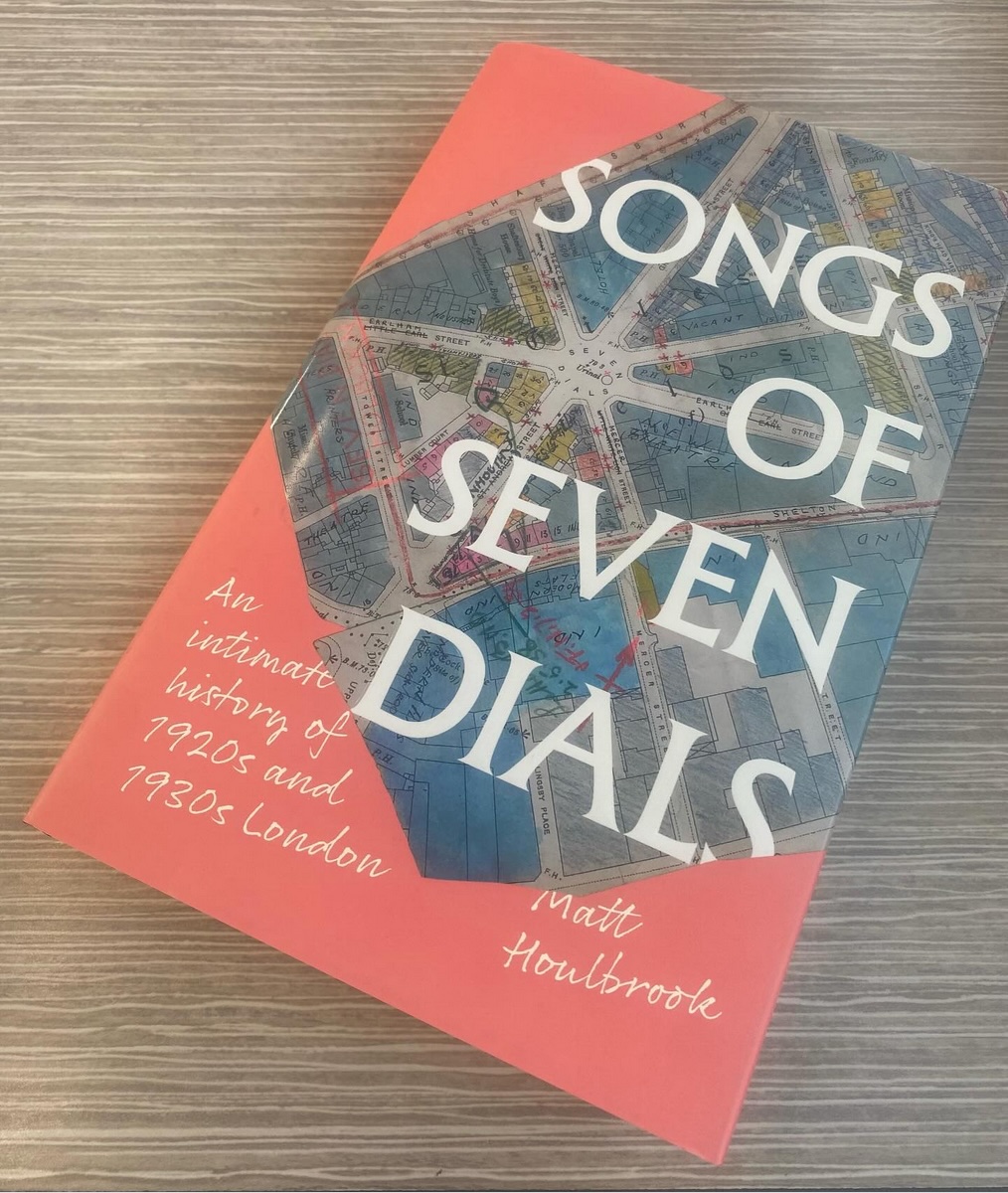
This review has taken me a while to write. Matt Houlbrook’s Songs of Seven Dials: An intimate history of 1920s and 1930s London turns out to be so rich that I have had to split my responses to it into two posts. This first post will be a slightly more formal review alongside a discussion of the ways in which the book is shaping my thinking about The Return of the Soldier, my own tilt at a broad social and cultural history of the legacy of the First World War in Britain. The second, which I will publish in the next couple of weeks, half term permitting, will focus on how the book intersects with my own family history.

In Songs of Seven Dials, Matt Houlbrook sets out to write a social and cultural history of the tiny neighbourhood of Seven Dials which lies between Shaftsbury Avenue, Charing Cross Road and Covent Garden produce market.  Originally defined as a neighbourhood in the seventeenth century, Houlbrook focusses on this ‘shabby cosmopolitan working-class neighbourhood’ (p.3) in the 1920s and ‘30s, a period in which the area was represented as, variously, a crime-ridden slum, London’s ‘Black Colony’, an artistic Bohemia and an opportunity ripe for commercial development. Subtitled an intimate history, the book attempts to focus on the lives of those who actually lived in Seven Dials, alongside those who attempted to impose their social, cultural or economic vision on the area from the outside. Unfortunately, this only has mixed success. The voices of the latter tend to be much louder in the archives than those of the former, and the extensive naming of names can’t always balance the narrative in favour of the historically marginalised who called Seven Dials their home. Even the use of the historic present, which allows Houlbrook to tell the story of Jim and Emily Kitten’s libel case against John Bull with some immediacy, can only go so far in bringing the names of other Seven Dials residents to life, and, at least for this reader, too often got between me and the story being told.

The other stylistic technique that Houlbrook uses to support his analysis is the structure of the book through seven chapters, each one focussing on one or two of the streets radiating out from the central square which make up the district. This structure both emphasise the microhistorical approach that Houlbrook takes to the subject, as well as allowing him to employ circular imagery as a metaphor across the volume as  whole. While this is generally an effective strategy, the inclusion of Long Acre and the Strand in chapter four disrupts the pattern in problematic ways. Both these streets, chosen to represent the locations of the press and legal system that imposed an external narrative on Seven Dials through the Kittens’ libel trial, are not only outside the district itself, but aren’t even accessed directly by Shorts Gardens (Chapter 3) or Great Earl Street (Chapter 5). Subject-wise, the location of the chapter is equally confusing. Houlbrook begins his introduction with the statement ‘It starts with a libel trial, held over three days in the High Court of Justice in February 1927.’ (p.1) Yet it isn’t until Chapter 4 that the reader is given the story of the trial itself, making the background detail of the actors given in the preceding chapters somewhat hard to follow, not least because, while there is a very rough chronology at work, Houlbrook moves back and forth not only across the two decades between 1919 and 1939, but as far back as the 1890s and as far forward as the 1960s.

A key point that this chronological muddying underpins is that the ‘modernisation’ of London, so often associated with the 1920s and 1930s, was far from a tidy linear progress. Grand modernist visions, both economic and architectural, failed. Nostalgia for an imagined past and old stereotypes were evoked to dismantle progressive trends towards diversity and anti-colonialism. At the same time, ‘the foundations of the what would be called gentrification were laid in the 1920s and 1930s, when politicians, planners, and entrepreneurs tried and failed to raze Seve Dials an build a new city from the ground up.’ (p.12) The making of modern London was, as most history is, far more messy than all-too-often romanticised visions of the ‘interwar’ would suggest. Houlbrook makes a powerful case for the need to think about this period as more than just the clichés of ‘The Roaring Twenties’, ‘The Hungry Thirties’, ‘The Interwar’. Yet in titling this story as one primarily about the 1920s and 1930s, contradictions start to emerge. Whatever Houlbrook’s intentions, this categorisation marks the period as ‘a kind of caesura – space between, a time apart’ (p.10), implicitly reinforcing the First World War as a historic paradigm shift in the creation of modernity. At the same time, the war itself is only a tiny part of the story that Houlbrook is telling. Jim Kitten’s wartime internment at Ruhleben and the gunshot wound to his arm he received there echoed through his life and may even have contributed to his death in 1940 (p.230), but they are less important to the story of the years between than his place of birth in Sierra Leone, his marriage to a white Englishwoman and his work as a café owner.

This question of periodisation and the way in which historians use time spans to organise and contain their arguments, particularly as it relates to the early twentieth century, are central to my own thinking about the arguments I am making in The Return of the Soldier. The historiographic tendency to position the years between 1914 and 1918 as not simply a time apart but as a paradigm shift – the end of the long 19th century, the birth of the modern era – has been something that I have tried to resist in all the histories that I have written.  Almost without exception, the men that I wrote about in my first two books were born in the 19th century. The same is true of the men who are the subjects of The Return of the Soldier. They survived the war and went on to live and work throughout the twentieth century. On the one hand, there is a story of social and cultural continuity to be told through these survivals. On the other hand, the very premise of the book is based on these men’s status as having served in the war. The war years were undoubtedly significant in shaping men’s lives and, as a total war, the lives of those who made up the society in which they lived. Bodies and minds were altered by the experiences lived through during the war – by wounds and illness, by separation and deprivation, by unanticipated opportunities for travel and work. The story of social and cultural discontinuity that emerges is a powerful one. How to explore the nature and meaning of the ruptures that war created without isolating the years between 1914 and 1919 as a time apart or the sole defining event in the lives of those who lived through it is the challenge I have been wrestling with since I first began trying to shape my research into  a coherent argument. If individuals lived their lives across the temporal boundaries historians attempt to impose, writing histories that do honour to those lives, and which, as is Houlbrook’s ambition, inform our present, forces us to rethink comforting historic periodisations.

My way of addressing this problem has been to rethink the subtitle of The Return of the Soldier as ‘British First World War Ex-Servicemen and the Making of the Twentieth Century’. The intention is to focus on a discussion of continuity and discontinuity in which the war plays a defining but not an exclusive role, and on the particularity of the lives of these men and those around them, rather than the more abstract categories of ‘the war’, ‘demobilization’ and ‘legacy’. The previous subtitle, ‘The Intimate History of Demobilization in Britain After the First World War’ tried to make this point by invoking the concept of ‘the intimate’, an idea that Houlbrook also uses in his subtitle. Yet I soon discovered that the intimate is a slippery historical category. For Bruno Cabanes it is the study of ‘the relationship of individuals to their own body, to their familiar haunts, and to their family and friends’[1], combining the history of the body with the history of the domestic, an approach exemplified in Joanna Bourke’s Dismembering the Male. Yet Bourke, in her own An Intimate History of Killing, uses the term to indicate as study of subjectivities, the intimacy that of the individual psyche. [2]

In Songs of Seven Dials, intimacy appears to be two-fold. On the one hand, in support of his argument that Seven Dials in the 1920s and 30s was a place of residence and work rather than simply the opportunity for improvement, development or entertainment that many imagined and represented it as, Houlbrook peoples his history with named individuals, located in specific places of residence and types of work. This is the intimacy of the reader with the specific historical actors. It is enabled by the digitization of the 1911 and 1921 census records, which Houlbrook uses, alongside local newspaper records, to great effect. The problem is that the level of intimacy achieved remains limited. While Houlbrook can give names and occupations to the residents of Seven Dials, these records don’t give deeper insight into their lives. Naming is, of course, vital to the process of remembering, but the only way that Houlbrook can give us more than government records offer in relation to people about whom there are few reflexive records is through speculation. He does this with care, and it is here that the historic present is most effective, but it remains speculation nonetheless. Like the tense, I found it got between me and the story being told, making it more distant rather than more intimate.

Where Houlbrook does convince with his claims to writing an intimate history is through the physical intimacy he evokes. Even without reliable images of many of the places he writes about, he conjures the cramped, noisy, sometimes squalid, always vivid nature of the streets, houses and businesses that make up this tiny pocket of London. As becomes clear in the conclusion, these are streets that Houlbrook has walked himself many times as he sought to understand how it transformed from a place ill-repute to the gentrified site of up-market commerce that it is today. It is the place, not the people, which makes this history feel intimate, pointing to the many forms of intimacy that the historian might seek to explore.

This multiplicity in meanings of the intimate is important for my thinking about ex-servicemen’s return for at least one chapter of The Return of the Soldier. ‘Returning Home’, which I am currently working up into my sample chapter for agents and publishers, is divided into two sections, ‘People’ and ‘Places’. Thinking of each as facets of an intimate historical appraoch is proving extremely helpful for working out how the chapter functions as a whole and what sort of evidence I need to support my argument about the long-term significance of ex-service return. At the same time, it is helping me to understand that some of my other chapters may not be intimate histories. Trying to force the ‘Returning to Work’ chapter into this conceptual box may be why I have been struggling so hard to make it work for so long.

So I return to the redrafting process with a new sense of direction having read Songs of Seven Dials. But first I need to grapple with the relationship between Houlbrook’s text and my own family’s history, a question which has been haunting me almost since I first picked up the book and which will form the subject of my next post.

[1] Bruno Cabanes, ‘Negotiating Intimacy in the Shadow of War (France, 1914-1920s)’, French Politics, Culture & Society 31(1): Spring 2013, 13.

[2] Joanna Bourke, Dismembering the Male: Men’s Bodies, Britain and the Great War (London: Reaktion Books, 1996); Joanna Bourke, An Intimate History of Killing: Face-to-Face Killing in Twentieth-Century Warfare (London: Granta Books, 1999).

What’s in a Name?

Cover of The New York Times, 24th May, 2020

I was in Cambridge on 11th September, 2001, but I went home to New York City for the Christmas holiday that year. My memory of that holiday is dominated two experiences: first seeing the city skyline without the domination of the Twin Towers as the cab drove me from JFK to Manhattan, and sitting for days at a time on the sofa in my father’s tiny apartment on 79th and Broadway reading the obituaries of those who died in the New York Times. Every day the paper included several pages of these, brief biographies, some accompanied by photographs, of the cross-section of New Yorkers and Americans who had lost their lives so inexplicably and suddenly. I found my old babysitter and a girl I had studied history of art there; I was introduced to firemen and cleaners, bankers and parents, real people with real lives cut brutally short.

On Sunday, the New York Times again placed a list of the dead at the heart of its publication, this time a list of those who lost their lives to Covid-19 as the number of pandemic fatalities in the US neared 100,000, over 30 times the number who died on 9/11. This time there was no space for pictures, even the short life stories of the 9/11 obituaries. Instead the front page lists names, ages, place of residence and, for most, a brief phrase describing something which made that person unique. These descriptions range from the banal through the humorous to the startling. They capture working lives, domesticities, private passions. They help to illustrate the claim of the sub-heading that these ‘were not simply names on a list. They were us.’

In all, the front page, and the continuation on page 12, lists 1,000 names, 1% of the marked death toll. It is, for me, as for so many others, profoundly moving in its personalisation of the loss that this pandemic is causing, not just in the US but across the world. But does it, as my cousin, who specialises in the visualisation of enormous numbers, asked, really convey the scale of this loss? Remembering these people as individuals is important, he implied, but in doing we lose a sense of the enormity of what 100,000 deaths really looks like.

The tension that my cousin is flagging here is one that has shaped commemorative practice for over a century, at least in the Anglophone world. While epidemic and pandemic illness have shaped society through extensive and profound loss of life for centuries, the First World War (and the ‘flu pandemic which followed it) brought this tension into focus as concentrated mass death occurred for the first time in a world of the nation state and global communication. Each death in and of itself was a personal tragedy and a loss to a community, but it was also, in the case of the deaths in war service, a death in the service of the state and thus required a more public marking. In Britain, this came in the form of casualty lists, published initially daily in the press, and later, as the numbers grew, weekly. Visually, these lists bear a startling resemblance to the New York Times cover, although they include none of the personalising details, only name, rank and unit of service.

It was after the war, however, that the process of naming the dead as a way of remembering them as individuals rather than as part of a mass truly came into its own in Britain. The decision not to repatriate the dead meant that traditional forms of naming on gravestones were precluded for all who died overseas. The loss of bodies meant that, for many, even a corner of a foreign field was an impossibility. Instead the names themselves became the markers and the memorials, both at home and overseas. It is impossible to travel around Britain without encountering a memorial listing the names of the dead – churches and churchyards, in schools and universities, on railway station concourses and street corners. The pattern is repeated in memorials overseas, most notably Lutyen’s monumental arches at Thiepval, with their overwhelming list of the 73,000 names of the missing of the Somme.

Panel of names, Thiepval Memorial, Thiepval

Thiepval seems, one way, to illustrate the problem of naming as a way of commemorating the enormity of mass death through naming. The scale of the memorial is such that it is impossible to see some of the names in its highest reaches from the ground. The names of the dead on my local village war memorial may mean little to me as an incomer of three years’ standing, but I can still read each and acknowledge them as individuals in a way that the sheer scale of Thiepval precludes. Unlike Maya Lin’s Vietnam Memorial, which most notably took on the tradition of naming as commemorative practice in the US, those visiting Thiepval cannot touch the names, as those visiting Washington often do. Sensory connection, whether of eye or fingertip, seem to be denied. The visitor to Thiepval risks being overwhelmed by the size, the number, the enormity of so many names who cannot be comprehended as individuals.

Blackshaw Head War Memorial

And yet Thiepval remains one of the most profoundly moving memorials to British war losses, inspiration for at least two generations of historians and cultural critics. The invocation of names, with their assertion of an individuality, and individual loss, mirrored in the gravestones of the Commonwealth War Cemeteries across the world, aids our perception of the scale of loss, rather than distracting from it. Smaller local war memorials can have a similar effect, particularly once one is aware of their prevalence. The relentlessness of encounter wherever one travels in Britain serves to bring home the sheer number of dead as profoundly as any weekly gazette of casualties or daily listing of obituaries. The dead are many, but they are not numbers. They are names – of soldiers, students, workers, congregation members, parents, children, siblings. This, then, is the power that the mass listing of names has in commemorative practice, to bridge the gap between the unknown individual and the incomprehensible scale of loss. Names make not just the dead but the meaning of their deaths as one of many known to us. They never were just names on a list, then or now. They were, they are us.

Because Remembrance is more than an Act

The Unknown Soldier


When a delegate visits a foreign country,

He brings a crown of flowers for the grave of the Unknown Soldier.


If tomorrow, a delegate came to my country and asked me:

Where is the grave of the Unknown Soldier?


I would say: Sir,

At the bank of every stream

Under the dome of every mosque

At the doorstep of every house

Every church

Every cave

Under the boulder of every mountain

Under the branches of every garden in this country

Over every inch of earth

Under every yard of sky,

Don’t be afraid, bow your head, and there set down your crown of flowers.

Abdulla Pashew

This poem forms the epigraph to my brother’s book of photographs of Kurdistan: Sebastian Meyer, Under Every Yard of Sky, Red Hook Editions, 2019.

Women, Gender and Sexuality visit Women, Work and War.

A guest post from Laura Boyd, a second-year PhD student in the School of Languages, Cultures and Societies at the University of Leeds. Laura is researching the work of non-combatant male medical caregivers in Britain and France during the First World War, and is a postgraduate member of the Women, Gender and Sexuality Research Cluster.

On 8 March 2017, the Women, Gender and Sexuality Research Cluster at the University of Leeds had the fantastic opportunity of a guided tour of the Women, Work and War exhibition at Armley Mills, followed by coffee and a chat. We were a mixed group of academic staff and postgraduates, from MA to Ph.D level in the Faculty of Arts. Guiding us was Lucy Moore, the Project Curator for First World War and member of the Legacies of War Project.

The visit began with the guided tour. The exhibition was wonderfully curated, and gave a real insight into the lives of the women working in and around Leeds during the Great War. These women came from all around Leeds and indeed much further, and took over the jobs in factories that were left by men who had gone off to war. Though it started in Armley, the factory expanded to the Barnbow site and employed large numbers of women.

Not only did it portray the ‘general’ or ‘bigger picture’ of the lives of these women who worked at Armley and Barnbow in the munitions factories, but was interspersed with personal stories. Lucy showed us around the different exhibits, including munitions and clothing, and shared other anecdotal tales that were not on display, taken from the writings of the ‘Canary Girls’ themselves. The exhibition featured personal accounts of the 1916 Barnbow explosion, which really brought home just how dangerous this behind-the-lines war work was. We even had the chance to have a sneak-peek at an original medal press that is currently awaiting restoration!

We then sat down for coffee and a chat with Lucy, and we began by asking about her own career progression into becoming a curator. Her answer? Refreshingly honest! And by that I mean that it wasn’t a straightforward, linear progression, as these things rarely are. A few of the postgraduates in attendance were interested in hearing about how to get into her line of work and Lucy gave us some great tips on how to get started.

This led to a discussion of the academic buzzwords ‘impact’, and ‘partnerships’ between academics and the community. Though these words tend to scare people like me, it was actually a really insightful and interesting discussion. Both Dr. Jessica Meyer and Lucy Moore are part of the Legacies of War Project here at Leeds, which they were delighted to talk about. Lucy was open about how the academic world has helped create interest around exhibitions such as Women, Work and War. Not only through organising trips such as ours, but by spreading the word among colleagues and at other academic events such as conferences and seminar series. She also said that she is happy to have connections to which (and whom) she can turn for information and help. Jessica was also keen on this point, telling us how the museum had also helped greatly in terms of ‘impact’, by helping the academic world bridge the gap between us and the public, leading to some fruitful and fascinating interactions. She also noted that often independent researchers involved in projects such as this come with knowledge and sources often unknown to academics!

So, to sum up, it was invaluable. Academic-community partnerships can help to get the public interested in what we do, and in turn can, through these partnerships make our research available to all. I would wholeheartedly suggest that if you have not yet been to the exhibition – GO! It will be well worth it, I promise.

Conference Report – Resistance to War

Following on (rather belatedly) from my last post, one of the conferences I was only able to attend partially in March was the Resistance to War conference, held in Leeds on 18th-20th March.  In addition to Twitter, an important, and more established, way of keeping up with conferences that one can’t attend in person is via conference reports.  It gives me great pleasure to publish a report of the Resistance to War conference written by Charlotte Tomlinson, a former undergraduate and current MA student in the School of History, University of Leeds, and founder of the HUll Blitz Trail project (which can be followed on Twitter @hullblitztrail).  My thanks to Charlotte for taking the time to write and reflect on what sounds like a fascinating few days.

As the centenary of the First World War has come upon us in the last two years, scholars across fields have turned their attention to the conflict and offered new ways to look at it. As well as encouraging commemoration and highlighting traditional narratives, the anniversary has inspired fresh perspectives and uncovered previously untold (or at least under-told) stories. One such strand of new thought was recently celebrated at the Resistance to War conference, held in Leeds March 18th-20th. It was a truly international event, with speakers visiting from stretches as far as Auckland, and covered an equally diverse scope of subjects relating to resistance to war. Inevitably then, the conference encouraged consideration of a less traditional approach to the First World War. However, as all papers seem to, the event had me thinking more broadly about how we, and I, approach histories of war.

The event began with a series of panels exploring different aspects of war resistance. I decided upon one which explored resistance and gender through the lens of wartime literature in France (Philippa Read), Germany (Corinne Painter) and Britain (Sabine Grimshaw and Sarah Hellawell). After four extremely interesting talks, and a few books added to my ever-growing summer reading list, it was a question on how these works were received at the time that really peaked my interest. Not in the answer, but in that it made me contemplate how we use literature in history more widely. As happens so often lately, I found myself pondering the representation vs reception debate, comparing the cultural and social approaches to sources such as those discussed. While our own readings of literature are insightful, and were hugely fascinating to listen to, the panel left me with more questions about my own research than theirs.

The following day, another question of how we approach history left me a little more excited. In a fascinating talk on two ‘gender dissidents’ of the early twentieth century, Conscientious Objectors and Suffragettes, Lois Bibbings argued for a more complex understanding of how the two groups used gender in their resistance. In doing so, she highlighted how Emmeline Pankhurst’s WSPU used fashion as a method of resistance, how suffragettes ‘consciously played on gender’ by maintaining a prim and proper appearance in order to defend their femininity, and oppose media representations of them as unruly and manly. In a later conversation, we discussed how the loss of control over appearance was also central to the suffragette prison experience. It was encouraging to see how the issue of fashion, so often overlooked as a trivial matter, could be integrated into an analysis of war resistance and I was left feeling quite uplifted about the potential for this research to be taken further in the future.

Another talk inspired a less encouraging but equally interesting reflection, on how collective histories continue to shape how researchers approach resistance to war. The huge success of the conference showed how far we have embraced less typically-glorified narratives of the conflict which do not place the volunteer soldier suffering in the trench as the quintessential war narrative. Benjamin Ziemann’s keynote paper, on German soldiers who refused to fight from July 1918 onwards and how these have been remembered in Germany since, did however cause me to consider how we approach war resisters who were not pacifists. Crucially, a point was raised about the likelihood that a similar project would be undertaken on British so-called ‘cowards’. While popular opinions of war resisters has undoubtedly altered in past decades and become more positive, it was rightly argued that our changing cultural memory in Britain of heroic fighters or brave COs has not yet allowed a shift that adequately acknowledges our ‘cowards’ too.

It is hardly surprising that Cyril Pearce’s paper proved thoroughly inspiring. His work continues to influence scholarly thought on conscientious objectors and encourage new work. It was not his insights into war resistance here that had me thinking though, but his approach. In using statistics and maps to explore the pattern of conscientious war resistance in Britain, the paper was undeniably unique in a historical conference. Outside of economic histories, it is perhaps unsettling for many of us to deal with such mathematically presented ideas, but by mapping COs it was easy to highlight resistance hotspots and identify interesting communities that require further study. Ultimately, it was refreshing and inspiring to see an approach many researchers, myself included, would usually shy away from and provided a visual exploration of COs that really brought the issue to life.

Finally, a paper on the infamous Alice Wheeldon left me thinking about the significance of new perspectives on war resistance beyond the weekend conference, and beyond academia. A moving paper was given by Nick Hiley and Wheeldon’s great granddaughter, Chloe Mason on how the conviction of her family for conspiring to murder the then Prime Minister Lloyd George should be overturned. Hiley and Mason unpacked the case and highlighted the secrecy surrounding it, explaining how they are now appealing for the conviction to be quashed. In doing this, rather than reflecting on war resistance as much of the other papers had, the paper reminded us that our memory of war and war resistance remains a contemporary issue that touches lives today.

Driving home after a long couple of days, my (non-academic) dad asked me, ‘so what’s the point in a conference?’ What followed was a lengthy answer which I don’t think he was quite expecting. In the first instance, the papers given offered interesting insights into many areas of resistance to the First World War, some related to my own research, some not. But more importantly, the papers, as always, left me with a number of questions and points to reflect upon, a few of which I have briefly discussed here. These relate above all to how both I, and we, approach history. So more than just gaining knowledge and enjoying papers from across the globe in a celebration of centenary research, I left the conference with a greater self-awareness of myself as a researcher. Once again I was reminded that no matter the topic, there is always something to be learned in hearing about another’s work.

Introducing … Men, Women and Care

It has been nearly five months, I realise, since I started my new project, and I have yet to formally introduce it to the public.  There are reasons for this.  Much of the past five months has involved rather more administrative work discussing the project than actual research.  And even then there doesn’t seem to be a great deal to show for it.  The website is still being built, I am still working out the nuts and bolts of the project’s centrepiece, the team is still being recruited.  But last week we made the first formal appointment to that team, a skeleton website should be up and running soon, and we are on the cusp of the new teaching semester, so now seemed a propitious moment for slightly more formal introductions. So here goes.

Star and Garter poster

Fundraising Poster for the British Red Cross Star & Garter Home

Men, Women and Care: The gendering of formal and informal care in interwar Britain is a European Research Council Starting Grant funded research project based in the School of History at the University of Leeds.  Over five years, it will explore the ways in which the State, charities and, above all, the family provided medical and social care to disabled ex-servicemen in the aftermath of the First World War, particularly the relationships which developed between these three groups in the course of care provision.  It asks how State, medical and charitable institutions, often dominated by men, interacted with the wives, mothers and sisters who found themselves caring for men who had suffered life-altering wounds and illnesses as a result of their war experiences and how these interactions shaped social and cultural understandings of care-giving as a gendered practice.

At the heart of the project is the creation of a database of the material held in PIN 26, the section of The National Archives which contains nearly 23,000 First World War pension award files.  This is not a digitisation project; many files contain medical records which it would not be ethical to digitise.  Rather, the database will collect demographic information and give an indication of what supplementary material the files contain.  This will allow for both quantitative analysis of the entire sample, as well as helping researchers identify relevant files for further qualitative analysis.  The project will work closely with The National Archives to enable the database to be made freely and publicly accessible upon completion.

In addition to working with the National Archives, the project is looking to build relationships with local, national and international partners to explore how this research might shape and be shaped by contemporary understandings of medical and social care provision, particularly in relation to the role of the family.  The project itself is a central element of the Medicine and War strand of the Legacies of War research and engagement hub based at the University of Leeds, and we are looking forward to building on the strong relationships and innovative work that Legacies of War has developed since its inception.

The Men, Women and Care team, at present, is made up of me as principal investigator and Alexia Moncrieff, who will join as postdoctoral researcher fellow over the summer.  Currently completing her PhD on the Australian Army Medical Services in the First World War at the University of Adelaide, Alexia’s research for the project will focus on the ‘Overseas’ subsection of PIN 26, to explore how ideas of distance shaped the provision of care by different institutions.  We are also in the process of recruiting two PhD candidates who will start their research on related questions in October.  Given the richness of the PIN 26 archive, as well as the range of related material in the archives of local government, charitable institutions and personal narratives, I am very interested in hearing from anyone who would like to collaborate or contribute.

As I say, there will be, in the near future, a project website and Twitter feed (@WW1PensionsCare – as soon as Twitter allows me to register it).  Please bookmark and follow us to see how we develop and do get in touch if you want to find out more.


Reminder

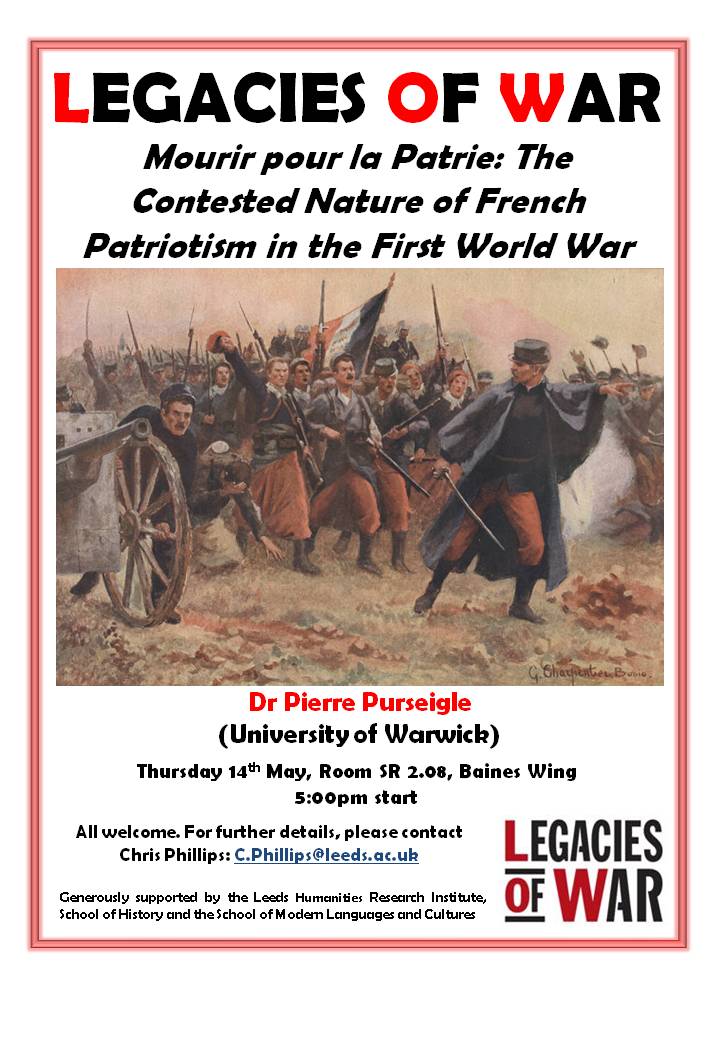
While I am on here, this seems a good opportunity to remind everyone that the next Legacies of War seminar will take place next week when Dr Pierre Purseigle (Warwick) will discuss French patriotism in the First World War. Please note, this is a rescheduling of Dr Purseigle’s talk which had to be postponed from earlier in the year.
Pierre Purseigle

And now for something completely different

The following post, by Christopher Phillips, a postgraduate student in the School of History at the University of Leeds and member of the Legacies of War project, is the second the occasional series of guest posts to this blog. One the surface, a biographical sketch of the coordinator of canal transportation for the British armed forces in France during the First World War may appear to have little relation to the medical research interests of this blog.  Yet Chris touches upon a number of key issues that I am currently exploring in both my book and related articles, including the key role of transport logistics and the relationship of the Regular Army and its officers to the range of support services that total war required.  I hope to explore some of these issues myself in future posts.  In the meantime, I leave you to enjoy Chris’s story of a man who exemplified war service in ways that go far beyond popular cliché.

The grave of Brigadier-General Gerald E. Holland lies in the Catholic cemetery in Holyhead, where he had lived and worked prior to the outbreak of the First World War. Holland died on 26 June 1917, at St Leonards-on-Sea in Sussex, from a sickness contracted whilst on active service in France. Alongside 888,245 of his colleagues from within the British Empire, Holland’s death was represented by a ceramic poppy planted outside the Tower of London as part of the commemorative activities linked to the centenary of 1914. Holland’s war service, however, was far from the popular stereotype of the First World War soldiers’ experience, whilst Holland himself was a distant cry from the stylised image of those who died on the battlefield.

Gerald Holland was born in Dublin in October 1860. At the age of 20, he joined the Royal Indian Marine, seeing service in Burma prior to a posting as a Naval Transport officer during the South African War. In 1905, at the age of 45 and with the rank of Commander, Holland retired from the navy and returned to Britain. He re-entered civilian life in the employ of the London and North-Western Railway, occupying the post of Marine Superintendent for the railway company, first at Fleetwood and later at Holyhead. In this role, Holland was responsible for the operations of the port, ensuring that goods traffic between the mainland and Ireland was handled efficiently. In August 1914 Holland was just two months shy of his 54th birthday. Despite his age, and his retirement from martial service almost ten years previously, Holland was able to apply his skills and abilities to the prosecution of the war in Europe.

In the opening month of hostilities, Holland approached the War Office with an idea to take advantage of the highly-developed system of inland waterways in France and Belgium to provide supplies to the army and to relieve pressure on the railway network behind the front line. As the position of that front line stabilized in the latter months of 1914, creating the conditions of trench warfare which have become synonymous with the conflict on the Western Front, Holland was offered the opportunity to put his ideas into practice. On 30 December 1914, the newly-appointed Lieutenant-Colonel Holland reported for duty at GHQ in France, and took over responsibility for the provision of canal transport to the British Expeditionary Force on the Western Front.

At first sight, Holland’s task seemed formidable. At the beginning of 1915, the Department of Inland Water Transport consisted of two officers (Holland and his assistant, another former naval officer), one tug hired from the French, and thirty-four barges. A meeting with the French Army’s canal expert also revealed that Holland would be unable to obtain much assistance from the locals, French canals having largely been plied by entire families who lived on their barges and chose not to follow military orders. With the British Army possessing no expertise in canal operations, the only alternative for Holland was to enlist personnel from Britain with the requisite skills to man the barges and provide the technical and administrative support necessary to maintain an efficient service. Whilst the War Office were able to provide officers for clerical support, the majority of the men, unsurprisingly, were chosen for their experience of the shipping industry (such as Horace Pitman, for ten years a yachtsman, or the fifty-two year old George Tagg, who came from a boat-building family and knew the French canal system well), whilst Holland’s pre-war employer also supplied fifty men from the Marine Department at Holyhead. An active campaign of enlistment at various ports in Britain accounted for the lightermen, watermen, seamen, engineers and other assorted trades required to ensure the department’s ability to fulfil its duties. By February, Holland had created a self-sufficient unit that had already begun to transport bulk commodities such as road stone and coal inland. By the end of June, just six months after Holland had arrived in France, inland water transport had moved: 19,142 tons of supplies; 27,421 tons of road stone; and had evacuated over 600 men from the battle zone by ambulance barge. As the war continued to grow in scale, Holland worked tirelessly to ensure his department’s ability not only to keep pace with demands, but to create new services.

By the middle of 1916, Holland controlled a fleet comprising almost 600 vehicles, with a capacity of over 70,000 tons. He had overseen the creation of a bespoke depot for inland water transport at a site which became known as Zeneghem, and had successfully argued for the creation of a cross-Channel barge service to eliminate the need for landing ships at the overstretched French ports. Arrangements were also already in place to commence a barge service for the evacuation of wounded horses to complement the ambulance barge service which continued to expand its operations. In October 1916, Holland’s department was, along with the army’s other transportation methods, placed under the control of Sir Eric Geddes as part of a widespread reorganization of the force’s logistics in the wake of the Battle of the Somme. Whilst those responsible for the provision of railway transport and the operations at the docks were ultimately replaced, such was Geddes’ appreciation of Holland’s work that he retained his position in the reshuffle (and gained a promotion to Brigadier-General), and both men looked forward to the continued expansion of waterborne traffic in 1917.

Unfortunately, it was not an expansion that Holland would live to see. As part of their coordinated withdrawal to the Hindenburg Line over the winter and early spring of 1917, the retreating German Army devastated the land and destroyed the canals in the surrendered territory. Days of inspecting the damage in freezing temperatures took their toll on the fifty-six year old, and Holland fell ill in April 1917. He was evacuated back to Britain but never recovered. His assistant, Cyril Luck, another former Royal Indian Marine commander, took over operations in France and retained his position until the armistice. The provision of canal transport on the Western Front, therefore, was at no point under the direct supervision of a regular officer of the British Army.

By discussing Holland’s service in more detail, a richer, more nuanced image of the diverse range of wartime experiences emerges. It reminds us again of the ‘totality’ of the First World War, and of the myriad relationships that developed during the tumultuous progress of the conflict, as armies, states and societies grappled with the unprecedented challenges of understanding, influencing and coping with the dislocation and shock brought about by the war.

We interrupt this programme…

Before I start, please may I assure regular followers (hi, Mum!) that I am contemplating a post on the new seasons of Downton Abbey and Peaky Blinders and what they have to tell us about bereavement, survival and disability in the wake of the First World War.  In the meantime,  however, I will be spending the next three weeks teaching on this:

WW1_4words


Changing Face of Heroism


If you haven’t already signed up, please do so.  If you have, please let anyone you think might be interested know about it.  It is completely free to register and join and you can take the course entirely at a pace that suits you.

As part of this course, our wonderful learning mentors, Chris Phillips and Philippa Read, will, I hope, be writing guest posts for this blog on aspects of heroism relating to their research, respectively wartime transport logistics (trains and canals) and classical references in French wartime culture and memory.  This is a new approach on the part of this blog, but one that I hope will lead to contributions by other students and colleagues who work in fields related to my research.  I hope you will make them all welcome.

And a final piece of publicity. The Legacies of War seminar series got off to a strong start in its third year with an excellent paper from Professor Roy MacLeod on ‘The Scientists Go To War’.  Our next meeting takes place on Thursday, 30th October at 5:15 in the Grant Room (Michael Sadler 3.11) at the University of Leeds when Dr Richard Smith (Goldsmiths) will be speaking on ‘Recovering West Indian Memories of the First World War’. Full details can be found here.  Please do join us if you are able to. All are welcome.

Very well then, I contradict myself…

Last Friday, I went to the final showcase for the Legacies of War Leeds Stories of the Great War project.  I haven’t had a huge amount to do with this project, so it was both a surprise and a delight of an event, with results (many of them ongoing) of six exciting community projects on display.  Of the six, two stood out, the year 11 students from Roundhay School who produced two films, one silent, one a pastiche news bulletin, inspired by the history of Belgian refugees in Leeds, and Urban Sprawl theatre company, Leeds’ sole homeless theatre company, who came up with a touching, funny, vulgar music hall riff on the theme of enlistment.  All the projects were moving, informed and passionate, but these two groups stood out for their creativity and humour that, in the case of Urban Sprawl, was true enough to the spirit of the times they evoked that it had me referencing Frederick Manning’s Her Privates We.

Which brings me to another First World War event from last week, this one a launch rather than a culmination.  14-18 NOW, which launched officially on 27th March, is an Arts Council and Heritage Lottery Fund funded series of events, hosted by the Imperial War Museum and taking place around the country.  Projects range from a Royal de Luxe production telling the story of the Accrington Pals using giant puppets in the streets of Liverpool to 1914 told day-by-day through cartoons.

The reactions have been almost as varied as the proposed artistic outputs.  The first response on Twitter was, in general, a rather patronising, ‘These people need to learn some “real” history.’  The mainstream media tended to pick up on the project to paint warships using First World War-era ‘Dazzle’ camouflage techniques, sparking this bizarre but somehow predictable response from the Guardian.  By the weekend there were some more detailed, considered response emerging on blogs, most notably those of George Simmers and Jonathan Boff. More recently, Gary Sheffield has pitched in with this interesting discussion of why the idea of turning off lights to mark the start of the war is historically uninformed.

By rights, I should be in complete agreement with these posts, and to some extent I am, having done my fair share of fulminating about luvvies voicing ill-informed opinions about how the war should be commemorated.  I agree that Stephen Fry’s letter to an unknown soldier, as well as several of the projects on 14-18 NOW, are deeply clichéd.  And yet overall I find myself intrigued and excited by the majority of ideas on display, and particularly by the Letter to Unknown Soldier soldier project.

Part of this is due to a huge personal affection for the Charles Jagger memorial sculpture honouring the dead of the Great Western Railway on platform 1 of Paddington Station, the Unknown Soldier of the title.  Reading his letter from home, he forms the cover of my monograph on writing wartime masculinity, in stunning a photograph by my brother, photographer Sebastian Meyer. Men of War coverAnything that makes people more aware of this particular statue is liable to get my attention and my approbation.

But I also keep coming back to those amazingly creative responses to the history of the war on display last week.  The Letter to the Unknown Soldier invites similar creativity from participants.  I doubt it will come from well-known artistic or creative figures, given the evidence so far available.  But I love the idea of a busy commuter, looking for the first time at that beautiful, powerful face, being inspired to engage with the history of the First World War enough to write their own letter, an act of commemoration speaking not only to Jagger’s vision but also that of Eliot and Auden.  Or maybe it will be a local homeless person who, like the clients of Urban Sprawl, locates a sense of identity and community in this imagined figure of the past.  Yes, these will be the projection of 21st-century ideas, concerns, aspirations on to an image almost a century old.  But in looking to the wider public, there is the potential for an artistic engagement with history beyond the clichés that, so often, have dominated Britain’s commemorations. It is an artistic response, certainly, but given the richness and complexity of artistic responses across the past century, responses which have led to their own branch of academic study, this too will be ‘real’ history.

At the heart of my unease at the response to 14-18 NOW, however, is, I realise after a week of thinking about it, actually very similar to the annoyance I felt at the luvvies’ letter (see above).  I resent, deeply, being told how to commemorate the First World War, whether it is by artists or historians.  Both groups have important contributions to make to the way in which the war is remembered.  At their best, the disciplines can combine in extraordinary and unexpected ways that enlighten the past anew, as was perfectly demonstrated at the Tetley last Friday night. As a historian, not only do I think that there is potential for the continuation of artistic commemorations that have been part of British culture since the war years in the 14-18 NOW project, but I hope that, given the opportunity to contribute through active engagement rather than holding aloof or, in the worst cases, simply sneering, my discipline may enable these artistic events to have real resonance throughout the centenary.  On which note, I am off to write my own letter to the unknown soldier of platform 1.