Second-hand Goods

Caroline Dunford, A Death in the Hospital

I have a very bad habit of picking up any novel with a First World War or immediate post-war setting when I come across them in a second-hand book sale. My husband grumbles about my bringing yet more books into the house while, in my heart of hearts, I know that, more likely than not, I will spend most of the time I am reading them getting annoyed by inauthentic, not to say inaccurate, portrayals of the war which rely heavily on clichés. Yet I carry on doing it, in part in forlorn hope that I may encounter an original (and thus enjoyable) new author or series, and in part to remind myself of all the pitfalls to avoid when writing my own war-set fictions.

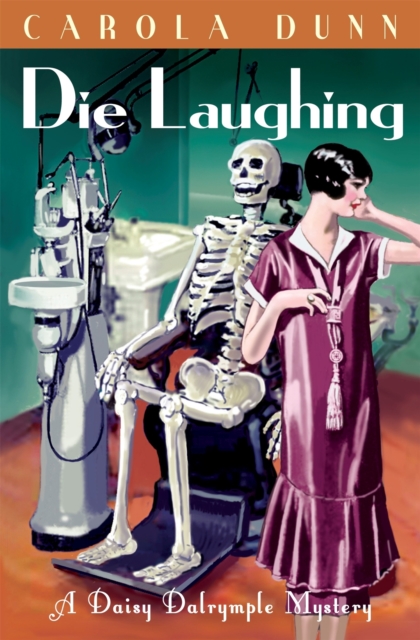
As painful as most of these are to read, in general I find there is enough to them, in terms of plot, characterisation or, very occasionally, setting, to keep me reading until the final pages. Certainly, I did manage to do this with Carola Dunn’s Die Laughing, in spite of its many short comings, and with Sulari Gentil’s A Few Right Thinking Men, which erred to much towards the thriller side of crime fiction for my taste, as including random fictional press clippings in a way that I found deeply confusing and off-putting. However, this cannot be said for my most recent acquisition, Caroline Dunford’s A Death in the Hospital (2020), which I picked up for 50 p. at our local National Trust property second-hand bookstall and which I abandoned about a quarter of the way through.

I had been vaguely hopeful about this novel, the 15th book in the Euphemia Martin series, which appears to still be going strong, with A Death at Christmas due out this year. After all, the war hospital setting was right up my street in terms of areas of historical interest, although this did risk a more than usual number of snorts at clichés about VADs and misuse of the term ‘field hospital’. What I didn’t expect, however, was a historical setting so inaccurate as to suggest that Dunford is not even familiar with Vera Brittain’s Testament of Youth, let alone any less ubiquitous representation of the British military medical services in the war. It was at the point where a hospital where the central character had gone undercover as a trainee nurse (not, apparently a VAD, although it remained entirely unclear what the character who made this distinction thought a VAD role entailed) was described as the first hospital of its type ‘since the Boer War or possibly the Crimean War’ that I gave up entirely. For the setting to have any meaning or interest, I did need to have evidence of some basic plausibility for the institution that formed that setting, including the awareness that the auxiliary hospital (which I think was what this one was supposed to be) was only one type of medical institution in Britain during the war. As well as the permanent military hospitals which treated the Regular army throughout the second half of the 19th and into the 20th century, at the outbreak of war, military hospitals were rapidly set up across Britain, usually in commandeered institutions. Where country houses were donated, these became auxiliary units, specialising in rehabilitation after initial treatment at a general hospital. The institution in A Death in the Hospital did not seem like any of these.

Which brings me to the second aspect that precluded my enjoyment of this book. In addition to the ahistorical setting, the question of timing made any suspension of disbelief I might have had impossible. The novel is, apparently, set in August 1914. Even if we assume that the book starts at the end of the month, in at most three weeks there has, apparently, been time for some sort of voluntary hospital to be set up and filled with wounded servicemen including at least one volunteer servicemen, although he just may have been a Territorial. It is also strongly implied that the military effort had achieved statis along the Western Front, although this wasn’t the case until the winter of 1914. In other words, the author attempts to invoke the war as historical context through clichés that ignore the somewhat atypical reality of the opening months of the war. This sort of telescoping of events is not just bad writing, it is terrible history.

I do like to think that I have a pretty high tolerance for inauthenticity in genre fiction set in the First World War, of which there is a remarkable amount. Yes, as I say, I do grumble about inappropriate uses of terms like ‘field hospital’ and conscientious objector, or assumptions about the incidence and understanding of executions and shellshock. But while reiterating worn tropes is boring and, for a historian, frustrating, I am aware that I bring a level of specialist knowledge to reading this type of fiction which gives me an unfair perspective. Where there is some evidence of basic historical research, some attempt to get to grips with the historic specificity of the world being depicted, I can usually suspend enough disbelief to at least finish the book. Here there was no evidence of any historicization, with events, ideas and innovations from at least three major conflicts mashed together in an ahistorical mess labelled ‘The First World War’ in a completely implausible time frame. It is the sort of historical fiction that makes me wish there were a way to certify an author’s credentials as a historical research before they are allowed to publish. Indeed, the only excuse for this sort of book, in my view, is the case it makes through absence for history, including that which informs creative products (films, television, art and games as well as literature) as an intellectual discipline that requires skill and rigour, not just a vague idea that the past is another country which might make for a romantic setting.

So A Death in the Hospital will return to the second-hand book sale table via my local charity shop, where I should clearly have left it in the first place.

In the Garden

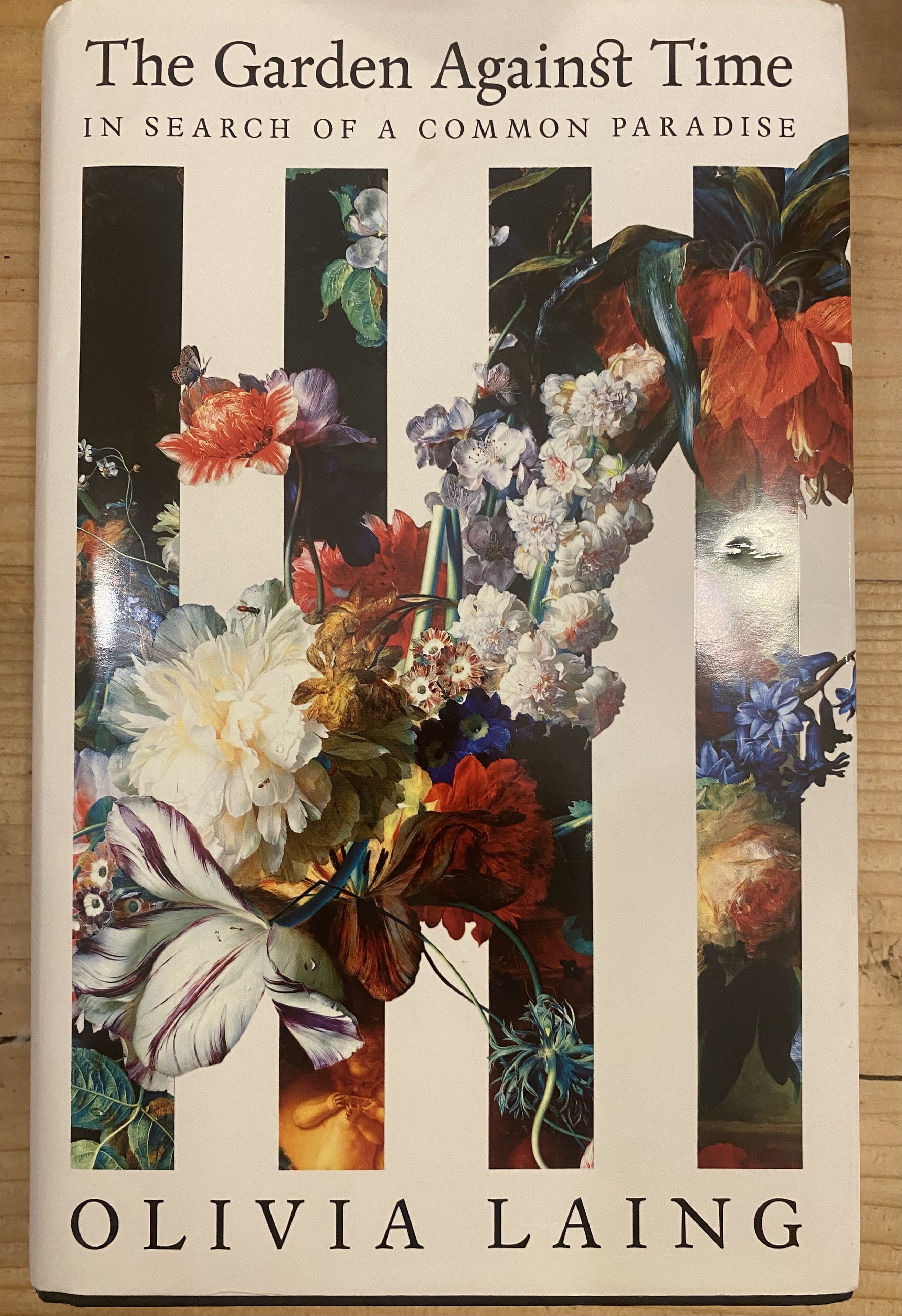
Several months ago a package arrived from Amazon containing a book. This is not an entirely unusual occurance in our household, although when we do buy books on line, it is more likely to be from bookshop.org or World of Books (my husband is a sucker for an ex-library edition). This package, however, was not an impulsive or accidentally overlooked purchase, but rather an unexpected un-birthday present from my stepmother, a copy of Olivia Laing’s much-praised The Garden Against Time. A few months later my husband gave me, as an actual birthday present and at my request, a copy of Penelope Lively’s even more critically acclaimed Life in the Garden.

Although I read them separated by several months, these two volumes have worked together in my head as part of a single genre of literary garden reflections. Both Laing and Lively write as both gardeners and writers, using the act of hands-on cultivation as a jumping-off point for reflections on the representational significance of gardens in predominantly Western, mostly British, culture. Both are erudite and both are beautiful objects (even the ex-library paperback edition of Life in the Garden), illustrated by a similary style of woodcut horticultural illustration.

Laing’s book is ostensibly structured by the story of her acquisition and reconstruction of a historic Suffolk garden, a process disrupted by the Covid-19 pandemic and its aftermath. Lively’s volume is, at least superficially, more academic than biographical, formed of series of essays on themes ranging from ‘Reality and Metaphor’ to ‘Time, Order and the Garden’. Yet it is Laing who spends signficant space in detailed analyses of John Milton’s Paradise Lost, W.G. Sebald’s The Rings of Saturn and the life and poetry of John Clare in terms which would not be out of place in an academic essay. Lively, meanwhile, ranges more widely in her references, with less critical depth but with a lightness of tone and analytic incisiveness that gives the book an immediatcy that is immensely engaging. As a result, I could see Lively’s Oxfordshire garden, created with her husband Jack, and the Egyptian garden of her childhood memories in ways that I could not with Laing’s restored greenhouse and pond. Although perhaps it was Lively’s early (and entirely accurate) identification of Tom’s Midnight Garden as one of the great works of 20th-century children’s literature that informed my sense of recognition and familiarity with her world and world view in ways that Laing’s work, for all its accomplishment never achieved. I have never read Sebald, and have only engaged episodically with Milton and Clare, whereas some of my most cherished memories of my mother revolve around her reading Tom’s Midnight Garden to me, first as a bed-time story and then on to audiotape, a process that, in the 1980s, was a true labour of love and dedication. I still have those tapes, the audio now preserved in digital form by my husband, although even now, over six years after her death, I am still not ready to listen to them and hear my mother’s voice reading to me again.

Nor are the intellectual contexts of the two books the only key differences which shaped my enjoyment. I found Lively’s writing much funnier than Laing’s, and was constantly reading out snippets of Life in the Garden to my husband. At no point was I tempted to do this with Laing, who also has a distancing literary tic of listing plants, many of them unfamiliar to a less-experienced gardener, without providing enough context to make them visible or meaningful to the reader. I think the idea is to evoke the poetry of gardening as well as the garden, but ultimate they just left me bored and confused. Laing’s discussion of John Clare’s life and work as a rural poet at the cusp of the industrial revolution was far more moving and effective, and has prompted me to seek out the poet’s autobiography, just as my husband, who read The Garden Against Time after I did, has purchased a (inevitably second-hand) copy of The Rings of Saturn.

I’m not a great reader of gardening books, and I read enough non-fiction for work that I tend to avoid such books as leisure reading, even when the genre overlaps with my own leisure interests. There is inevitably a lot of cultural history, often relevant to my own research, which precludes using such work as a way of fully switching off. But I am glad that I read both these books, not least for their many seredipties, and will certainly be dipping into Lively again, although I not so sure about Laing. In the meantime, with the snow falling outside, I will use them less as inspiration for the garden than for further reading, not only John Clare but also Lively’s fiction.

Oh Dear

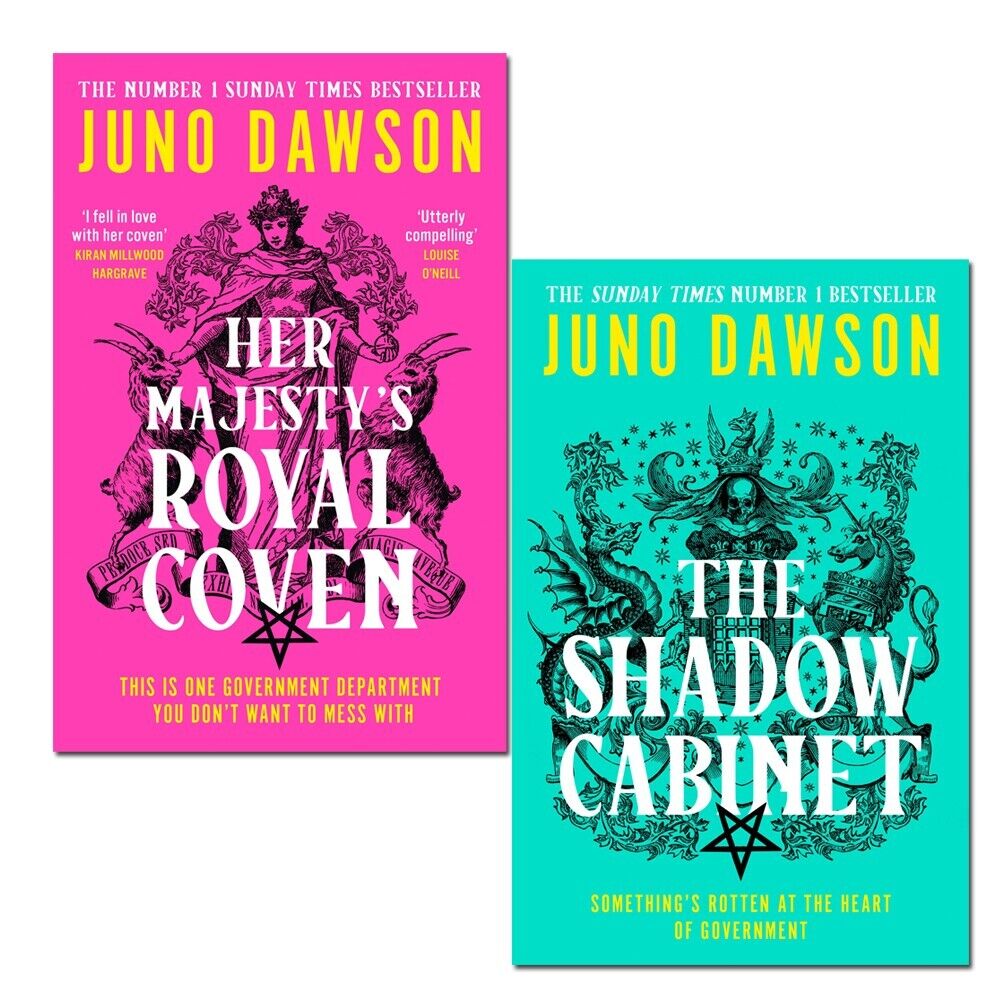
I was so looking foward to Juno Dawson’s Her Majesty’s Royal Coven. Modern witchcraft set in Hebden Bridge, which came highly recommended by both a friend whose taste I trust and the local bookstore that sold it to me? What could be better as escapist reading? In fact, I anticipated enjoying it so much that I bought the sequel before I even started the first volume and savoured my anticipation of losing myself in the West Yorkshire equivalent of Deborah Harkness’s All Souls series (recommened by another friend whose taste I trust and which I enjoy enormously).

So it is with great regret that I must inform you that Her Majesty’s Secret Coven is the lastest of my very rare ‘did not finishes’, and this was after I got over 150 pages in. Usually if I make it past page 50, I will keep going with a book, even if only out of pure bloody-mindedness. This, however, felt like too much of a slog. The characterisation was remarkably flat, particularly of the women who were portrayed as archetypes rather than indivuals. Given that this is a story predominantly about women, with a plot centring on female identity, this is a serious problem, one reinforced by a confusing plot with gaping holes in it. I spent most of the time struggling to understand what was happening or why characters were choosing to act in the ways described.

But the biggest disappointment was the aspect I had been anticipating most eagerly – the setting. As a Hebden Bridge resident, I freely admit to being an ‘offcumbden’. But the town and its surrounding villages have a unique enough personality for me to feel, even after only seven years of residence, that I know them at least a little bit. And they are definitely not the town depicted in this book. Yes, they form a small pocket of liberalism, not to say radicalism, enfolded by the Calder Valley in the more generally conservative rural West Yorkshire. And yes, the 1960s hippie vibe which is central to the town’s identity is being diluted by an influx of the professional middle classes (of which I freely admit to being one). Sitting halfway between Leeds and Manchester, even the vaguaries of Northern Rail cannot detract from the attraction of the town to commuters. But for all that, Hebden Bridge is still very much Happy Valley, not Nappy Valley. I don’t recall ever meeting a yummy mummy, as asserted in one description of a local café, and this is after five years of schoolgate attendance. Dawson appears to see Hebden Bridge as a version of Brighton in the north, which it is not. It is its own distinct place, with its own unique, often contradictory, always fascinating character, one which Dawson fails to capture.

The geography also doesn’t make sense. The book is full of descriptions of characters’ homes, but I was unable to locate any of them in my mental map of the area. The actual map that forms the frontispiece is no help, drawing as it does on the imagery of maps in fantasy novels. By the time I gave up, I found I was lost, not in the story but rather in confusion. I kept longing to find my way back tot he real world, rather than continue to make my way through a fantastical vision of the placy I call home, peopled by unreal phantasms, not people with recognisable conflicts and motivations. My recommendation is, if you want to discover the complex magic of Hebden Bridge through fiction, try the work of Sally Wainright rather than Juno Dawson. Happy Valley is on iPlayer and Riot Girls is due for broadcast this year. Or better yet, come visit, and experience this darkly enchanting place for yourself.

Catching Up

Carola Dunn, Die Laughing, 2003

Louise Penny, The Long Way Home, 2014

Louise Penny, Kingdom of the Blind, 2018

After several months (indeed years) of accumulation, over the summer I decided to make one of my periodic concerted efforts at putting a dent in my to-be-read shelf, which then stood at thirty-five books and counting. I started with wth collection of second-hand books from part way through various contemporary series that that have been recommended to me but which I have been motivated to buy unless I came across a used copy. I haven’t been entirely successful in completing this endeavour (a volumen of Sulari Gentil’s Rowland Sinclair mysteries is next on my list), but I did manage a couple of volumes from Louise Penny’s Armand Garmache series and a Daisy Dalrymple mystery by Carola Dunn.

The Dunn series is one that has been hovering at the edge of my consciousness for a number of years now. When I was reading my way through Frances Brodie’s Kate Shackleton series and Jacqueline Winspear’s Maisie Dobbs series (recommended to me by the late, great Dennis Showalter, who knew whereof he spoke), Daisy Dalrymple regularly popped up in my on-line recommendations. So it was with interest, although not necessarily great expectations, that I started Die Laughing, the tenth book in the series. Unfortunately, these expectations were definitely not exceeded. One of the blurbs on my copy states that the book is ‘For lovers of Dorothy L. Sayers’, but like so many so-called ‘cosy’ crime novels with a British interwar setting, the only Sayers-like attribute that the book has is the fact that the detective (or at least one of them) is an aristocrat (although we are told multiple times that her title is ‘only’ an honorary one).

The problem is that the novel doesn’t work as either a classic detective novel, with a focus on the puzzle element, or as the sort of social reflection that makes Sayers (and many of the other classic queens of Golden Age detective fiction) such good source material for the social historian. By splitting the detective work between an amateur who doesn’t really want to be detecting and her professional husband and his team, the novel rejects the structural formality of classic detective fiction storytelling. Sherlock Holmes explaining his reasoning to Watson and Japp or Poirot collecting the suspects in the drawing room for the unveiling of the criminal may be the stuff of cliché, but such scenes work to construct a narrative with tension by making the unravelling the work of a single intelligence. Even where the sidekick or professional assistant makes as great a contribution to that unravelling as the detective, the sharing of information needs to be integral to both the plot and laying the evidence before the reader. For a masterclass in the approach, you only have to look at the conversations between Peter and Harriet in Have His Carcase (1932), which are used to convey any facts gathered separately as well as interpret them as part of the satisfying working out of the mystery. Not so in the world of Daisy Dalrymple and Alec Fletcher where each undertakes their own investigations and the sharing of clues is perfunctory, with little reference to either the plot or the character developments

So much for the structural form of the detective story. What about the novel as a reflection of society in the interwar period? Dunn has clearly done a certain amount of research into the period, but her representation of class is clumsy to the point of farce. The middle classes are almost uniformly snobbish and racist, with the exception of Daisy’s two female friends, who are only distinguishable from each other by the fact that one is Indian (and therefore the victim of racist prejudice). The working-class characters are distinguishable by their entirely generic vernacular, with a Scots policeman apparently speaking in almost exactly the same way as a Cockney charwoman. The theme of the ‘servant problem’ is shoe-horned into the book, with little relevance to the central crime or its investigation, and drawing on debates from the late nineteenth century, rather than those being articulated in 1924. The result is that, while the reader is told multiple times that the war changed class relationships, but we are never effectively shown this. I finally lost patience with the representation of a character, introduced to late in the book to be fully fleshed out, as a Second World War-style spiv, whose service with the Army Service Corps was used as shorthand for his not having served overseas during the war. Given the the extensive work of men of this unit as motor ambulance and lorry drivers on all fighting fronts, this misrepresentation smacked, like far too much else in this book, of superficial research and lazy historical cliché.

So I will not be seeking out any more of the Dalrymple series. I am, however, more ambivalent about Penny’s Gamache series, although I can’t say I was overly enamoured of either of the two volumes I read. I know many people love this but, like Elly Griffith’s equally loved Ruth Galloway series, I found the tone too knowingly whimsical for my taste. These series are, apparently, part of a genre now marketed as ‘character-led’ mysteries (presumably as opposed to action-led thrillers) but, for me, the characters were oddly flat. The reader is told, over and over, who these people are, and even what they are thinking, but this is rarely matched by them then acting in psychologically convincing ways. The criminal in one of the stories barely registers as a character in their own right, and certainly not as the magnetic character that we are informed they are. There is also a dissonance in tone between, for instance, constant references to an aged, sweary, alcoholic poet who keeps a pet duck and is loved (inexplicably) by her neighbours, and plotlines around the distribution of carfentenil and its brutalising effects on the homeless population of Montreal, that is jarring to say the least.

Penny’s writing is good enough to make me mildly curious about how she introduced her recurring characters in the first novel in the series, Still Life (2005). However, I can’t say I feel compelled to read any more, certainly not at the moment when unregulated holiday browsing in second-hand bookshops has my to-be-read shelf to closer to forty volumes. I am glad that I finally gave these popular series a go, but equally glad that neither captured me to the extent that I will now be adding any more of their work to that shelf.

Summer Reading and Future Plans

Somehow, it is the August bank holiday weekend, and thus almost the end of summer. I am back at work (which means hundreds of emails and frantic lecture writing and lesson planning for a month before teaching starts) on Wednesday and the kids are back at school the following week. This summer seems to have gone by in a blur, over before it barely began, but it has seen two important developments, at least as far as this blog is concerned.

In the first place, I have managed to to a lot more fiction reading this summer than I have for the past couple of years. Returning to immersion in fiction as a space for relaxation and recuperation has been a joy, and I hope to carry on with this habit even as the busyness of the academic year accelerates. My-to-be read shelf has not noticeably contracted, as holiday travels have involved many bookshops and and I appear constitutionally unable to enter a bookshop without purchasing something, particularly second-hand bookshops, and there is also the list of things I want to read but haven’t quite got around (or found a good excuse) to purchase yet.

The second development of the summer was my decision (along with many others) to finally cut ties with the social media site formally know as Twitter and move my micro-blogging onto Threads, where I go by @thehistorianskitchengarden. As I originally joined Twitter to publicise this blog, in the days when there was a 180-character limit, this transition feels like a good excuse to revive and revise what I am doing on here.

My initial enrolment with Threads was due to the fact that I have an Instagram account, where I mainly post pictures of my cooking and gardening endeavours, as well as views from my morning runs and holiday walks. However, I have also been intermittently involved with the #bookstagram hashtag, primarily through posting stacks of books prompted by a theme. However, I also enjoy reading reviews of books posted on the site, and have considered posting my own, thwarted only by the incovenience of writing a detailed review on my phone keypad. Given the regularity with which I post typos due either to fat fingers or the vagaries of auto-correct as it is, attempting this on a regular basis seemed like a bad idea.

I did flirt with the idea of launching a Substack, something I may do in the future depending on the direction my writing career develops in the future, but adding an additional platform at this stage, when I already have this one at my disposal. So how I will be using this blog will change over the next few months. In addition to publicising my posts on Threads, I will be posting more (and hopefully more regular) book reviews. These will mainly be fiction, moving this site away from its focus on the First World War, although there will be some non-fiction reviews as well.

I don’t want to move entirely away from the role that this site has played as a research diary, not least because I am now working on not one but two book, a history of men and war in the modern period and a history of the returning British servicemen of the First World War. Both of these are now at the proposal stage and starting to have both argument and form. All that is lacking is sufficient time for me to write them. I will be trying to carve this out over the next year and the practice of working through ideas on this blog can only help make the process more efficient. Again, I will use Threads to help disseminate my writing, highlighting the historian as much as the kitchen and the garden of my handle.

So there will be quite a lot going on on here, I hope, and I will be updating the look of this site as part of that. There will be separate pages for the reviews and the two book projects, as well as an updated profile. There will be more photographs integrated into my posts, reflecting how I have developed my use of Threads in conjunction with Instagram. There may be some publicity for my other project, the podcast on the intersections of the First World War with popular culture, that I co-present, although I am not clear what form this will take. Finally, there will, I hope, be more scope for comment and discussion both on here and on social media, particularly relating to the book reviews. All of this may take some time, not least because, as of next week, my priority will be writing and creating the presentation slides for the eleven lectures I am due to deliver in the current term. But there will be reviews of at least some of the books I have read this summer before then, and before the start of the new year catches up to me.

The Return of Downton Abbey

DowntonAbbey2019PosterI went to see Downton Abbey, the film, last night. Well, I had to, didn’t I, given that I have written about it with enough seriousness that I am seriously considering including my article on the television programme as part of my REF submission slate? And yes, I enjoyed it, a couple of hours of beautiful costumes and historical and dramatic silliness.
But goodness me, what a shaggy dog story of a narrative! Branson alone had three different plots – a Boys’ Own Paper adventure, a Mills & Boon romance and an encounter with Princess Mary that was so underdeveloped that it’s origins and significance were completely obscure. Given that pretty much every one of the major characters, both upstairs and downstairs, had their own plot lines (sometimes multiple), encompassing pregnancy (wanted and unwanted), illness, power struggles, theft and sexual jealousy, there really was far too much going on. There was also, particularly towards the end, some extremely heavy-handed special pleading for the significance of the aristocracy to national life which felt out of time. It was, as David Cannadine has argued, ‘the period since the Second World War [which] has seen the almost total disintegratin of patrician high society’. [1] I don’t believe that Lady Mary would have needed telling by anyone that the Big House formed the centre of community life c.1927.

There were other moments where, as so often with Downton, I found it hard to sustain my suspension of historical disbelief. The relationship between Princess Mary and Lord Lascelles was one, principally because, for all the focus on the King and Queen’s anxiety about their daughter and her relationship, the characters were entirely undeveloped. I don’t know enough royal history to comment on how accurate even this superficial representation of their relationship might be in relation to the historical record. However, the dramatic arc made no sort of psychological sense purely in terms of the portrayal of the characters as human beings.

The storyline that really had me yelling at the screen (internally at least, so as not to spoil the enjoyment of my viewing companions who had kindly included me on their evening out), however, was that involving, yet again, Thomas Barrow. I have noted before how Barrow’s identity as a gay man in an era when sexual activity between men was illegal and subject to prosecution has been used by the programme to obscure more interesting histories of medicine and war disability. This time, this identity was given a social, rather than a medical, storyline to make a plea for tolerance of difference in sexuality that was framed as modern beyond the scope of 1920s imagination. Yet just because sex between men was illegal in interwar Britain does not mean that it was either unimaginable or unknown at the time. Barrow’s naive wonder at the all-male dance club that he is taken to suggests a life entirely sheltered from same-sex encounters. Yet we know that he served as a soldier during the war, when the sight of men dancing together would not have been either unknown or particular shocking in male dominated spaces of rest and relaxation. Nor, indeed, as Helen Smith has pointed out, would Barrow have had to have left Yorkshire to encounter the idea of sex between men as part of a range of expressions of sexual desire (although the club itself appears to be a less likely phenomenon to be found in a city like York). As Smith notes:

Encounters took place all over the region, and were not limited to large towns and cities. … Away from work, men met in pubs, cafes, toilets, urinals and the street, often with the purpose of sex in mind. However, the north differed from London, as well as from large American cities such as New York and San Francisco, in that these venues of sex and socialisation did not become linked to form a distinct and often visible subculture. These examples of sex between men still operated under the veil of discretion and privacy … and this ensured that venues where men could meet other men for sex remained part of the wider landscape of working-class social life and entertainment. [2]

Smith’s argument is mainly concerned with working-class men in industrial occupations in the region. Working in domestic service in a rural location may have isolated Barrow, but I can’t quite believe that, at his time of life, he would be as innocent as he is portrayed here.

None of which is to suggest that I didn’t enjoy the film, not least because one of the pleasures of watching Downton for me has always been the opportunity to pick historical holes in the plot and presentation. But there were also incidental pleasures: drooling over the costumes, particularly the hats and tiaras, the former of which has inspired me to branch out from my collection of cloches to search for a) something like Lady Mary’s feminine pseudo-Homburg and b) an a-symetrical number as modeled by the incomparable Dowager Duchess of Grantham; the joy of  Maggie Smith out-act everyone else on screen with the mere lift of an eyebrow; watching Smith, Penelope Wilton and Imelda Staunton enjoying themselves doing what they love so well. And there were the cultural references, intended or not, which kept me amused throughout. From the visual reference of The Night Mail in the opening sequence through the BOP and Mills & Boon plots involving Branson already noted to the undeniable overtones of Bertie Wooster’s morning-after recollections in the raid on the nightclub, Julian Fellowes once again plundered the culture of interwar Britain for his ideas and images. There was even a bit of Laurel and Hardy slapstick in Mrs Patmore’s subversion of Mr Wilson.

So, yes, I enjoyed myself. The film ticks all the boxes I wanted it to – luscious visuals, good, comforting acting by familiar faces, some good, if rather obvious jokes, and just enough historical anachronism to keep me nicely irritated. I’m not sure I would recommend it as such, but I am glad to have seen it.

[1] David Cannadine, The Decline and Fall of the British Aristocracy (New York: Anchor Books, 1992), p.691.

[2] Helen Smith, Masculinity, Class and Same-Sex Desire in Industrial England, 1895-1957 (Basingstoke: Palgrave Macmillan, 2015), p.154.

Looking back; looking forward

1868_LittleWomen_RobertsBros_tp copy

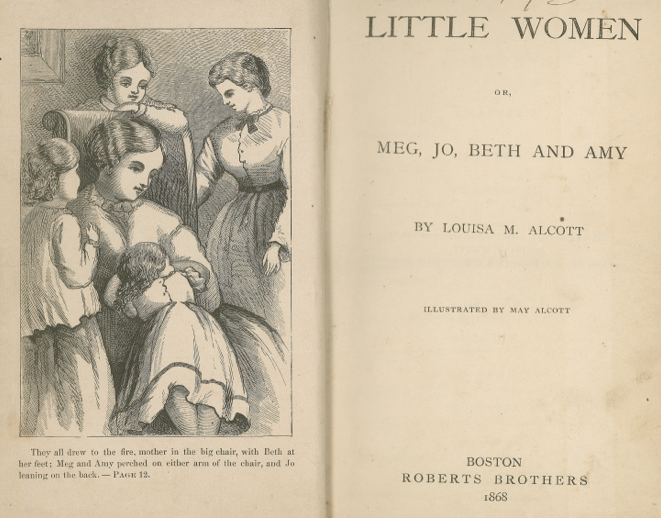
It has become a bit of a tradition with me that I start the new year with some form of comment, often grumpy, occasionally laudatory, about the one of the historically-based or costume dramas that has been shown on British television over Christmas. (I am including Sherlock in the ‘historically-based’ category here as, despite the modern setting, the raison d’etre of the series is its connection to its literary inspiration.)  This year is going to be a grumpy one, and my subject is, I am sorry to say, the BBC’s three-part adaptation of Little Women (BBC1).

I was really looking forward this programme. Emily Watson (who plays Marmee) is one of my favourite actresses, Angela Lansbury as Aunt March was an inspired bit of casting, and I always enjoy Call the Midwife (BBC1) created by adaptor Heidi Thomas. Above all, the original novels, Little Women (1868) and Good Wives (1869), were an enormous part of intellectual and cultural development as a child and young women and I continue to re-read them on a fairly regular basis. As with many other women raised in the Anglophone tradition, these novels, like those of L.M. Montgomery, E. Nesbit and Frances Hodgeson Burnett have, for better or worse, shaped the woman I am today.

To be honest, I’ve never been a huge fan of screen adaptation of Alcott’s classic novel, of which there have been a remarkable number (two silent versions, released in 1917 and 1918, three major Hollywood productions in 1933, 1949 and 1994, plus a 1978 television mini-series featuring William Shatner as Frederic Bhaer). In those that I have seen, the tendency has been to focus on the sentimentality of the novels (and Beth’s death in particular) at the expense of the acute reflections on Civil War-era New England society (and the gendering of that society) that forms the heart of the novels themselves.

To be fair, this is not something that this latest adaptation can be accused of. There are lingering shots of dying Civil War soldiers; the poverty of the Hummell children is depicted as deeply shocking, and Hannah, the Marches’ Irish maid is one of the more well-rounded characters in the drama. And yet these attempts at social realism seemed to miss so much of the complex social reality that Alcott was not merely depicting but actively critiquing in her novels.

Two things, I think, were at play here. The first was the attempt to fit as many of the multiple events that form the novel as possible into three hour-long episodes, rather than simply eliminating extraneous ones. As a result, some key episodes are seriously truncated, while others have their chronology muddled. Both adaptive strategies eliminate much of the subtext that Alcott inserts (not always subtly) into each of her stories within stories. Setting Amy’s valley of humiliation with the pickled limes after the departure of Marmee for the South to nurse her husband puts Jo in the role of the outraged maternal figure, rejecting corporal punishment, rather than Marmee, so that the episode no longer reflects on the polemical ideas about the appropriate way to raise and school young women that are so evident in the text.  The shortening of the ‘Camp Laurence’ episode, meanwhile, to Miss Vaughan’s snubbing of Meg and Beth’s self-sacrifice in talking to one of the twins (who is portrayed as temporarily incapacitated rather than crippled, as in the book), reduces a wider message about American self-reliance in comparison to European class consciousness to a caricature, while failing to fully capture the heroism of Beth’s actions. Most noticeably, the relationship between Beth, Jo and old peppery old Mr Lawrence is so underwritten as to have the emotion removed from it entirely, again reducing Beth’s characterization to a cypher, while criminally under-using Michael Gambon in the role of Mr Lawrence.

It is, of course, impossible to fit everything into a mini-series of this length, but these strategies, combined with shortening the overall trajectory from five years to less than three means that character development is seriously compromised. Amy and Beth are, as usual, cast far too old to begin with (they are 12 and 13 in the book), and all Beth’s ‘rosiness’ is eliminated in favour of portraying her as a permanently frail introvert. And this points to the second reason for my disappointment with this adaptation, namely the modernization of the characters to deliver a message about female agency which results in what felt like a series of mis-characterizations.  Jo’s independence becomes something to be celebrated rather than schooled; Marmee becomes a frustrated house-wife; even Aunt March gets an anachronistic feminist speech of regret in the final episode. Yet this, for me, misses the great joy of the book, which tackles head on the complexity of white womanhood, young and old, in mid-nineteenth century England. The process by which Jo goes from immaturity to adulthood, the challenges that Marmee faces in raising her children in a society increasingly defined by consumption, Meg’s failures at domesticity and the consequent negotiation of marital relations, Beth’s courage in facing loss of health and ultimately death, Amy’s search for a purpose that uses her skills but does not require genius, Aunt March’s loneliness and social isolation – all these plots have contemporary echoes which this programme, in its rush to tell so much about the limits of nineteenth century society for women, missed.

For me, the emblematic scene thus became the final one, with Marmee sitting surrounded by her surviving daughters in the orchard at Plumfield. The camera cuts to their menfolk – Mr March, John Brooke, Laurie and Professor Bhaer. In the book, this scene is one of mutual affection and endeavor, the statement of Alcott’s view that a successful life involves the mutual aid of family, with men and women both having roles, rather than personal independence.  Yet in the programme, the men have been so reduced (with Professor Bhaer in particular barely allowed time to develop at all, as well as being far too young), that the message appears to be that they have been sidelined in a manner that is profoundly a-historical. Misrepresenting historical reality in this way in a work of fiction is not in itself problematic, but this, for me, misrepresents the source text in ways that undermine the whole adaptation.

Alcott, it is worth noting, was the daughter of Amos Bronson Alcott, an educator, philosopher, reformer and member of the Transcendentalists. Her father’s progressive ideas about education and the raising of children are reflected in many of her novels, not only Little Women, but also Eight Cousins (1875), which articulates the case for women’s dress reform, its sequel, Rose in Bloom (1876) and An Old-Fashioned Girl (1870). These latter two, along with the sequels to Little Women, Little Men (1871) and Jo’s Boys (1876), are explicit in their exploration of the desirability for women’s independent labour outside the home, and the tensions that this raises with many women’s desires for marriage and family. The novels all end, in good sentimental Victorian tradition, with weddings. However, the portrayal of Jo’s ultimate success as a writer occurring well after her marriage in Jo’s Boys and the insistence on Rose Campbell’s independent philanthropy in Rose in Bloom and Polly Mason’s self-reliance even in face of her lover’s poverty, points to Alcott’s refusal to see women’s work and the achievement of domesticity as mutually exclusive.

The window into the past that Alcott’s work offers, therefore, is one that exhibits a nuanced and complex reality, a past populated by women and men attempting to negotiate tensions and contradictions and, more often than not, succeeding. Little Women draws its loyal readers back again and again not only because of its overt sentimentality (as comforting as that can, upon occasion be) or because we see ourselves reflected in it (although, as the commentary around the television programme demonstrated, many women do identify strongly with the four sisters, and Jo in particular), but also because it shows us a world at once very different from ours but nonetheless asking many familiar questions of women seeking find their own way in a world and suggesting that we may, in fact, be able to find it, but not without cost. In seeking to impose a narrative of frustrated modernity, rather than exploring how the March sisters successfully negotiated these oh-so-familiar challenges, this latest adaptation, as visually beautiful and beautifully acted as it was, was ultimately a missed opportunity.

Women, Gender and Sexuality visit Women, Work and War.

A guest post from Laura Boyd, a second-year PhD student in the School of Languages, Cultures and Societies at the University of Leeds. Laura is researching the work of non-combatant male medical caregivers in Britain and France during the First World War, and is a postgraduate member of the Women, Gender and Sexuality Research Cluster.

On 8 March 2017, the Women, Gender and Sexuality Research Cluster at the University of Leeds had the fantastic opportunity of a guided tour of the Women, Work and War exhibition at Armley Mills, followed by coffee and a chat. We were a mixed group of academic staff and postgraduates, from MA to Ph.D level in the Faculty of Arts. Guiding us was Lucy Moore, the Project Curator for First World War and member of the Legacies of War Project.

The visit began with the guided tour. The exhibition was wonderfully curated, and gave a real insight into the lives of the women working in and around Leeds during the Great War. These women came from all around Leeds and indeed much further, and took over the jobs in factories that were left by men who had gone off to war. Though it started in Armley, the factory expanded to the Barnbow site and employed large numbers of women.

Not only did it portray the ‘general’ or ‘bigger picture’ of the lives of these women who worked at Armley and Barnbow in the munitions factories, but was interspersed with personal stories. Lucy showed us around the different exhibits, including munitions and clothing, and shared other anecdotal tales that were not on display, taken from the writings of the ‘Canary Girls’ themselves. The exhibition featured personal accounts of the 1916 Barnbow explosion, which really brought home just how dangerous this behind-the-lines war work was. We even had the chance to have a sneak-peek at an original medal press that is currently awaiting restoration!

We then sat down for coffee and a chat with Lucy, and we began by asking about her own career progression into becoming a curator. Her answer? Refreshingly honest! And by that I mean that it wasn’t a straightforward, linear progression, as these things rarely are. A few of the postgraduates in attendance were interested in hearing about how to get into her line of work and Lucy gave us some great tips on how to get started.

This led to a discussion of the academic buzzwords ‘impact’, and ‘partnerships’ between academics and the community. Though these words tend to scare people like me, it was actually a really insightful and interesting discussion. Both Dr. Jessica Meyer and Lucy Moore are part of the Legacies of War Project here at Leeds, which they were delighted to talk about. Lucy was open about how the academic world has helped create interest around exhibitions such as Women, Work and War. Not only through organising trips such as ours, but by spreading the word among colleagues and at other academic events such as conferences and seminar series. She also said that she is happy to have connections to which (and whom) she can turn for information and help. Jessica was also keen on this point, telling us how the museum had also helped greatly in terms of ‘impact’, by helping the academic world bridge the gap between us and the public, leading to some fruitful and fascinating interactions. She also noted that often independent researchers involved in projects such as this come with knowledge and sources often unknown to academics!

So, to sum up, it was invaluable. Academic-community partnerships can help to get the public interested in what we do, and in turn can, through these partnerships make our research available to all. I would wholeheartedly suggest that if you have not yet been to the exhibition – GO! It will be well worth it, I promise.

A (belated) report from the wilds of Borsetshire

A recent post on Twitter asked if we are starting to witness the demise of the personal academic blog, at least in the field of history. Reasons put forward for the decline in the number of posts being written were pressures on time, developments in the research cycle (implicitly related to the increased imminence of the Research Excellence Framework) and variations in the teaching cycle, as posited by George Gosling.  Concern was also expressed that blogging was coming to be viewed as a requirement of postgraduate and early careers scholars, rather than more established ones.

I didn’t respond, all too aware that it has been months since I posted anything here, and even more since I directly posted anything related directly to either of my research projects.  This is due to all of the above reasons. I am teaching this term, not much but a new module that requires a certain amount of additional preparation and organisation.  I have committed myself to a large number of speaking engagements and forthcoming publications, as well as helping to organise two conferences.  On top of my research commitments and administrative obligations, this leaves me little time for writing the remaining chapters of the book, let alone reflections for the blog. And then there is the question of what I write about.  While I agree that blogging should not be the sole responsibility of PGRs and ECRs, I am becoming increasingly aware that it is easier to blog about searching for a job than it is about applying for promotion.  Similarly, blogging about ideas at the start of a project enabled me to work through key themes in ways that now seem to have less utility as I actively incorporate them into the book. If I am going to write about these ideas, I need to do it as part of my manuscript, not as a shorter reflection.

Which doesn’t mean that I don’t have things to write about (beyond my despair at the current political situation).  There are stories emerging from the new research project, although as this has its own blog now, I tend to reserve them for that forum.  And the number of speaking engagements I have undertaken means I am regularly coming into contact with the work and ideas of others which is giving me much food for thought and which is worthy of putting on record.

Which brings me to the Academic Archers conference, possibly one of the oddest but also  among the most interesting academic experiences I have had since I spent two days up to my ankles in mud talking about medical care on the Somme last summer.  This was the second annual conference organised to bring together academic analysis subjects based on or inspired by Radio 4’s long-running rural soap opera and the immensely knowlegable ‘Research Associates’, the long-term listeners whose knowledge of the world of Ambridge and Borsetshire is unrivalled in terms of breadth and depth.  Papers presented range from sociological analyses of familial relationships among prominent family groups, and the wider social implications of the resulting (matriarchal) power structures through an examination of the programme as an exemplar of rural theology to a discussion of the social standing of male characters and the relationship to perceived penis size (a phrase I never thought I would type on this blog or, indeed, anywhere else).

Arguably this was all tongue-in-cheek good fun, something not to be taken very seriously but to be played predominantly for laughs.  Certainly the most popular papers, such as the ones picked up by the press looking at negative aspects of competing in village flower and produce shows, and the ‘Ambridge Paradox’, or why all the characters don’t suffer from type 2 diabetes, involved much laughter along with the learning.  But there was very serious scholarship being undertaken here as well.  The session focussing specifically on the Rob and Helen story line of domestic violence and coercive control was sobering not only in terms of the subject matter, but also in relation to the information conveyed, whether on the forensic analysis of blood spatter patterns or the cost per day of food for women in prison.  Additionally, my understanding of my own work has been enhanced by a number of papers.  I have come away with a long list of recent sociological texts on masculinity, disability and violence taken from Katherine Runswick-Cole and Becky Wood’s paper on the use of the stoma bag in representing Rob’s disability and Jennifer Brown’s keynot on using Rob to understand the antecendents of domestic violence perpetration. Amber Medland’s concept of culinary coercion, while derived from the domestic context of Rob’s control of Helen, has opened up questions for me about the regulation of food in the institutional setting of the military hospital.  And I am looking forward to learning a lot more about masculinity in post-Second World War literature, particularly as it relates to birdwatching, in the on-going work of Joanna Dobson.

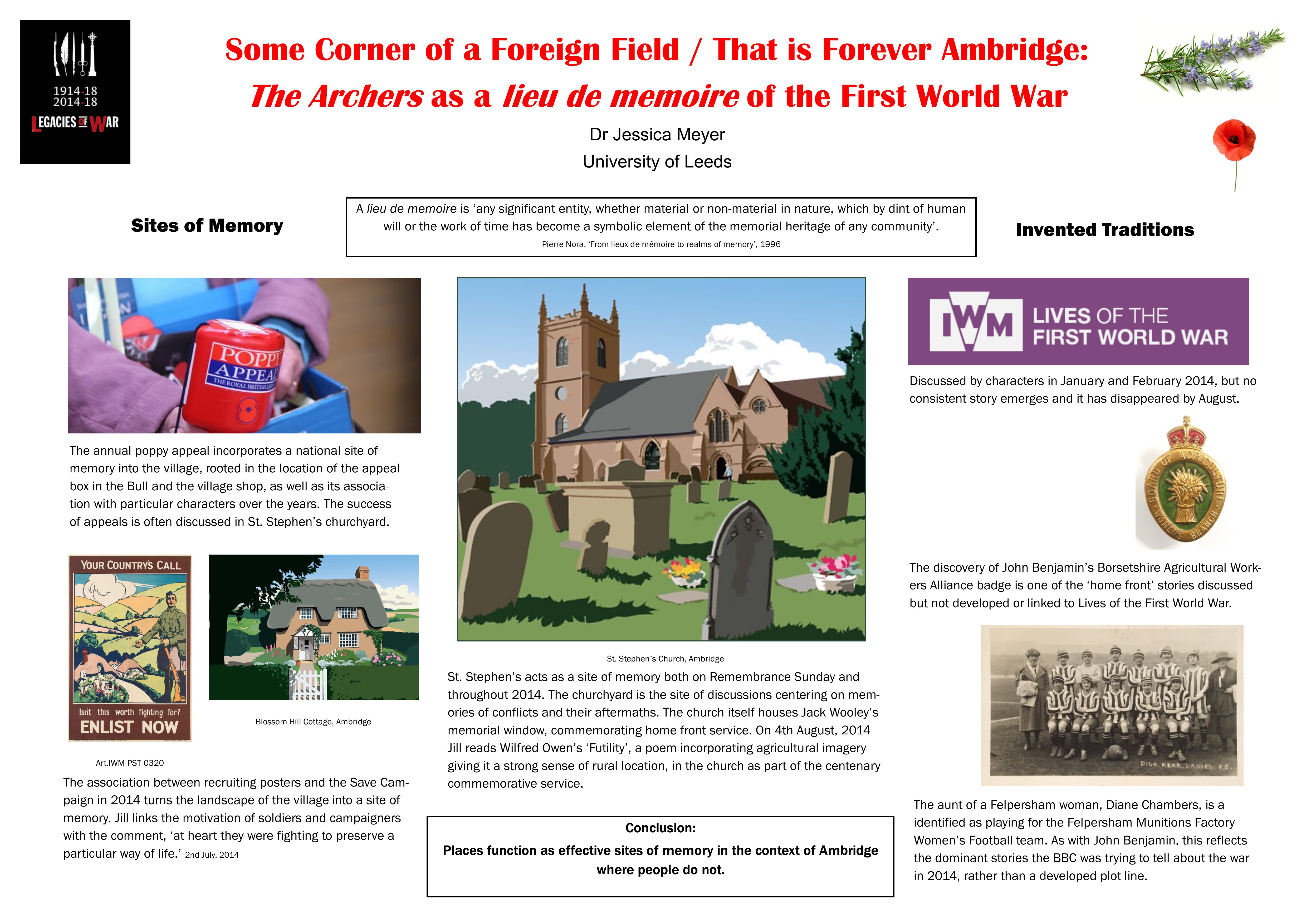
As for my own paper, I’m not sure I got the balance between humour and scholarship quite right.  ‘Erudite’ was one description of it, and I can only apologise to the tweeter whose brain apparently hurt when I finished speaking.  But the opportunity to explore how this particular artefact of British popular culture has memorialised the First World War – and to use the title ‘Some Corner of a Foreign Field/That is Forever Ambridge’ – was too good an opportunity to miss.  Among other things, it provided me with the opportunity to design an academicMeyer Poster poster in collaboration with some very excited and supportive colleagues. [1] I will, I hope, be publishing an extended version of the paper in the forthcoming edited collection (the one from last year’s conference is a beautiful object, available to buy from Amazon).  Writing it up will enable me to engage more fully with debates around imagined communities and invented traditions than I have done since I was a post-graduate, a useful exercise that will enhance my other academic endeavours.

And, in a sign of just how stimulating and welcoming the conference was, I’m already considering the topic of next year’s proposal. Leading the field is a plan to recreate the Ambridge War Memorial using the information from English Heritage uncovered by Laurie MacLeod, one of the attending RAs.  I’m even thinking about putting together an application to the Heritage Lottery Fund, if any of the Academic Archers community would like to form a group to work on this.  And I know there are several other First World War historians, many more eminent than I, who might be persuaded to trace the progress of the Borsetshire Regiment on the Western Front, analyse the minor poetry of Lt. Rupert Pargeter, explore the records of the Borsetshire Military Appeals Tribunal or discuss the impact of the use of women and prisoners of war in agricultural labour on wartime Ambridge.  I hope they will consider putting in a proposal when the call goes out.  The experience, both intellectual and social, will be well worth it.


[1] My thanks to Sara Barker, Tess Hornsby-Smith and Sabina Peck for their encouragement and insight.

Conference Report – Resistance to War

Following on (rather belatedly) from my last post, one of the conferences I was only able to attend partially in March was the Resistance to War conference, held in Leeds on 18th-20th March.  In addition to Twitter, an important, and more established, way of keeping up with conferences that one can’t attend in person is via conference reports.  It gives me great pleasure to publish a report of the Resistance to War conference written by Charlotte Tomlinson, a former undergraduate and current MA student in the School of History, University of Leeds, and founder of the HUll Blitz Trail project (which can be followed on Twitter @hullblitztrail).  My thanks to Charlotte for taking the time to write and reflect on what sounds like a fascinating few days.

As the centenary of the First World War has come upon us in the last two years, scholars across fields have turned their attention to the conflict and offered new ways to look at it. As well as encouraging commemoration and highlighting traditional narratives, the anniversary has inspired fresh perspectives and uncovered previously untold (or at least under-told) stories. One such strand of new thought was recently celebrated at the Resistance to War conference, held in Leeds March 18th-20th. It was a truly international event, with speakers visiting from stretches as far as Auckland, and covered an equally diverse scope of subjects relating to resistance to war. Inevitably then, the conference encouraged consideration of a less traditional approach to the First World War. However, as all papers seem to, the event had me thinking more broadly about how we, and I, approach histories of war.

The event began with a series of panels exploring different aspects of war resistance. I decided upon one which explored resistance and gender through the lens of wartime literature in France (Philippa Read), Germany (Corinne Painter) and Britain (Sabine Grimshaw and Sarah Hellawell). After four extremely interesting talks, and a few books added to my ever-growing summer reading list, it was a question on how these works were received at the time that really peaked my interest. Not in the answer, but in that it made me contemplate how we use literature in history more widely. As happens so often lately, I found myself pondering the representation vs reception debate, comparing the cultural and social approaches to sources such as those discussed. While our own readings of literature are insightful, and were hugely fascinating to listen to, the panel left me with more questions about my own research than theirs.

The following day, another question of how we approach history left me a little more excited. In a fascinating talk on two ‘gender dissidents’ of the early twentieth century, Conscientious Objectors and Suffragettes, Lois Bibbings argued for a more complex understanding of how the two groups used gender in their resistance. In doing so, she highlighted how Emmeline Pankhurst’s WSPU used fashion as a method of resistance, how suffragettes ‘consciously played on gender’ by maintaining a prim and proper appearance in order to defend their femininity, and oppose media representations of them as unruly and manly. In a later conversation, we discussed how the loss of control over appearance was also central to the suffragette prison experience. It was encouraging to see how the issue of fashion, so often overlooked as a trivial matter, could be integrated into an analysis of war resistance and I was left feeling quite uplifted about the potential for this research to be taken further in the future.

Another talk inspired a less encouraging but equally interesting reflection, on how collective histories continue to shape how researchers approach resistance to war. The huge success of the conference showed how far we have embraced less typically-glorified narratives of the conflict which do not place the volunteer soldier suffering in the trench as the quintessential war narrative. Benjamin Ziemann’s keynote paper, on German soldiers who refused to fight from July 1918 onwards and how these have been remembered in Germany since, did however cause me to consider how we approach war resisters who were not pacifists. Crucially, a point was raised about the likelihood that a similar project would be undertaken on British so-called ‘cowards’. While popular opinions of war resisters has undoubtedly altered in past decades and become more positive, it was rightly argued that our changing cultural memory in Britain of heroic fighters or brave COs has not yet allowed a shift that adequately acknowledges our ‘cowards’ too.

It is hardly surprising that Cyril Pearce’s paper proved thoroughly inspiring. His work continues to influence scholarly thought on conscientious objectors and encourage new work. It was not his insights into war resistance here that had me thinking though, but his approach. In using statistics and maps to explore the pattern of conscientious war resistance in Britain, the paper was undeniably unique in a historical conference. Outside of economic histories, it is perhaps unsettling for many of us to deal with such mathematically presented ideas, but by mapping COs it was easy to highlight resistance hotspots and identify interesting communities that require further study. Ultimately, it was refreshing and inspiring to see an approach many researchers, myself included, would usually shy away from and provided a visual exploration of COs that really brought the issue to life.

Finally, a paper on the infamous Alice Wheeldon left me thinking about the significance of new perspectives on war resistance beyond the weekend conference, and beyond academia. A moving paper was given by Nick Hiley and Wheeldon’s great granddaughter, Chloe Mason on how the conviction of her family for conspiring to murder the then Prime Minister Lloyd George should be overturned. Hiley and Mason unpacked the case and highlighted the secrecy surrounding it, explaining how they are now appealing for the conviction to be quashed. In doing this, rather than reflecting on war resistance as much of the other papers had, the paper reminded us that our memory of war and war resistance remains a contemporary issue that touches lives today.

Driving home after a long couple of days, my (non-academic) dad asked me, ‘so what’s the point in a conference?’ What followed was a lengthy answer which I don’t think he was quite expecting. In the first instance, the papers given offered interesting insights into many areas of resistance to the First World War, some related to my own research, some not. But more importantly, the papers, as always, left me with a number of questions and points to reflect upon, a few of which I have briefly discussed here. These relate above all to how both I, and we, approach history. So more than just gaining knowledge and enjoying papers from across the globe in a celebration of centenary research, I left the conference with a greater self-awareness of myself as a researcher. Once again I was reminded that no matter the topic, there is always something to be learned in hearing about another’s work.