The Book I Wish I Had Written

The culture section of the Saturday edition of a major British newspaper runs a regular column in which celebrities in the arts are asked to identify subjects from their cultural life such as ‘The book I am currently reading’, ‘The instrument I wish I had learnt’ and ‘The last film that made me laugh/cry’. These lists are always fun to play along with but, while my answer to topics such as ‘My favourite piece of music’ has changed over the years, my answer to the regular question ‘The book I wish I had written’ has long remained the same: The Great War and Modern Memory by Paul Fussell.

Celebrity answers to this topic tends to be couched in terms of either a personally inspirational text or a best-seller that made the author a lot of money. In my case, the answer arises from a mixture of both. I first read The Great War and Modern Memory as a freshman, a first year undergraduate in my first semester at university. I thought at the time that I wanted to be an English major. By the end of the year, I knew that I would be a history major. This shift was only in part down to Fussell’s pivotal work of cultural history (Geoffrey Parker’s lecture on the possible role of sunspots in the development of early modern military strategy also had something to do with it), but what the book undoubtedly informed was my commitment to history that took fiction as one of its primary sources. This would shape not only my undergraduate module choices but the topic of my senior essay (an analysis of Ford Madox Ford’s Parade’s End tetralogy and R.H. Mottram’s The Spanish Farm trilogy as representations of the Western Front), but also my master’s and doctoral theses as well as almost every major work I have published since.

Of course, my view of Fussell’s work has evolved since then but that ‘heady mixture of literary criticism and cultural and historical analysis’ [1] remains deeply alluring as a point of reference not necessarily as a cultural history of the First World War, but as a pivotal moment in the cultural turn in First World War studies. As Ian Isherwood and Steven Trout argue in their excellent recent review article, ‘But It Still Goes On: Paul Fussell’s The Great War and Modern Memory at 50’, ‘the book is perhaps best approached as a an experimental study – a hybrid mixture … of  literary scholarship, cultural analysis, historical writing, and veiled autobiography.’ [2] This hybridity, if not Fussell’s argument about the centrality of irony to a Modernist paradigm shift in cultural expression, has gone on to inform the approach and ambition of major works in the field, including Samuel Hynes’ A War Imagined (1990) and Jay Winter’s Sites of Memory, Sites of Mourning (1995), as well as many of their students, among whose number I include myself. And, in ‘reigniting a debate from the late 1920s and early 1930s over literary treatments of the Great War and their portrayal of disillusionment supposedly shared by an entire generation’ [3], Fussell helped shape what we now define as the canon of British First World War literature as surely as any writer, publisher or critic of the ‘war books’ boom. We cannot understand not only how we in Britain and the US remember the First World War today, but how it is represented in contemporary cultural forms. Alice Winn’s almost constant references to Robert Graves’ Good-bye To All That in In Memoriam (2023) provides only the most recent testimony to Fussell’s historiographic influence.

It is, as Isherwood and Trout note, the representativeness of the authors selected by Fussell for analysis that lie at the heart of many of the critiques of his approach. Yet representativeness was never really the point: ‘Drawn … to highly literate, middle-class junior officers like himself (albeit members of a different army in a different war), he never intended to write a comprehensive study of British Firs World War literature or, for that matter, an exhaustive treatment of British culture before, during, and after the conflict.’ [4] But that debate, with its echoes of the critiques of Douglas Jerrold and Cyril Falls [5], highlights an issue that those of us who use fictional, semi-fictional and poetic sources in our research and analysis still grapple with today. No cultural history of the war can ever be comprehensive, either in breadth or depth, particularly when the conflict is considered in global rather than national terms. How do we choose which texts to focus on? How do we balance close reading of the symbolism of particular texts with broad claims about the culture in which they were produced and which they sought to shape?

It is here that Isherwood and Trout’s identification of the importance of autobiography to Fussell’s endeavour spoke most strongly to me. Unlike Fussell (or indeed Hynes), I am not trying to use my practice of cultural history to grapple with experiences as a former soldier. I make no claims to, as Fussell did, to sharing a bond of experience with the authors he selected for particular consideration. But I have always been aware of the extent to which my own personal preferences and youthful exposure to particular literary works has shaped the texts I have chosen to focus on (the work of Dorothy L. Sayers being the most obvious example), as well as my vulnerability to the critique levelled by Charles Carrington against Fussell, that the analysis of someone who wasn’t there can never be a true history of the war. Indeed, as a newly minted PhD, I was bluntly told by one ex-serviceman (himself too young to have served in the First World War), that my thesis on representations of wartime masculinities was worthless because I was not a man and had not myself served in the war. (My gender and age clearly trumped my nationality in this instance as my critic chose not to point out the fact that, like Fussell, I am an American.)

So I take comfort from Isherwood and Trout’s argument that ‘Fussell’s status as a cultural outsider … sharpened his insights … and emboldened him to say things that he might not have if he had been British…. [H]is distance from the war’s living memory enabled him to study the “troglodyte world” of the trenches and the mythology it produced with fresh eyes.’ [6]  Which is not to say that I necessarily take comfort from the text itself, which remains as challenging and provocative today in many ways as fifty years ago. For me today, the particular challenge of the autobiographical element is the most stimulating as I grapple with the ‘genealogical’ or ‘family history’ turn in social history, as exemplified by the work of Alison Light, Michael Roper and, most recently, Laura King. My family’s history doesn’t fit neatly with the history of the First World War, challenging cultural narratives of the war’s universality. But is this distance a handicap or a benefit? As I grapple with these questions as part of the process of writing my own book, The Great War and Modern Memory will continue to remain as much of an inspiration for my historical practice as it was when I first read it thirty years ago

[1] Ian Isherwood and Steven Trout, ‘But It Still Goes On: Paul Fussell’s The Great War and Modern Memory at 50’, The Journal of Military History, 89 (January 2025): 155-170 (160).

[2] Isherwood and Trout, ‘But It Still Goes On’, 158.

[3] Ibid., 160.

[4] Ibid., 160.

[5] Douglas Jerrold, The Lie About the War: A Note on Some Contemporary War Books (Faber & Faber, 1930); Cyril Falls, War Books: A Critical Guide (Peter Davies, Ltd, 1930)

[6] Isherwood and Trout, ‘But It Still Goes On’, 168

Not Doing Family History

Last week I attended the Social History Society annual conference, held this year in Essex. It was the first time I attended this conference since 2013, when it was held in Leeds and where I presented my first paper on what would eventually become An Equal Burden. This time, I presented not-quite-the-first paper on what I intend to be my next book, on the social history of demobilization after the First World War in Britain.

It was an enjoyable, if hot and exhausting, few days. The Essex Business School in built on the precepts of a tropical glass house and, despite a torrential downpour which deafened us on the first day, the humidity remained a noticeable factor throughout. And there were a lot of papers to cram in, particularly on the final day when I spent a fair amount of time dashing around the building, trying to hear as much as possible. But it was lovely to catch with old friends and colleagues, some of whom I hadn’t seen in person since well before the pandemic, and hear about exciting new research, particularly from postgraduate research students. Honor Morris and Mandy Barrie, both writing about working-class women’s experiences of feminism at either end of the 20th century, produced engaging and intriguing analyses which makes me excited to read more of their work. Clare Tebbut’s paper on a complicated story of a trans(?) marriage in the interwar years, and Jessamy Carlson’s discussion of child protection in the same period, both chimed with my own work, prompting me to rethink the significance of my arguments about the time frame of developments in the entangled relationships between the domestic and state welfare provision.

The highlight of the panels I attended, however, was the final session on Friday, when Julia Laite, Cath Feely, Laura King and Lucinda Matthews-Jones discussed their uses of their own family histories in their historical work. Separately, the four papers were fascinating studies in their own right; together, they suggest important new methodologies for those of us who work on histories of emotions, material objects and the everyday. This was, in fact, the second event on the topic that I had attended in as many weeks, following the roundtable discussion hosted by the IHR’s Contemporary British History Seminar, where Julia and Laura spoke alongside Michael Roper and Matt Houlbrook, both of whom have written or are writing histories which included consideration of their own families. That so many important historians in fields related to my own (and who I have had the honour of working with over the years) should be developing practice in this area suggests that this is an approach I need to consider exploring in my own work. Certainly listening to Cath’s discussion of the ways in which her great-grandfather’s death was mythologised through his First World War service, and how the wider historical context and her expertise as a local historian shaped her research into the story, suggested a number of questions about the returning soldier and the legacy of the First World War that I want to pursue further in my own work.

But that work won’t be through my own family history and Friday’s panel, in combination with the IHR seminar, has forced me to think about why not. After all, I have my mother’s archive, including both her own papers and the research she conducted into her parents’ histories in the final years of her life, sitting in my spare room in half a dozen boxes. Why not use them as a springboard for my discussion of 20th century domesticities, or integrate the information they contain into my analysis? No, the connections between my family’s history and the First World War are not obvious, but I am, at least in part, a historian of the everyday in time of war. There may be relevant stories of the quotidian in my own family’s experiences of the war. And, even if there are not, I do not need to be defined solely as a First World War historian for my entire career, even if this is how I predominantly see myself. Indeed, my current project is not about the war itself but about its resonance through the lives of those who lived through it throughout the rest of the 20th century. Surely there will be members of my family whose lives can help me explore the process. If not, there must be other stories they can tell of 20th century British social history, from the intimate variation on the special relationship that was my parents’ marriage to the changing nature of women’s employment across at least two generations. Why should I not think about exploring these?

And yet I still find I cannot. My mother’s archive sits in the spare room unexamined, as it has done for four and half years now. There is always something more urgent to do, either professionally or privately, than opening those boxes and exploring their contents. And the reason for this avoidance is that the emotions that such research would evoke are still too powerful for me face in order to do this work.

In the discussion session following Friday’s panel, Michael Roper asked about the role of grief in the work each of the panelists were undertaking, pointing to the ways in which his own work on his family’s history, incorporated into his new book, Afterlives of War, formed part of the process of grieving for his late father. And maybe someday I will be able to use my mother’s archive to work through my grief over losing her too early at 73. But the primary emotion I feel when contemplating those boxes and the work that they represent, both that done already by my mother and that which I would need to do to integrate them into my historical practice, is fear.

I am still working out what, precisely, I am so frightened of. It has, I am sure, something to do with the anger I still feel about my mother’s death, an anger that swells every time I read of another celebrity dying of pancreatic cancer. But there is also the fact that the history contained in the files is that of my mother as much as that of my more distant ancestors. As I noted in my own question to the panel, none of them were working directly on histories of family members more proximate than grandparents. I asked if they thought too-close generational proximity makes the work of integrating family history and academic history harder. As the discussion touched on, proximity brings into focus the fact that family histories are, in the end, emotional histories and these emotions, as Laura King argued in her paper, are a direct challenge to the idea of the pre-eminence of objectivity in professional historical practice.

I am, among other things, a historian of emotion, something I was reminded of listening to Julie-Marie Strange’s tribute to Joanna Bourke on her retirement earlier this week. I am one of the many heirs and beneficiaries to Joanna’s pioneering work in the field, which has and continues to profoundly shape the questions I ask, the sources I explore, the arguments I make. And I do not merely analyse historical emotions but engage emotionally with the past. I regularly respond to the grief of wartime loss or the anger of injustice in the treatment of the disabled or dispossessed when reading archival sources. But when asked to consider my family history, I do not know how to manage the emotions it makes (or threaten to make) me feel. Even contemplating  the boxed archive feels overwhelming and, to protect myself, I continue to turn away.

Citing Richard White’s Remembering Ahanagran, Laura spoke of the cruelty inherent in intimate histories of subjectivity and emotion which rely on the analysis of the stories that individuals tell about themselves. I am all too aware of this, having provoked fury on the part of one descendant of a man whose diaries I quoted in my first book, who felt that my interpretation was an insult to his ancestor.  This is also a point that has been made in relation to personal essayists and authors of autofiction, such as Rachel Cusk, who use (exploit, even) their intimate relationships – with parents, with partners, with children – to produce work for publication. This was a discussion that my mother herself was familiar with. Her own writing, principally her MFA dissertation, explored her complex relationship with her father, but was only written after his death. Her diaries, which she asked to be burnt without reading after her own death, almost certainly grappled with her feelings about motherhood, including reflections on her perceptions on her relationships with us, her three children. Telling the stories of interpersonal relationships, whether in the past or the present, has immense power, the power to enlighten, inspire, even comfort, but also the power to disrupt and harm.

So the fear I feel when faced with my mother’s archive is, at least in part, fear of the damage I will do – to myself and to others, not least my two siblings, my children and theirs – by trying to negotiate the boundaries between subjectivity and objectivity that the process of doing family history as an academic historian demands of us. I agree with Laura’s central argument that we need to challenge the reification of objectivity in academic history, and that family history can help us to do this. But, at least for now, I cannot participate to this methodological project through the doing of family history. I can, however, contribute through the process of thinking about and exploring the emotions that prevent me. There is, I believe, a story to tell in not doing family history as well.

The Past is Personal

IMG_4813‘What do you think?’

It is a cold, wet morning in October last year and I am standing in an old Jewish cemetery in Hackney, looking at a newly unveiled sign, formed out of an old steel beam. On the plaque are etched the words:

Here lie Helena and Lehmann Glückstein.

Matriarch and patriarch of the family,

who founded the catering firm J. Lyons

and the tobacco retailer Salmon & Gluckstein

Whose legacy was:

Find a safe place. Love your family and friends.

Give back to society. Savour the good things.

Tell your story.

Pass it on.

What do I think? To be honest, I don’t know what to think. I am experiencing one of the worst weekends of my life. A carefully constructed complex of plans – to visit family, meet up with one of my mother’s oldest friends, attend this unveiling and deliver a keynote address – had all but foundered on the shoal of sudden family illness which had sent me pelting back from Doncaster to Hebden Bridge for a night, before trying again, with a revised schedule, the next day.

So here I am. My toes are freezing and I am fathoms deep in grief for my mother who had died two months before. She is the one who should have been here. This bit of family history was her project, the words on the memorial one of the last things we know that she heard, read out by my sister so that she could give her approval. I am here as her representative, and trying to express what she would have thought about this – the ceremony, the memorial – are beyond my ability to articulate or even, I realise, comprehend.

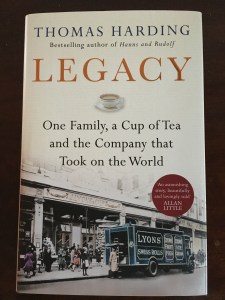
But if I am here to stand in for my mother, I am also here in my own right, both as a descendant of Helena and Lehmann, and as one of two professional historians present. The other is my interlocutor, Thomas Harding, my third cousin and the prime mover of this memorial project and the gathering we are at. He is also the author of the book, Legacy: One Family, a Cup of Tea and the Company that Took on the World, which was the original basis for both.

Nine months later, after the birth of my niece and nephew in the US, after the second memorial celebrating my mother’s life, after grief has had a chance to work its way into my heart and become part of my day-to-day life, I will read the book.  It will take me several weeks, read in gulps and dribbles between my commitments to work and childcare.

And what do I think of the book?

I’m still not quite sure I know. I cannot make the judgement as to whether or not it is an informative, perceptive, well-written history; I simply do not have that objectivity and, purely based on accepted professional ethics, I shouldn’t be reviewing it as all, as I, along with my siblings, appear in the acknowledgements. With my professional hat on, there are definite quibbles (is it really fair to quote an Orwell essay published in 1952 to illustrate a description of the Trocadero in 1897?), but this is a very different sort of history form that which I have written to date. As I try to write a more general ‘trade’ history of my own research, seeing how it can be done is extremely useful. And yes, I learned a huge amount, much of it absolutely fascinating, about the history of J. Lyons & Co. and its place in the social history of nineteenth and twentieth century Britain, as well as about the personal relations within the family. If the sign of a good book is the need to share it with others, then the many, many snippets and interesting facts I read aloud to my husband in bed in the evenings stand as testament to this one’s quality.

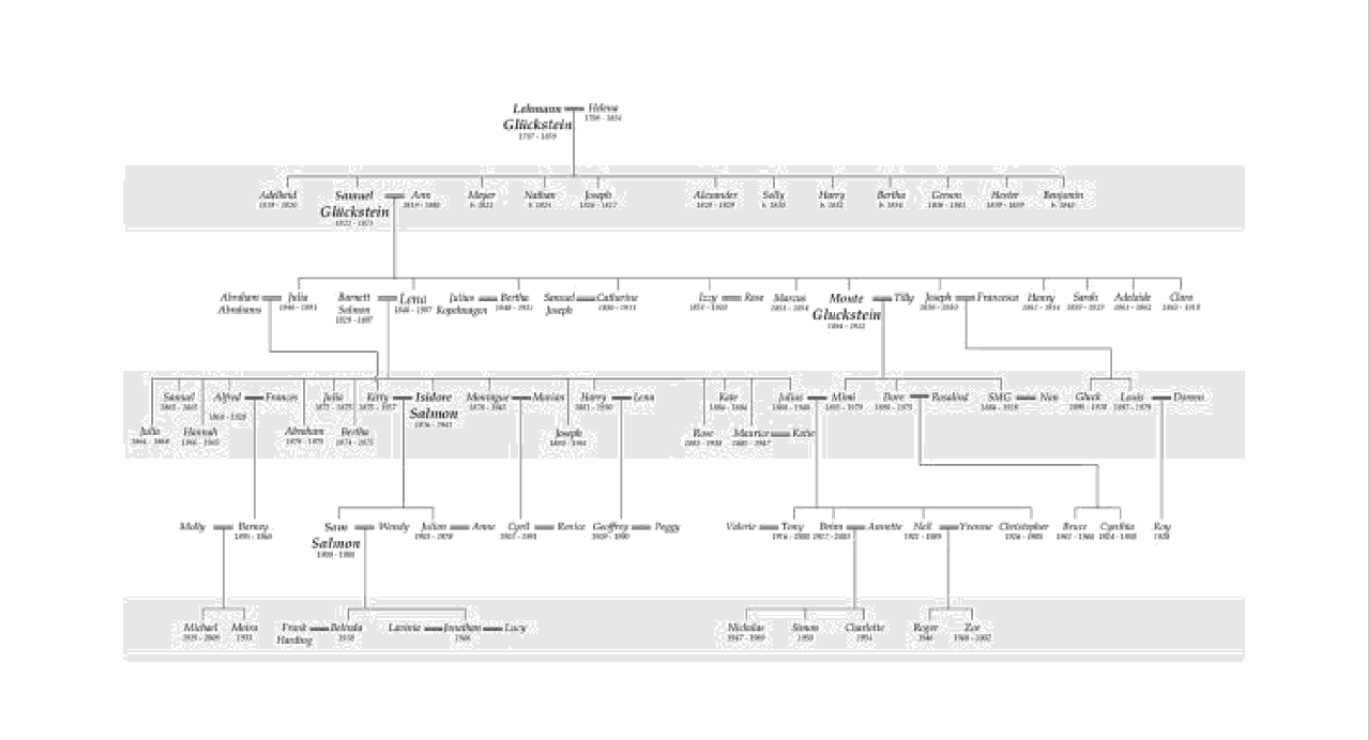
But in the end, I cannot read this book as I would any other history, academic or trade. It is, after all, the history of my family, or at least a partial history. As Thomas notes in the conclusion, the Salmon and Glückstein dynasties have, over the generations, developed an extraordinary number of off-shoots and ramifications, ranging across the globe. The impossibility of writing a comprehensive history of a family which contained 12 siblings in each of two generations and 14 in another (even if many didn’t survive childhood) means that strategies are needed to tell the family history of a family business empire. The one that Thomas has chosen is to focus on the lives and work of five men who form his own ancestry, Sam Salmon (his grandfather), Sir Isidore Salmon (his great-grandfather), Monte Gluckstein (his great-great uncle), Samuel Gluckstein (his great-great-great grandfather) and Lehmann Gluckstëin (Samuel’s father and the family patriarch).

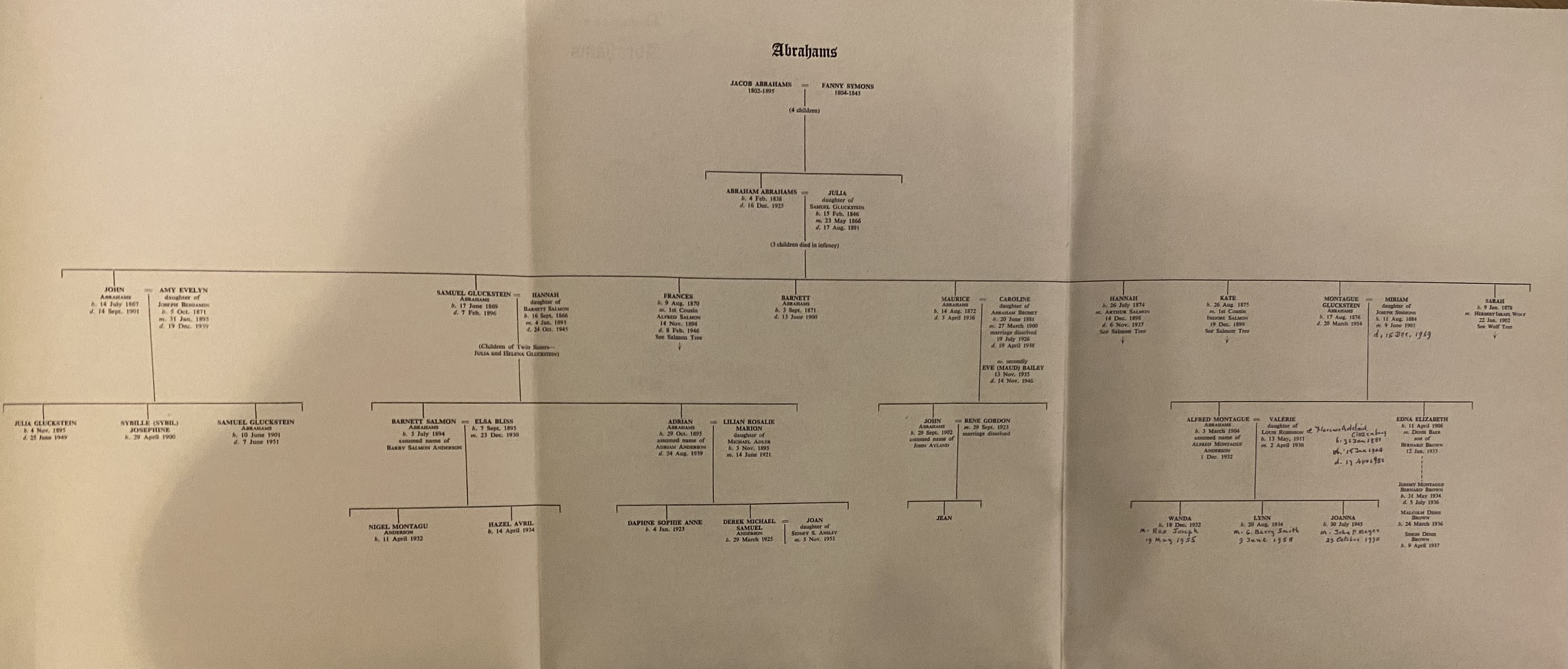
In many ways, this strategy makes sense. Samuel was the entrepreneur behind the founding of Salmon & Gluckstein, Monte the moving force in turning the family firm into the empire that was J. Lyons and Co., Isidore the great example of the family’s assimilation into the British Establishment, Sam clearly Thomas’s closest personal tie to the family history as a remembered and clearly loved grandfather. For me, however, it was frustrating on two counts. Firstly, it left me with many questions about my own branch of the family.  Through my mother, I am descended from Julia Gluckstein, Samuel’s daughter, mother of Kitty, Isidore’s wife, and twin sister of Lena, herself Isidore’s mother (there is a notable tendency for cousins to marry in this generation of the family). Julia married Abraham Abrahams who, we are told in passing, drank whiskey, even in the mornings, and could be violent. This is not a comfortable history, but one I feel I should know more about than this book has (or perhaps can) give me.

Which relates to the second, larger source of frustration. While Julia and Abraham’s story is mentioned only in passing, as the context of Kitty and Isidore’s relationship, it becomes patently obvious throughout the sections on Monte that Julia’s twin, Lena, had a significant, not to say vital, role in the success and expansion of Salmon & Gluckstein. Lena is only the most obvious example because, although Thomas has chosen to focus on the men, the story of Salmon & Gluckstein, of J. Lyons, of ‘The Fund’ set up to share the profits across the family, is the story of women. It is the story of Helena, the family matriarch; it is the story of Lena, who managed the tobacconist business while her brother developed the catering firm; it is the story of Gluck, the gender non-conforming lesbian artist who flits in and out of the narrative across the twentieth century; it is the story of all the women of the family who were never allowed access to the ‘The Fund’ in their own right, with their dowries controlled by their fathers and brothers throughout the twentieth century; it is the story of Belinda, Thomas’s mother, whose voice provides much of the witness of later generations of the family.  Thomas acknowledges all this, but there remains a story to be told about these women themselves, rather than as part of a story structured around men.

But in the end, the telling of the story transcended these concerns for me. At its heart, as Thomas argues, it is a story of belonging, of finding a place in the world, in society, in a family, even if that place isn’t always secure or comfortable. The loss of my mother, with all its accompanying psychic dislocation, the selling of her apartment, which cut the last physical tie to the city of my birth, had shaken my sense of belonging – to Britain, to Yorkshire, to the academic community. But through this book I was able to at least start to find it again.

It was not just that Legacy introduced me to the history of my family in more depth and detail than I had known before (I had no idea of the important role the company had played in the development of ice cream as a leisure product in Britain). It was also, in part, my mother’s legacy to me, my siblings and our children. In the years before she died, she had, along with her cousin Susan, become deeply involved in researching the history of the family. Through Susan, she had been introduced to Thomas and had become involved in their plans for the memorial to Helena and Lehmann. That scene of her listening to the words of the memorial with us, her three children, gathered around her, is captured in the final pages of the book.

As a professional historian, I long resisted the tug of family history, proud as I have always been of its richness. I am still resisting, in many ways, telling myself that it can wait until the next book, the next project, the next grant application is complete. But now the years of research undertaken by my mother – the family trees which spread widthways across living room floors, the folders of letters, the books on nineteenth century catering – sit in three boxes in my office. My son has developed a passionate interest in the subject, asking to read the book. One day, and soon I suspect, I am going to have to open those boxes. They are going to become part of where I belong, professionally as well as personally.

So, as a historian, what do I think? I think that Thomas was right in the dedication he made in the copy of the book he gave to me and my siblings and, above all, in the words he chose for Helena and Lehmann’s memorial.

The past is personal. Tell your story. Pass it on.