Second-hand Goods

Caroline Dunford, A Death in the Hospital

I have a very bad habit of picking up any novel with a First World War or immediate post-war setting when I come across them in a second-hand book sale. My husband grumbles about my bringing yet more books into the house while, in my heart of hearts, I know that, more likely than not, I will spend most of the time I am reading them getting annoyed by inauthentic, not to say inaccurate, portrayals of the war which rely heavily on clichés. Yet I carry on doing it, in part in forlorn hope that I may encounter an original (and thus enjoyable) new author or series, and in part to remind myself of all the pitfalls to avoid when writing my own war-set fictions.

As painful as most of these are to read, in general I find there is enough to them, in terms of plot, characterisation or, very occasionally, setting, to keep me reading until the final pages. Certainly, I did manage to do this with Carola Dunn’s Die Laughing, in spite of its many short comings, and with Sulari Gentil’s A Few Right Thinking Men, which erred to much towards the thriller side of crime fiction for my taste, as including random fictional press clippings in a way that I found deeply confusing and off-putting. However, this cannot be said for my most recent acquisition, Caroline Dunford’s A Death in the Hospital (2020), which I picked up for 50 p. at our local National Trust property second-hand bookstall and which I abandoned about a quarter of the way through.

I had been vaguely hopeful about this novel, the 15th book in the Euphemia Martin series, which appears to still be going strong, with A Death at Christmas due out this year. After all, the war hospital setting was right up my street in terms of areas of historical interest, although this did risk a more than usual number of snorts at clichés about VADs and misuse of the term ‘field hospital’. What I didn’t expect, however, was a historical setting so inaccurate as to suggest that Dunford is not even familiar with Vera Brittain’s Testament of Youth, let alone any less ubiquitous representation of the British military medical services in the war. It was at the point where a hospital where the central character had gone undercover as a trainee nurse (not, apparently a VAD, although it remained entirely unclear what the character who made this distinction thought a VAD role entailed) was described as the first hospital of its type ‘since the Boer War or possibly the Crimean War’ that I gave up entirely. For the setting to have any meaning or interest, I did need to have evidence of some basic plausibility for the institution that formed that setting, including the awareness that the auxiliary hospital (which I think was what this one was supposed to be) was only one type of medical institution in Britain during the war. As well as the permanent military hospitals which treated the Regular army throughout the second half of the 19th and into the 20th century, at the outbreak of war, military hospitals were rapidly set up across Britain, usually in commandeered institutions. Where country houses were donated, these became auxiliary units, specialising in rehabilitation after initial treatment at a general hospital. The institution in A Death in the Hospital did not seem like any of these.

Which brings me to the second aspect that precluded my enjoyment of this book. In addition to the ahistorical setting, the question of timing made any suspension of disbelief I might have had impossible. The novel is, apparently, set in August 1914. Even if we assume that the book starts at the end of the month, in at most three weeks there has, apparently, been time for some sort of voluntary hospital to be set up and filled with wounded servicemen including at least one volunteer servicemen, although he just may have been a Territorial. It is also strongly implied that the military effort had achieved statis along the Western Front, although this wasn’t the case until the winter of 1914. In other words, the author attempts to invoke the war as historical context through clichés that ignore the somewhat atypical reality of the opening months of the war. This sort of telescoping of events is not just bad writing, it is terrible history.

I do like to think that I have a pretty high tolerance for inauthenticity in genre fiction set in the First World War, of which there is a remarkable amount. Yes, as I say, I do grumble about inappropriate uses of terms like ‘field hospital’ and conscientious objector, or assumptions about the incidence and understanding of executions and shellshock. But while reiterating worn tropes is boring and, for a historian, frustrating, I am aware that I bring a level of specialist knowledge to reading this type of fiction which gives me an unfair perspective. Where there is some evidence of basic historical research, some attempt to get to grips with the historic specificity of the world being depicted, I can usually suspend enough disbelief to at least finish the book. Here there was no evidence of any historicization, with events, ideas and innovations from at least three major conflicts mashed together in an ahistorical mess labelled ‘The First World War’ in a completely implausible time frame. It is the sort of historical fiction that makes me wish there were a way to certify an author’s credentials as a historical research before they are allowed to publish. Indeed, the only excuse for this sort of book, in my view, is the case it makes through absence for history, including that which informs creative products (films, television, art and games as well as literature) as an intellectual discipline that requires skill and rigour, not just a vague idea that the past is another country which might make for a romantic setting.

So A Death in the Hospital will return to the second-hand book sale table via my local charity shop, where I should clearly have left it in the first place.

The Book I Wish I Had Written

The culture section of the Saturday edition of a major British newspaper runs a regular column in which celebrities in the arts are asked to identify subjects from their cultural life such as ‘The book I am currently reading’, ‘The instrument I wish I had learnt’ and ‘The last film that made me laugh/cry’. These lists are always fun to play along with but, while my answer to topics such as ‘My favourite piece of music’ has changed over the years, my answer to the regular question ‘The book I wish I had written’ has long remained the same: The Great War and Modern Memory by Paul Fussell.

Celebrity answers to this topic tends to be couched in terms of either a personally inspirational text or a best-seller that made the author a lot of money. In my case, the answer arises from a mixture of both. I first read The Great War and Modern Memory as a freshman, a first year undergraduate in my first semester at university. I thought at the time that I wanted to be an English major. By the end of the year, I knew that I would be a history major. This shift was only in part down to Fussell’s pivotal work of cultural history (Geoffrey Parker’s lecture on the possible role of sunspots in the development of early modern military strategy also had something to do with it), but what the book undoubtedly informed was my commitment to history that took fiction as one of its primary sources. This would shape not only my undergraduate module choices but the topic of my senior essay (an analysis of Ford Madox Ford’s Parade’s End tetralogy and R.H. Mottram’s The Spanish Farm trilogy as representations of the Western Front), but also my master’s and doctoral theses as well as almost every major work I have published since.

Of course, my view of Fussell’s work has evolved since then but that ‘heady mixture of literary criticism and cultural and historical analysis’ [1] remains deeply alluring as a point of reference not necessarily as a cultural history of the First World War, but as a pivotal moment in the cultural turn in First World War studies. As Ian Isherwood and Steven Trout argue in their excellent recent review article, ‘But It Still Goes On: Paul Fussell’s The Great War and Modern Memory at 50’, ‘the book is perhaps best approached as a an experimental study – a hybrid mixture … of  literary scholarship, cultural analysis, historical writing, and veiled autobiography.’ [2] This hybridity, if not Fussell’s argument about the centrality of irony to a Modernist paradigm shift in cultural expression, has gone on to inform the approach and ambition of major works in the field, including Samuel Hynes’ A War Imagined (1990) and Jay Winter’s Sites of Memory, Sites of Mourning (1995), as well as many of their students, among whose number I include myself. And, in ‘reigniting a debate from the late 1920s and early 1930s over literary treatments of the Great War and their portrayal of disillusionment supposedly shared by an entire generation’ [3], Fussell helped shape what we now define as the canon of British First World War literature as surely as any writer, publisher or critic of the ‘war books’ boom. We cannot understand not only how we in Britain and the US remember the First World War today, but how it is represented in contemporary cultural forms. Alice Winn’s almost constant references to Robert Graves’ Good-bye To All That in In Memoriam (2023) provides only the most recent testimony to Fussell’s historiographic influence.

It is, as Isherwood and Trout note, the representativeness of the authors selected by Fussell for analysis that lie at the heart of many of the critiques of his approach. Yet representativeness was never really the point: ‘Drawn … to highly literate, middle-class junior officers like himself (albeit members of a different army in a different war), he never intended to write a comprehensive study of British Firs World War literature or, for that matter, an exhaustive treatment of British culture before, during, and after the conflict.’ [4] But that debate, with its echoes of the critiques of Douglas Jerrold and Cyril Falls [5], highlights an issue that those of us who use fictional, semi-fictional and poetic sources in our research and analysis still grapple with today. No cultural history of the war can ever be comprehensive, either in breadth or depth, particularly when the conflict is considered in global rather than national terms. How do we choose which texts to focus on? How do we balance close reading of the symbolism of particular texts with broad claims about the culture in which they were produced and which they sought to shape?

It is here that Isherwood and Trout’s identification of the importance of autobiography to Fussell’s endeavour spoke most strongly to me. Unlike Fussell (or indeed Hynes), I am not trying to use my practice of cultural history to grapple with experiences as a former soldier. I make no claims to, as Fussell did, to sharing a bond of experience with the authors he selected for particular consideration. But I have always been aware of the extent to which my own personal preferences and youthful exposure to particular literary works has shaped the texts I have chosen to focus on (the work of Dorothy L. Sayers being the most obvious example), as well as my vulnerability to the critique levelled by Charles Carrington against Fussell, that the analysis of someone who wasn’t there can never be a true history of the war. Indeed, as a newly minted PhD, I was bluntly told by one ex-serviceman (himself too young to have served in the First World War), that my thesis on representations of wartime masculinities was worthless because I was not a man and had not myself served in the war. (My gender and age clearly trumped my nationality in this instance as my critic chose not to point out the fact that, like Fussell, I am an American.)

So I take comfort from Isherwood and Trout’s argument that ‘Fussell’s status as a cultural outsider … sharpened his insights … and emboldened him to say things that he might not have if he had been British…. [H]is distance from the war’s living memory enabled him to study the “troglodyte world” of the trenches and the mythology it produced with fresh eyes.’ [6]  Which is not to say that I necessarily take comfort from the text itself, which remains as challenging and provocative today in many ways as fifty years ago. For me today, the particular challenge of the autobiographical element is the most stimulating as I grapple with the ‘genealogical’ or ‘family history’ turn in social history, as exemplified by the work of Alison Light, Michael Roper and, most recently, Laura King. My family’s history doesn’t fit neatly with the history of the First World War, challenging cultural narratives of the war’s universality. But is this distance a handicap or a benefit? As I grapple with these questions as part of the process of writing my own book, The Great War and Modern Memory will continue to remain as much of an inspiration for my historical practice as it was when I first read it thirty years ago

[1] Ian Isherwood and Steven Trout, ‘But It Still Goes On: Paul Fussell’s The Great War and Modern Memory at 50’, The Journal of Military History, 89 (January 2025): 155-170 (160).

[2] Isherwood and Trout, ‘But It Still Goes On’, 158.

[3] Ibid., 160.

[4] Ibid., 160.

[5] Douglas Jerrold, The Lie About the War: A Note on Some Contemporary War Books (Faber & Faber, 1930); Cyril Falls, War Books: A Critical Guide (Peter Davies, Ltd, 1930)

[6] Isherwood and Trout, ‘But It Still Goes On’, 168

Unreal City

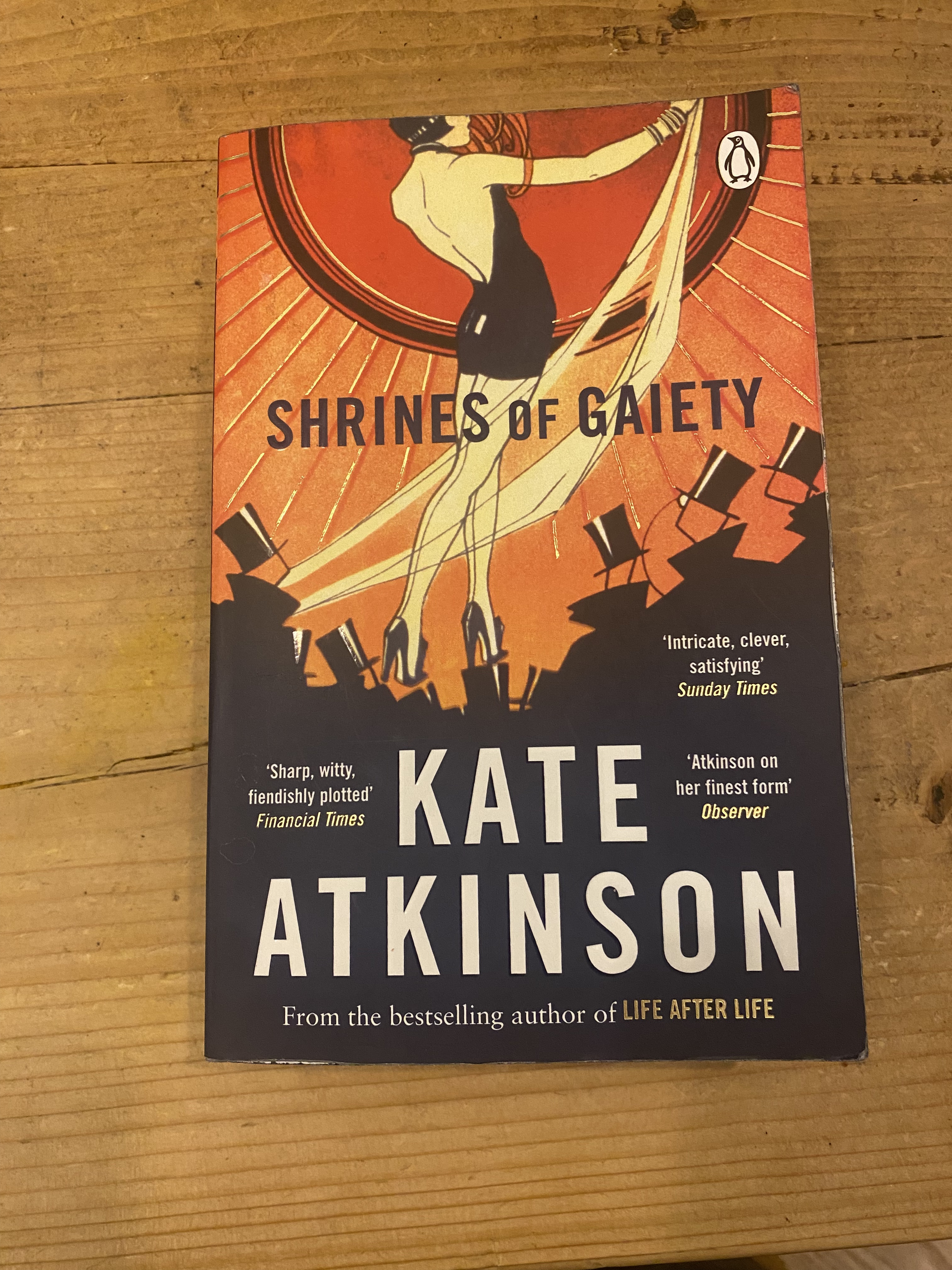
Kate Atkinson, Shrines of Gaiety

Having swallowed down Human Croquet and Normal Rules Don’t Apply in a gulp, I took a bit more time over Shrines of Gaiety, which is probably a good thing.  I enjoyed it – I think it is probably impossible for Atkinson to write a book that I don’t find totally immersive and enjoyable to read – but, in retrospect, I’m not sure it was as entirely wonderful as I had hoped. I don’t really expect anything to live up to the wonder of A God in Ruins, a book which speaks to so much that I love, am interested in and have dedicated my intellectual life to, or Life After Life, a literary and imaginative life raft which I clung to in the days after my mother died. But his is a book that had the potential to speak to me as strongly as either of these, a story of a time and people who are, in part, the subject of the (non-fiction) book I am writing at the moment, as well as being crime fiction-adjacent, touching on another of my great passions.

And there certainly were elements of this book that I loved. Nellie Coker, Gwendolen Keeling and Freda Murgatroyd (what a name!) are all wonderful creations – rich, complex, engaging women whose attitudes and actions I could deplore and root for in equal measure. I also loved the character of Niven Coker, a man shaped but not defined (except perhaps in the eyes of others) by his experiences of war. The ambiguity of the ending of his and Gwendolen’s story, so typical of Atkinson’s play with multiple narratives and possible outcomes, was one of the great pleasures of the novel for me.

And yet… And yet… I did not love this book the way I loved even Transmission, a novel that I know many critics struggled with. The problem for me was two-fold. In the first place, there were too many characters and storylines introduced, with the result that several of the plots and characters felt underdeveloped. Ramsey Coker in particular, who gets a considerable amount of space in the book, never came fully alive for me, and I never truly believed in his (strategically important) relationship with Freda. Similarly, the murdered girls whose disappearance I think is intended to be a central plot device, merged into one in my mind, which was a problem given the centrality of the moral imperative that drives Inspector Frobisher’s desire to name them individually. And to leave one major plot strand (the disappearance of Florence Ingram) entirely unexplained may be considered artistic license. For there to be a second (the murder of Vivian Quinn) feels like authorial carelessness.

Secondly, and relatedly, the book is weakened by the attempt to coral all 73 characters and their interlinking storylines into small a social and geographic space. There are any number of coincidences – Frobisher’s presence on the bridge when Freda goes into the river, Freda and Florence rooming in the house of the abortionist employed by Maddox, Niven Coker passing by when Gwendolen is mugged. One of these would work to help drive the plot but, like the unexplained plot points, their accumulation over the course of the novel feels contrived. The appearance of Gertie Bridges as a deus ex machina and virtual twin of a central character feels particularly in artistic, violating as it does the tenth of Ronald Knox’s commandments of detective fiction for the period. Having invoked Eliot and his unreal city, the imagery of the nameless crowd flowing over London Bridge, undone by death, is undermined by the boundaries these coincidences put in place.

Ultimately, then, this in really a novel about the aftermath and legacy of the First World War as I had hoped. The decadence of the clubland setting, with its corrupt police, violent gangsters and privileged patrons, could belong as easily to the fin de siècle, with Wilde rather than Eliot as muse. The experience of the horrors of war are part but not the entirety of the life the characters, something which does ring true, particularly in the case of Niven, but this raises questions about Atkinson’s stated inspiration for the novel, as discussed in the Author’s Note. Unlike her Second World War novels, which do so brilliantly, this one fails to fully capture the uniqueness of the historical moment of its setting. Possibly this is a specific problem of the interwar period, which does seem to have a certain ubiquity in historical novels, although Sarah Waters undoubtedly managed to capture the unique flavour of changing times and social mores in the period in The Paying Guest.

None of which is to say that I don’t recommend Shrines of Gaiety. Anything by Atkinson is worth reading and Nellie Coker is far too good a character to refuse introduction to. I am very glad I met her, and her elder son. But this novel won’t haunt me the way that A God in Ruins and Behind the Scenes at the Museum do, enriching my life and scholarship in the process. However, this slight disappointment certainly won’t keep me for eagerly anticipating the paperback publication of Death at the Sign of the Rook, Atkinson’s latest (and apparently last) Jackson Brodie detective novel, an homage to Golden Age detective fiction. I live in hope that it manages to capture the feeling of the interwar – this elusive, infuriating, enthralling period that continues to fascinate me as both a historian and reader of fiction. I do so in the certainty that even if it does not, it will still, like Shrines of Gaiety, be a great read.

Enough is as Good as a Feast

Kate Atkinson, Human Croquet

Kate Atkinson, Normal Rules Don’t Apply

It may have been a mistake, saving my stash of Kate Atkinsons to take with me on holiday over the summer. Not because they are not wonderful; they absolutely are. Reading Human Croquet, which I did in a day, gulping it down in a way I haven’t done with a book since the height of the pandemic, was a joy, an immersion in language and characterisation and intricately intersecting plot lines that took me to another place as only a great book can.

But oh! they are so rich! Coming to the end of the book after a day spent reading like that felt a bit like getting up from the table after an overly rich meal, or waking up with a hangover. It was almost too much, to the point where I felt lethargic and slightly headachy. So following such overindulgence with more of the same may, as I say, have been a mistake. Yes, Normal Rules Don’t Apply was, as a collection of short stories, briefer and lighter, but the collection of linking characters, locations and storylines required work, the language was just as intoxicating and the emotions evoked were, if anything, even more quietly devastating.

To recover, I gave myself a palate cleanser of Georgette Heyer’s The Quiet Gentleman, which was light and funny and straightforward in terms of plotlines and the emotions aroused, although not, perhaps, overly memorable. But it did leave me slightly out of time to tackle Shrines of Gaiety, which I had been keeping to savour,before the end of our stay in the US. I was left with the choice of starting it on the plane ride home or saving it for the long weekend trip to Scotland scheduled for the week after we returned. The former option risked my staying up all night reading, followed by jetlagged exhaustion on arrival. That was how I read Life After Life, but I wouldn’t have slept on that flight anyway, In the depths of grief following my mother’s death the week before, that book saved me from going mad, a life raft in the ocean of suspended time that flying back to my family in the UK entailed. This time I anticipated no such need, just the prospect of houseguests to prepare for, making the prospect of exhaustion compounded by jetlag a less than enticing prospect.

Saving it for Scotland, meanwhile, would give me something to look forward too when my husband and son headed off to climb Ben Nevis without me, a challenge to far for my torn ACL, which had been playing up even in the slightly less strenuous context of the hills of Western Massachusetts. So that is was I decided to do, planning to balance the intensity of Atkinson’s rich literary vision of 1920s London with the anticipated jeu d’esprit of Juno Dawson’s Hebden Bridge-set witchcraft novels.

Summer Reading and Future Plans

Somehow, it is the August bank holiday weekend, and thus almost the end of summer. I am back at work (which means hundreds of emails and frantic lecture writing and lesson planning for a month before teaching starts) on Wednesday and the kids are back at school the following week. This summer seems to have gone by in a blur, over before it barely began, but it has seen two important developments, at least as far as this blog is concerned.

In the first place, I have managed to to a lot more fiction reading this summer than I have for the past couple of years. Returning to immersion in fiction as a space for relaxation and recuperation has been a joy, and I hope to carry on with this habit even as the busyness of the academic year accelerates. My-to-be read shelf has not noticeably contracted, as holiday travels have involved many bookshops and and I appear constitutionally unable to enter a bookshop without purchasing something, particularly second-hand bookshops, and there is also the list of things I want to read but haven’t quite got around (or found a good excuse) to purchase yet.

The second development of the summer was my decision (along with many others) to finally cut ties with the social media site formally know as Twitter and move my micro-blogging onto Threads, where I go by @thehistorianskitchengarden. As I originally joined Twitter to publicise this blog, in the days when there was a 180-character limit, this transition feels like a good excuse to revive and revise what I am doing on here.

My initial enrolment with Threads was due to the fact that I have an Instagram account, where I mainly post pictures of my cooking and gardening endeavours, as well as views from my morning runs and holiday walks. However, I have also been intermittently involved with the #bookstagram hashtag, primarily through posting stacks of books prompted by a theme. However, I also enjoy reading reviews of books posted on the site, and have considered posting my own, thwarted only by the incovenience of writing a detailed review on my phone keypad. Given the regularity with which I post typos due either to fat fingers or the vagaries of auto-correct as it is, attempting this on a regular basis seemed like a bad idea.

I did flirt with the idea of launching a Substack, something I may do in the future depending on the direction my writing career develops in the future, but adding an additional platform at this stage, when I already have this one at my disposal. So how I will be using this blog will change over the next few months. In addition to publicising my posts on Threads, I will be posting more (and hopefully more regular) book reviews. These will mainly be fiction, moving this site away from its focus on the First World War, although there will be some non-fiction reviews as well.

I don’t want to move entirely away from the role that this site has played as a research diary, not least because I am now working on not one but two book, a history of men and war in the modern period and a history of the returning British servicemen of the First World War. Both of these are now at the proposal stage and starting to have both argument and form. All that is lacking is sufficient time for me to write them. I will be trying to carve this out over the next year and the practice of working through ideas on this blog can only help make the process more efficient. Again, I will use Threads to help disseminate my writing, highlighting the historian as much as the kitchen and the garden of my handle.

So there will be quite a lot going on on here, I hope, and I will be updating the look of this site as part of that. There will be separate pages for the reviews and the two book projects, as well as an updated profile. There will be more photographs integrated into my posts, reflecting how I have developed my use of Threads in conjunction with Instagram. There may be some publicity for my other project, the podcast on the intersections of the First World War with popular culture, that I co-present, although I am not clear what form this will take. Finally, there will, I hope, be more scope for comment and discussion both on here and on social media, particularly relating to the book reviews. All of this may take some time, not least because, as of next week, my priority will be writing and creating the presentation slides for the eleven lectures I am due to deliver in the current term. But there will be reviews of at least some of the books I have read this summer before then, and before the start of the new year catches up to me.

All I have is a voice

So I am coming to the end of another summer of writing, the third focused primarily on the book. With little bit of luck, this will be the last, as I now have an at least somewhat definite deadline for submission of the full manuscript, although next summer is likely to be occupied with editing and incorporating reader comments.  Sadly, while I have emerged from the previous two summers energized and enthused by successes in completing chapters, I end this summer with far more mixed feelings, having spent a significant portion writing what I can only describe as the wrong chapter. That is, I got an idea of what I was supposed to be writing into my head, struggled to draft about 15,000 words, went back and reread what I had actually proposed and discovered it was something different – more complex and less linear, but potentially far more useful in the overall scheme of the book.  There are bits that can be salvaged from the previous version, and the rest will form the basis of a lecture I hope to be giving next spring. In the meantime, I have nearly finished drafting the correct version, a process I have found far easier and quicker than the original. This version is far more comfortable because I am writing in a way that suits me, not trying to take on the voice of a different type of historian and applying it to my research.

I have been thinking a lot about this question of the writer’s ‘voice’ this summer, in part because my period of focused writing has been bookended by events which have (or will) asked me to push myself out of my comfort zone as a writer.  The first was the final event in the Passions of War workshops which I have been attending for the past 2 years (for details of previous workshops, see posts here and here). In addition to hearing updates from participants on the research they had presented on at previous events, participants engaged in a guided fiction writing session, aimed at helping us free up the writing process and gives us skills and strategies for our academic writing practice.  The second is a story-telling workshop that I will be attending as part of the War Through Other Stuff workshop, being held at Leeds City Museum on 30th September.

Both of these events form part of a wider trend towards ‘creative histories’ which has been developing over the past few years.  This is the move towards exploring the variety of ways in which ‘educators, researchers, writers, artists, students, practitioners, and curators [bring] the past to life, [make] history compelling, and [have] fun’, to quote the call for papers from the summer’s Creative Histories conference.  The idea that the doing of history involves more than solely academic analysis or traditional exhibitions (a subject which has been raised in my own field in relation to the newly renovated National Army Museum, more of which in a moment) is undoubtedly to be welcomed.  But my experiences this summer have left me thinking that we need to make the case for more traditional analytic, even formal, histories as well.

One of the things that the fiction writing workshop reminded me was how uncomfortable the writing of fiction can be.  I say that as someone who started out as a writer of fiction (and weak adolescent poetry). For three summers during my school days, I attended that most American of institutions, an writing camp.  For two weeks each summer I took classes on poetry, short fiction, screen plays, learning how to create characters, set scenes, develop plot.  I wrote some very bad fiction, most of it thankfully long destroyed, but at the time I was quite convinced that I would, one day, be a writer of fiction.  I even thought that I might be able to make a living out of it.

What being asked to write fiction again reminded me was how constrained I have always felt by the process of scene and character creation. Far from inhabiting my imagined worlds and people, I have always needed to get it right – to be historically, or socially accurate, to get the slang correct, the details of the setting just so.  Developing a good story (or even a believable character) fell foul of this obsession with detail, a fear of the criticism that it was unauthentic, wrong.  I couldn’t, writing fiction, find that most elusive of qualities, my own writer’s voice.

I did eventually find it, however, in my final year of my undergraduate degree in the rather unexpected form of the dissertation, or long-form academic essay.  Since then I have honed and developed it, through two post-graduate theses, journal articles, book reviews and one (nearly two) complete monographs.  While there have been moments of doubt about the process (am I just stringing interesting/relevant quotations together/this is entirely and blindingly obvious/x, y and z have all said exactly this before), I have developed (and hopefully will continue to do so), my own style, my own perspective, my own contribution to understanding, my own ‘voice’.

As part of the process of learning the rules and limitations of the form I work in, I have also learned how to bend and subvert them, how far I can push the boundaries while maintaining my own authenticity, how this can be used to make my work engaging to a variety of audiences.  I am learning how to adapt my voice to different forms – discursive/reflexive essays (probably the form I aspire most to succeed in – Joan Didion has been a hero since school days), public lectures, academic seminars, scholarly monographs, someday, I hope, trade histories. This summer I have sought to push the boundaries of my own form in a peer-reviewed journal article that adapts reflexive practices and a book chapter for a collection that will be marketed to the Christmas trade as something of a novelty volume.  But within these experiments I try to remain true to the voice that I have come to through my academic writing and training, a voice shaped by analysis, historiographic considerations, and a belief in the value of proper citation and acknowledgement of intellectual debts (even if that does take the form of the despised footnote).

That locating and nurturing an individual voice is a significant part of the historian’s craft even in the most traditional forms of academic writing has been brought home to me by two museum events that I contributed to, the late opening of the Science Museum in July as part of their current Wounded exhibition, and the Masculinity Late event at the National Army Museum last night, part of their current season exploring gender and the military.  For both, I was asked to provide some sort of interactive session for museum visitors, although I had initially been asked to give a talk at the National Army Museum (the change was to make the event over all work more smoothly).  For both, I did the same thing, taking an article (one published, one currently under review) and deconstructing it into a series of quotations and images which I stuck to a wall and asked participants to respond to with their own thoughts.  Essentially, I took myself, my analysis, my voice out of the presentation of my work and then presented it to a non-specialist, if culturally engaged audience.

I came away from each event with very different feelings about the process.  The Science Museum experience was, for want of a better word, depressing.  While I had many interesting conversations, and felt my audience was engaged with the material presented, I was left wondering what the point of my labour was in the process.  Many of the responses I got were conditioned by dominant narratives around shell shock, which I found difficult to challenge in this format.  What then was the point of my research? It wouldn’t reach a wide audience in the format it was published in (a respected but slightly niche academic journal), but, in removing my voice from the format in presenting it to a wider audience, my ability to shape that narrative had dissipated. My voice was important; it needed to be there in some form.

By contrast, last night’s event at the NAM left me feeling far more energised and enthusiastic.  This may have been due to the fact that the audience was smaller, allowing me more opportunities to explain my perspective in some detail. It may have been due to the fact that the work presented hasn’t yet been published, leaving me more open to having my understanding shaped by the audience responses (there were also more of these in the form of post-it notes stuck to the wall by participants than there had been at the Science Museum, a reflection of the event being held in a more intimate space within the museum, allowing participants to feel safer in voicing their opinions, I think.) But I had also organised the display in ways that allowed me to demonstrate my ideas, my argument.  It was subtle, but it felt as if my voice was able to come through more clearly.

What last night demonstrated for me is that is possible for more traditional forms of history to be adapted to communicate with diverse audiences in ways that are both creative and yet recognise the authenticity of the original form.  This is the power of respecting one’s own authorial voice. Which may mean that, as fun and adventurous as writing fiction can be, it doesn’t need to be the approach taken by everyone. I will bear this in mind as I prepare to engage with storytelling at the end of the month.
The Village, Part 1

So I started watching The Village last night, Peter Moffat’s new drama about a northern rural village over the course of the twentieth century.  It began, when else, in the summer of 1914 (I am waiting for a course-of-the-twentieth-century drama that has the courage to begin with either the death of Victoria or the end of the Boer War!) although it managed to avoid most of the First World War clichés by the simple expedient of ending the episode with the departure of the first draft of volunteers.

There were some lovely moments.  John Simm’s shame at the generosity (or patronage) of his neighbour in face of his drunken aggression, the dismissal of the unpleasant schoolmaster from the recruitment station for being too short, the use of a recruiting poster that was not the (anachronistic) Kitchener. The implication that Bert’s older brother enlists in order to escape from a life of subservience and drudgery, rather than from war enthusiasm was a particular pleasure.  But overall the whole left me feeling uncomfortable.  It has been sold as the anti-Downton Abbey, a dose of working-class reality in opposition to Julian Fellowes’s soft focus nostalgia for the upper classes and noblesse oblige.  And there were certainly very few positive views of the upper classes, although the middle class (as represented by the nicer, taller schoolmaster and the vicar’s suffragette daughter) came off best.  But in making the daughter of the local squire a sexually predatory halfwit, her mother a vicious snob and promoter of (literally) Victorian gender values and the squire himself a physically damaged recluse who forces his staff to turn their back on him when he passes, the caricature seems to have swung too far in the other direction. Nor did the working classes come off as any more real.  Even with the skills of actors such as Simm and Maxine Peake, they never really gained more depth than ‘violent, drunken failed farmer’, ‘put-upon wife’ and ‘naive country girl’.

And then there was the focus on sex.  Yes, the story is being told from the perspective of a 12-year-old boy, so such a focus can be justified.  But did we really need quite so many scenes of voyeurism and sexual innuendo, culminating in a scene straight out of Lady Chatterley’s Lover?  The whole thing felt extremely Lawrentian, in fact, which coming from me is not particularly high praise.  I do like some of Lawrence’s poetry (Snake is something of a favourite) but as a portrayer of class and sexual relationships in his fiction, I have always found him unconvincing.  Or at least no more convincing than Fellowes’s historical world view.

Can there, then, be no middle way in how the past is portrayed in contemporary television drama?  Are we condemned to see history either in terms of soft-focus nostalgia or sex-and-violence grimness?  Parade’s End might point in another direction, having a satirical bite to its vision of the upper and upper-middle classes at war, although Ford’s portrayal of working class characters verges on the sentimental.  And it was, of course, an adaptation of contemporaneous fiction rather than a contemporary fictionalization of history, a point which rather supports my on-going argument that the fictions of the past have as much to teach us about the times they were created in as any facts.

In short, I don’t know.  I will carry on watching The Village, at least for the moment, but I will need a lot more convincing that this is the correct and necessary riposte to national and international obsession with Downton.