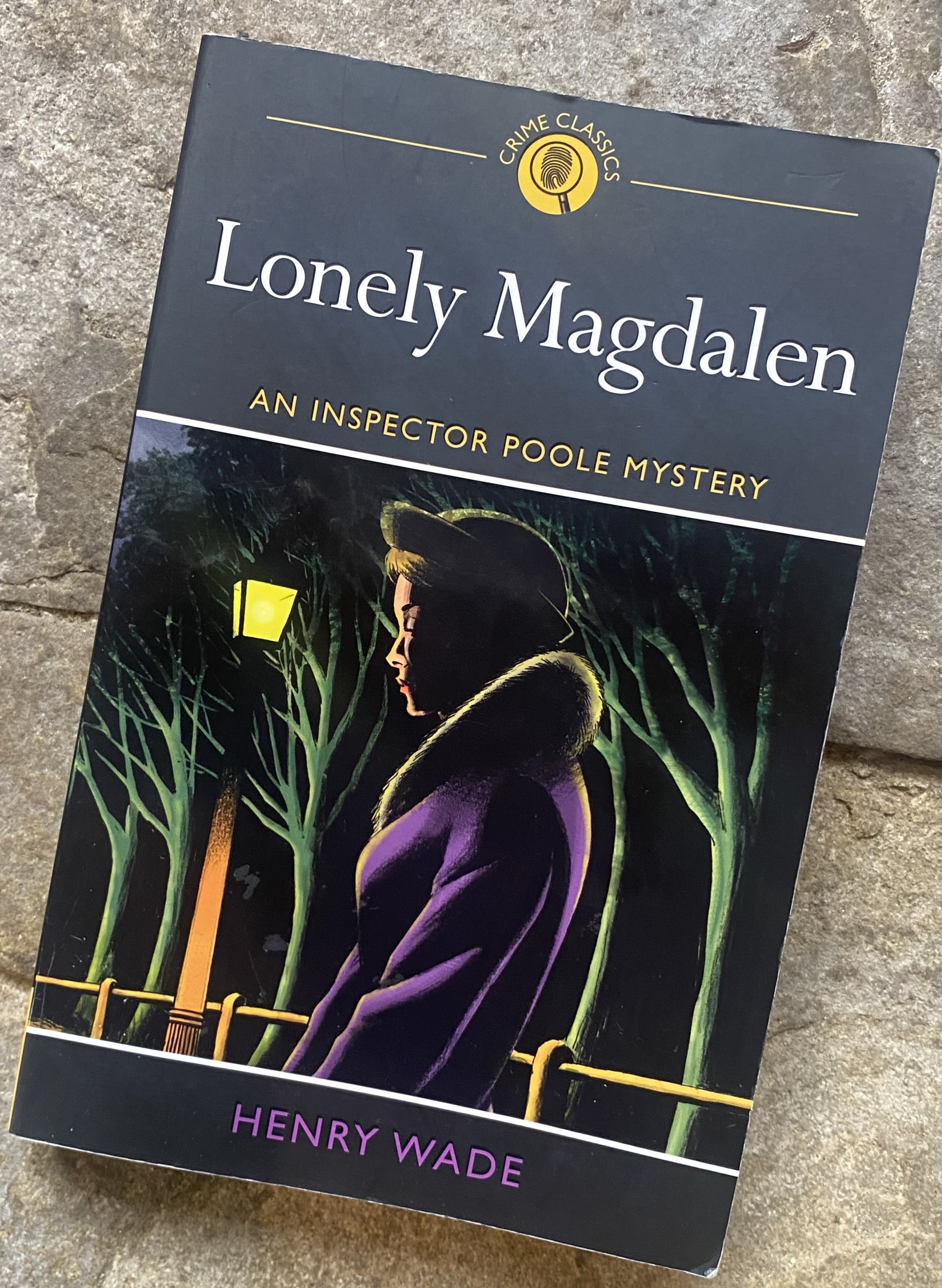
Last September, I picked up a copy of Henry Wade’s Lonely Magdalen at the Golden Age of Crime conference. I was delighted, as I had identified Wade as a key author in my on-going interest in the relationship between the First World War and Golden Age detective fiction. Wade was the pseudonym of Major Sir Henry Launcelot Aubrey-Fletcher, Bt KStJ CVO DSO, who served with distinction in the Grenadier Guards in both world wars, as well as being a founder member of the Detection Club. Ex-servicemen and their war experiences feature explicitly in many of his stories and, indeed, I quoted extensively from the The Duke of York’s Steps in the key note address I gave at the Golden Age of Crime conference.
If anything, Lonely Magdalen is even more directly related to the war than The Duke of York’s Steps. Although written in 1939, and published in 1940, with the murder and detection set contemporaneously, the central section of the book, ‘Twenty-Five Years Ago’, is set during the First World War, telling the backstory of the victim and her wartime marriage.
This structure is an interesting choice on Wade’s part. It allows him to drop what is essentially a post-war middle-brow state-of-the-nation narrative, similar to Warwick Deeping’s Kitty and Robert Keable’s Simon Called Peter (1921), into a mystery novel that is, otherwise, essentially a police procedural. Indeed, much of the two framing sections, ‘Working Back’ and ‘Working Forwards’ deal with the minutiae of police work and politics, including a very detailed description of tailing a suspect. Yet rather than exploring the history of the victim through descriptions of interviews with relevant witnesses, Wade chooses to present it through an omniscient narrator, although he then tells the reader that different witnesses give different emphases and perspectives on the various characters involved.
The result is that the book is rather weak as a detective novel. The solution is pedestrian although it does take on the Golden Age cliché of the least obvious suspect being the criminal to reasonably good effect. An alternative, more ingenious solution is suggested in the novels final lines, but isn’t particularly convincing. The character (and consequent motive) of the suggested murder hasn’t been sufficiently fleshed out, nor is the method given in enough detail to convince this reader, at least. Indeed, the characterisation throughout is quite flat, with a tendency to tell the reader what characters are like, rather than showing them. This is true of much Golden Age detective fiction, which tend to be plot driven. Here, the lack of focus on either is quite noticeable.
And yet I enjoyed Lonely Magdalen because it does actually function quite effectively as a middle-brow social problem novel. It tackles, among other subjects, prostitution, alcoholism, gambling and downward mobility. Yes, the perspective is sexist and snobbish, as is true of most of this type of novel from this period. But, like so many of them, it is highly readable on its own terms. And, as an example of the on-going influence of this type of First World War narrative, right up to the outbreak of the Second World War, it makes for a fascinating historical source. I am very glad that I managed to lay my hands on a copy.

