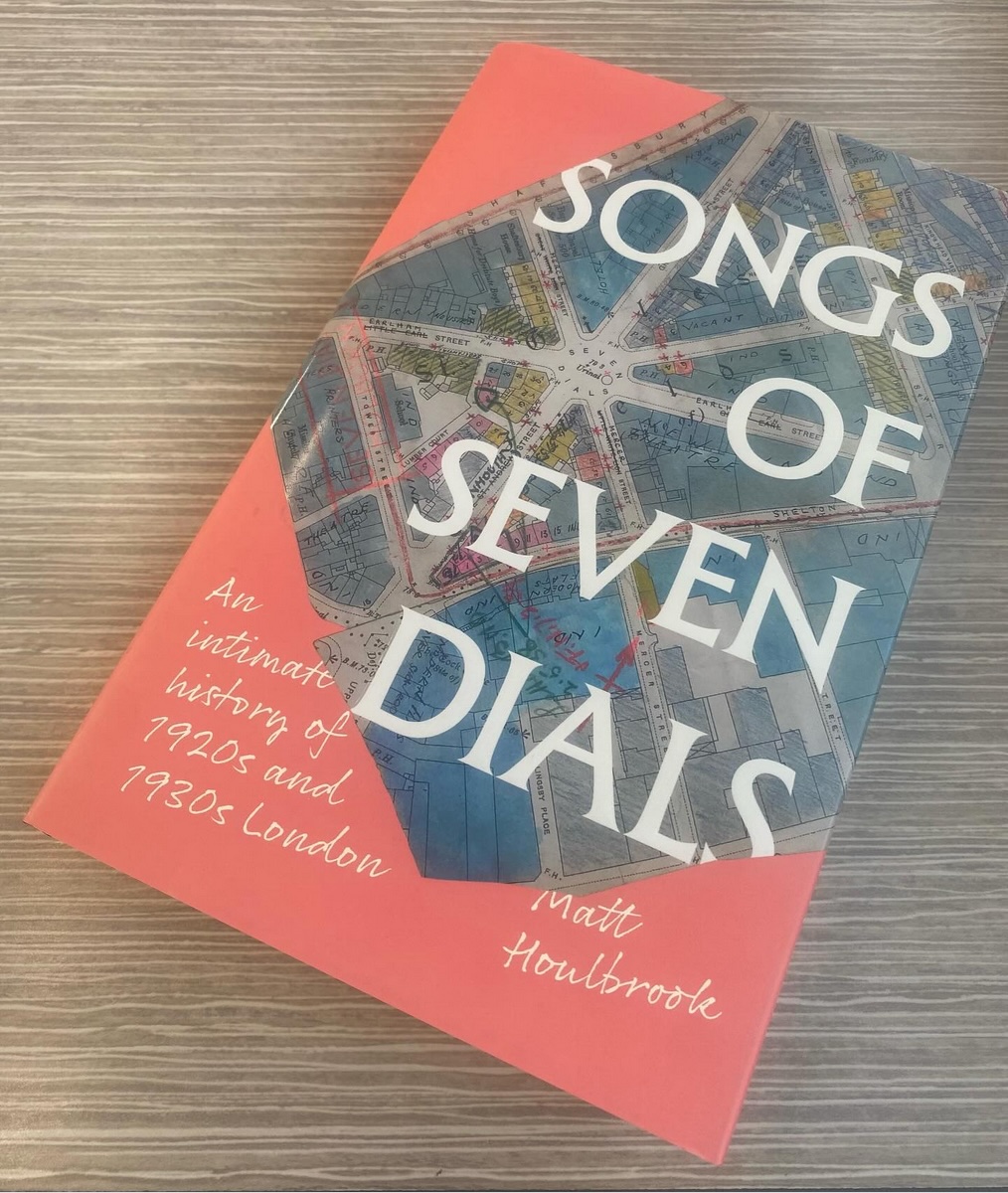
Welcome to Seven Dials
This review has taken me a while to write. Matt Houlbrook’s Songs of Seven Dials: An intimate history of 1920s and 1930s London turns out to be so rich that I have had to split my responses to it into two posts. This first post will be a slightly more formal review alongside a discussion of the ways in which the book is shaping my thinking about The Return of the Soldier, my own tilt at a broad social and cultural history of the legacy of the First World War in Britain. The second, which I will publish in the next couple of weeks, half term permitting, will focus on how the book intersects with my own family history.
In Songs of Seven Dials, Matt Houlbrook sets out to write a social and cultural history of the tiny neighbourhood of Seven Dials which lies between Shaftsbury Avenue, Charing Cross Road and Covent Garden produce market. Originally defined as a neighbourhood in the seventeenth century, Houlbrook focusses on this ‘shabby cosmopolitan working-class neighbourhood’ (p.3) in the 1920s and ‘30s, a period in which the area was represented as, variously, a crime-ridden slum, London’s ‘Black Colony’, an artistic Bohemia and an opportunity ripe for commercial development. Subtitled an intimate history, the book attempts to focus on the lives of those who actually lived in Seven Dials, alongside those who attempted to impose their social, cultural or economic vision on the area from the outside. Unfortunately, this only has mixed success. The voices of the latter tend to be much louder in the archives than those of the former, and the extensive naming of names can’t always balance the narrative in favour of the historically marginalised who called Seven Dials their home. Even the use of the historic present, which allows Houlbrook to tell the story of Jim and Emily Kitten’s libel case against John Bull with some immediacy, can only go so far in bringing the names of other Seven Dials residents to life, and, at least for this reader, too often got between me and the story being told.
The other stylistic technique that Houlbrook uses to support his analysis is the structure of the book through seven chapters, each one focussing on one or two of the streets radiating out from the central square which make up the district. This structure both emphasise the microhistorical approach that Houlbrook takes to the subject, as well as allowing him to employ circular imagery as a metaphor across the volume as whole. While this is generally an effective strategy, the inclusion of Long Acre and the Strand in chapter four disrupts the pattern in problematic ways. Both these streets, chosen to represent the locations of the press and legal system that imposed an external narrative on Seven Dials through the Kittens’ libel trial, are not only outside the district itself, but aren’t even accessed directly by Shorts Gardens (Chapter 3) or Great Earl Street (Chapter 5). Subject-wise, the location of the chapter is equally confusing. Houlbrook begins his introduction with the statement ‘It starts with a libel trial, held over three days in the High Court of Justice in February 1927.’ (p.1) Yet it isn’t until Chapter 4 that the reader is given the story of the trial itself, making the background detail of the actors given in the preceding chapters somewhat hard to follow, not least because, while there is a very rough chronology at work, Houlbrook moves back and forth not only across the two decades between 1919 and 1939, but as far back as the 1890s and as far forward as the 1960s.
A key point that this chronological muddying underpins is that the ‘modernisation’ of London, so often associated with the 1920s and 1930s, was far from a tidy linear progress. Grand modernist visions, both economic and architectural, failed. Nostalgia for an imagined past and old stereotypes were evoked to dismantle progressive trends towards diversity and anti-colonialism. At the same time, ‘the foundations of the what would be called gentrification were laid in the 1920s and 1930s, when politicians, planners, and entrepreneurs tried and failed to raze Seve Dials an build a new city from the ground up.’ (p.12) The making of modern London was, as most history is, far more messy than all-too-often romanticised visions of the ‘interwar’ would suggest. Houlbrook makes a powerful case for the need to think about this period as more than just the clichés of ‘The Roaring Twenties’, ‘The Hungry Thirties’, ‘The Interwar’. Yet in titling this story as one primarily about the 1920s and 1930s, contradictions start to emerge. Whatever Houlbrook’s intentions, this categorisation marks the period as ‘a kind of caesura – space between, a time apart’ (p.10), implicitly reinforcing the First World War as a historic paradigm shift in the creation of modernity. At the same time, the war itself is only a tiny part of the story that Houlbrook is telling. Jim Kitten’s wartime internment at Ruhleben and the gunshot wound to his arm he received there echoed through his life and may even have contributed to his death in 1940 (p.230), but they are less important to the story of the years between than his place of birth in Sierra Leone, his marriage to a white Englishwoman and his work as a café owner.
This question of periodisation and the way in which historians use time spans to organise and contain their arguments, particularly as it relates to the early twentieth century, are central to my own thinking about the arguments I am making in The Return of the Soldier. The historiographic tendency to position the years between 1914 and 1918 as not simply a time apart but as a paradigm shift – the end of the long 19th century, the birth of the modern era – has been something that I have tried to resist in all the histories that I have written. Almost without exception, the men that I wrote about in my first two books were born in the 19th century. The same is true of the men who are the subjects of The Return of the Soldier. They survived the war and went on to live and work throughout the twentieth century. On the one hand, there is a story of social and cultural continuity to be told through these survivals. On the other hand, the very premise of the book is based on these men’s status as having served in the war. The war years were undoubtedly significant in shaping men’s lives and, as a total war, the lives of those who made up the society in which they lived. Bodies and minds were altered by the experiences lived through during the war – by wounds and illness, by separation and deprivation, by unanticipated opportunities for travel and work. The story of social and cultural discontinuity that emerges is a powerful one. How to explore the nature and meaning of the ruptures that war created without isolating the years between 1914 and 1919 as a time apart or the sole defining event in the lives of those who lived through it is the challenge I have been wrestling with since I first began trying to shape my research into a coherent argument. If individuals lived their lives across the temporal boundaries historians attempt to impose, writing histories that do honour to those lives, and which, as is Houlbrook’s ambition, inform our present, forces us to rethink comforting historic periodisations.
My way of addressing this problem has been to rethink the subtitle of The Return of the Soldier as ‘British First World War Ex-Servicemen and the Making of the Twentieth Century’. The intention is to focus on a discussion of continuity and discontinuity in which the war plays a defining but not an exclusive role, and on the particularity of the lives of these men and those around them, rather than the more abstract categories of ‘the war’, ‘demobilization’ and ‘legacy’. The previous subtitle, ‘The Intimate History of Demobilization in Britain After the First World War’ tried to make this point by invoking the concept of ‘the intimate’, an idea that Houlbrook also uses in his subtitle. Yet I soon discovered that the intimate is a slippery historical category. For Bruno Cabanes it is the study of ‘the relationship of individuals to their own body, to their familiar haunts, and to their family and friends’[1], combining the history of the body with the history of the domestic, an approach exemplified in Joanna Bourke’s Dismembering the Male. Yet Bourke, in her own An Intimate History of Killing, uses the term to indicate as study of subjectivities, the intimacy that of the individual psyche. [2]
In Songs of Seven Dials, intimacy appears to be two-fold. On the one hand, in support of his argument that Seven Dials in the 1920s and 30s was a place of residence and work rather than simply the opportunity for improvement, development or entertainment that many imagined and represented it as, Houlbrook peoples his history with named individuals, located in specific places of residence and types of work. This is the intimacy of the reader with the specific historical actors. It is enabled by the digitization of the 1911 and 1921 census records, which Houlbrook uses, alongside local newspaper records, to great effect. The problem is that the level of intimacy achieved remains limited. While Houlbrook can give names and occupations to the residents of Seven Dials, these records don’t give deeper insight into their lives. Naming is, of course, vital to the process of remembering, but the only way that Houlbrook can give us more than government records offer in relation to people about whom there are few reflexive records is through speculation. He does this with care, and it is here that the historic present is most effective, but it remains speculation nonetheless. Like the tense, I found it got between me and the story being told, making it more distant rather than more intimate.
Where Houlbrook does convince with his claims to writing an intimate history is through the physical intimacy he evokes. Even without reliable images of many of the places he writes about, he conjures the cramped, noisy, sometimes squalid, always vivid nature of the streets, houses and businesses that make up this tiny pocket of London. As becomes clear in the conclusion, these are streets that Houlbrook has walked himself many times as he sought to understand how it transformed from a place ill-repute to the gentrified site of up-market commerce that it is today. It is the place, not the people, which makes this history feel intimate, pointing to the many forms of intimacy that the historian might seek to explore.
This multiplicity in meanings of the intimate is important for my thinking about ex-servicemen’s return for at least one chapter of The Return of the Soldier. ‘Returning Home’, which I am currently working up into my sample chapter for agents and publishers, is divided into two sections, ‘People’ and ‘Places’. Thinking of each as facets of an intimate historical appraoch is proving extremely helpful for working out how the chapter functions as a whole and what sort of evidence I need to support my argument about the long-term significance of ex-service return. At the same time, it is helping me to understand that some of my other chapters may not be intimate histories. Trying to force the ‘Returning to Work’ chapter into this conceptual box may be why I have been struggling so hard to make it work for so long.
So I return to the redrafting process with a new sense of direction having read Songs of Seven Dials. But first I need to grapple with the relationship between Houlbrook’s text and my own family’s history, a question which has been haunting me almost since I first picked up the book and which will form the subject of my next post.
[1] Bruno Cabanes, ‘Negotiating Intimacy in the Shadow of War (France, 1914-1920s)’, French Politics, Culture & Society 31(1): Spring 2013, 13.
[2] Joanna Bourke, Dismembering the Male: Men’s Bodies, Britain and the Great War (London: Reaktion Books, 1996); Joanna Bourke, An Intimate History of Killing: Face-to-Face Killing in Twentieth-Century Warfare (London: Granta Books, 1999).

 I was on television last night. If you follow me on Twitter, then you will probably have seen this already. Given that
  armsandthemedicalman