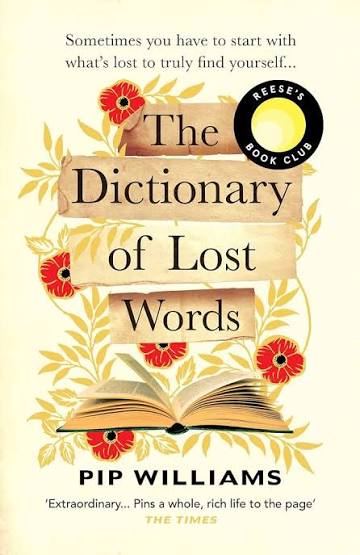
The Dictionary of Lost Words by Pip Williams
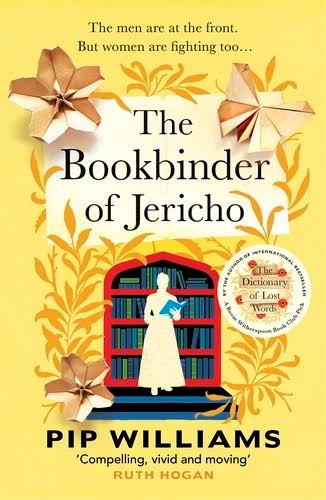
The Bookbinder of Jericho by Pip Williams
I am writing this review sitting in my brother’s living room in Conway, Massachusetts, where I have come on a whirlwind holiday, using the flight credits from a trip I was supposed take in April which had to be postponed when my husband fell ill. It was supposed to be a trip of pure indulgence after a summer focussed on work and family caregiving, with upgraded flights, tickets to a concert by one of my favourite groups, and a chance to spend time with friends and family members who I haven’t seen in far too long. The concert and the family time have or are going to plan; the meteorological gods, however, decided that I was not to be allowed a stress-free start to my trip. Thunderstorms over the north of England delayed the first leg of my flight so badly that I had to be rebooked for the second leg. As a result, rather than sitting at the end of an empty row, I was placed at the end of a full row, next to a woman who, for most of the seven hour flight, was reading Pip William’s The Dictionary of Lost Words.
It has been quite a while since I read The Dictionary of Lost Words and its sequel, The Bookbinder of Jericho, but this serendipitous moment of reencounter reminded me of how much I wanted to do so. Because, slightly against expectations, I adored these books. To be more precise, I thoroughly enjoyed The Dictionary of Lost Words, enough to go out and buy The Bookbinder of Jericho which I then proceeded to fall completely in love with.
Williams’ novels are both excellent examples of historical feminine middlebrow fiction, a genre which itself has a history going back for over a century, but which has recently had something of a flourishing. In particular, a number of excellent novels by and about women set in the late 19th and early 20th century have appeared over the last decade, from Sara Moss’s late-19th century-set Bodies of Light and Songs for Lost Children through Lissa Evans’ Second World War novels and The Whalebone Theatre by Joanna Quinn to Kate Atkinson’s playful experiments with temporality across the first half of the twentieth century.
The Dictionary of Lost Words, which tells the story of Esme, a young women involved, through her father, with the publication of the Oxford English Dictionary, starts at the end of the 19th century and runs through the First World War, so I approached it with some trepidation. And if the book has weakness, it is the section written as correspondence from a young man at the front just misses the tone of actual frontline correspondence. As with so many fictional attempts at this literary form, there is too much hindsight and to little emotional complexity in both the story told and the mode of telling. But this forms only a tiny fraction of the book which, in its treatment of the suffrage movement that forms the bulk of the narrative, demonstrates a subtle and moving understanding of the gender and class dynamics of the period. Williams’ writing style, which combines an ability to create distinctive and engaging narrative voices and characters with the ability to tell a compelling story ensured that, in spite of the break in my suspension of disbelief caused by the wartime correspondence, I thoroughly enjoyed the book and wanted to read more of her work.
I was, therefore, looking forward to an enjoyable read when I picked up The Bookbinder of Jericho, but I hadn’t expected to love it as much as I did. In this volume, not quite a sequel, but set in the same world of the OED as The Dictionary of Lost Words, with overlapping characters and events, the war is far more central to the narrative. Yet it is treated with far more originality than in either Williams’ previous work or many other novels with similar temporal settings. The aspirations of the protagonist, Peggy, are shaped but not defined by the war. Similarly, the war is shown creating new opportunities for women of all classes, but also new barriers. This is not a simple story of war as female opportunity in opposition to the confinement and destruction of masculinity.[1] Williams includes Belgian refugees in her representation of wartime home front society, and shows that women’s wartime work, both paid and voluntary, went beyond the Red Cross and the munitions factory. It is these less familiar stories of the war that enable her to create a credible world populated by believable characters. It also helped that I found Peggy a more engaging and sympathetic character than Esme. I loved spending time with her and was sorry when her story came to an end, even if it was in a satisfying way.
I didn’t ask my neighbour on the flight if she was planning to read The Bookbinder of Jericho, but I hope she does as it is well worth the time. As for me, I have finally got hold of the paperback of Joanna Miller’s The Eights, which I am hoping will make another enjoyable addition to my collection of historical female middlebrow novels. The language of the publicity blurb makes me slightly nervous, but I am hopeful of an engaging read, even if it can’t match the unexpected originality and emotional depth of The Bookbinder of Jericho.
[1] This forms the classic ‘double-helix’ model of wartime gender relations identified by Margaret and Patrice Higonnet and reflected in the influential analytic work of Elaine Showalter and Sandra Gilbert. See Higonnet, et. al. (eds.), Behind the Lines: Gender and the Two World Wars, Yale University Press, 1987.


Hi Jessica,
I enjoy your posts very much, and often think I should let you know. Now’s my chance, since this time I have a question. I’m curious about your comment(s) regarding the letters in The Dictionary: And if the book has weakness, it is the section written as correspondence from a young man at the front just misses the tone of actual frontline correspondence. As with so many fictional attempts at this literary form, there is too much hindsight and to little emotional complexity in both the story told and the mode of telling.
In your opinion, how do Gareth’s letters “just miss the tone of actual frontline correspondence”? I thought they were a little stilted, but wondered if I was being a little harsh, considering the way he’s written to begin with, as well as his and Esme’s connection with words.
Hope you’re well, Elaine Schroller
Thanks so much for your kind words and interesting question, Elaine. I agree with your view on them being a bit stilted, but the real problem is that they appear to be written with a sense of dramatic inevitability. I felt as if I knew Gareth’s fate from the first letter. This isn’t a problem specific to Williams, or even First World War historical fictions, although I do find it more prevelant in such works (the war is always entirely, unrelentingly horrific and futile and everybody dies). It is incredibly hard for fiction writers, with a sense of their own plot, to write letters which don’t have the future in view, yet actual letters are written this way, which makes them harder to interpret, so not as effective in driving forward a plot. But there are ways to make the voice they are written in more authentic. For war letters, that involves including more mundanities and humour, the day-to-day experiences that allowed men to keep fighting for four and a half years without going mad, because that is what most did. Alex Mayhew’s Enduring the Great War is a fantastic history of how this worked (and some of the things, like gardening behind the lines that men wrote about). Another strategy is the fully epistlatory novel, which gives scope for more gradual plot development through letter writing, allowing them to reflect the discursive nature of actual letter collections more effectively, although, having just read Virginia Evans’ The Correspondent, this isn’t necessarily a fail-safe. In short, I think using letters to convey historical authenticity in a fiction is both incredibly seductive and extremely challenging, and Williams doesn’t quite pull it off.