A question to which the answer is no

This is the first of three interrelated posts about doing history across disciplines, time and space.  These reflections were inspired by two events I have attended in the past couple of months, the second of the Passions of War workshop series, held at the University of Leicester on 19-20 February, and the Globalising and Localising the Great War Graduate Conference on Spaces, Stories and Societies, which took place in Oxford on 17-18 March.  Both were interdisciplinary and both took place either coinciding with or within a week of other academic events I was either attending or wanted to attend. In this first post, I want consider the how interdisciplinarity can inform understandings of historical sexuality.

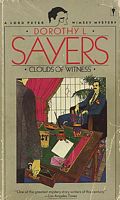
Recently the blogger Jeanne de Montbaston published a post asking ‘Is Peter Wimsey Bisexual?‘ de Montbaston is the pen name of Lucy Allen, a medievalist examining the relationships between popular culture and medieval literature, particularly in relation to gender.  It is a little unclear, but the post suggests that Allen has only begun reading the eleven novels by Dorothy L. Sayers featuring her aristocratic detective fairly recently.  As someone who has some small pretensions as a Wimsey (if not exactly a Sayers) scholar, in that an entire chapter of my PhD thesis analysed the construction of Wimsey as a post-war heroic figure, I would answer the question in the posts title with an emphatic ‘no’.  This is for two reasons: firstly, the weakness of the evidence deployed by Allen in her post; secondly, the wider problem of the relationship between effeminacy and deviant sexualities in the period under discussion.

Clouds of Witness  To begin with the actual evidence deployed by Allen which is drawn from the second novel in the series, Clouds of Witness, and relies entirely on the relationship between Wimsey and the barrister Sir Impey Biggs, QC.  There can be little doubt that, as a character, Sir Impey is coded as gay for all the reasons that Allen lays out.  What is more problematic is the reading of Sir Impey as Wimsey’s ‘good friend and oftentimes colleague’.  There may be a friendship between the two men to be read in their episodic encounters but, in the two novels and one short story where Sir Impey actually appears (rather than simply being referred to in conversation) their professional relationship is not that of colleagues.  In both Clouds of Witness and Strong Poison Wimsey is in the position of a pseudo-client, with deep emotional attachments to the accused whom Sir Impey is defending as well as that of detective.  But Sir Impey is not a fellow detective, or even a legal detective in the mould of Anthony Gilbert’s Arthur G. Crook or, later, John Mortimer’s Horace Rumpole.  Indeed, in both novels, Wimsey’s detective work actively conflicts with Biggs’s legal interests, leading to professional, if not necessarily personal breaches between the two men. If Wimsey does have a good male friend and colleague in the novels, it is not Biggs, but Detective Inspector Charles Parker, with whom he gets incapably, childishly drunk at the end of Clouds of Witness. But Parker is a figure of such rigid petit-bourgeois social and sexual respectability that he ends up marrying Peter’s sister – after a long struggle with whether even asking her to marry him is a socially appropriate thing to do.[1]

What of Allen’s other evidence, Wimsey’s ‘husky’ voice when speaking to Biggs, the comparison of Biggs to Greek statuary, and Wimsey’s parody of Mother Goose in court?  The first two are matters of interpretation.  Certainly Wimsey later, particularly in Gaudy Night, speaks huskily on several occasions to his acknowledged love-interest, Harriet Vane.  But I have always read the emotion of that meeting as relating a) to the frustrating interview with the police that Wimsey has just returned from and b) the fact that his brother is in prison on a charge of murder which is referred to in the next line.  Similarly, the Greek beauty of the Charioteer of Delphi may be a hint at Oscar Wilde’s ‘Greek love’, but given the consistent playful use that Sayers makes of classical imagery and quotation throughout the novels, and which is clearly the overt intention of association the Charioteer with the (female) Oracle, I can’t help feeling Allen may be reading too much into this.  As I am sure she is in the case of the ‘Biggy and Wiggy’ rhyme.  There is nothing in the text to suggest, as Allen does, that Sir Impey is ‘blushing’ (or, indeed, ‘surprised’) in this scene, and ‘Wiggy’ is very clearly a reference not Wimsey himself, as Allen implies, but to Sir Wigmore Wrinching, the Attorney-General who is prosecuting the case against the Duke of Denver in opposition to Sir Impey.

Have His CarcaseSo no, I don’t think that even by innuendo can Wimsey’s relationships with Sir Impey or, indeed, any of the other male characters who are presented recurrently as his friends, be read as hinting at bisexual desire.  Which is not to say that Wimsey’s mas culinary and sexuality in the novels is unproblematic. Far from it. Throughout the novels he is characterised by others as sexually and morally dubious. Henry Weldon, in Have His Carcase, for instance, implies that Wimsey is ‘exploiting his mother for my private ends and probably sucking up to her for her money’, or, in other words, behaving in precisely the same way as the gigolo Paul Alexis (and later M. Antoine) behave towards her. [2]

Gaudy NightThe issue of Wimsey’s sexuality is, unsurprisingly, made most explicit in Gaudy Night, a novel whose overarching theme is the question of sex and relationships between the sexes.  It is Reggie Pomfret, an undergraduate infatuated with Harriet Vane, who demands:

‘Who … is this effeminate bounder?’

‘I have been accused of many things,’ said Wimsey, interested; ‘but the charge of effeminacy is new to me.’ [3]

Later, the criminal in the case, when confronted, accuses him of being a

rotten little white-face rat! It’s men like you that make women like this. You don’t know how to do anything but talk.  What do you know about life, with your title and your title and your money and your clothes and motor-cars. You’ve never done a hand’s turn of honest work. You can buy all the women you want. Wives and mothers may rot and die for all you care, while you chatter about duty and honor.’ [4]

On the one hand, both these accusations can be read as charges of (hetero)sexual impotence implied in the accusations of effeminacy and the inability to do anything but talk. But the anxieties which prompt the accusations are, on closer reading, of heterosexual jealousy and fear.  Reggie is outraged that Wimsey appears to be publicly wooing Harriet (and insulting him in the process).  The charge that he can buy all the women he wants is one of sexual profligacy and financial dominance, not of lack of interest in sex.

The sexual deviancy that is implied about Wimsey therefore is not homo or bisexuality but rather sexual exploitation – the man who views sex as transactionary in ways that are solely to his advantage.  These anxieties place Wimsey in a Victorian tradition of gigolos, seducers and flâneurs as much as in the Wilde-ean tradition of coded homosexuality.

Why does this distinction matter? Because the implicit accusations against Wimsey as a sexual character is a form of sexually threatening masculininty that, today, has relatively little social purchase.  Yet it is one that was dominant in late 19th and early 20th century popular and middlebrow fiction.  It is only by placing Sayers’s novels within this historic literary context that we can start unpicking multiple and complex levels on which her critique of sex and sexuality works.  Simply reading her novels through the prism of our contemporary understandings of homosexuality as the dominant form of non-normative (or at least non-hegemonic) male sexuality limits our understanding.

Which brings me to that question of interdisciplinarity.  Because sexuality is both historically contingent and historically unspoken, something beautifully demonstrated by Justin Bengray in his post on the Notches Blog, ‘The Case of the Sultry Mountie‘.  What Wimsey demonstrates is the way in which fiction can fill the silences around subjects like sexuality that exist in archives but he also provides insight into social and cultural norms that have slipped out of the contemporary reader’s view.  The first can be accessed and identified through the sort of close reading that the study of literature and methodologies of literary critics fosters.  The second draws on the perspective that derives from the contextualising processes of social and, above all, cultural history.

A call for close collaboration between these disciplines and methodologies will probably not come as any sort of shock to most of this blog’s readership, and most will I suspect be personally and professionally sympathetic to it.  When presenting at the GLGW conference in Oxford last week, I spoke of how I have used fiction to access women’s perspectives on war disability in the past, and was, in turn, asked the extent to which I intend to use such sources in my current project. (The answer is less than before simply because the archive I am working with promises to keep me more than busy enough over the next five years, but I would love other scholars to take up the analysis of wives of disabled ex-servicemen in fiction to develop my arguments and challenge my conclusions.)

Yet it is worth, once again, reiterating the importance of such interdisciplinarity. There are still enough historians who sniff at literature as unrepresentative source material and literary scholars who shrug off the complexities of historical context as unimportant to make this a case that still needs to be made.  Most unnerving of all is the backlash against cultural history which continues to rear its head.  At this week’s Social History Society Conference Rohan Mcwilliam apparently called for cultural history to be dropped from the title of the journal Social and Cultural History. I wasn’t actually present when this was said (which I will discuss further in my post on doing history across space), so am unclear how serious this suggestion was, but such comments reinforce the need for those of us who work across disciplinary boundaries to continue to make the case for why it is so vital to our understanding of ourselves, our culture and our history.

[1] The Hon. Freddy Arbuthnot makes a third in end-of-novel drunkenness, another male friend of Wimsey’s who recurs in the novels far more often than Biggs.  Like Parker, his sexuality is rigidly respectable.  Any suspicion thrown over it by his decision to marry Rachel Levy, the daughter of the Jewish victim of Whose Body? is counteracted both by the self-interested logic of the financially-minded Freddy in marrying the daughter of a City magnate and by the devotion of the bride’s parent’s own inter-religious marriage.

[2] Dorothy L. Sayers, Have His Carcase, New English Library Edition, London: Hodder and Stoughton, 1974, 156.  First published London: Victor Gollancz Ltd., 1932.

[3] Dorothy L. Sayers, Gaudy Night, Perennial Library Edition, New York: Harper & Row, 1986, 385. First published London: Victor Gollancz Ltd., 1936.

[4] Sayers, Gaudy Night, 445.

How I got here

The weekly convulsion of my Twitter-feed in response to the Academics Anonymous column in The Guardian is becoming something of a ritual.  Last week’s, a former PhD candidate’s complaints about the British viva voice examination system for doctoral dissertations, happened to coincide for me with a dinner discussion of the path I took getting from my PhD to my current permanent position with external funding.  Based on that conversation, and the comments below the line of the Academics Anonymous article, I’ve decided it is time for me to come clean about how I got to where I am today.  It has taken me a long time to reach the point where I feel confident enought to discuss this in a post on here, but the time has come, so here goes.

Why is it so hard for me to talk completely openly about my academic journey?  Well, based on the opinions of some in the academic community (reflected in the below-the-line comments), for the following reasons I am a failure as an academic:

1) My MPhil and PhD were both self-funded.  The practical reasons for this was that my decision to apply to do both degrees came quite late in the annual application cycle.  My options for funding were further complicated by the fact that I was applying as an overseas (non-EU) candidate.  Yes, I could have taken time out, waited a year, reapplied for funding, but in the case of the PhD that would have involved considerable complications with regards to relocating and would probably have thrown me off my academic course.  As I was in the fortunate position to be able to self-fund, that is what I did, and ended up with a degree from a highly respected institution as a result.  However, in a landscape where many believe that too many weak PhDs are being produced, self-funding is often seen not as a practical choice (even if one that isn’t necessarily politically palatable to those who make it) but as a shorthand for a project too weak to compete for competitive funding.

2) To confirm those critics who would argue my research was too weak for a PhD, my thesis was referred following my viva.  There is quite a lot of confusion around the various terms relating to examination outcomes, so to clarify, the options for examiners at my university are a) unconditional approval (pass), b) conditional approval (requiring either minor OR major corrections), c) revision and resubmission of the thesis (referral), d) revision and resubmission OR the offer of a lesser degree (MLitt/MSc.), e) offer of a lesser degree without the option of revising and resubmitting, f) outright failure.  Roughly 10% of vivas at my institution result in option c, the option my examiners went for, which means that the candidate has longer to make the suggested revisions (6 months as opposed to 3).  While it can be emotionally tough, and certainly tougher than major corrections, it can provide the necessary time and space to absorb the ideas discussed in the viva, read any additional suggested literature, and produce work of the expected quality.  In my case, this time was invaluable in addressing the key theoretical weakenesses quite rightly identified by my examiners.  Using their suggestions I was able, in this time, to produce a thesis that did not require a second oral examination upon resubmission, although this in turn has left me with a strong sense of anti-climax around my degree, and a more than usually heightened sense of imposter syndrome.

3) I left academia for five years.  Nope, I couldn’t hack it.  After 2 years of temporary teaching jobs and about 300 failed applications, I decided to cut my losses and try something else.  I spent a year working in academic publishing before my personal circumstances changed, after which I did some freelance editing, finished my book and had a baby.  It was in this period that I realised that historical research and writing was what I loved, what I wanted to do with my life.  But I had left academia, hadn’t I?  I was a failed academic, with a weak degree that probably should never have been undertaken in the first place…

Except, that isn’t quite how things panned out.  When my son was 6 months old I was invited to lunch by Alison Fell and asked if I wanted to contribute to the Legacies of War project she was just starting to develop with colleagues at the University of Leeds.  My answer was yes, of course, but I had no professional links with the university.  With the support of Alison and the School of History, I was able to put together a successful Wellcome Trust Research Fellowship application, a job which in turn enabled me to put together my successful applications of the position of University Academic Fellowship in Legacies of War and for European Research Council funding.

So what did Alison, the University of Leeds and the Wellcome Trust see in me to make them take the risk of giving me the opportunity to get back into academia? I’m not entirely sure, but the following probably contributed.

1) I was REF-able.  My PhD may not have met the standard of being publishable on submission, but two chapters, almost entirely unrevised, formed the basis of half of my monograph, published four years after I was awarded my degree.  I  had also published two refereed journal articles (as well as several book chapters) based on the research undertaken for my doctorate, so publishers, journal editors and referees had, independently come to the conclusion that my research and writing were of sufficient standard to be published.  I had passed the criteria for examination by publication, if you like.

2) I had strong networks.  I never really fully left academia, even in the period I stopped actively pursuing a straightforwardly academic career.  I organised conferences, edited essay collections, reviewed books, acted as membership secretary for a scholarly society.  People knew may name, were willing to write references for me, launch and review my books, endorse my work.  In other words, I had the endorsement of ‘the academic judgement of the scholarly community as a whole’, as called for as an alternative form of examination by the anonymous academic.

3) I had good ideas which I was able to put forward as coherent, fundable projects (although I currently fear that I have overpromised on my current project, a by -now familiar phase of any new undertaking).  These ideas, both for Wellcome and for the ERC, arose directly from my PhD.  They are questions I was not able to answer within the scope of that project but which now, with greater experience and knowledge of the field, I can tackle.

So what is the point of this confession other than to finally make a clean breast of my academic failures, to show some of the frantic paddling that has gone on under the surface to travel this far?  Primarily, I think, to note that the PhD, while a necessary qualification for an academic career, is not the be-all and end-all of making a success of that career.  Being a successful academic requires skills that can be reflected in a PhD, but which can also be developed over the course of and after gaining the degree. The examination of our credentials does not end on the far side of the viva door but carries on throughout our careers, undertaken by funders, publishers, colleagues, students and, increasingly, the government and the public (but that is a discussion for another post).  The prospect is a daunting one, whatever stage of a career you are at, but it is also one that, at least for those of us who started our careers with a sense of failure, also offers immense opportunity.

Introducing … Men, Women and Care

It has been nearly five months, I realise, since I started my new project, and I have yet to formally introduce it to the public.  There are reasons for this.  Much of the past five months has involved rather more administrative work discussing the project than actual research.  And even then there doesn’t seem to be a great deal to show for it.  The website is still being built, I am still working out the nuts and bolts of the project’s centrepiece, the team is still being recruited.  But last week we made the first formal appointment to that team, a skeleton website should be up and running soon, and we are on the cusp of the new teaching semester, so now seemed a propitious moment for slightly more formal introductions. So here goes.

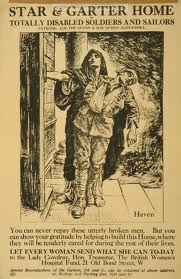
Star and Garter poster

Fundraising Poster for the British Red Cross Star & Garter Home

Men, Women and Care: The gendering of formal and informal care in interwar Britain is a European Research Council Starting Grant funded research project based in the School of History at the University of Leeds.  Over five years, it will explore the ways in which the State, charities and, above all, the family provided medical and social care to disabled ex-servicemen in the aftermath of the First World War, particularly the relationships which developed between these three groups in the course of care provision.  It asks how State, medical and charitable institutions, often dominated by men, interacted with the wives, mothers and sisters who found themselves caring for men who had suffered life-altering wounds and illnesses as a result of their war experiences and how these interactions shaped social and cultural understandings of care-giving as a gendered practice.

At the heart of the project is the creation of a database of the material held in PIN 26, the section of The National Archives which contains nearly 23,000 First World War pension award files.  This is not a digitisation project; many files contain medical records which it would not be ethical to digitise.  Rather, the database will collect demographic information and give an indication of what supplementary material the files contain.  This will allow for both quantitative analysis of the entire sample, as well as helping researchers identify relevant files for further qualitative analysis.  The project will work closely with The National Archives to enable the database to be made freely and publicly accessible upon completion.

In addition to working with the National Archives, the project is looking to build relationships with local, national and international partners to explore how this research might shape and be shaped by contemporary understandings of medical and social care provision, particularly in relation to the role of the family.  The project itself is a central element of the Medicine and War strand of the Legacies of War research and engagement hub based at the University of Leeds, and we are looking forward to building on the strong relationships and innovative work that Legacies of War has developed since its inception.

The Men, Women and Care team, at present, is made up of me as principal investigator and Alexia Moncrieff, who will join as postdoctoral researcher fellow over the summer.  Currently completing her PhD on the Australian Army Medical Services in the First World War at the University of Adelaide, Alexia’s research for the project will focus on the ‘Overseas’ subsection of PIN 26, to explore how ideas of distance shaped the provision of care by different institutions.  We are also in the process of recruiting two PhD candidates who will start their research on related questions in October.  Given the richness of the PIN 26 archive, as well as the range of related material in the archives of local government, charitable institutions and personal narratives, I am very interested in hearing from anyone who would like to collaborate or contribute.

As I say, there will be, in the near future, a project website and Twitter feed (@WW1PensionsCare – as soon as Twitter allows me to register it).  Please bookmark and follow us to see how we develop and do get in touch if you want to find out more.


Easing into the new year

Due to a teacher training day at my son’s school, today is my first day back at my desk since the Christmas holidays.  After two and a half weeks of combined childcare and hosting family, this comes as something of a relief, despite the fact that a misremembered date has left me with a book chapter to complete in less than a month.  In fact, January is going to be pretty writing intensive, with a couple of book reviews due at the same time, as well as my sole New Year’s resolution, to draft or redraft a chapter a month until I get my book completed and sent to a publisher.

SherlockOn the theory that writing breeds writing, I am going to embark on this rigorous schedule with a blog post about … the New Year’s Day episode of Sherlock (BBC1). (Beware spoilers from here on in.) I don’t even really have the excuse of doing this with my historian’s hat on.  I make no pretensions to being a proper Victorianist, but I am, alongside my First World War expertise, a historian of popular culture with a specialism in detective fiction and it is as such that am going to make so bold as to comment.

I am also, of course, a gender historian so let me start off by saying that, as far as the ‘mansplaining’ debate which convulsed portions of Twitter in the wake of this episode, I agree entirely with Camilla Ulleland Hoel, who articulates why this is not an example of men silencing women far more eloquently than I can.  I do, however, take one slight issue with her reading of the episode, and that is in her comments on the ‘the pointy hats of Ku Klux Klan (in order to create an echo, I assume, to the orange pips story)’.  Because I am fairly sure that the entire set up to the scene was not a gratuitous KKK reference, but rather one to the 1985 film The Young Sherlock Holmes, directed by Barry Levinson, a film which, aged 12, frightened me into nightmares for months (no, I was not very sophisticated and rather too imaginative for my own good).

And that is what I loved about the episode.  Yes, there were the many, many references to the Sherlock canon.  But there were also the references to the much wider field of Sherlockiana, including Watson’s suggestion for ‘The Monstrous Regiment’ as a potential title for the episode, one that has already been used by Laurie R. King as the title for one of her Mary Russell and Sherlock Holmes series, an explicitly feminist reworking of the tradition.  And then there was the plot, not simply a metafictional phantasmagoria but also a spoof on Anthony Schaffer’s Sleuth (1970), itself part of a long line of spoofs on the detective fiction tradition, which Conan Doyle arguable founded, stretching back through the entire 20th century.

I picked up three references, but I am sure there were many, many more which I missed, given that it is some years since I have been properly involved with Sherlockiana and the field has developed hugely since then (a couple more can be found here).  My guess is that most of these conceits were the contribution of Mark Gatiss rather than Steven Moffat.  Gatiss’s writing, whether on Sherlock, Dr Who or the ridiculously clever clever and very funny Lucifer Box series, always gives me the disquieting if rather pleasing sense that here is a man who shares my somewhat obscure frame of reference when it comes to popular culture.  Which probably just means that my very limited and specialised frame of reference also happens to be a very small subset of his far, far larger one.  This is a man, after all, who, as Hoel points out, is as happy incorporating a Victorian music hall stage trick into his plots as he is with referencing semi-obscure mid-to-late 20th century plays and novels.

The delight of all this to me, beyond the comfortable smugness that comes from feeling that I am getting the joke, is the reinforcement it gives to my own belief in the importance of the history of popular culture, including low- and middle-brow material that is all to often dismissed as culturally worthless.  This is in part because it tells us something about the time in which such cultural production was created, always useful for a historian, but also, often, because if forms part of a much longer tradition, allowing us to read change and continuity across time.  Sherlock itself embodies this duality and, in this episode, made it the very conceit on which the plot was built. Itself a hugely popular element of contemporary popular culture, it nonetheless lays explicit claim to the timelessness of Conan Doyle’s creation.  By tipping its hat to the long tradition in Anglo-American culture of riffing on that creation in ways which illuminate different historical moments, it located itself within that linear tradition and made its own bid for immortality. Now there is metafiction and self-referentiality for you!

A Hard Year

A recent email from WordPress reminds me that it is the time of year for reflective blog posts. Having singularly failed to post a festive message last week, I am going to try to post this one, although being on a hilltop near Scarborough with intermittent internet may yet thwart my ambitions.

So, 2015. It has been, without doubt, a hard year. Much of that hardness has been straightforwardly negative. The family illnesses which I wrote about in May have defined a great deal of my year and look set to do so well into next year and beyond. On the positive side, my mother’s cancer now appears to be in remission (touch wood!) but the rapidity and intensity of the disease and its treatment will be central to how I remember and reflect on this year. Coping with that, alongside the stresses of other illnesses and the normal strains of family life – the small boy who wakes no later than 10 past 6 every morning, the four-year-old with increasingly picky eating habits – has been, as I say, hard.

Other aspects, particularly the professional aspects, have been hard in other ways. I started this year full of uncertainty, with my professional future in the balance. By mid-February, that uncertainty had been resolved in the most positive way possible, a full-time job, a large grant, bright prospects and exciting work to do on the horizon, but not without a great deal of labour and anxiety, not least in those first six weeks of the year. And that work, as exciting as it is, is itself, as I am discovering, hard in the sense that it is challenging. The challenge is not solely intellectual, but also managerial, pushing me well out of my comfort zone and asking me to take roles that often make me uncomfortable. As much as I anticipated the challenge of this aspect of the grant when applying for it, the lived experience is nonetheless still as hard if not harder than imagined.

So I have been working hard, not only getting the new project off the ground but also attempting to complete the old one. Here the hard labour has, perhaps, proved most rewarding. The concentrated writing I did over the summer has resulted in three draft chapters and a large chunk of the introduction for the book, as well as a chapter for an edited collection and a rejected journal article, as well as the wholly joyful publication of a special issue which I both edited and contributed to. With the exception of the special issue, itself the result of several years of hard work, all these pieces hold within them the promise of more hard work – editing, revising, expanding, (re)submitting. And there is more such work to be done – four book reviews, a chapter for an edited collection, an article for a special issue, a conference paper. Each endeavour will involve time, energy, thought. Each in there own way will be hard and, if I work hard enough, will also be contributions of value to my field.

So for me the definitive moment of 2015 remains one that came in the middle, in that first hot weekend of July when, in her keynote at the Modern British Studies conference in Birmingham, Catherine Hall reminded us that the work of history, if done well, especially when done well, is by its very nature hard. It requires facing hard truths and a clarity of both thought and expression that necessitates focus and energy. The demands of the research that underpin this thought also requires labour which, in turn, must be integrated into the other demands that life places on us, to earn a living, to care for our families, to nourish ourselves body and soul. But as Hall demonstrated, in act as much as speech, it is work that is worth doing because it is hard work. Here, at the end of this year, I cannot but be glad for how hard it has been, personally and professionally because that hardness and heaviness have helped me to define my sense of purpose about what I am doing and will being doing with my life for the foreseeable future.

All that being said, there is undoubtedly part of me that wishes for an easier 2016, or at least a slightly more restful one. May yours be peaceful, joyful and kind to you and yours.

A very happy new year to you all!

#am(not)reading

tumblr_ncgkryMwuc1s1zlzoo1_500I miss reading.

That may sound like an odd thing for an academic to say.  After all, I read all the time.  Within the past few weeks I have read 10 2000-word essays, two articles for discussion in a reading group, a draft of a colleague’s article, a draft of an other colleague’s grant proposal, three pieces of work written by postgraduate students, bits and pieces of roughly two dozen books that I am using to write a book chapter, half of a review book plus an unnumbered number of articles, blog posts, twitter conversations, emails and other forms of writing that historians of the future may class as ‘ephemera’.  Next week I will read over a dozen research proposals, another piece of postgraduate writing, some more of the review book and yet more articles, blog posts, twitter conversations and emails.

My job is based on reading and reading occupies a huge portion of my time. So what do I mean when I say I miss reading?

What I really mean, of course, is that I miss reading uncritically.  Everything I read for work requires me at some level to think about it, evaluate the ideas it contains and make judgements based on those evaluations.  Some judgements are superficial or easily made. Deciding whether or not to attend the range of seminars that emails regularly invite me to falls into this category.  Others are more time and energy consuming.  Fully grasping the way a student has grappled with complex ideas of masculine hegemony or the sophisticated arguments of 250-page academic monograph requires attention and focus.  The former is a necessary aspect of daily life, the management of communication.  The latter can be hugely satisfying, reflecting achievements in communicating and comprehending complex ideas.  But both are forms of reading as work, reading in which the self is always present, bringing to bear critical faculties on the text.

What I miss, what I really miss is the sort of reading that entails the loss of self within the story, where the act of reading is enough, where judgement is not necessarily suspended but not the ultimate definition of the interaction between reader and text.  I miss reading for pleasure, a loss to the multiple demands on my time that I become ever more acutely aware of as my six-year-old son makes the transition from reading as learning to reading for self-satisfaction.  Watching him make that journey is wonderfully exciting, opening up new worlds of books that I can offer him to lose himself in.  But it is also a poignant reminder of how little time I spend doing such losing myself. There are books on my ‘to read’ shelf that have been there since he was born – and the pile still grows, a testament to the power of hope (and good intentions) over experience.  I will read these book someday, I know I will.

On the positive side, not only does my son’s growing discovery of the pleasures of reading for pleasure provide me with greater opportunities to read myself (although he still loves being read to, a joy I hope he never loses, as I have never done), but the Christmas holidays are nearly upon us, with their eternal promise of time to read.  The past few years have been dominated by grant deadlines which have eaten in to any time not already committed to festive preparations and family celebrations.  But this year I am determined to carve out some time to finish the novel I haven’t looked at since September, and maybe even one or two others besides. Because if I am to retain the ability to read critically, as I must do, I need allow myself the space read uncritically as well, to lose myself in the written word as a way of finding myself again.

Breaking the silence

It’s been a long time since I have posted, over three months in fact.  This is not down to a lack of material to write about (I have pondered at least a post a month which has never been written) and only slightly to do with lack of time (although I am pleased to say that the book is now four draft chapters long and well on the way to being completed in draft form).  Rather, I have got out of the habit of blogging and have struggled to get back into it.

Posting on here requires me to make the time to identify subjects, think them through and actually write posts down. Other things have to take a lower priority for this to happen and, as Matt Houlbrook recently pointed out, there are times when other things need to be prioritized.  Life can be more than history, and neither history nor historical blogging can alway console us for everything life throws us.

But there comes a point when even the priorities beyond history cease, at least temporarily, to be so compelling, when the deadlines retreat for a while, when the business of teaching and admin and childcare and housework have the potential to be treated as background noise rather than the narrative itself. But restarting old habits, however beneficial we may know them to be, can be difficult.  Blogging, like any other form of writing, at least for me, is a form of concentrated labour that needs time and space, time and space which need to be consciously carved out of already crowded days.  Forcing myself to do something that is difficult and time consuming but which has no deadline may be a very good self-mortifying discipline; that doesn’t mean I can or will do it.

So, in an attempt to get myself back into the habit of finding some time and space to write in this voice, a voice which I know is important to me both personally and professionally, I present you with the following query and half-formed thoughts which arose yesterday when I asked on Twitter whether any historians had included details of childcare responsiblities in their grant applications.  I received no more than a dozen responses, so this is a deeply unscientific survey, but the results interested me on a number of levels.  From the answers I did receive the following information emerged:

– The inclusion of childcare most often occurs as an explanation for past behaviours (time off for maternity leave) rather than as justification for proposed future behaviours (such as why a certain number of research trips of a certain length have been budgeted for).

– Some funders (take a bow, AHRC) have specific policies for taking childcare responsiblities into consideration. I did not know this. I am very glad I do now.

– There is a US/UK divide, with US applicants much more willing to view childcare as a legitimate concern of funders than UK applicants.

– Almost all responses were from women. Where men did responded it tended to be to be in relation of their female partner’s applications, rather than their own.

– All responses expressing anxiety about how the inclusion of childcare would be viewed by funders came from women, but so did the cheerleading for funders who explicitly stated that childcare consideration could and should be included in applications.

As I say, the tiny sample of responses makes any conclusions difficult to draw, even if I had any, but I remain interested in seeing where this discussion might take me, not least because of my own responses.  I have never included childcare in any application beyond the statement of maternity leave taken and the inclusion of my children’s birth certificates as evidence of my qualification for time credited for leave.  But now I am seriously questioning whether I should have done or do so in the future.

Thinking about it, I realise the extent to which I still separate my caring responsiblities from my professional identity, despite the immense impact they have on each other, an impact I freely acknowledge here.  How I ensure my children are properly cared for while fulfilling my obligations as a researcher and a teacher is an immensely complicated issue requiring great good will from many others (as I was reminded when my son fell ill two hours before my husband was due at work and 2.5 hours before I was due to teach as seminar).  Yet I still assume that sorting them out is my responsibillity rather than my funders.  That others, funders and academics, don’t see it as such is both cheering and challenging.

There is also a question of gender to be addressed, a question that seems obvious but which I find surprisingly hard to articulate.  Is childcare still a dominant concern of women? Are men more confident in asserting their right to have childcare responsibilities taken into account?  If so, why?  And what about other caring responsibilities?  Like so many of my colleagues, the necessity of caring for aging parents is becoming an increasing demand on my time and emotional energy, time and emotional energy that cannot then be invested in research.

I will need to think more about this, ask more questions, have more discussions, write more blog posts.  If I want to change the status quo, my own as much as anything, I need to break silence.


Mileage may vary*

I hadn’t meant to write this post.  I wanted (still want) to write one about laughter and its uses in understanding historical power structures.  But yesterday I found myself drawn into the debate sparked by Mathew Lyons’ article on the experience of Early Careers Research in history and as my position on the subject needs far more than 140 characters to express fully, this seemed the most logical venue to articulate it.

Before I start, I need to make clear the position from which I am writing. As regular readers of this blog will know, I now hold a ‘tenure-track’ position at the University of Leeds.  This means that I have a five-year probationary period to go through but, all things being equal, at the end of that five years I will hold a permanent position. This is not an entirely secure post, and some of the probationary requirements have a whiff of requiring more luck than judgement to fulfill.  Nonetheless, it is considerably more secure than either the 3-year fixed-term contract I had immediately preceding this appointment, or the sort of very short-term fixed-term contract described in Lyons’ article.

A bit more background. Although I have only just stopped being officially an ECR (as I have explained here), I actually completed my PhD in 2005.  Between 2003 and 2006 I held a series of exactly this sort of short-term contract at four different universities. In many ways these jobs echo the description in the article – no training, poor pay, few if any resources to support career development activities. They all differed in one highly significant aspect.  In every institution, I was able to get and maintain these jobs, jobs which gave me important experience for my CV as well as a small income, due to the support of more senior academics who held permanent positions. They advocated for me, mentored me, advised me in ways that still inform and shape my academic practice.  They were, and are, my allies, not my enemies.

What they couldn’t do, despite huge amounts of support including sponsoring grant applications and writing letters of recommendation, is get me a full-time academic job. Despite hundreds of applications over a three-plus year period, the summer of 2006 saw me facing the possibility of no work at all the following term.  So I took the decision to explore other options and moved into publishing.  In other words, I left academia.  As it happens, publishing didn’t work out for me either, but it provided me with employment and a (very small) income while I undertook various academic-related projects – organising a conference, editing a collection of essays, writing a book chapter, completing my monograph.  Throughout this I was hugely privileged by the fact that my partner (now husband) was able to support me as the primary wage earner in our family, a privilege I am fully aware is not available to all or even most. But what does not necessarily require the advantage of family and financial support is the realisation that taking time out from academia, either temporarily or permanently, does not make you a failure.  This is hugely difficult to come to terms with, on a personal as much as a social level, but given the number of scholars across all disciplines who I know who have either taken time out or left the academy entirely, the time is well past where we need to challenge a limited definition of what a successful post-PhD career looks like.

If we are to accept that less established academics are highly unlikely to move seamlessly from PhD through postdoc to permanent position, how to we ensure that, for those like me who want to find a way back get the support they need to do so? More by accident than design throughout my ‘career break’ I was able to maintain a network of contacts in the field, if a somewhat limited one. It was one of these contacts who encouraged me to apply for funding and the generosity and support of a range of established academics and administrators who advised me as I wrote my grant application. Helping to support and maintain networks for post-PhDs, whatever direction their career takes them, is undoubtedly something established academics could do more of, although my experience has been that many do this already.

It is worth, at this point, pointing out that my way back into academia was not via an advertised teaching role, but rather through a research position that I managed to create for myself (with a great deal of support and good will from others within what has become my institution, as well as the luck of being in the right place at the right time). Working towards a research-focussed role made sense to me as I love research and communicating research through writing.  As with many if not most academics, research is the primary element of what I do and my motivation for doing it. This is not to say, however, that I do not see teaching as a very important facet of the academic role, in part as it is another way of communicating research.  But for me undergraduate teaching is not my first choice of communicating my passion for my subject. I do it because I know it is important. I believe I do it conscientiously; I hope I do it well. But I do not approach teaching with the passion I approach my research and writing. It does not inspire me in the same way and I am therefore less likely to invest the time and energy required to constantly reflect and innovate.  That being said, I do not ‘disdain’ teaching or the creative approaches that so many of my colleagues (both established and more junior) develop and practice.  I simply find it less rewarding (my lack of self-confidence possibly having something to do with lack of early training in the discipline) and am therefore inclined to focus what energy I have on the equally difficult challenges of public engagement, research innovation and writing for publication.  This is a personal preference, not a politically motivated calculation to improve my employment prospects and I am very aware of the need to ensure that teaching and research are equally valued within academia, something which I would argue involves challenging the divisiveness of the language used by so many politicians in their statements on university funding.

Which brings me back to Lyons’ article, where that accusation of established academics’ supposed ‘disdain’ for teaching has touched a very raw nerve.  It highlights the principle problem with the argument being put forward, that is the dichotomy being set between ECRs and permanent staff.  This dichotomy implies that both groups are monolithic, with all permanent staff failing to offer support to their more junior colleagues on whom they pile all the teaching, and that all young academics have identical aspirations and definitions of what makes academic success.  By generalising anecdotal evidence to make an argument about a huge range of experiences, it fails to acknowledge the diversity across institutions, disciplines and, above all, individuals.**  In doing so, it undermines the very solidarity that many commentators have been calling for as a way to challenge the very real problems of the exploitation of ECR labour which undoubtedly exist. It serves to silence those of us who have only recently achieved permanent positions, and therefore still wield very little power within our institutions. We worry about being accused of being ‘smug’ because we speak from a position of ‘success’, however much experience we may have of exploitation and ways in which we challenged it. Many established scholars worry even more about the security of their jobs, particularly if they are seen to speak out against university administrations. And it silences those of us who seek to challenge the oppositionality of research and teaching that the REF and the (rumoured) TEF imply.  Being research-focussed, and using that as a way to gain a job, does not make you an enemy of teaching staff, but nor does it give you the power, within a system which has drained so much direct power from academics, to challenge single-handedly the exploitation of fixed-term teaching staff.  We need to work together, making use of experience, providing support, advice and mentorship.  Yes, we need to be more honest about the competition of the job market, but we also need to be challenging a narrow vision of academic success, for ECRs and established academics alike.

*With thanks to Cath Feely and Victoria Stiles for the inspiration behind this post and its title.

** I am fully aware that I have used my personal experience here to call for a more nuanced view, something which may ultimately not be entirely helpful.  But as has been pointed out, much of the commentary has been based on individual experiences, such as those described here, and including narratives which present an alternative view on how to forge a fulfilling career from a PhD in the discussion may be helpful in providing said nuance.

The time has come, the Walrus said

to talk of many things

‘Tis the season. I have been conferencing, attending a workshop and a conference in the past fortnight which have both forced me to think very, very hard indeed. The two could not have been more different, but both have been hugely productive for a variety of reasons. What follows is my attempt to articulate what I have and am learning from both experiences.

Of shoes and ships and sealing wax

Passions of War, Ghent, 20th June

The first gathering was not, officially, a conference, but rather a workshop, one of a series of three being organised by the Passions of War, an AHRC-funded network exploring ‘the influence of war on constructions of gender and sexual practices, and how these constructions and practices have, in turn, conditioned the ways in which wars are waged, mediated, felt and understood’. We were a small group, no more than 20 in total, and formal proceedings were limited to a single day’s presentation and discussion. The event, the theme of which was ‘Identities’ took place in a single room at the Dr. Guislain museum, with all participants engaging with all the papers and joining in with vigorous and wide-ranging discussion.

And when I say wide-ranging, I mean wide-ranging. My own paper, which kicked things off, was an examination of why we need to explore the masculine identities of non-commissioned medical service personnel in the First World War, as well as those of wounded men and doctors. It formed part of a panel in which other papers explored nationhood, motherhood and death in war poetry (Marysa Demoor) and nostalgic conceptions of the Second World War in contemporary social and political discourse (Victoria Basham). A presentation on the now-closed War and Trauma exhibition was followed by an afternoon panel focusing on gender and citizenship in 18th-century conflicts, with papers from Marian Füssell, Stefan Dudink, and Simon Bainbridge. The day closed with a public lecture from James Wharton, including readings from his autobiography, Out in the Army.

On the surface, this range of papers might not seem to have all that much in common, other than the very broad theme of gender and war. They covered huge swathes of time, geography, media and disciplinary approach. Yet together they worked as jumping off points for intense and involving discussion. At the centre of the day’s debates, for me at any rate, was the question of the languages we use to talk about conflict, how that language is gendered and how it can and should be historicized. How does ‘shell shock’ translate into Dutch, and what are we saying if we don’t translate it? What does the changing meaning of ‘nostalgia’, from a nineteenth-century illness to a twentieth-century political tool tell us about the place of war in society? How do we analyse discourses and the literature of the past in ways which are both intellectually and historically rigorous, which speak to both the reality of past experience and the debates of today? The small group set-up of the workshop allowed these discussions to flourish, with ideas and connections developing in interesting and exciting ways across disciplinary, national and periodic divides.

While the formal procedures were enlivening, however, for me the most exciting discussions were those that happened between and around the formal sessions. It was, for instance, an honour and a pleasure to meet Holly Furneaux, whose forthcoming book on the masculinity of Victorian soldiers looks set to shape my own work in important ways. Indeed, on the back of the workshop she has sent me a copy of her chapter on Crimean stretcher bearers which I have been having a lovely time reading and engaging with this past week. Then there was the discussion I had with James Wharton at dinner (and much later into the evening than was probably sensible) about what motivates young men to enlist, how the memory and commemoration of a divisive conflict affects those who served in it, and the practical implications of the government’s current policy on military reserves. These are all issues that have arisen in my historical research; to explore their importance in a contemporary context was illuminating. And, in the end, as I traveled home on a very early Eurostar train from Brussels the following morning, the ideas that had been stimulated over the course of the day coalesced into a moment of inspiration about the argument my book is making and why it is significant. I had gone to Ghent with a paper that attempted to articulate the main argument of my introduction; I came home with the seeds of a conclusion.

Of cabbages and kings

Modern British Studies, Birmingham, 1st-3rd July

The second conference (and this one was a conference) was the Modern British Conference, held in Birmingham this last week. Organisationally, this could not have been more different from Ghent – 280 delegates, three days, 6 keynotes, four parallel panels each session – and my own contribution reflected this difference, being on the project to come rather than on my work at present. The sheer size of the conference meant that my own path through the various ways in which the rethinking of modern British studies is being addressed by contemporary scholarship was particular to me and my interests. It was, quite simply, impossible to attend all the panels that I would have liked to attend, at least not without learning the neglected art of being in two places at once.

The panels I did attend were excellent. Most were flat-out entertaining, many were innovative, all were thought-provoking. Standouts were those on ‘Interrogating British Boundaries’, which pushed me to think again about how I will approach the ‘Overseas’ section of the PIN 26 archive, ‘Money, Belief and Politics in Modern Britain’, where Sarah Roddy’s work in particular was highly suggestive about my methodological practice and the wonderful ‘Humour and Comedy in Modern British Studies’, where not only did Lucy Deplap’s exploration of anti-suffrage humour suggest an angle on hospital journals that I now plan to pursue further, but Peter Bailey gave a demonstration of conference paper presentation as performance that was as powerful as it was funny. I have never experienced a conference panel as joyful – this one, for all its potentially uncomfortable subject matter, was.

I was sad to miss panels on regional histories and creative histories, and it sounds as if panels on the 1970s, subcultures, and ‘The Future History of Race’ were all extraordinary experiences for those who did attend. However, I was able to get a flavour of all through Twitter, this being the most Twitter-active conference I have ever attended. Indeed, this was the first conference I have ever attended where live tweeting made sense, one where the sheer quantity (and quality) of online participation facilitated participation and discussion rather than distracting from it. The extent of online engagement, in addition to the normal face-to-face interaction of a large conference, was, however, more than usually exhausting. As intellectually exciting as it was, I’m not sure that level of critical engagement over three days is entirely healthy or productive. Given the many calls for self-care made throughout the conference, this may be a facet of conferencing that needs revisiting on a regular basis both by individuals and ‘twitterstorians’ collectively.

Of course, not all aspects were equally impressive, and I did come away with a number of reservations. The first of these was about an uncomfortable tendency to try to periodize Modern British Studies as a historic undertaking. James Vernon gave the most overt example of this in his keynote address, where he sought to define the field generationally, starting with the ‘generation of 1945’. I found this sort of grouping of scholarly endeavour, which also found expression in the focus on established scholars as opposed to PhD and early career scholars mildly alienating. As someone who has not had the opportunity to define myself as part of a generation, indeed has only just moved from the precariousness of a temporary contract to the security of a permanent position, I certainly don’t feel ‘established’, although I do feel the responsibility to support the intellectual endeavours of those in less secure positions within the academy. I was not clear where I and people like me fit into to this mapping of the professional field. And if we are going to talk about self-care and support within the profession, we do need to discuss issues that arise at different points in the life-cycle, not least the caring responsibilities that impact on the time and energy of so many mid-career scholars, a subject that, as far as I was aware, was simply never mentioned.

The second issue to disturb me was the rather startling absence of gender as a category of explicit historical analysis, particularly in the keynote speeches. Where gender was specifically discussed, in Geoff Eley’s public lecture, it was, shockingly, in a way in which women were viewed as the only gendered sex, thereby completely ignoring quarter of a century’s work to make men visible as gendered historical subjects. The story of gender and the political aftermath of the First World War, for instance, is far more than one of maternalist discourse v. fear of the flapper, not least because the ‘Lost Generation’ was, for most politicians in Britain, exclusively male.

Is this a piece of special pleading on the part of a gender historian? Well possibly. There is, of course, only so much that can be said in a thirty-five minute paper and the subjects addressed by Seth Koven, Stephen Brooke, Deborah Cohen and Catherine Hall were all wonderfully rich and complex in ways that defied simplification or easy summation. But given the focus on specific families in Koven and Cohen’s papers, and the discussion of domestic violence in Brooke’s, a more explicit acknowledgement that the power structures being uncovered and analysed have a gendered element would have made clear what was only in the end implicit, that gender histories continue to have relevance at least as significant as those of race. If the point that the history of modern Britain is the history of imperialism could be made as clearly and emphatically as it was over the course of three days, then I only wish there had been the space to make the parallel point that it is also the history of gendered relations of power.

Despite these reservations, in the end it was Catherine Hall’s keynote, of all the panels and plenaries over the three days, that spoke most deeply to me. At once a razor-sharp analysis of a rich, deeply problematic source with powerful implications for our understanding of both the past and the present, and a rallying cry to the profession to use our passion to demonstrate the undoubted relevance of the work we do, it left me energised and even inspired. I left Birmingham knowing that the practice of history is hard, should be hard, but however hard it is, it is also fun and undoubtedly worth doing.

And why the sea is boiling hot/ And whether pigs have wings

So, two very different events in two very different venues at which I attempted to grapple with two very different facets of my work as I understand it at the moment. Yet there were also themes that connected them. The invisibility of men as gendered historical actors, for instance, formed the basis of a question raised in Ghent, reinforcing my sense that historians of gender, and masculinity in particular, still have work to do in making our political and theoretical project clear and accepted. More positively, the relevance of the study of the past to questions of social, cultural and political import in the present was made crystal clear at both events. Every panel I attended in Birmingham contained at least one paper that addressed a contemporary debate or concern, illuminating the connection between past and present as clearly as my post-workshop discussion with James. Oh, and both were wonderful social events, where the pleasures of reunion with old friends was only matched by that of forging new friendships.

There is still much that I absorbed both in Belgium and the Midlands that I have yet to fully process. But in sum, if Ghent provided me with inspiration, Birmingham was a source of exhilaration. The remainder of the summer, then, will have to provide the perspiration that will, I hope, result in, if not a work of genius, then at least a good book.

Some thoughts on Tim Hunt and the problems of power

I hadn’t intended to post anything on the Tim Hunt affair.  This was not simply because I am not a scientist.  As Rachel Moss has demonstrated, some of us in the humanities have eloquent points to make about gender and professional academic relations well beyond the lab. It was principally because the response of so many female scientists on Twitter, posting under the #devestatinglysexy hash tag, made, through ironic appropriation and genuine self-deprecation, the elegant and amusing point of how damn silly and outdated the views Professor Hunt expressed were in a non-aggressive fashion.

And then I read this. And started to get interested. Because it implicitly highlighted something that has been missing from the discussion of exactly why this ‘joke’ was not simply unfunny, but deeply problematic for interpersonal relationships in some parts of academia. And we need to discuss it, ‘it’ being the relationships of power and authority which shape our working lives (both within and without academia) and which, all too often, are still shaped by gender and caricatures of gender.

What do I mean? Professor Collins, in her defense of her husband, is quoted as saying “You can see why it [the ‘joke’] could be taken as offensive if you didn’t know Tim. But really it was just part of his upbringing. He went to a single-sex school in the 1960s. Nevertheless he is not sexist. I am a feminist, and I would not have put up with him if he were sexist.” But this completely ignores the fact that, due to his exceptional scientific abilities, Professor Hunt has earned himself a position of renown which means his views are encountered, and taken seriously, by many, many people who do not know him, are not married to him, were never his students.  His ability has, quite rightly, won him a position of power and authority within the world of scientific research. He held influential positions at UCL and with the European Research Council.  But with power and authority comes responsibility. And making ‘jokes’ which demean their subjects in public is to wield authority irresponsibly.  It is an abuse of power.

Yes, I know that Professor Hunt has claimed that his ‘joke’ was self-deprecating.  But this is only one-third true, at best.  Charitably, it might be argued that the claim that one result of working with women is that ‘you [the man] fall in love with them [the girls]’ (and yes, I do think it telling that Professor Hunt has refered to female scientists as ‘girls’ in both his original speech and his later interview for the Today Programme) is self-deprecating. But the other two claims, that ‘they fall in love with you’ and that women cry when criticised are not self-deprecating, they are deprecating only of others, others defined solely by their sex.  Forgive me Professor Collins, but if that isn’t sexist, I’m not quite sure how you are defining the term.

In other words, Professor Hunt used his position of power as a noted and notable scientist to make fun of a particular group who work in a subordinate position to him.  One not very nice word for this is bullying.  And, with my own professional hat on, thinking about the power structures of gender relations (intermasculine relationships in this case) in medical contexts as I am doing at present, it made me start to question how much power relations within scientific laboratories are structured by gender.  I don’t only mean the assumptions which are always cited in relation to why relatively few women go into STEM subjects – the gendering of science as a masculine pursuit from childhood, the lack of support for women in relation to maternity – but also those that relate to the specific community structures of the lab which are not places of equality or even meritocracy from what I can gather.  The lab leader, the principle investigator on the grant, the man or woman who recruits and employs a team to undertake research into a question he or she has defined and refined, is a person of immense power and patronage within this professional arena.  I have seen this at work when I was a PhD student and a contemporary found himself at odds with his supervisor, the scientist in whose lab he was working.  The end result was the PhD student left without taking his degree and went off to become a much happier and more successful doctor.  In this anecdotal case, the student was male and the supervisor female, but I started wondering about how gender shaped relationships within these personal spaces, as it shaped relationships in the even-more intimate space of the hospital ward. [1] I was interested enough to throw the question open to Twitter, and received back enough responses to form an interesting reading list for a moment of rather more leisure.  However, Dominic Berry did note that it is hard to find historical sources on this question from inside the lab itself.  These are still secretive spaces whose power structures remain opaque. Maybe, in light of Professor Hunt’s ‘joke’, it is time we started to explore these social spaces more critically from the perspective of gender.

Which brings me on to the final point I feel I need to make in relation to Professor Hunt, and this is specifically to do with his now former role as a member of the European Research Council’s Scientific Council, the governing body which defines the strategy and methodology of the Council’s funding aims.  Now, as it happens, from September I will begin a five year research project funded by an ERC Starting Grant.  As part of this grant I will be building my own research team, recruiting a postdoctoral researcher and two postgraduate students to work on aspects of an ambitious project whose questions I have defined and refined.  The money is in my name. I will be in a position of no little power and patronage. (Sound familiar?  Structures of power within academia and their potential for abuse are as relevant to the humanities as to the sciences in many ways, although the scope for escaping from toxic relationships with comparatively little damage may be slightly greater in the former.)

The leadership aspect is a key element of the remit of the Starting Grant, which aims to enable excellent science, where ambition and scope are deemed integral to excellence.  Frankly, I am terrified of the responsibility it brings, but I am excited as well.  I believe I can rise to the challenges that developing as an academic leader will pose in the coming years in no small part because I have had several superb teachers and mentors, both men and women, who have demonstrated by example how to build successful and supportive teams.  In fact, at risk of embarrassing her, I would suggest that Professor Alison Fell, leader of the Legacies of War project, provides one of the best examples of how to recruit, nurture and lead a successful team in the humanities that it has been my privilege to encounter. I consider myself extremely lucky to be part of that team.

I have no doubt that the many female scientists who came out in support of Professor Hunt, pointing to the ways he nurtured their individual careers, have much the same feeling about him as I have about those who have taught and mentored me. But their defense has the same flaw as that of his wife; Professor Hunt is a man of authority above and beyond the circle of his intimates and pupils.  He earned that authority and nothing should detract from the skill which earned it, but he has demonstrated an inability to use it wisely.  In doing so, he has potentially undermined the mission of the ERC, to promote excellence in science, and leadership in the field, wherever it may be identified.  In such circumstances, he had to resign, however painful that might be for him personally.

But for myself, this whole sorry situation has at least taught me an important lesson to take with me into my next challenge.  I will take up my new role with an exquisite awareness of the responsibilities it places on me to wield my authority (however limited) wisely and to assume, always, that I will be judged by those who do not know me, either as a historian or a woman.

[1] See also Ana Carden-Coyne, The Politics of Wounds: Military Patients and Medical Power in the First World War.