The senses of history

History is textural (as opposed to textual), something I was reminded of while reading a recent blog post from the always articulate and evocative Matt Houlbrook. It reminded me of another post, this one by Will Pooley, which similarly thinks about history in terms of the tactile. The interactions of history become as much about touch as intellectual comprehension.

This post, then, forms my own contribution to this mini-genre of historical thought, inspired by the coincidence that, on the same train journey where I read Matt’s blog, I also read the recent seminar paper that Edmund King gave at the Senate House on ‘British Manuscript Cultures of the First World War’. I wasn’t able to attend the seminar, but the wonders of modern technology (well, a combination of Twitter and email) meant that I was able to read the text the following day.

Among a variety of fascinating sources quoted, one stood out in relation to this question of the textures of history, from a letter from 2nd Lt. Sanders Lewis to his fiancee:

‘So my letters smell like a tobacco store. I am glad … I have been able to give you at last some real taste of the sort of place we live in. Here out of the line the officers’ mess is one wood huts heated by two stoves. There is a long table … and on it candles flicker a shadowy light over the hut at night. A few men are writing letters at one end, two parties are playing bridge at the other … and everywhere med are smoking so that with the shadows flicked on the walls by the candle flames, and the slow columns of pipe and cigarette smoke hanging over our heads, everyone looks dim at ten yards interval.’ [1]

In this quotation, Lewis evokes three of the five senses – smell, sight and touch – to try to describe his experiences to Margaret. As King notes, ‘Describing the material contexts of writing becomes a way of bridging the sensory and temporal divides between writer and recipient.

Lewis was by no means alone in doing this, nor were the senses of hearing and taste to be forgotten. Descriptions of sound were a deeply significant element of men’s letters home in their attempts to describe their experiences to their families. [2] Taste was similarly central to the emotional power of the food parcel from home, as discussed by Rachel Duffett. [3] The senses, all five of them, then, were vitally important to the ways in which the First World War was communicated as an experience at the time.

But what struck me is that, if such evocation of sensory experience acts as a bridge between writer and recipient, it also has the power to act as a bridge between the writer and other readers, in this case the historian who has accessed the letter through an archive. As with the original reader, the descriptions in men’s letters have the potential to show us what we have not experienced ourselves, to share with us a world we do not know.

At the same time, while verbal descriptions remain potentially powerful, other sensory aspects of these manuscripts and objects have been lost. 100 years on, I doubt the smell of tobacco still clings to Lewis’s manuscript. Metaphorical evocations also start to fail. Does the comparison of a bombardment to coal being tipped down a cellar have any meaning for the historian who has never heard either? What does plum and apple jam or Machonocie stew taste like?

Attempts have been made to recreate historic materials which evoke the senses. Rowntree’s experiments with an original 1914 recipe for chocolate had mixed results, while museuological experiments with evoking the sensory nature of the trenches have attracted as much criticism as praise. [4] More successfully, my colleague Iona McCleery’s You Are What You Ate project has been recreating historic recipes as part of a long-term educational project introducing the history of food to audiences throughout West Yorkshire. Films such as The Battle of the Somme allow us to see, if not the battle itself, then the view offered to British civilians of that battle in 1916. Early recordings bring the voices and music of the war years back to life. But as historians we can only access these senses critically and from a distance. Ingredients change with farming practices, the medium deteriorates, introducing visual and aural flaws, the scent of tobacco clinging to a piece of paper fades over time, the paper itself crumbles at the reader’s touch.

History is a sensory discipline and one that is becoming more so as material histories and histories of the body increase their reach and impact. The weight of a wood and canvass stretcher loaded with three sodden blankets and the dead weight of a wounded man is vitally important to my understanding of my historical subjects, even if I have never tried to lift one myself. But, as with all disciplinary developments, this one throws up its own complications and contradictions, giving the practice as much texture and richness as the as the sources themselves. I don’t think historians would have it any other way.

[1]Saunders Lewis to Margaret Gilcriest, 6th February, 1917, quoted in Edmund King, ‘British Manuscript Cultures of the First World War’, paper given to the Paper, Pen and Ink 2: Manuscript Cultures in the Age of Print Research Seminar, London, 18th May, 2015.

[2] Jessica Meyer, Men of War: Masculinity and the First World War in Britain, Basingstoke: Palgrave Macmillan, 2009, 30-31.

[3] Rachel Duffett, The Stomach for Fighting: Food and the Soldiers of the Great War, Manchester: Manchester University Press, 2012, 199-205.

[4] Richard Espley, ‘”How much of an ‘experience’ do way the public to receive?”: Trench reconstructions and popular images of the Great War’ in Jessica Meyer (ed), British Popular Culture and the First World War, Leiden: Brill, 2008, 325-349.

Reminder

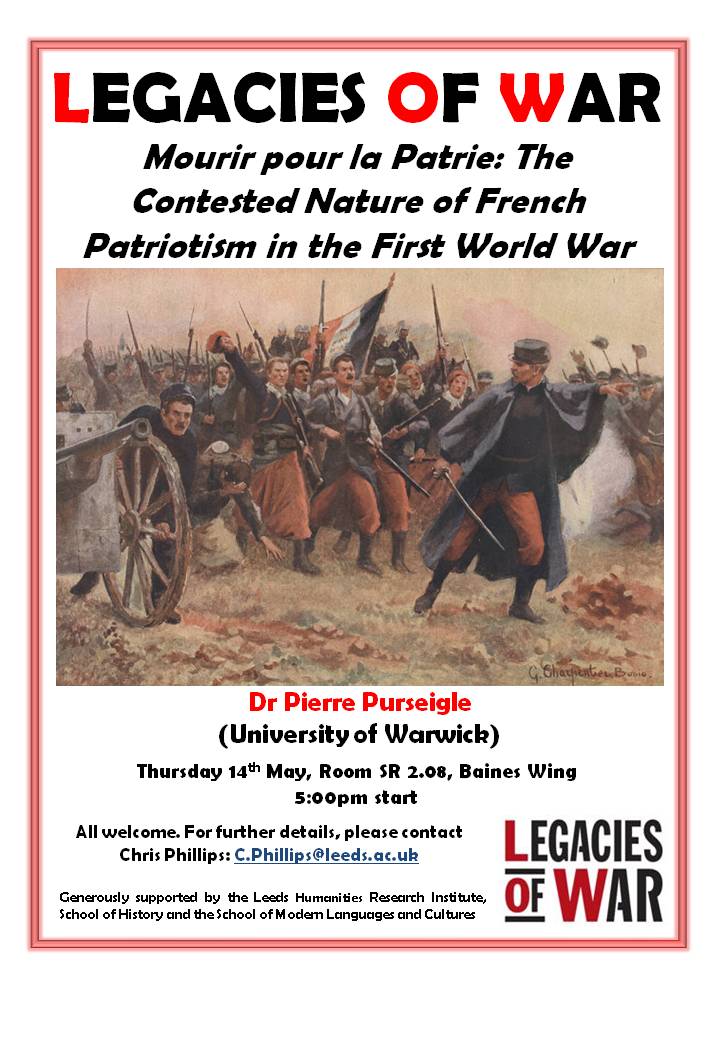
While I am on here, this seems a good opportunity to remind everyone that the next Legacies of War seminar will take place next week when Dr Pierre Purseigle (Warwick) will discuss French patriotism in the First World War. Please note, this is a rescheduling of Dr Purseigle’s talk which had to be postponed from earlier in the year.
Pierre Purseigle

The things we do not talk about

Things have been a bit quiet on the blogging front for the past couple of months. This has been for a few reasons.

a) I have been preparing for the end of my current project (which officially finished last week) by doing rather a lot of other writing – conference papers for the imminent summer conference season, a book proposal, detailed chapter outlines, even some things that some day may actually start to look like chapters of the book I want to complete this summer.
b) I have been preparing for the beginning of the next project, which should start in September, by finalising a number of administrative details including, most time-consumingly it turns out, organising an ethical review of the project and responding to several ethical queries raised by the body funding the work. Because the basis of the project involves documentation relating to the medical histories of ex-servicemen from the First World War, this has turned out to be more complicated than anticipated, as I will come back to in a minute.
c) Three members of my close family are suffering from illnesses which have involved a significant commitment of temporal and emotional resources from me, including multiple trips to the US. The severity of these conditions ranges from the life-threatening to the debilitating but all have been life-altering, both for the sufferers and for those of in their immediate family who, along with a variety of medical professionals, are seeking to care for them.

Now, you may have noticed that I am being rather vague about the specific details of the illnesses that have become such a central part of my life recently. This is deliberate. I have spoken in more detail about what is happening with various friends and colleagues who may be able to identify some or all of the family members I am referring to. Even then, outside my family and one or two very close friends whose support in maintaining my own equilibrium has been invaluable to me, I have not confided the precise details of diagnosis, treatment or prognosis.

This is for two reasons. Firstly, these medical details are not mine to share. They are, by all accepted ethical standards, the information of the patients. They have chosen to share this information with me (thankfully, as this has allowed me to offer what support I can to people I love very much and who are important to me), but have not necessarily chosen to share it more widely. It is not my right to share it in ways that they might not wish me to, however much the information shapes my own life. Indeed, on at least one occasion I have been asked specifically not to discuss the situation in detail with people outside the immediate family.

But, even if I had the explicit permission of the primary individual to share this information, there are other important considerations I need to take into account before discussing these illnesses. Because the sufferer and I are not the only ones involved. Coping with these conditions has, in all three cases, involved important interconnected networks which include, from my perspective, my husband, my parents, my siblings, my dad’s wife and her daughters, my children and my in-laws. All of us within these networks have our own emotional relationship with the illnesses and those suffering from them (as well as a variety of other additional stresses in our live – new jobs, house moves, professional concerns, etc.) Not all of us might be comfortable with a public discussion of the details of the medical matters that are shaping all our lives so profoundly.

Which brings me back to those ethical questions that I have been attempting to answer over the past six weeks. I was asked, among other things, to confirm that the information I will be collecting and analysing for the project is in the public domain and does not contravene any data protection laws. As it happens, the information is all publicly available and, because the subjects whose data is being scrutinized are dead, data protection laws do not apply. However, I was also asked to consider whether I was likely to reveal information (specifically medical details) that might be considered sensitive to those who are living. And here the issue of confidentiality arises. Because while the data involved may not be that relating to any living person, there is the possibility that the stories the data has to tell – about medical conditions and the care provided and received for these conditions – might be considered sensitive by surviving family members. Information about the nature of a wound or illness might be exposed which challenges the family stories told about a relative. Details of care might reflect new light on the behaviour of surviving family members. Embarrassing details about the effects of wartime injuries might emerge. As I haven’t yet done the research, I don’t know if such information will emerge; even if it does, I cannot predict whether any individual family or family member might be negatively affected by the information if they ever become aware of my research. Ethically I cannot ignore the possibility and must consider what contingencies I must put in place to ideally prevent and, in the worst case, remedy, any such effect.

The result has been a number of long and very fruitful conversations, in person, on the phone and via email, with a variety of archivists, data protection officers and researchers working in related ethical fields. The ultimate conclusion is that I will keep the sensitivity of the information I am dealing with in mind as I undertake and eventually publish my research. I will pseudonomise sources, although this will have to be balanced by the necessity of maintaining appropriate conventions of citation for my field. And I will continue discussing, with peer reviewers, with colleagues, with archive and university officials, the appropriate course to take in the specific contexts that may (or may not) arise.

There is, it turns out, no simple concrete answer to this sort of ethical question, and nor should there be. But I think it is helpful for me to acknowledge that, throughout this process my sensitivities and consequent decisions will be shaped, in part, by my awareness of my own willingness to share my family’s medical history in public. If I am unwilling to discuss certain details of my own family’s situation, including both the patients and carers, in public, how much can I ask of the families of the men I am researching? The answer is, at the moment, I don’t know, although I suspect it will change over time. However, I can say that my personal experience has re-emphasised for me the importance of the project I will be undertaking. Because to fully understand medical care-giving, whether historically or today, we must acknowledge and understand the role, and consequent sensitivities, of the family.

A letter to the Imperial War Museums

The following post contains links to a pay-walled site, for which I apologise, but I hope the gist will be clear. On 24th February, 2015, The Times published a brief report on plans by the Imperial War Museums to introduce reduced hours and daily charges of £14 a day for use of their London reading room, the only place scholars and researchers can access the unique collection of documents and books relating to modern warfare which form the basis of the Museums’ collection. This plan is modification of an original plan to close the library and Explore History facilities. It has, however, caused great concern among scholars, myself among them. I was one of over seventy academics and historians to sign a letter to The Times, written by Dr Clare Makepeace of University College London and published on 26th February, expressing our belief that these plans will negatively impact on future scholarship, impair understanding of modern conflict, and silence the voices of veterans of two world wars who are no longer with us, voices that continue to need to be heard in our society. There was not space in the letter to give voice to the huge range of concerns about specific impacts that these plans may have, but one that was voiced by many involved was the impact on post-graduate and early career scholars, those whose work has the potential to be most original but who are often shortest of discretionary funds for research. I am taking this opportunity, therefore, to host the publication of an open letter to the Imperial War Museums, written by Christopher Phillips of the University of Leeds and signed by seventeen other postgraduate students, which clearly articulates these concerns. If you are a postgraduate and would like your name added to the list of signatories, please contact Chris at C.Phillips@leeds.ac.uk with your name and institution.

Dear Ms Lees,

Having read the letter to The Times by Dr Clare Makepeace and seventy-six academic colleagues (published 27 February), we would like to place on record the reservations of the postgraduate and undergraduate communities over the proposed changes to IWM’s research provision.

The decision to charge £14 per day for researchers to access IWM’s collections will have a disproportionately negative effect on the student population and will materially alter the manner in which researchers approach IWM as an institution. At best, the £14 per day charge will lead undergraduate and postgraduate researchers to rely upon material which has already been highly cited in academic and popular works, leading to a narrowing of focus upon a relatively small number of the collection’s holdings and a commensurate reduction in the development of original, ground-breaking research based upon the exploration of previously under-used material. At worst, IWM’s decision to charge researchers £14 per day will result in a significant number of students choosing to forego any engagement with the collections whatsoever. As the letter signed by our academic colleagues makes clear, such actions will serve only to impair our understanding of modern warfare.

Primary research at undergraduate and postgraduate level is a significant aspect of academic learning. The writing of dissertations and theses plays a fundamental role in introducing new material to the historical conversation and in testing, challenging, and improving the work of established academics, many of whom have already registered their concern and discomfort at the proposed changes to IWM’s services.

Yours sincerely,

Christopher Phillips, PhD student and Postgraduate Tutor, University of Leeds
Christina Andrew, President of the War Studies Society, King’s College London
Aimée Fox-Godden, PhD student, University of Birmingham
Alina Enzensberger, PhD student, Humboldt-Universität, Berlin
Carlos Alves Lopes, PhD student and integrated researcher, Instituto de História Contemporânea, Lisbon
Linda Maynard, PhD student, Birkbeck, University of London
Meighen McCrae, DPhil candidate, Linacre College, University of Oxford
Margarida Portela, PhD student and integrated researcher, Instituto de História Contemporânea, Lisbon
Adam Prime, PhD student and Postgraduate Tutor, University of Leicester
Philippa Read, PhD student and Postgraduate Tutor, University of Leeds
Claire Rennie, PhD student and Postgraduate Tutor, University of Leeds
Olivia Tidswell, MA student, University of Leeds
Michael Reeve, MA student, University of Leeds
Melyssa Dawson, MA student, University of Leeds
Patrick Watt, PhD candidate and Postgraduate Tutor, University of Edinburgh
Vicky Davis, PhD student, Institute of Historical Research, London
Ashleigh Gilbertson, PhD student, University of Adelaide
Caitriona McCartney, PhD student, University of Birmingham

And now for something completely different

The following post, by Christopher Phillips, a postgraduate student in the School of History at the University of Leeds and member of the Legacies of War project, is the second the occasional series of guest posts to this blog. One the surface, a biographical sketch of the coordinator of canal transportation for the British armed forces in France during the First World War may appear to have little relation to the medical research interests of this blog.  Yet Chris touches upon a number of key issues that I am currently exploring in both my book and related articles, including the key role of transport logistics and the relationship of the Regular Army and its officers to the range of support services that total war required.  I hope to explore some of these issues myself in future posts.  In the meantime, I leave you to enjoy Chris’s story of a man who exemplified war service in ways that go far beyond popular cliché.

The grave of Brigadier-General Gerald E. Holland lies in the Catholic cemetery in Holyhead, where he had lived and worked prior to the outbreak of the First World War. Holland died on 26 June 1917, at St Leonards-on-Sea in Sussex, from a sickness contracted whilst on active service in France. Alongside 888,245 of his colleagues from within the British Empire, Holland’s death was represented by a ceramic poppy planted outside the Tower of London as part of the commemorative activities linked to the centenary of 1914. Holland’s war service, however, was far from the popular stereotype of the First World War soldiers’ experience, whilst Holland himself was a distant cry from the stylised image of those who died on the battlefield.

Gerald Holland was born in Dublin in October 1860. At the age of 20, he joined the Royal Indian Marine, seeing service in Burma prior to a posting as a Naval Transport officer during the South African War. In 1905, at the age of 45 and with the rank of Commander, Holland retired from the navy and returned to Britain. He re-entered civilian life in the employ of the London and North-Western Railway, occupying the post of Marine Superintendent for the railway company, first at Fleetwood and later at Holyhead. In this role, Holland was responsible for the operations of the port, ensuring that goods traffic between the mainland and Ireland was handled efficiently. In August 1914 Holland was just two months shy of his 54th birthday. Despite his age, and his retirement from martial service almost ten years previously, Holland was able to apply his skills and abilities to the prosecution of the war in Europe.

In the opening month of hostilities, Holland approached the War Office with an idea to take advantage of the highly-developed system of inland waterways in France and Belgium to provide supplies to the army and to relieve pressure on the railway network behind the front line. As the position of that front line stabilized in the latter months of 1914, creating the conditions of trench warfare which have become synonymous with the conflict on the Western Front, Holland was offered the opportunity to put his ideas into practice. On 30 December 1914, the newly-appointed Lieutenant-Colonel Holland reported for duty at GHQ in France, and took over responsibility for the provision of canal transport to the British Expeditionary Force on the Western Front.

At first sight, Holland’s task seemed formidable. At the beginning of 1915, the Department of Inland Water Transport consisted of two officers (Holland and his assistant, another former naval officer), one tug hired from the French, and thirty-four barges. A meeting with the French Army’s canal expert also revealed that Holland would be unable to obtain much assistance from the locals, French canals having largely been plied by entire families who lived on their barges and chose not to follow military orders. With the British Army possessing no expertise in canal operations, the only alternative for Holland was to enlist personnel from Britain with the requisite skills to man the barges and provide the technical and administrative support necessary to maintain an efficient service. Whilst the War Office were able to provide officers for clerical support, the majority of the men, unsurprisingly, were chosen for their experience of the shipping industry (such as Horace Pitman, for ten years a yachtsman, or the fifty-two year old George Tagg, who came from a boat-building family and knew the French canal system well), whilst Holland’s pre-war employer also supplied fifty men from the Marine Department at Holyhead. An active campaign of enlistment at various ports in Britain accounted for the lightermen, watermen, seamen, engineers and other assorted trades required to ensure the department’s ability to fulfil its duties. By February, Holland had created a self-sufficient unit that had already begun to transport bulk commodities such as road stone and coal inland. By the end of June, just six months after Holland had arrived in France, inland water transport had moved: 19,142 tons of supplies; 27,421 tons of road stone; and had evacuated over 600 men from the battle zone by ambulance barge. As the war continued to grow in scale, Holland worked tirelessly to ensure his department’s ability not only to keep pace with demands, but to create new services.

By the middle of 1916, Holland controlled a fleet comprising almost 600 vehicles, with a capacity of over 70,000 tons. He had overseen the creation of a bespoke depot for inland water transport at a site which became known as Zeneghem, and had successfully argued for the creation of a cross-Channel barge service to eliminate the need for landing ships at the overstretched French ports. Arrangements were also already in place to commence a barge service for the evacuation of wounded horses to complement the ambulance barge service which continued to expand its operations. In October 1916, Holland’s department was, along with the army’s other transportation methods, placed under the control of Sir Eric Geddes as part of a widespread reorganization of the force’s logistics in the wake of the Battle of the Somme. Whilst those responsible for the provision of railway transport and the operations at the docks were ultimately replaced, such was Geddes’ appreciation of Holland’s work that he retained his position in the reshuffle (and gained a promotion to Brigadier-General), and both men looked forward to the continued expansion of waterborne traffic in 1917.

Unfortunately, it was not an expansion that Holland would live to see. As part of their coordinated withdrawal to the Hindenburg Line over the winter and early spring of 1917, the retreating German Army devastated the land and destroyed the canals in the surrendered territory. Days of inspecting the damage in freezing temperatures took their toll on the fifty-six year old, and Holland fell ill in April 1917. He was evacuated back to Britain but never recovered. His assistant, Cyril Luck, another former Royal Indian Marine commander, took over operations in France and retained his position until the armistice. The provision of canal transport on the Western Front, therefore, was at no point under the direct supervision of a regular officer of the British Army.

By discussing Holland’s service in more detail, a richer, more nuanced image of the diverse range of wartime experiences emerges. It reminds us again of the ‘totality’ of the First World War, and of the myriad relationships that developed during the tumultuous progress of the conflict, as armies, states and societies grappled with the unprecedented challenges of understanding, influencing and coping with the dislocation and shock brought about by the war.

A few last thoughts on the ‘tunnel’; or a love letter to my colleagues

I quite badly want to start writing about writing my book, my next big project now that I have landed a job. (And yes, it is official, my letter of employment was signed and delivered to HR two days ago.)

But before I do, there are, I discover, a couple more things to say about my experiences over the past month and, in particular, about the experience of academic rejection.  Because while I do now have a permanent job, of all the certainties I have in life, none is more certain than that I will again experience academic rejection of the sort I experienced when my Wellcome application was turned down.  It may (and indeed probably will) take the form of a rejected article or book proposal.  It may (and again probably will) take the form of a rejected grant application.  Because while a permanent job in academia may seem like a holy grail from the far side of temporary contracts, the reality of the academic marketplace today means that in-and-of itself such a position does not bring complete security.  Tenure-track is not tenure and any academic job, even a tenured one, brings with it expectations that you will bring in research funding.  This expectation may not be as onerous as some recent terrible examples, most dreadfully the case of Stefan Grimm, but it is nonetheless there, stated plainly in the terms of my probation, that at the end of three years I will have secured significant funding and by the end of five years have a ‘sustained record’ of grant funding.  I know I will be supported, and on the evidence to date, the likelihood is that I will meet this probationary requirement, but the funding landscape in this age of austerity is pretty bleak, so the experience of rejection of carefully crafted, passionately believed-in applications is also likely.

Of course, I won’t be faced with the elemental fear that accompanied my last rejection in the sense that I will have, at least for five years, a job even if I don’t have research funding.  But how much consolation does that offer in the face of rejection of a project, an idea that you have poured your heart and soul into?  Academic projects can be deeply personal, especially ones which require immense effort and time to put together (as almost all do).  And the ways in which projects are examined and critiqued as part of the evaluation process, generally with rigorous knowledge and attention to detail, can make subsequent rejection feel even more overwhelming.  No surprise then that not only have I experienced rejection as a flattening process, but I have also seen colleagues with secure jobs shattered, at least temporarily, by the experience of being turned down by a funding council or a grant-making body.  It is simply part of academic life, learning to deal with that sort of rejection. Again and again and again.

How do we cope?  Because we do have to learn coping strategies if this cycle is not to destroy our mental health.  And not all of us do terribly well, as the extensive literature on mental health in academia illustrates.  Most of the rest of us find personal strategies – temporary retreat to a dark room, exercise, a bottle of gin, compartmentalizing, a sympathetic non-academic spouse or partner.  In the case of my Wellcome application, I was force to compartmentalize due to the timescales I faced, but running probably helped keep me sane.

However, in the end, it was not my own resources, or even the looming deadlines, that kept me from despair but the immediate support of my colleagues.  From a sympathetic coffee and slice of cake to an advice session with my mentor, from the quick ‘Are you alright?’ in the corridor as I struggled to keep my emotions in check to allowing me (when I was ready) to dissect at length what had gone wrong with the application, work friends and colleagues provided the time, space and emotional energy which kept me going.

If the negative side of academia is the intensity, pressure and scrutiny of the grant application process, then this collegiality is the flip side of the coin, one of the things that, where it exists, makes academia an extraordinary and desirable place to work.  In myriad ways it allowed me to feel that I and my ideas were valued above and beyond the financial value of the grant itself.  And yes, it made the eventual success in gaining a fellowship all the sweeter in two ways.  In the first place, knowing that I will be working with such supportive colleagues in such a supportive atmosphere is both a joy and a confirmation that this is the right job for me. And in the second place, I now have the opportunity to contribute to that collegiate atmosphere myself, to pay back the support I have received by supporting those around me. So I start my new role with my own small probationary requirement for myself – that I do all in my power to support those who were so supportive of me.

Out of the tunnel

So, those overtaking events which I wrote about when I posted last week…  We’ll get to that in a minute. Firstly, a quick word about those deadlines that got in the way of posting my blog for most of January.

The biggest of these was a mid-January interview at the Wellcome Trust for a University Award, a hugely prestigious award which would fund five years of research and ensure me a permanent job at the end of it.  The interview was friendly but very, very tough.  At least one question caught me on the hop and I answered it to the best of my ability although not, as it turns out, terribly well.  Because the following week I found out that I had not succeeded.

This news flattened me, almost entirely literally.  I lay on the table in my office and howled about it for a good three minutes.  Over a year of effort, involving two two-part applications (one a detailed revision) had gone into getting to the interview stage.  This was a project I believed in passionately.  The criticisms of my project were directed at what I felt were two of its fundamental elements.  I was left wondering whether or not I had any sort of future as a professional historian.

The prospect was terrifying. My current grant from Wellcome enabled me to return to academia after a five-year break.  Given that this was my second act already, I knew there would be no comeback if I was forced to leave academia now.  But reverting to the status of temporary lecturer at this point in my career seemed equally unthinkable. I am, as my by-line states, a wife and mother as well as a historian. Two young children make me much less flexible than when I finished my PhD, in terms of time as well as geography.  The sort of commuting to make ends meet discussed by Cath Feely simply isn’t an option for me any more.

The problem was that there was no time for me to assimilate any of these emotions of grief or fear.  Because more deadlines loomed – a resubmission to the European Research Council and an all-day interview for a prestigious academic fellowship at Leeds – both on the same day.  Both in their different ways were equally vital. Both required very different things from me in terms of communicating my research plans coherently and, above all, with passion and conviction.

So, while the previous 15 months of applications might have felt like something of a tunnel, they were nothing to those last three weeks of January.  My life was haunted by these two projects – the written application and the oral presentation and interview.  I ate and slept them. On the Sunday before the deadline my husband and I went for a three-hour hike; I rehearsed answers to interview questions the whole way up and revised the role of the postdoctoral research assistant on the ERC proposal the whole way down.  I rehearsed and revised my presentation daily, explaining slides to imaginary audiences as I pounded the pavement on my morning run.

And in the end…

Reader, I got the job.

As of 1st May I will be University Academic Fellow in Legacies of War.  It is (subject to probation) a permanent position as member of the School of History. It is, in all sorts of ways, my dream job and, in obtaining it, I have not only established that I have an academic career but finally, definitively made that transition from early to mid-career. I have come out of the tunnel and into a landscape at once deeply familiar and strangely new. I am delighted, terrified, exhilarated. And no, the reality, the permanence of it all, and what that means for both me and my family, still hasn’t quite sunk in yet.  I still keep getting small shocks of amazement and happiness, at a comment from a colleague, at the sight of my library card.

So there you have it. Now I too have my own particular story of the path I took as a young academic.  It has not been an easy path so far, although yes, unequivocally, it has been worth it to get here.  I am profoundly grateful, to more people than I can possibly say without sounding like a very bad Oscar’s speech, that it doesn’t end here. So I repeat what I have been saying, if occasionally through tears and gritted teeth, since December:

Onwards! And this time, upwards as well!

Now, about that book I need to write…

On no longer being an early career researcher

I haven’t published anything on this blog for over a month. However, I wrote the following post in the first week of January but never got around to posting it due to the pressures of various deadlines. Since writing it, some of the points raised have been overtaken by events, but I am posting this now as it is relevant to what has happened to me over this past week, which I am still digesting. I will write more about that next week, when I have had a chance to reflect further.

Before Christmas I wrote a post looking back over the past year, attempting to take stock of the range of activities and opportunities that the centenary of the First World War presented to an early careers fellow researching the period. In the end, the post ended up being as much a moan about the exhausting, prolonged nature of applying for research funding as a celebration of concrete research achievements. Nonetheless, I was able to end my working year on a reasonably positive and hopeful note, even if one which brought with it rather a lot of work over the Christmas holidays.

So now, at the start of the new year (and having done only about a third of the work I set myself over the break), I pause again, this time to look forward to what the new year has to offer. And with this pause comes the realisation that, for me, 2015 will, above all else, bring the end to the ‘early’ phase of my career. As of July, it will be ten years since I was awarded my PhD. Even taking into account the generous 18-month allowance that many grant-making bodies now give as credit for each of my two periods of maternity leave, there are no early career grant schemes that I am aware of which accept applications from candidates with that amount of time elapsed since the award of a PhD. From this summer onward I am no longer an ECR, at least as an applicant.

So what will I become this year? Well, as it stands, possibly unemployed as of the end of April, although enough opportunities are still outstanding that I am hopeful this won’t be the case. But the possibility, presented just on the cusp of this loss of career-progression identity is rather terrifying. While I can now lay claim to a number of publications and a wealth of experience that I have accrued since I was last on the job market, the limits that no longer being able to define myself as an ECR place on my ability to apply for specific grant schemes make me a potentially less attractive candidate. With two small children, one happily settled in his school, and a mortgage, the fallback of temporary teaching contracts at whatever university will hire me looks even more unattractive than it did at the outset of my academic career (and that is before you factor in the growth in the use of zero-hours contracts in academia).

And yet, for all the fear that this change in status induces in me, I remain hopeful. Because if ceasing to be an ECR means anything it means that I am not starting afresh. Whatever my new identity will be as of July, it will be backed up by the experience I have accrued over the past ten years and the confidence that that experience brings. This is more than the items listed on my CV, although reading through it can give me courage, even after the twelfth revision in as many months. It comes from the good working relationships with colleagues I have developed, the esteem expressed in grant referee reports for my ideas, the invitations to speak, the requests to supervise. These are all things I have achieved as an ECR, things which will stand me in good stead as I embark on becoming whatever it is I am yet to become.

Imposter syndrome is rife in academia and yes, most of the time I remain incredulous that I should be taken seriously as an academic, a situation exacerbated by the rather convoluted route I took as an ECR which saw me taking a five-year break from academic employment. But right now, for this moment of looking forward, I do so with the belief that, wherever my career eventually ends up, I have made that most of the ‘early’ stage of my career, and the hope that, whatever the next steps may turn out to be, the next stage will be as fruitful and productive.

Bring it on!

Taking stock

It is the last day the university is open before Christmas.  The heating is off in my office, as is the light in the hallway.  In fact, I think I am the only person left working on this floor.  So what better time to take a moment to look back and take stock of this incredibly hectic year.

IMG_1224

I had hoped to be doing this from the perspective of a clear desk, with all major projects completed, at least until the new year. Sadly, this is not to be.  I am preparing to place the fifth draft of an article which still needs a conclusion, a few more supporting quotations and a couple of hours of formatting footnotes before I can send it to the editor in my bag to take home with me.  Alongside that are a 350-page book and 48-page grant application, both of which I need to (re)familiarize myself with in preparation for two interviews early in the new year.  Oh, and then there is the grant application I need to redraft with the goal of resubmitting in early February. This will be the sixth time I have submitted this project for consideration by a funding body or grant-awarding committee.

So there is quite a lot of work still to do over the next two weeks, between the turkey and the Christmas cake and the two excited small children for whom Christmas is nothing but magic, a fact that makes it hard, sometimes, to remember just how much I have achieved over the past year.  But for all the lack of a nice tidy ending, there are definite signs of progress, not least the lovely folder that tops my document list bearing the working title of the book I will be writing next year.  The joy of the folder lies not just in its existence, but also in the fact that it contains two documents, a draft proposal and a draft introduction.  Baby steps perhaps, but concrete evidence nonetheless that this book is actually happening.  In the past 12 months it has gone from a vague promise to myself and my funding body to a clear outline and argument with a story to tell and a point to make.

And there are other concrete achievements.  The article I have been working on for the last few weeks may be tantalizingly unfinished, but the one I was working on this time last year is not only completed but has also been accepted for publication next year, marking the culmination of a project that had its inception nearly three years ago.  Slightly more abstractly, the piles of marking and course documentation, waiting to be filed following the completion of exams and second marking next month, bear witness to the time I have committed to teaching this year, time which has not only boosted both my CV and my confidence in possibly my least favourite aspect of the academic discipline, but also laid the groundwork for my forthcoming application to the Higher Education Academy for professional validation.

And then there are the abstract developments, such as the discovery that, despite two television appearances and a number of radio interviews, I am probably not cut out to be a full scale media don or public intellectual.  As much as I have enjoyed my engagement with broadcast media, particularly my interactions with the BBC as a New Generation Thinkers finalist and a World War One at Home adviser, I suspect I will always prefer blogging, whether on here or for collaborative blogs, as a form of public engagement.  Which brings me to my greatest regret of the year, the fact I have not been able to commit more time to this blog.  Too many subjects have slipped away from me as I have struggled to manage my priorities and keep some semblance of a work-life balance; too many comments have been made too late and in too much of a hurry.  I make no rash promises for doing better next year, but absence has made the heart grow fonder in this case, making me realize how important the process of blogging has become to working through my ideas.  With a little luck and slightly better management, I hope to be able to properly blog the progress of my book next year, as it goes from draft outline to completed manuscript.

Next year will, of course, be different.  As a colleague and fellow First World War historian has pointed out to me, 2014 has been a particularly hectic one for those of us who study the subject.  There have been more opportunities for undertaking innovative research and engaging with interested audiences than any of us could possibly take complete advantage of. Highlights for me have included the wealth of interesting academic conferences to choose from, including the wonderful War: An Emotional History which continues to inspire me and shape my approach to my work; the opportunity to help put together and teach a Massive Open Online Course, not something I could ever have anticipated or which I altogether enjoyed but which taught me a great deal; and the opportunity to engage with a range of interesting and inspiring artistic projects that have, once again, raised questions of the roles of historic and artistic interpretation in the process of commemoration. Low points include some frustratingly bad television, pointless and clichéd debates which failed to make full use of the real depth of historical knowledge about the war, both nationally and transnationally, that exists in Britain today, and the mind-numbing boredom that overwhelms me every time I contemplate the pointless unending discussions of the Christmas Truce which appear to have overwhelmed all else in the past weeks.  I think the high points more than balance out the low; at the very least they give me hope that there will be interesting discussions to be had in the future as we continue the centenary commemorations.

So there we have it, quite a lot of good, a bit of bad, a smattering of seriously ugly.  A year in which, however slowly, progress has been made and one in which much more has been promised but not yet achieved.  I enter the final week of the old year with a sense of incompletion but also of hope, a hope which I will desperately cling to as I face 2015 from a point of deep uncertainty and insecurity.  At present my current contract is due to come to an end in May.  I do have a very real chance of securing more funding after that (the interviews and grant applications I mentioned), although after over a year of pursuing them I am reaching exhaustion point.  I have spent so much of this year saying that I should know, one way or the other what would be happening to me by the end of the year.  It is not to be.  It will not, in my case, all be over by Christmas.  But for all that, there is hope of a positive resolution, something that would mean both immense personal achievement for me and security for my family.  So I will leave you with that sense of hope, to temper the anticipation of the hard work that will be needed if I am to have any chance of accomplishing the desired outcome.

Merry Christmas. And a hopeful, healthy, happy New Year to you all.

We need to talk about Arthur Shelby

Firstly, an apology.  This is not going to be a very seasonal or festive post, although hopefully there will be one of those next week.  Rather, this is something that, as is becoming increasingly common, I have been meaning to write for a long time, but have struggled to fit in with everything else going on.  Essentially, the teaching term opened up its maw in October and swallowed up anything that might conceivably have been blogging time.  But now my last bit of marking is completed (at least until the new year exams) and I have cleared my desk of all admin and (bar editing an article on the American Field Service Ambulance) I am free to consider series 2 of Peaky Blinders, the commemoration of the First World War and the problem of male violence.

These last two topics are something that, unsurprisingly perhaps, have been preoccupying me quite a bit this year.  The question of commemoration has haunted pretty much everything I have done or written in relation to work for at least 12 months, although there have been times when it has felt as if it has occupied every waking moment for a lot longer. (War fatigue hit with full force on 12th November in my case, although I think I am starting to get my second wind.)  The issue of male violence as a legacy of the First World, by contrast, has been a more intermittent concern.  It isn’t directly related to my current research (although it is likely to be an important issue for the project I have been hawking around to numerous potential funders for over a year now) but it has been popping up in all sorts of interesting places, including the British Academy’s War: An Emotional History Conference, my lecture at the Freud Museum in October and, finally, in Peaky Blinders, where Arthur Selby loses control in the boxing ring and beats a man to death.

As I posted on Twitter at the time, when I write about the ugliness of shell shock, that is, at least in part, what I mean.  Because the narrative of the programme clearly links Arthur’s violent outbursts to his emotional reaction to his war experience.  This is an interesting shift from series 1, in which Arthur’s violence was portrayed as more psychopathic, violence for the love of violence rather than as a form of emotional release.  An even more interesting shift is that it is Tommy, the man who suffered throughout series 1 from nightmares relating to his days as a tunneller on the Western Front, who voices the view that Arthur needs to get over whatever lingering trauma he may be suffering because the war is over and done with.  This particularly piece of characterisation sadly didn’t ring true for me.  Surely, of all people, Tommy should know that the war is never truely over for some men.  One definition of war trauma is that it condemns those who suffer from it to relive their experiences as the present rather than, as healthy psyches are capable of doing, render it into livable, if unhappy, memory.   By putting the ‘all in the past’ stance on war trauma into Tommy’s mouth, the drama, so much of which does emotional justice to the era it represents (even if it does so most successfully through anachronism), descends momentarily into the realm of cosy cliché, taking on the middlebrow narrative that war trauma can, ultimately be cured through the love of (possibly) good woman.

That being said, Peaky Blinders remains, from a historical viewpoint, a far more exciting dramatic exploration of the social and emotional legacies of the First World War than, for instance, Downton Abbey, the fifth series of which was broadcast at much the same time in Britain.  Downton set out much more explicitly to depict the legacy of the war through its preposterous and inaccurate memorial subplot which made me want to hurl the works of Alex King and Mark Connelly [1] (among many others) at the heads of the script writers.  Yet one of the most significant legacies, that most men who fought in the war returned but changed by their experiences, was completely ignored.  Thomas, the drama’s only surviving combat veteran now that Matthew Crawley has been killed off, is, indeed, troubled, but his drug use, unlike that of Arthur Shelby, is attributed to his emotional conflict over being gay (that again!) rather than any memory of his war service.  Even his physical wound, the self-inflicted gunshot wound to his hand which did miraculously little damage at the time, does not seem to bother him at all any more, at least based on the representation on screen.  Indeed, long-term physical disability is remarkably absent in Downton, although I think I caught sight of a man with a missing arm at the unveiling of the war memorial.

Which brings me to the subject of wider commemorations of the war in this centenary year.  Throughout the year we have, appropriately enough, talked a great deal about the reasons why the war broke out and carried on for as long as it did. We seem to currently be talking about the history of the 1914 Christmas Truce on the Western Front.  This is not something that interests me a great deal, not simply because I don’t have any interest in football beyond the ways in which association with football (either as players or spectators) was used to construct ideas of patriotic masculinity (very negatively in the case of Sapper’s short stories, if you are wondering), but also because whatever happened on Christmas Day 1914 is not an overarching symbol of the war in its entirety, any more than 1st July, 1916 was.  To understand why men fought and continued fighting, we need to look at these individual days within the wider context of the 1,560 days of the conflict, all days in which, somewhere, men joined the army, killed and were killed, thought kindly of the enemy, rebelled against their commanders and reaffirmed their sense of duty to whatever they felt they were fighting for. So focussing on one particular day as a way of remembering the war risks losing our perspective (as I fear some of my colleagues may be running the risk of doing) about the full extent of what it is we are commemorating.

But the Christmas Truce has, at least, the redeeming factor of being, like the outbreak of the war, an appropriate moment this year to pause, think and discuss what happened 100 years ago.  I have struggled a great deal more with the focus this year upon the dead of the war, with any number of projects examining extant memorials and creating new ones.  The dead should, of course, be a hugely important part of our commemorations, but by making them the centre of the centenary from the outset runs the risk of recreating the struggles over commemoration of the interwar period when, as Dan Todman as noted, the interests of the bereaved came to take priority over those of the survivors,[2] a situation which had important and devestating implications for those who, like Arthur Selby, continued to suffer from the traumas of war experience long after it was all over and done with.

Which is why, as we come to the end of this first year of commemorations and gird our loins for the second, I reiterate a plea that I know I have made before, that we talk about men like Arthur Shelby, men like Robert Fentiman and men like the one cited by Michael Roper whose child recalled how he eschewed as violence in the wake of war, including corporal punishment, deeming it pointless and ineffective.  Only by talking about these men, and representing them in our popular cultural as much as we do the dead, can we ensure that they too are remembered.

[1] Alex King, Memorials of the Great War in Britain: The Symbolism and Politics of Remembrance (London: Bloomsbury, 1998); Mark Connelly, The Great War, Memory and Ritual: Commemoration in the City and East London, 1916-1939 (Woodbridge: Boydell Press, 2002).

[2] Dan Todman, The Great War: Myth and Memory (London: Hambledon and London, 2005), 53.