The time has come, the Walrus said

to talk of many things

‘Tis the season. I have been conferencing, attending a workshop and a conference in the past fortnight which have both forced me to think very, very hard indeed. The two could not have been more different, but both have been hugely productive for a variety of reasons. What follows is my attempt to articulate what I have and am learning from both experiences.

Of shoes and ships and sealing wax

Passions of War, Ghent, 20th June

The first gathering was not, officially, a conference, but rather a workshop, one of a series of three being organised by the Passions of War, an AHRC-funded network exploring ‘the influence of war on constructions of gender and sexual practices, and how these constructions and practices have, in turn, conditioned the ways in which wars are waged, mediated, felt and understood’. We were a small group, no more than 20 in total, and formal proceedings were limited to a single day’s presentation and discussion. The event, the theme of which was ‘Identities’ took place in a single room at the Dr. Guislain museum, with all participants engaging with all the papers and joining in with vigorous and wide-ranging discussion.

And when I say wide-ranging, I mean wide-ranging. My own paper, which kicked things off, was an examination of why we need to explore the masculine identities of non-commissioned medical service personnel in the First World War, as well as those of wounded men and doctors. It formed part of a panel in which other papers explored nationhood, motherhood and death in war poetry (Marysa Demoor) and nostalgic conceptions of the Second World War in contemporary social and political discourse (Victoria Basham). A presentation on the now-closed War and Trauma exhibition was followed by an afternoon panel focusing on gender and citizenship in 18th-century conflicts, with papers from Marian Füssell, Stefan Dudink, and Simon Bainbridge. The day closed with a public lecture from James Wharton, including readings from his autobiography, Out in the Army.

On the surface, this range of papers might not seem to have all that much in common, other than the very broad theme of gender and war. They covered huge swathes of time, geography, media and disciplinary approach. Yet together they worked as jumping off points for intense and involving discussion. At the centre of the day’s debates, for me at any rate, was the question of the languages we use to talk about conflict, how that language is gendered and how it can and should be historicized. How does ‘shell shock’ translate into Dutch, and what are we saying if we don’t translate it? What does the changing meaning of ‘nostalgia’, from a nineteenth-century illness to a twentieth-century political tool tell us about the place of war in society? How do we analyse discourses and the literature of the past in ways which are both intellectually and historically rigorous, which speak to both the reality of past experience and the debates of today? The small group set-up of the workshop allowed these discussions to flourish, with ideas and connections developing in interesting and exciting ways across disciplinary, national and periodic divides.

While the formal procedures were enlivening, however, for me the most exciting discussions were those that happened between and around the formal sessions. It was, for instance, an honour and a pleasure to meet Holly Furneaux, whose forthcoming book on the masculinity of Victorian soldiers looks set to shape my own work in important ways. Indeed, on the back of the workshop she has sent me a copy of her chapter on Crimean stretcher bearers which I have been having a lovely time reading and engaging with this past week. Then there was the discussion I had with James Wharton at dinner (and much later into the evening than was probably sensible) about what motivates young men to enlist, how the memory and commemoration of a divisive conflict affects those who served in it, and the practical implications of the government’s current policy on military reserves. These are all issues that have arisen in my historical research; to explore their importance in a contemporary context was illuminating. And, in the end, as I traveled home on a very early Eurostar train from Brussels the following morning, the ideas that had been stimulated over the course of the day coalesced into a moment of inspiration about the argument my book is making and why it is significant. I had gone to Ghent with a paper that attempted to articulate the main argument of my introduction; I came home with the seeds of a conclusion.

Of cabbages and kings

Modern British Studies, Birmingham, 1st-3rd July

The second conference (and this one was a conference) was the Modern British Conference, held in Birmingham this last week. Organisationally, this could not have been more different from Ghent – 280 delegates, three days, 6 keynotes, four parallel panels each session – and my own contribution reflected this difference, being on the project to come rather than on my work at present. The sheer size of the conference meant that my own path through the various ways in which the rethinking of modern British studies is being addressed by contemporary scholarship was particular to me and my interests. It was, quite simply, impossible to attend all the panels that I would have liked to attend, at least not without learning the neglected art of being in two places at once.

The panels I did attend were excellent. Most were flat-out entertaining, many were innovative, all were thought-provoking. Standouts were those on ‘Interrogating British Boundaries’, which pushed me to think again about how I will approach the ‘Overseas’ section of the PIN 26 archive, ‘Money, Belief and Politics in Modern Britain’, where Sarah Roddy’s work in particular was highly suggestive about my methodological practice and the wonderful ‘Humour and Comedy in Modern British Studies’, where not only did Lucy Deplap’s exploration of anti-suffrage humour suggest an angle on hospital journals that I now plan to pursue further, but Peter Bailey gave a demonstration of conference paper presentation as performance that was as powerful as it was funny. I have never experienced a conference panel as joyful – this one, for all its potentially uncomfortable subject matter, was.

I was sad to miss panels on regional histories and creative histories, and it sounds as if panels on the 1970s, subcultures, and ‘The Future History of Race’ were all extraordinary experiences for those who did attend. However, I was able to get a flavour of all through Twitter, this being the most Twitter-active conference I have ever attended. Indeed, this was the first conference I have ever attended where live tweeting made sense, one where the sheer quantity (and quality) of online participation facilitated participation and discussion rather than distracting from it. The extent of online engagement, in addition to the normal face-to-face interaction of a large conference, was, however, more than usually exhausting. As intellectually exciting as it was, I’m not sure that level of critical engagement over three days is entirely healthy or productive. Given the many calls for self-care made throughout the conference, this may be a facet of conferencing that needs revisiting on a regular basis both by individuals and ‘twitterstorians’ collectively.

Of course, not all aspects were equally impressive, and I did come away with a number of reservations. The first of these was about an uncomfortable tendency to try to periodize Modern British Studies as a historic undertaking. James Vernon gave the most overt example of this in his keynote address, where he sought to define the field generationally, starting with the ‘generation of 1945’. I found this sort of grouping of scholarly endeavour, which also found expression in the focus on established scholars as opposed to PhD and early career scholars mildly alienating. As someone who has not had the opportunity to define myself as part of a generation, indeed has only just moved from the precariousness of a temporary contract to the security of a permanent position, I certainly don’t feel ‘established’, although I do feel the responsibility to support the intellectual endeavours of those in less secure positions within the academy. I was not clear where I and people like me fit into to this mapping of the professional field. And if we are going to talk about self-care and support within the profession, we do need to discuss issues that arise at different points in the life-cycle, not least the caring responsibilities that impact on the time and energy of so many mid-career scholars, a subject that, as far as I was aware, was simply never mentioned.

The second issue to disturb me was the rather startling absence of gender as a category of explicit historical analysis, particularly in the keynote speeches. Where gender was specifically discussed, in Geoff Eley’s public lecture, it was, shockingly, in a way in which women were viewed as the only gendered sex, thereby completely ignoring quarter of a century’s work to make men visible as gendered historical subjects. The story of gender and the political aftermath of the First World War, for instance, is far more than one of maternalist discourse v. fear of the flapper, not least because the ‘Lost Generation’ was, for most politicians in Britain, exclusively male.

Is this a piece of special pleading on the part of a gender historian? Well possibly. There is, of course, only so much that can be said in a thirty-five minute paper and the subjects addressed by Seth Koven, Stephen Brooke, Deborah Cohen and Catherine Hall were all wonderfully rich and complex in ways that defied simplification or easy summation. But given the focus on specific families in Koven and Cohen’s papers, and the discussion of domestic violence in Brooke’s, a more explicit acknowledgement that the power structures being uncovered and analysed have a gendered element would have made clear what was only in the end implicit, that gender histories continue to have relevance at least as significant as those of race. If the point that the history of modern Britain is the history of imperialism could be made as clearly and emphatically as it was over the course of three days, then I only wish there had been the space to make the parallel point that it is also the history of gendered relations of power.

Despite these reservations, in the end it was Catherine Hall’s keynote, of all the panels and plenaries over the three days, that spoke most deeply to me. At once a razor-sharp analysis of a rich, deeply problematic source with powerful implications for our understanding of both the past and the present, and a rallying cry to the profession to use our passion to demonstrate the undoubted relevance of the work we do, it left me energised and even inspired. I left Birmingham knowing that the practice of history is hard, should be hard, but however hard it is, it is also fun and undoubtedly worth doing.

And why the sea is boiling hot/ And whether pigs have wings

So, two very different events in two very different venues at which I attempted to grapple with two very different facets of my work as I understand it at the moment. Yet there were also themes that connected them. The invisibility of men as gendered historical actors, for instance, formed the basis of a question raised in Ghent, reinforcing my sense that historians of gender, and masculinity in particular, still have work to do in making our political and theoretical project clear and accepted. More positively, the relevance of the study of the past to questions of social, cultural and political import in the present was made crystal clear at both events. Every panel I attended in Birmingham contained at least one paper that addressed a contemporary debate or concern, illuminating the connection between past and present as clearly as my post-workshop discussion with James. Oh, and both were wonderful social events, where the pleasures of reunion with old friends was only matched by that of forging new friendships.

There is still much that I absorbed both in Belgium and the Midlands that I have yet to fully process. But in sum, if Ghent provided me with inspiration, Birmingham was a source of exhilaration. The remainder of the summer, then, will have to provide the perspiration that will, I hope, result in, if not a work of genius, then at least a good book.

Remembering Robert Fentiman

I started this month with two frantic weeks of research, paper presentation and working at the Great Yorkshire Show.  By the time the last event, a two-day conference on the emotional history of war at the British Academy, came around, I was exhausted, sick of train travel and worried that my children no longer knew who I was.  I seriously considered giving it a miss; I wasn’t giving a paper and wasn’t sure how emotional history might be significant for my work on RAMC servicemen.

However, I had booked a hotel room and paid for my train ticket, so I packed my bag and headed back to London.  And boy am I glad I went!  Not only was it a conference attended by many of the most notable historians of the cultural history of war (walking into the room where coffee was served felt a bit like seeing large parts of my PhD bibliography made flesh), but it forced me to rethink the nature of my work as a form of emotional history.  In fact, the ideas about emotional labour and the archiving of emotion that I took away from those two days have made me completely rethink the structure of the book proposal I am in the process of writing.

I still have a huge amount of work to do sorting out how my work is located in the history of emotions, but I’ve been thinking about one idea in particular over the past couple of weeks.  During the round table session which closed the conference, one point was made three times, in three different ways, namely how do we, as historians, research and write about emotions that make us feel uncomfortable.  The conference was divided into sessions on love, fear and grief.  None of these are comfortable emotions, of course, and the evoke strong reactions in us as historians and in those who read what we write.  But there are other emotions felt by participants in war that we didn’t discuss directly, skirting around or mentioning only in relation to other emotions: anger, joy, relief, pride, shame.  These are emotions that don’t necessarily fit into the narratives we want to tell ourselves about war.  They highlight the power of war not only to traumatise, creating victims of its participants, but also to brutalise, even dehumanise, the perpetrators of violence.  But they are as important a part of the historical narratives of war as an emotional experience as those easier, possibly more acceptable emotions.

Which brings me to Robert Fentiman.  Robert Fentiman is one of the central characters in Dorothy L. Sayers’s 1928 novel, The Unpleasantness at the Bellona Club. Like his brother, George, another key character, Robert served in the war.  Unlike George, who was gassed and suffers from shell shock throughout the novel, Robert, is described as ‘frightfully hearty – a regular army type.’ [1]  Indeed, he chooses to remain in the army after the war.  Throughout the novel, the differences between himself and his brother are emphasised.  Where George has a fit of hysterics upon the discovery of his grandfather’s corpse, Robert [spoiler alert], laughs with humour when recalling using the two-minute silence to hide the body in order to commit fraud. Neither is a particularly attractive character.  George is depicted as bullying his wife while Robert is described as ‘thick-skinned; the regular unimaginative Briton. I believe Robert would cheerfully go through another five years of war and think it all a very good rag. … I remember Robert, at that ghastly hole at Carency, where the whole ground was rotten with corpses–ugh!–potting those swollen great rats for a penny a time, and laughing at them. Rats. Alive and putrid with what they’d been feeding on. Oh, yes, Robert was thought a damn good soldier.’ [2]

Neither George nor Robert is particularly emblematic of how we like to construct our image of veterans of the First World War today.  As I have argued before, our culture wants to smooth out the image of shell-shock sufferer, to remove the violence and ugliness in order to create the image of a victim we can pity without qualms.  But, even in this bowdlerized form, the shell-shock sufferer retains an important place in our cultural memory, indeed an increasingly important place as the definition of shell shock expands to encompass an increasing number of men.  By comparison, we seem to have little cultural memory of the Robert Fentimans of the war, the men who went through it phlegmatically, found an acceptable niche for themselves in post-war society, and displayed little or no sentiment about publically commemorating the dead, however much they privately honoured their comrades.

Some might argue that such men did not exist, that even if they did appear to display resilience in public, the psychic wounds that war inflicted on them were repressed, to echo down the generations and that, to this extent, all men who had been under a rolling barrage, as Robert Graves and Alan Hodge asserted in 1940, suffered from shell shock. [3] Yet Graves and Hodge go on to assert that what they called shell shock was a temporary condition. The resilient, even thick-skinned war veteran was certainly a common enough cultural figure for Sayers to place him in direct, antithetical comparison to the equally emblematic shell-shock sufferer in a popular novel that sold well in the interwar years.  George and Robert Fentiman are two sides of the same coin, and would almost certainly have been recognised as such at the time, yet today we only remember one of them.

As I say, it is not easy to write about men like Robert Fentiman.  They aren’t particularly likable or sympathetic.  They do not fit into our definitions of heroes.  But these men too fought the war; they too must form part of our history.  The challenge that War: An Emotional History set me was how to write about these men whose emotions I struggle to recognise and respond to in a way that is honest and does them the honour they deserve.  I will be grappling with this over the next couple of months.  If you would like to hear how I get on, I will be giving a lecture on The Fentiman Brothers at War: Shell Shock, Emotional Resilience and the Cultural Memory of the First World War at the Freud Museum in London on 2nd October. Do join me.

[1] Dorothy L. Sayers, The Unpleasantness at the Bellona Club, New English Library Paperback edition (London: Hodder & Stoughton, 2003), 14.

[2] Sayers, 99-100.

[3] Robert Graves and Alan Hodge, The Lond Week-End: A Social History of Great Britain 1918-1939 (New Yorkk: W.W. Norton and Company, 1940), 16.

Back to School

This blog has had a bit of a summer holiday.  Not a complete holiday, lazing in the sun and recharging batteries; two weeks of toddler illness and the start of big school for my eldest rather put paid to that.  But here we are at the beginning of the new term.  Marquees are going up around campus to help welcome the new students; language students no longer clog the lifts and staircases in the building that houses my office; my husband and I are slowly getting used to having a schoolboy in the house and to the lunacy of a morning routine that now involves a 30-minute school run and an evening routine of making packed lunches.  There is a chill in the air; I have sorted out the winter woollies (thereby guaranteeing a heatwave in the near future); I was seriously contemplating the advisability of gloves on the walk to work this morning.  Yes, autumn has arrived; the new school year has started.

I love the excitement of the start of the new school year.  As an academic I have never really left it behind in terms of the annual rhythms of my life. This year that excitement has been rather more stress-laden than usual, what with the need to help launch the first of my progeny on his own voyage of academic discovery. He seems such a frail craft at this stage, and the oceans of academe are indeed mighty from the vantage point of reception.  Winds have been set fair so far, but I am sure there will be squalls ahead.

In the meantime, the map of my own voyage through the term is filled with exciting potential destinations and discoveries.  Up first is the return of the Leeds Legacies of War seminar series, this year bigger and better with additional funding from the Schools of History and Modern Languages, as well as the Leeds Humanities Research Institute.  We have even managed to be organized enough to produce a term card this term:

LoW Term Card (2)(This is slightly false advertising as at least two of the seminars are going to have to move to larger venues but we haven’t been able to confirm where with central booking yet. More details will be advertised closer to the time.)

On a more specifically medical line, I am organising a workshop on the history of medicine and the First World War in Europe on 17th and 18th October.  More details can be found here, although I am afraid I have had to close registration due to the number of people who have already registered.  Full reports will, of course, follow, and I hope the workshop will lead to more exciting projects in the future.

Further afield, the terms looks to be a busy one for travel. At the end of the month I will attending the International Society for First World War Studies’ conference on Encountering the Other in Wartime in Paris and in November I am off to Ypres for the In Flanders’ Field Museum’s conference on War and Trauma.  There will also be a trip to London in my role as postdoctoral research fellow on the Legacies of War ‘Discovering First World War Heritage’ project and various trips to Salford and around the Yorkshire region for research and (whisper it) possibly broadcast purposes.

In between, I have a fair bit of writing to do: a couple of articles, draft chapters for the book proposal and, of course, keeping this blog up-to-date.  Writing it all down is fairly intimidating on the one hand, but enormously exciting on the other.  Like my son, I am embarking on a voyage, not into the unknown as he is, but certainly to destinations far enough on the horizon that I cannot clearly discern their shape and form.  It should be quite a journey, and I do hope you will accompany me, at least some of the way.  It is always good to have traveling companions.

In which the saga concludes (sort of)

Those of you who follow me on Twitter may remember a series of tweets attached to the hashtag #thesagacontinues.  These related to the writing of a paper on cultural representations of shell shock which I was struggling with.  One part of the problem was that I was extremely intimidated by the line-up of participants at the conference, Aftershock: Post-traumatic Cultures since the Great War, where I was presenting the paper, an extraordinary pantheon of academic specialists including Jay Winter, Mike Roper, Simon Wesselly, Sophie Delaporte and Fiona Reid, among many others.  Reading the participants list felt a bit like reading the bibliography of my PhD.

Well, the conference, held at the end of May, has been and gone and was much more enjoyable than my agonized tweeting might have predicted.  It was a pleasure to meet up again with colleagues such as Jay and Mike who I haven’t seen since my move to Leeds.  It was even more of a pleasure to make the acquaintance of others whose work I either have admired from afar or whose exciting research (into the trauma suffered by Second World War RAF ground crew or French films of shell shock, to give just two examples) I encountered for the first time.  The papers presented were, as might be expected, extremely stimulating.  Particularly exciting from my perspective were Sophie Delaporte’s discussion of psychological trauma in relation to Freud’s ideas about the encounter with death, which has forced me to completely rethink my own attitude to Freudian theory, and Mike Roper’s paper on his current project interviewing the children of First World War ex-servicemen on their experiences of childhood which looks to be yielding a wealth of original and fascinating information.  I also acted as commentator on a panel of papers well outside my own field of expertise, dealing with the interactions between civilians and soldiers of contemporary conflicts, which gave fascinating perspectives on the problems of that individuals have in making transitions between the identities of civilian, soldier and veteran.

There was also a great deal of networking (some over one of the tastiest conference dinners, in a unique restaurant in Christiania, that I have ever had), with the happy result that I was able to add three more speakers to the roster of the workshop I am running in October.

Oh, yes, and the paper went quite well in the end, with it even being described as ‘lovely’ by one person!  More usefully, I realised that the other problem I had had with writing it is that I was attempting to squeeze the subject matter for a book into the space of 20-minute paper.  At some point in the future I am going to need to write something substantial on representations of trauma in 20th century popular culture.  It is a subject I keep coming back to, time and again.  Some day I am going to have to research it much more fully and lay that particular ghost of my Phd. to rest.

So the saga has concluded successfully.  Well, almost.  Two months later and I am still waiting for my expenses claim to make its way through the new(ish) on-line system…

Library time

So, another hiatus in posting here while I have done battle with my next conference paper, this one on representations of shell shock as immaturity across 20th century British popular culture.  It is the third paper I have written on the subject.  Every time I write the proposal for the paper I think what a brilliant idea it is; every time I actually sit down to write the paper itself I find myself doing vicious intellectual battle and wondering how I could think there was any mileage in the concept at all.  Still, I must be doing something right as both the previous tilts at this particular windmill have been published. And this is a conference paper, so I am going to leave it intentionally (honest, guv!) rough in the hope of getting useful feedback.  Given that the conference is being attended by what feels like all the world-class historians of shell shock available, this could be either a very good (or very, very bad) idea.  We will see. I am going to write the second draft next week.

This seemingly endless struggle has been interspersed with some work more directly related to what I am paid to do.  I spent a fabulous week in the Army Medical Services Museum (about which I intend to write a much longer blog shortly) and gave a paper to the Legacies of War seminar series. (Like the majority of those papers, it will be on-line soon here.)  This was another rough draft and the feedback was immensely useful so I am hopeful that, when I actually get around to rewriting and expanding the paper, there will be some hope of publishing it.

Library Shoot 58 (2)I also spent a really enjoyable Saturday morning in Special Collections, working with writers from Snowgoose.  Legacies of War is working with writers from the project to research a series of monologues based on the civilian experiences of the First World War in Leeds which will be performed on camera and available for festivals, as an educational tool and to view on-line.  The Saturday session I helped facilitate was an opportunity to introduce the writers, who were unfamiliar with working in historical archives, to the holdings of the Liddle Collection.  The Liddle catalogue is something of a mystery, even to professional historians with archival experience.  Add to that the complexities of copyright law and queries over the reproduction of images and the potential for intimidation is quite high.  So it was a complete joy to help this group quite literally get their hands on original documents and objects. Library Shoot 42 Library Shoot 24 (2)An hour in and everyone was engrossed in their research, a sight I found remarkably rewarding.  It was also a pleasure to be able to offer advice to someone whose research interest is likely to take her beyond Special Collections and into the city archives and other resources that I am not familiar with.  Helping someone to plot the map for a research journey is almost as exciting as plotting your own, I discover.

Library Shoot 53 (2)

My work for Research for Community Heritage has, to date, been somewhat confusing and occasionally unnerving but the interactions with the community research groups have, as this last experience exemplifies, been enormously rewarding in unexpected ways.  (On a similar note, some work I have done with Headingley LitFest has made me view Park Square in Leeds in an entirely new light.)  There are aspects of the project that make an unanswerable case for community engagement by the academy. More thought needs to be given about the ways in which such engagement integrates with other academic responsibilities, especially for early careers researchers, but the engagement itself offers enormous potential rewards for all involved.

(Photo credit: All photographs are by Laura Whitaker of www.definingbeauty.co.uk)

Cake, biscuits and lemony pudding

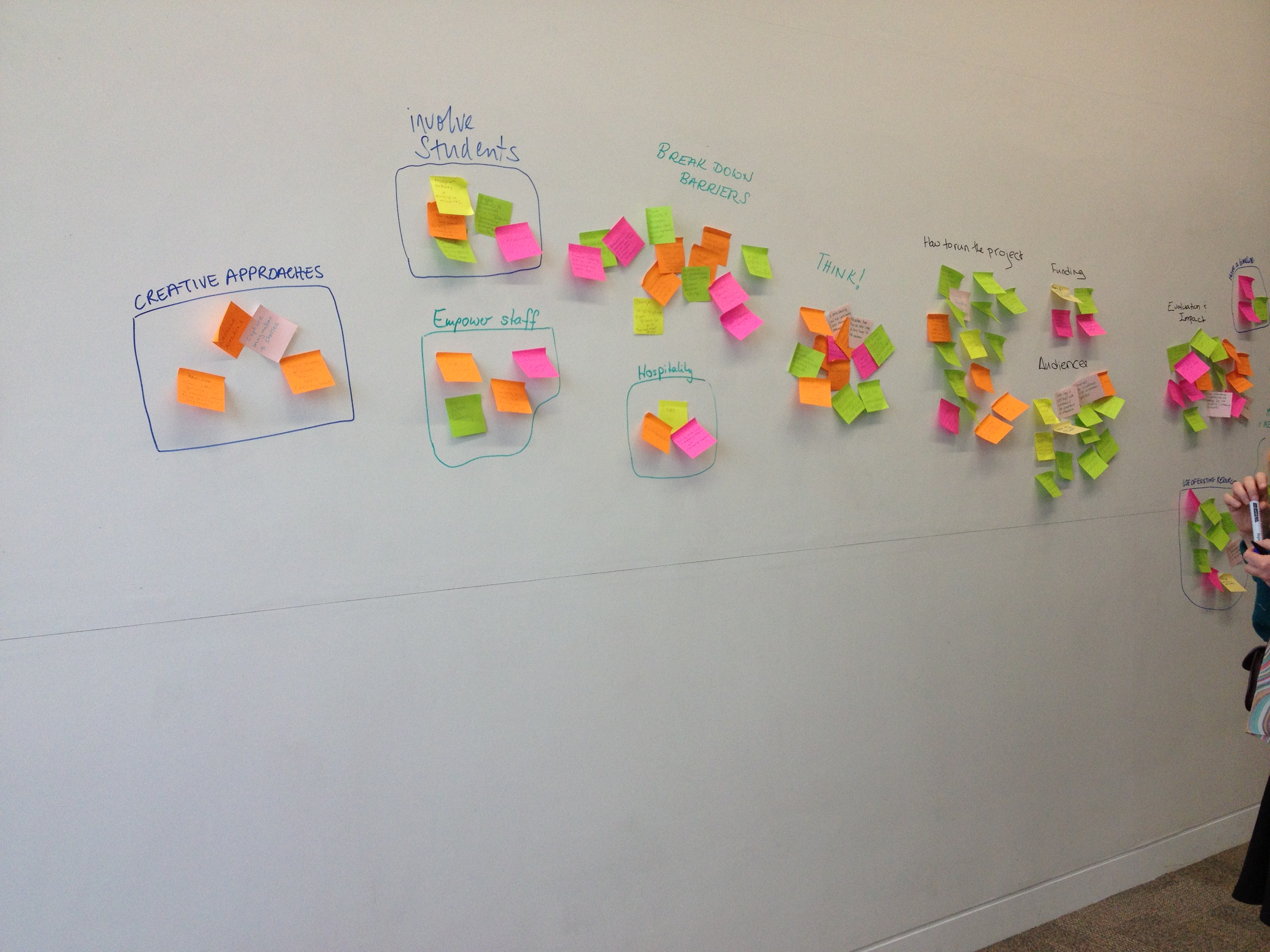
Cake: It may not be obvphotoious from this picture, but on one of the post-it notes in the ‘hospitality’ section is written the word ‘CAKE’.  This, along with all the other post-its, was part of a ‘brain dump’ exercise undertaken as part of a facilitated meeting of the Legacies of War steering group aimed at defining the next steps for the project.  The process took 3 busy very hours, moving from defining desirable outcomes for interested parties (individuals, funders and audiences, both in the flesh and on-line) through the brain-dump of achieving those ends to prioritizing aims and, via a series of specific questions, suggesting practical steps for achieving those priorities.

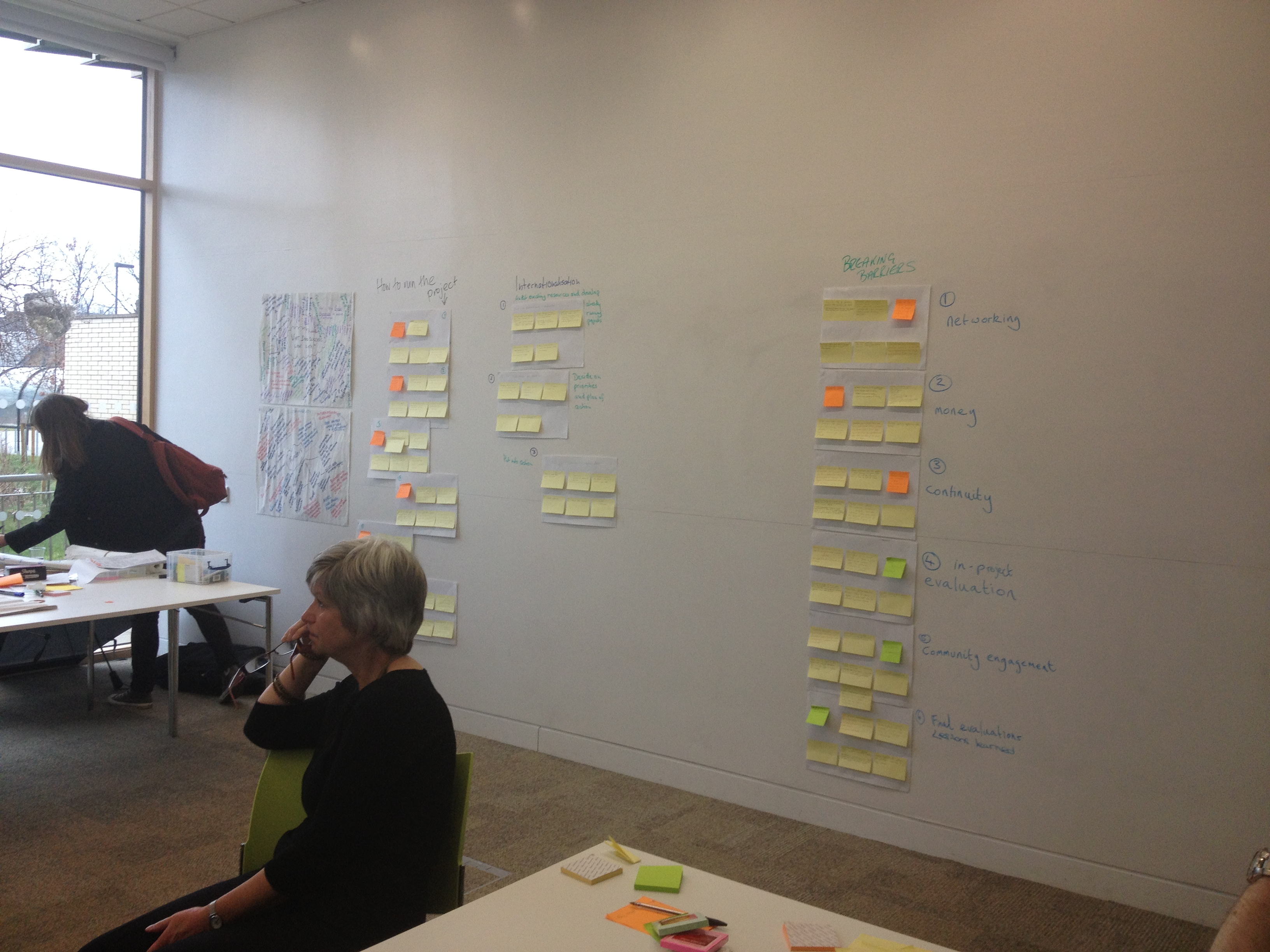
The final result was this:

photo (2)a rather neater arrangement of post-it notes.  ‘Cake’ did rather get lost in the shuffle, with priorities being defined as the way the project is run, locating the project in the international context of war commemoration and breaking down barriers. However a few immediate plans of action were decided upon and the process, unlike anything I have participated in before, was a fascinating experience.  I am not sure precisely how useful it would be more than very occasionally, but as a focusing exercise it certainly worked in the short term and hopefully will show results in the medium to long term as well.  And cake, we all concluded, is not a bad answer to any question.

Biscuits: Following this intense morning, four of us then headed over to the Imperial War Museum North for a meeting of regional scholars to discuss the forthcoming exhibition on the First World War in Manchester and the North West.  While the (very nice) biscuits were promoted as a principle attraction, the discussion of pretty much every aspect of the war, from recruitment and enlistment to demobilisation and disability managed to distract us from them most effectively.  The scope of the proposed exhibition is vast, covering aspects relating to both civil and military experience over the course of the entire war, with the locality serving as the focus.  As a result, I suspect the museum’s researchers got more than they perhaps bargained for in terms of suggestions of subjects to be pursued.  It will be very interesting to see how the project develops.  In the meantime, I got to take away a good deal of information about the demographics of the Manchester region c.1914 and some food for thought about population mobility in the years before the war.

Lemony pudding: These were the puddings on offer at lunch on the second day of the Social History Society conference, held at the beginning of the week.  I was only able to attend two days but those were both so full that I haven’t yet been able to fully absorb everything that I learned. Highlights were meeting Carina Peniston-Bird, with whom I had a chat over said lemony puddings, and Cath Feely, whose work on conscientious objectors’ reading in wartime is intriguing.  My top paper, though, has to be Helen Smith’s on masculinity and sexuality in northern working-class communities in the years just after the First World War with its important challenge to Joanna Bourke’s argument about male intimacy as a product of the trenches.  It reaffirmed for me the importance of work and professional identity as key to understanding masculinities, something that I need to explore more in relation to my ideas about the centrality of life cycle and maturity to these understandings as well.

So, lots to think about on all sorts of levels.  Never underestimate the power of dessert.

The historian wants a wife

It does seem appropriate that my son’s current favourite nursery rhyme is ‘The farmer wants a wife’, as that is precisely how I was feeling at 9:00 pm last night.

The background: my husband left yesterday for a week-long conference/collaboration exercise in France (not Sweden) yesterday afternoon.  In about an hour I will be heading downstairs to register for the Social History Society conference where I am giving a paper tomorrow morning.  This will be my first conference paper in about 5 years (I have given seminar papers, but the audiences have been fairly small), and the first on my new research.  I am terrified (not helped by the fact that the paper appears to be coming in five minutes too long).  On top of this, I now have a month to write two further 20-minute papers on two entirely different topics, and I am in the process of applying for funding and advertising a workshop.  Work is busy at the moment, to put it mildly.

So while my husband battled with a delayed flight and the language barrier of speaking minimal French, I spent yesterday evening doing the following: cooking dinner, feeding dinner to both children accompanied by my son’s interminable monologue which rather gets in the way of eating, getting both children undressed, bathed, redressed in night clothes, milk drunk, teeth brushed, stories read and into bed, putting on a load of washing, cleaning up the dinner table, washing the dishes and hoovering the floor.  I then managed to read through my conference paper (still coming in too long), tried to edit it down and read half an article.  At which point I realised my son was still awake (at gone 9) so I went and confiscated his globe, to much complaint.

Now, this isn’t a complaint about my husband’s relatively easy life.  For a start, it isn’t that easy as he hates travelling and the weather has made it more complicated and stressful than it need be.  Plus, when he is at home he pulls his weight on the domestic front (he does all the laundry for a start) and he will find himself in my position, trying to juggle domestic duties with paid employment, in a few weeks when I go on yet another trip to a distant archive. Rather I want to record my personal experience of a very old observation, to whit, that someone who works outside of the home, whatever their sex, needs domestic assistance if they are to do their paid job and run their home properly.  And I don’t just mean help with the cleaning or the childcare, but rather holistic assistance with household management. In other words, a housekeeper or, indeed, a housewife.  As I say, this is not new.  Many professional women have, over the years, argued that they need a wife in the home as much as a secretary at work to enable them to keep all the balls they juggle personally and professionally in the air. Some feminists have argued that domestic labour should be paid for and valued as highly as any other, given the support it provides to the smooth running of the economy.  And, indeed, the work of the housewife as a support to her husband’s career has, increasingly, been acknowledged in recent divorce settlements of self-made men in Britain. But coming from a home where domestic duties fall on both partners relatively evenly, as does the support given to both our outside jobs, this week looks set to be a valuable reiteration of the importance of the partnership I have with my husband in maintaining an even keel, both domestically and professionally.

In addition to a renewed realisation of the importance of the keeper of the home to productive employment outside it, my admiration for single parents has also reached one of its periodic peaks. I discovered this morning, for example, that we have half a tank of petrol in the car, so now I have to think about where to find a petrol station with pay-at-the-pump facilities because I will have both children in the car whenever I am driving this week. This is precisely the sort of detail that having a partner or assistant to share the burden of domestic tasks (if not take them over entirely) ensures is not forgotten.  We are at the start of the week.  I am just hoping that the end of it doesn’t find me and my children sitting by the side of the road somewhere between home and the university, desperately seeking assistance with moving a petrol-less car!

So what conclusions can I draw from my labours?  Nothing very original.  I know there are plenty of households with far more demands on their time and energy and far fewer resources than I can call upon.  But as the British government finds itself in the midst of debate over how to support working women through childcare subsidies it is perhaps worth reiterating that domestic labour is both time-consuming and vital.  It extends beyond being with children in their early years to ensuring the comfort, health and well-being of all members of a family, whatever shape that family may take, nurturing the energies and abilities of both of the economic producers of the present and of the future, as well as the comfort and happiness of citizens of all ages.  It needs to be valued as a public good, rather than dismissed as a private arrangement.  Debates over childcare are a start, but only a start and not a terribly helpful one if they alienate those who provide the domestic labour.

Now, what did I do with my daughter’s clean clothes for nursery?

AHRC ‘Connected Communities’ Showcase: 12th March, 2013

I have been spending the last several weeks frantically writing, something that may come as a bit of a surprise to any regular readers out there.  At the beginning of February I realized that I had three months to write three conference and/or seminar papers, plus several planning documents, so I have had to get my head down.  The results of my industry are drafts of a variety of things, including a call for papers that you will be seeing a lot more of in the future, I suspect.

In between writing and the general demands of family life, however, I also seem to have spent a great deal of time in London, mainly in relation to the AHRC and HLF-funded Research for Community Heritage project that I am now a postdoctoral research fellow for (this is in addition to my Wellcome fellowship which is on-going).  The project is part of phase two of the AHRC’s Connected Communities programme which is funding some 200 projects bringing together community groups and academic institutions in a variety of ways.  After a session on public engagement for postdoctoral fellows which I attended last week, this week I found myself in London again for a showcase event which allowed me to get a much better sense of the breadth of the programme, as well as bringing me into contact with an extraordinary range of highly engaged (and engaging) individuals.

The day started with a series of short presentations from representatives of the AHRC and the programme’s leadership fellows, followed by a key note address from David Willetts, the Minister of State for Universities and Science.  This sought to emphasize the importance he, as minister, placed on humanities and social science research which he believed to be a ‘bold, significant, world-class participant in UK research’.  He also labelled as ‘unfair’ the impression that the humanities had less connection with the wider world than the sciences.  I couldn’t help feeling there was an element of the lady protesting too much with this. Should the government really need to reassure arts and humanities researchers that they are just as important as all the big scientists and their funding, ring-fenced with funding for the sciences was safe?  If so, it must be down to the impression given by the policies and pronouncements of said government.  The message was also rather undermined by the answer given to a question from the floor about how arts and humanities researchers might influence policy, to the effect that ministers might be accessed via the chief scientist of each department.  Apparently this included social scientists.  I am not sure this was of much comfort to various groups whose excellent work in the arts, often in collaboration, was on display.

The bulk of the remainder of the day was an opportunity to explore the projects whose work was showcased around the venue and participate in breakout sessions.  I missed the session which involved weaving small circlets but did go to a showing of the Imperial War Museum’s film ‘Whose Remembrance?’, based on their on-going project into the black and colonial history of the world wars.  This was fascinating, not only because it tied so beautifully into last week’s Legacies of War seminar from Santanu Das, but also because of the questions it raised about how communities can be encouraged to engage with archives which, all too often they feel excluded from by institutional gate-keepers.  Given that communities are often the very sources that these archives spring from, this is something that needs to be tackled, something that I hope to contribute to through my work with groups involved in Research for Community Heritage.  Making sure that the Liddle and Bamji Collections here at Leeds are better known and fully exploited by all interested communities has suddenly become a very important part of what I am trying to do.  And I was very excited to make the acquaintance of  Cliff Pereira who worked on the Bamji Collection when it was still held in Sidcup.  My one reservation about the session was the rather London-centric nature of the discussion of archival resources.  Given the community-based nature of the research that Connected Communities supports, local and regional archives and their accessibility to community groups really needs to form part of the discussion.

Outside the breakout sessions there were 30-odd stands presenting information about a huge variety of projects.  Many involved mapping and I had long and potentially fruitful discussions with researchers from Birmingham and Bristol about how to present images and information relating to historical geography in an interesting and accessible way.  I ended the day with a fascinating conversation with Paul Crawford from University of Nottingham about health versus medical humanities which gave me some exciting new ideas about how to frame aspects of my own research.  The focus on community activity and expertise within healthcare implicit in health humanities is something that chimes with my long-term interests in the role of families in supporting disabled service personnel.

The formal schedule concluded with round-table discussion about how the Connected Communities project  could evolve in order to achieve ends that will include, as hoped by Keri Facer, one of the programme’s leadership fellows, a change in how universities approach and structure research in the arts and humanities.  Few definite conclusions were reached, but points were raised about interactions with other funding bodies, the need for spaces to share failures and discuss difficulties as well as celebrate achievements, international connections between communities, how resources can be made visible and accessible and, again, that question of how the research being undertaken might affect public policy.

All in all, it was a stimulating, if exhausting day (not helped by the cancellation of my train ‘due to technical failure’ which made it that much longer).  Quite apart from all the ideas generated for the various research projects I am engaged with, and the potential for at least one, if not two, new sources of funding for the Legacies of War project, it was my first experiment with live tweeting a professional event.  I am still not sure I have worked out how to do it.  I certainly wouldn’t want to try at an academic conference as I think I might do injustice to a denser, more complex argument simply through lack of proper concentration.  And I owe a huge apology to my friends and family who, through the linking of my twitter feed and Facebook page, were subjected to a stream of posts of little or no interest outside my professional sphere.  Yet again the question of the work/life balance raises its ugly head in the most unexpected places.

Catching up

Last week my husband and I sat down and updated our diaries and (more importantly) the family wall planner for the rest of the year, or at least until November.  A household that consists of two academics and two young children poses some challenges when it comes to attending conferences, seminars and the like.  Remarkably, we seem to be doing quite well, with only one major conflict where both of us are due to speak at different events at the same time.  Fortunately, mine is the Social History Society Conference which takes place in Leeds this year, so I will have skip the evening events to look after the children while my husband swans off to, well, Sweden. (I would be a lot more resentful if it was the South of France, but that isn’t until later in the year.)

Seeing all my commitments written down (bar the yet-to-be scheduled meetings and the workshop I haven’t confirmed funding for but which hopefully will take place in October) has brought home to me just how much writing I have to do.  With a rising sense of panic, I realise that I am giving three conference papers this year, on three different subjects, only one of which I have spoken on before.  The fact that the first of these is the one based most firmly in my primary research topic and will be the first time I have presented at a society’s general annual conference since speaking at the IHR’s Anglo-American conference in the final year of my PhD, getting on for eight years ago, does not help matters.  Last week I found myself facing a blank page, in a state of complete and utter academic paralysis.

This was not helped by the fact that, along with realising just how much work I had set myself to do, I was also put into contact at that time with Dr Emily Mayhew, who is currently working on a narrative history of stretcher bearers during the war.  Her work sounds fascinating and will, quite rightly, introduce the public to this all-too-often forgotten group of servicemen, which is rather what I hoped my work was going to do.  Having also found out that Amanda Vickery will be presenting a new radio series on gender and disability, a subject central to my research since I began it, I started to panic about being seriously behind the curve.  For the first time in my career I began to wonder if my years’ maternity leave, wonderful as it was, might have been a bad idea.

Fortunately, at this point one I had what I can only describe as a stroke of luck, or rather several small strokes.  In rapid succession I discovered that there are copies of the Gazette of the 3rd London General Hospital in the Bamji Collection here at Leeds as well as in the Wellcome Library and, via an unrelated Twitter conversation, began following Sue Light who blogs about the Happy Hospital, as the 3rd London General was known.  The name comes from the title given by Ward Muir, one of the hospital’s orderlies, to his second collection of columns and vignettes, published in 1918.  (His first, and better-known collection, Observations of an Orderly, was published in 1916 and is now available print on demand.)  Co-incidentally, and in my third small stroke of good fortune, I was reading this volume, and worrying that my forthcoming paper was going to be overly weighted to the 3rd London General, when I came across the following:

‘the case of two of our orderlies, both privates, whose sons are officers: these youths will have to be saluted and Sirred if by any chance they ever turn up here as patients and are waited on by their fathers.’

This one sentence contains so much of what my work is about: rank and authority, maturity and age, medical and combat roles.  All at once I was excited again about not only my forthcoming conference paper, despite the narrower-than-desired focus, but also about my project as a whole.  If this is what the experiences of one (very articulate) orderly in one (slightly unusual) hospital have to offer, the potential for unpacking a great deal more about the masculinity of men serving in these roles is still there.  And while the work of Dr Mayhew and Liana Markovich, who is writing on Australian stretcher bearers, will do much to open up the subject of these remarkable men, there is still so much to say about them in relation to courage under fire, the bearing of arms in warfare and the strength necessary to be a soldier.  In fact, I have started toying with the idea of a definition of masculine courage in wartime as endurance of danger in direct and explicit contrast to armed attack. (This will need a lot more work, but given the disproportionate number of medals awarded to RAMC personnel there does seem some basis for exploring this further.)

So I may not have caught up with my year off, or even with my schedule for the next month (the conference paper has yet to be written), but I have come out of the dip in research energy which, along with my fear, was holding me back.  Now to turn my new-found engagement into a decent paper…

Looking Ahead

Happy New Year! I hope you have all had very merry and happy holiday seasons. Mine was lovely, marred only by sickness which struck on Boxing Day and has affected one or other member of my household ever since. Still, sore throats notwithstanding, we KBO.

Today is my first back at work since the holidays, although given the silence in the corridors, most of my colleagues have decided that this half a week is a bit pointless and have sensibly stayed away. With only one day in the office, I have mainly been concentrating on clearing my desk in preparation for the new year and, having almost succeeded (there is one proposal still to draft that is proving so intractable that I think yet another cup of tea will be needed to crack it), I thought this would a good opportunity to take a look ahead at what 2013 has to offer.

Firstly we have a great line-up of speakers for the Legacies of War seminar series. Final confirmation of titles is pending (and the full list will be posted in a week or so), but Adrian Gregory and Santanu Das have both agreed to speak, on ‘Did God Survive the Somme’ (!) and on ‘India, Empire and the First World War’. Both should be fascinating.

Before then I will be heading off to London, to the Wellcome Library where I will be on the hunt for memories of and about medical orderlies. Having had my proposal on the experiences of orderlies accepted for the Social History Society’s annual conference in March (see here for details), I am now looking for material to support the conclusions I have been drawing from reading Ward Muir’s Observations of an Orderly.  There is at least one orderly memoir at the Wellcome, plus a long list of potential manuscript sources, so it will be a busy.  I am also hoping to attend the IHR conference on open access, The Finch Report, open access and the historical community while I am there (there is a waiting list).

Also coming up is a meeting at the Imperial War Museum North for academics across the North of England to discuss plans for the centenary commemorations and I will be taking the opportunity to go round the ‘Saving Lives’ exhibition while I am there.

There are also a couple of long term plans that are starting to take shape – workshop for the autumn on the history of medicine and warfare, a journal special issue that I have been putting together for years now that hopefully will find a suitable home this year, plans for a primary school class on First World War medicine that may or may not include an accurate reproduction of a stretcher and work with some of the All Our Stories projects relating to Leeds hospitals during the war that have received funding.

And in the interim there will be reading and writing – lots of both.  There is the article on voluntary medical services and their relation to the military that I have been trying to write for a couple of months now, and the stack of books on the Territorial Army sitting seductively on my desk which will, hopefully, inform it.  There is the aforementioned conference paper on medical orderlies and the related research.  There is a beautiful (literally – the cover image is gorgeous) book from Ashgate to review.  And there is the ever-growing reading list, not including the ten books sitting disconsolate on my ‘to read’ shelf awaiting my attention.

So all in all it looks as if this will be a very busy and hopefully productive year in the annals of Arms and the Medical Man.  I will, of course, keep you updated as I go along.  I hope you enjoy the ride as much as I think I will.