Tears, idle tears

Never let it be said that the BBC’s flagship television programme marking the centenary of the First World War, Britain’s Great War, has had no impact on academic research. Following a flippant comment on Twitter, in response to Jeremy Paxman’s description of members of the British cabinet crying at the outbreak of war, I seem to have rather publicly committed myself to writing an article on British soldiers crying during the First World War.

This is actually slightly less ambitious and out of left field than it might first appear. I have a number of examples of men crying, and commenting on crying in relation to their masculine sense of self, while at the front. I am also actively looking for examples of men showing emotion through tears in hospital. These are examples of men crying as a response to fear or to pain. Following from André Loez’s article in Macleod and Purseigle (eds.), Uncovered Fields: Perspectives in War Studies (Brill, 2004), on French soldiers’ tears, I suspect there are also men who cry out of grief and relief/joy.  I would love to find more examples of these, so if anyone comes across any, please do let me know.

I have also been working my way through quite a lot of literature on the history of emotions, as I try to work out my theoretical and methodological approach to the study of masculine subjectivity, something that has definitely changed since I published my book five years ago.  This is a fascinating and complicated subject that I will be posting about at greater length in the near future.  Having a discrete, concrete project to work on that allows me to put a mass of theory into some sort of practice should be quite a useful discipline.  I have always been the sort of researcher who needs to write as she goes, if only to keep my ideas in order.

So I will keep hunting for examples of men whose stiff upper lip trembled far more often than we might believe, and work at locating them in the context of the history of emotions in wartime.  Thank you, BBC and Twitter, yet another job to add to my list!

Why am I still writing about Michael Gove?

I thought that, with yesterday’s post, I had managed to get everything I needed to say about Michael Gove’s intervention on the First World War out of my system.  Then I read this and I discovered that I had not.

I consider myself a ‘proper’ historian, a ‘careful’ researcher and, as it happens, one who spends an awful lot of time reading the accounts, both contemporary and retrospective of ‘the men who were there’.  In fact, I have written at some length about why there are historical problems of privileging ‘the men who were there’ as witnesses to the ‘truth’ of the past.  And yet, unlike Mr Mastin, and, as it happens, Sir Richard Evans and Gary Sheffield, I do believe there is a value to showing Blackadder Goes Forth in the classroom, not simply for what it tells us about ‘the different ways in which the past has been interpreted’, and certainly not because of what it has to tell about the lived reality of the war.  But it does have a great deal to tell us about the history of how the war has been remembered and commemorated as a major cultural (as well as military) event in British history and is thus an important historical document in its own right.

I am not going to rehearse my defense of why the cultural history of the war is at least as important as the military history, this centenary year of all years, here.  I have been making that argument in just about every piece of academic work I have published and I have a book review to write.  But I am going come out and say yes, we should be showing students of the history of the war television programmes like Blackadder and getting them to read books like Birdsong and Regeneration. They will teach students as much about how the war was remembered in the last quarter of the twentieth century as they will about the war itself, but that too is part of the history of the war.

What is more, I would add that we should also be getting students to read Sergeant Michael Cassidy by ‘Sapper’, The Return of the Soldier by Rebecca West, Unpleasantness at the Bellonna Club by Dorothy L. Sayers, Kitty by Warwick Deeping.*  They should be watching Journey’s End and The Big Parade and La Grande Illusion.  Will these cultural works tell them the ‘truth’ about war experience? Only as much as Robert Graves’s Goodbye To All That tells the truth of war experience.  But they do tell us a great deal about how the war was remembered and understood and interpreted by British (and French) culture.  And that, too, is the proper history of the First World War.

*I have personally cited all these works of fiction as historical evidence in essays which have been published by reputable publishers in independently refereed journals. References available upon request.

Of historians and politicians

Michael Gove, Secretary of State for Education, has decided that the best way to start off the centenary years of the First World War is through an article in the Daily Mail which attacks the ‘myths’ of the war and the ‘left-wing academics’ who he accuses of being ‘all too happy to feed those myths by attacking Britain’s role in the conflict’.  The response has been predictably excitable, with various blog posts from a variety of researchers into the history of the First World springing up over the weekend (a fair representation can be found here, here and here), as well as several articles in the print media and from the BBC giving the views of everyone from Tristram Hunt to Margaret Macmillan to Tony Robinson

For me, however, one of the most interesting interventions was one of the earliest, a discussion between Sir Richard Evans (held up by Gove as the prime example of a ‘left-wing academic’ intent on discrediting British national pride) and Gary Sheffield (cited by Gove as a historian engaging in ‘proper study’ for his work on Douglas Haig) on the World At One on Radio 4. These men had been invited to contribute because they were named in Gove’s article, but what emerged most clearly from the debate was the difference of perspective offered by two different types of historical approach, the internationalist analysis which allowed Sir Richard to make an argument about Russia’s lack of democracy, and the national (but by no means nationalist) military history that informs Gary’s views on why the British Army (as an entity) fought the way it did.  These differing approaches expose the many-layered complexity of trying to understand the historic realities of why British men fought in the First World War.

From my perspective as a social and cultural historian, however, there was an important methodological perspective that was missing from this discussion, namely that of the personal or individual history.  This is an explicable, but nonetheless interesting omission, given that personal and family histories are the most common way into a discussion of First World War history for the non-specialist.  This is evidenced by the rash of ‘my grandfather told me’ tweets in response to the discussion of Gove’s article, as well as longer, more thoughtful discussions of individual motivations from researchers such as John Lewis-Stempel and David Underdown.  In my own work, there are plenty of examples of men with equally complex motivations for enlisting initially, as well as those whose ideas about what they, personally, were fighting for changed over the course of their service.

My current favourite example of this is David Randle McMaster, whose papers I read at the National Army Museum last year. McMaster was a bank clerk who enlisted in the RAMC in August 1914 and served with 24th and 2/1st Wessex Field Ambulances throughout the war.  McMaster’s motivations for enlisting were both patriotic and self-interested.  From the outset, he expressed his belief in the necessity of defending the country from invasion and his personal willingness to do so. The son of a Congregationalist draper, he was clearly aspirational and initially enquired about enlisting as an officer, something that, without a medical degree, he was unable to do in the RAMC, the unit he favoured because its non-combatant status could be squared with his religious qualms about killing and violence.  Later, in 1917, McMaster contemplated transferring to a combatant unit in order to attain the social status of officer.  He only decided against doing so when it became clear that he would only be offered a commission in an artillery regiment, rather than an infantry regiment which he viewed as having higher social status.  It is clear from the letters to his parents in which he discusses this decision at length that, in the two and a half years since his enlistment, McMaster’s belief in the justness of the cause he was fighting for had not been eroded.  If anything, it had been enhanced by his experiences under fire (as a stretcher bearer he came under fire and in contact with the extremes of what bullets and shrapnel could inflict on the human body on numerous occasions) to the point where he was willing to compromise the religious teachings with which he had been raised.

Yet McMaster cannot be defined as simply a patriotic jingoist either. At no point does he claim to be fighting for ‘democracy’ as an abstract ideal.  Rather, like so many others, he declared himself to be fighting in defense of home and freedom, in his case embodied in the figure of his mother.  The values he is fighting for aren’t those of politicians but far more concrete ideas about a very particular way of life and the freedoms, from conscription, for example, that it offered. From a 21st-century perspective, these freedoms may appear severely limited, being hedged about by restrictions of class, gender, race and social convention but they nonetheless had value and were deemed worth fighting for by many in 1914.

Why is the personal history of an individual like David Randle McMaster significant?  Partly because he fits part of a pattern with other men, mostly of similar social background and education, who were willing both to enlist and to continue fighting because of a belief in what they were fighting for grounded in an individual and concrete reality, rather than a series of abstractions.  And partly because he is not necessarily representative of all the 5 million British men who served, many of whom enlisted, for instance, because of a desire for glory, because they needed the work, or because, as Regular soldiers, it was their work. Nor is he representative of men who were conscripted, who fought because they had to, rather than because they either wanted to or were misled about what they were fighting for.  The reasons that men enlisted and served were mutiple, complex and contigent upon their personal circumstances and should not be simplified into narratives of either patriotism (as presented by Gove) or ‘lions led by donkeys’ (as suggested by Hunt).

So individual stories are important, giving a much-needed nuance to arguments about why the war was fought. At the same time, individual stories cannot stand alone as representative of every experience.  They need the context of the broader picture for their significance beyond the personal interest of their descendants to be properly evaluated. The benefits of this can be seen in such excellent social histories as Adrian Gregory’s The Last Great War: British Society and the First World War and Catriona Pennell’s A Kingdom United: Popular Responses to the Outbreak of the First World War in Britain and Ireland, both of which locate individual experience clearly in the contexts of geography, class and change over time. The letters of David Randle McMaster help explain why concepts of ‘democracy’ could still be used to justify a nation fighting a war as an ally of imperial Russia and why Haig could remain an enormously popular figure among servicemen (and later veterans), while a knowledge of the structure of the British military helps to contextualise his attitude towards different regiments.

Taking all three perspectives, the international, the national and the personal, together we may be able to start to understand the immensely complex and often contradictory period of history that is the First World War.  What has been encouraging in the past year of working with educators from outside of academe is the extent to which there is a willingness, even an eagerness, to engage with this narrative complexity rather than resort to the crude caricatures that seem to be informing the political debate.  On one level, Gove and Hunt, from their oppositional perspectives, have done a huge disservice to the centenary commemorations by their insistence on reducing the debate to a question of party politics and attempting to divide those researching the subject into camps that fit with their stereotyped ideas. But at least in creating the debate they have made some space for more nuanced discussion among educators and the much maligned Great British Public, a discussion many on both sides seem to want to engage in.

Finally, a brief thought on the word ‘myth’ which has been bandied about pretty freely in a lot of these discussions.  Both sides seem to take the word to mean something equivalent to ‘fiction’ or even ‘a lie’.  Yet, as Samuel Hynes points out, a myth is ‘not a falsification of reality, but an imaginative version of it, the story … that has evolved, and come to be accepted as true.’ (A War Imagined, ix).  So the myths may be challenged, but they are worth studying too, for what they tell us about the historic societies in which they were developed and came to represent truth.  Even if that does mean showing Blackadder Goes Forth in the classroom.

An apology

For any regular readers of this blog (yes, I mean you, Mum), I apologise for the lack of posts over the last couple of months.  November was wildly busy; December has so far been spent catching up with all the things I neglected to do in November; and now, with only one working day left before Christmas, I am getting seriously demob happy, which means reading is taking precedence over writing as a way of getting anything done.

If anyone is eagerly anticipating more random First World War thoughts, please be assured I am working on a response to David Mitchell’s column about poppies and I am also fighting a battle with some new ideas about gender, subjectivity and cultural history that are emerging from that reading that I mentioned.  If I ever manage to work out an even mildly coherent intervention on the subject, that too will be on here.

In the meantime, I leave you with an early Christmas present, gleaned from yesterday’s edition of Radio 4’s ‘A Cause for Caroling’, on the origins of the celebration of Nine Lessons and Carols.  I had not previously realised that King’s College, Cambridge service, probably the most famous version due to its international broadcast by the BBC, was first held on Christmas Eve 1918 at the instigation of Eric Milner-White, Dean of King’s College and a former army chaplain who had seen service in the First World War.  As part of the service that he adapted, from an earlier one created by Edward White Benson when he was Bishop of Truro, Milner-White wrote a new bidding prayer that was described in ‘A Cause for Caroling’ as ‘the last war poem’.  It was with the words of that prayer that yesterday’s programme ended:

‘let us remember before God all those who rejoice with us, but upon another shore, and in a greater light, that multitude which no man can number, whose hope was in the Word made flesh, and with whom in the Lord Jesus we are for ever one.’

Merry Christmas.

Peaky Blinders and the Ubiquity of Poetry

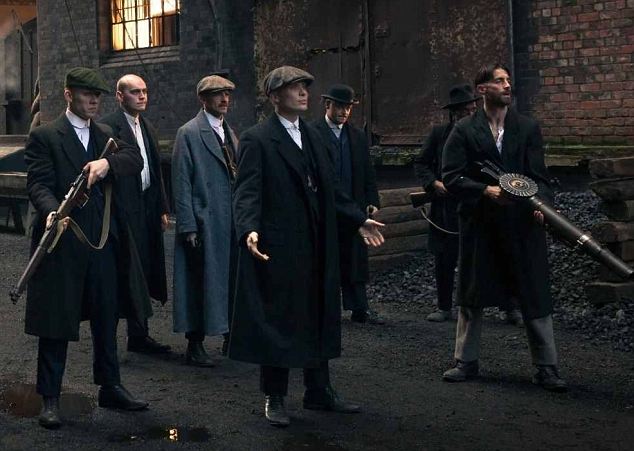
Peaky Blinders gang in Stanley DockA quick disclaimer to begin with.  I do not propose to get involved in the debate over the accuracy of the Brummie accent in Peaky Blinders, the stylish interwar gangland drama broadcast on BBC2 earlier this month, that exercised a number of tweeters.  As someone whose accent hovers around the oddly mid-Atlantic, and has, mortifyingly, once been compared to that of Lloyd Grossman, I am in no position to make any comment on anyone’s accent. Nor is this post is not going to be, strictly speaking, a historical critique of the drama.  I am not a historian of crime and that sort of critique has been done already by those who are, notably Heather Shore in this blog post.

That being said, as a historian of the First World War, I was always going to be interested in a drama set in the war’s immediate aftermath, and there were an unsurprising number of references to the conflict.  The only one I took real issue with was the incitement to strike in the first episode, where men’s war service was used as a reason for striking.  Now, the injustices of the failure to find a land fit for heroes on demobilization was certainly a cause of labour unrest in the 1920s. What was less convincing was the purported date, 1919.  I find it hard to imagine that a significant number of working-class men had been demobilized, rehired and were already prepared to strike at that date.  More plausibly these men would have been on the verge of riot in a camp in France, chafing at the delays in demobilization.

Such quibbles aside, Peaky Blinders wore its war context relatively lightly.  There was the inevitable victim of shell shock, although shooting such a man with pig’s brains at close range is a form of aversion therapy is a treatment I have yet to come across in the medical literature.  The references to the role of women, most obviously in the form of the redoubtable Aunt Polly (Helen McCrory) as the mainstay of the family business in wartime, were nicely done.  And it was interesting to note that the inevitable flashbacks to war experience were set in the tunnels, a trope of war that seems to be increasingly popular at the moment, as if Paul Fussell’s metaphor of the trogolodyte world can only now be properly understood if represented literally.  (Something similar seems to be happening with facial disfigurement, which appears to be overtaking shell shock as the metaphoric wound of the war.)

But it was only in the final episode that I felt I was being beaten about the head by the fact that this was a post-war drama and that war experience was at the heart of character’s attitudes and actions.  That it should be so is no surprise.  This was the episode where the Peaky Blinders, under the command of their wartime leader, Tommy Shelby (Cillian Murphy), went into defensive battle against Billy Kimber (the fantastically spivvy  Charlie Creed-Miles) armed with that key weapon of First World War battles (at least in the popular imagination), a machine gun.  The references were inevitable.

What interested me, however, was that extent to which the images of the battle referenced war poetry as much as military history.  This started early on, when Aunt Polly told Grace (Annabelle Wallis), that Tommy had thrown his medals into the cut.  Siegfried Sassoon allegedly throwing his MC into the Mersey is the obvious precedent.  This is followed by Tommy’s extended meditation on living in the present in the moments before he and his comrades going into battle, a meditation intercut not with the earlier images of the fighting in the tunnels of France that made up his flashbacks, but memories of making love to Grace the night before.  As I watched I found myself quoting from Alan Seeger’s ‘I Have a Rendevous with Death’:

God knows ’twere better to be deep

Pillowed in silk and scented down,

Where love throbs out in blissful sleep,

Pulse nigh to pulse, and breath to breath,

Where hushed awakenings are dear…

But I’ve a rendezvous with Death

At midnight in some flaming town,

When Spring trips north again this year,

And I to my pledged word am true,

I shall not fail that rendezvous.[i]

Then there is Ada Shelby’s appearance, in widow’s weeds and pushing her infant son in a pram (an extraordinary image that I want to think about further in terms of what it says about domesticity and respectability), bringing to mind ‘the pallor of girls’ brows’ that was, for Wilfred Owen, the pall of young men dying in battle.  And finally, in the culminating moment of battle, when Tommy Shelby single-handedly kills Billy Kimber, I thought I saw a look of recognition pass across Murphy’s. By this time I was so attuned to potential poetic references that all I could think was ‘Oh, Strange Meeting, of course’.

Now, I have no way of knowing if Murphy read any Wilfred Owen when researching the part of Tommy Shelby, or if the director Otto Bathurst is familiar with ‘I Have a Rendevous with Death’, not one of the better-known poems of the war, though it should be.  My associations may simply be an over-sensitivity on my part to any poetic reference in relation to the war, an unfortunate aftereffect of studying the war and its culture for too long.  But the fact that the references are there, even only subconsciously, tells me something about the power of these poems to speak down the generations in their representations of an emotional truth about war, violence and its aftermath.  Dramatically, this is how our culture understands the war and its aftermath, the images that it associates with this bit of history.

This is a fact that those of us who argue that there is far more to the war than ‘the mud, the blood, the endless poetry’ must come to terms with in our attempts to convey what else history has to tell us about the First World War.  That there are emotional as well as historic truths to be acknowledged.  The continued power of war poetry is that it taps into the sense of being ‘of all time’, speaking as powerfully to us today as it did to those who read it when it was first composed and published.  This does not make it the only narrative of the war, but it does make it a significant one.  And if we stay attuned to these references, in whatever unlikely scenario they pop up, not only will we be able learn more about the place of the First World War within our cultural heritage, but we may also have an excuse to quote some very moving and beautiful poetry.


[i] Alan Seeger, ‘I have a rendezvous with death’, http://www.poets.org/viewmedia.php/prmMID/19396, last accessed 28/10/2013, 15-24.

Seventeen Soldiers

With the new term upon us, the Legacies of War seminar series is about to resume.  Our first talk will take place on 10th October at 5:15 in Banham Theatre, University of Leeds.  Professor Anthony Fletcher will be speaking on ‘Seventeen Soldiers: Life and Death on the Western Front’. (For early modernists among you, yes, this is Professor Anthony Fletcher, formerly of the University of Essex. His new book, upon which his talk will be based, applies his expertise in the history of gender and childhood to the subject of the soldier’s experience in the First World War.)

Anthony Fletcher

The Wipers Times (belatedly)

A couple of months ago, I tweeted this in response to the publicity surrounding a new television drama co-scripted by Ian Hislop and starring Michael Palin as a First World War general. That drama was The Wipers Times, which has now been broadcast, several weeks ago, and I can only apologise for the delay caused by pressure of work which means it is no longer available on iPlayer for anyone in Britain who may have missed it.

As the comments on my original tweet forshadowed, I am forced to eat my words because, as a historical drama, it was, I thought, very good indeed, mainly because it didn’t attempt to represent itself as historical realism.  Rather it adopted the tone of the trench journal which was its subject to represent the war as seen by the Wipers Times.  Here I want to particularly commend Ben Daniels as a stereotypical brass hat blowhard, the very stereotype I was so concerned about, played to the point of exquisite caricature, beautifully illustrating the way in which trench journals such as the Wipers Times satirized the absurdist situation in which the men who created them found themselves.  Far more than the music hall interludes, with their nods to ‘Oh, What a Lovely War’ and the excesses of cabaret culture, Daniels’s performance (and that of the more sympathetic figure played by Michael Palin) illustrated how our view of the war has been distorted by a tendency to define all wartime behaviours in black and white terms.  No one in reality could be either so blindingly stupid or so wittily sympathetic as the characters these two actors portrayed. Only as satire do they make sense.

In general, all the performances were excellent, although Emilia Fox’s role as a loving wife was more or less superfluous.  And my only potential historical criticism relates to some mumbling on the part of Julian Rhind-Tutt who made what I assume was meant to be ‘red tabs’ (staff officers) sound suspiciously like ‘red hats’ (military policemen), an entirely different, if equally loathed group of authority figures.  But it was a good drama and, for the first third, very funny indeed.  After that the humour became repetitive, and the shift of focus almost exclusively to the officers meant a loss of the voices of the ordinary soldier.  While the tone towards these men was generally condescending, mocking the ignorance and unsophistication of the young British working class man, this was an accurate reflection of the language used by many trench journals which were as class-bound as so much else in British culture during the war.

The increasing staleness of the humour as the drama continued may seem like a criticism, but it is not.  It too is an accurate reflection of trench journalism.  For anyone who has spent any time reading such journals, and those produced in prisoner of war camps and hospitals, this growing staleness is all too familiar. It reflects the fact that (pace all those television reviewers who referred to the public school humour of the publication) these publications represented the humour not of the upper-middle classes (although this was well represented) as much as that of the institution.  The result is a predominance of in-jokes which, to the outsider who is not caught in the institutional setting, be it a hospital, a prison or a military unit under orders, seem either inexplicable or dull.  The trajectory of the drama captured this beautifully, with the only duff note being the uncharacteristic injection of sentimentality and 20/20 ‘foresight’ in the scenes depicting Fred Roberts, the originator and editor of the Wipers Times, at home with his wife on leave.

In the end, it was not the drama itself which troubled me as a First World War historian, but the response of television critics after its broadcast, an number of whom implied that the Wipers Times was worthy of note because it dramatised the viewpoint of a unique publication and, as such, stands as a necessary corrective to more sombre commemorations of the war.  In fact, as I have suggested, it was one of a number of such publications which treated the trials and tribulations of warfare (including serious injury and the loss of liberty) as subjects of humour and absurdity.  Some 800 such journals have been collected by Cambridge University Library.  Nor was it only periodicals that adopted this tone.  Herman Cyril McNeile, better known as ‘Sapper’, wrote a number of short stories which were published for propaganda and recruitment purposes by The Daily Mail, which also adopted an amused, flippant tone in their descriptions of life at war.  For anyone interested in the subject, I highly recommend George Simmers’s excellent essay on facetiousness in wartime and post-war writing (which does a far better job of teasing out the class dimensions of this literature than I have done here).  And for anyone want to read more institutional war time journals, Sue Light’s blog of the Gazette of the 3rd London General Hospital, Ward Muir’s Happy Hospital, gives an excellent idea of what can be found in that extraordinary organ, including contributions from C.R.W Nevinson, later a war artist, and Stephen Baghot de la Bere, the cartoonist.  Nor were British the only servicemen to produce trench journals.  Stéphane Audoin-Rouzeau’s Men at war, 1914-1918 : national sentiment and trench journalism in France during the First World War(translated by Helen McPhail) and Robert L. Nelson’s German Soldier Newspapers of the First World War present a transnational picture of bottom-up morale building during the war.

So The Wipers Times ended up not only proving itself an enjoyable drama, but also the source of considerable reflection on popular understandings of the war. While reviews of the programme expose some of the limits of public knowledge, my previewing comment exposed the limits of my own.  It provoked a very interesting discussion with the historical adviser to the programme on the limitations inevitable with creating drama out of history, particularly on the sort of budgets provided by the BBC.  I am now training myself not to complain about the misrepresentation of roles until I consider how a limited cast is being deployed to cope with sheer lack of numbers, and not to judge a popular television programme by its publicity.

Back to School

This blog has had a bit of a summer holiday.  Not a complete holiday, lazing in the sun and recharging batteries; two weeks of toddler illness and the start of big school for my eldest rather put paid to that.  But here we are at the beginning of the new term.  Marquees are going up around campus to help welcome the new students; language students no longer clog the lifts and staircases in the building that houses my office; my husband and I are slowly getting used to having a schoolboy in the house and to the lunacy of a morning routine that now involves a 30-minute school run and an evening routine of making packed lunches.  There is a chill in the air; I have sorted out the winter woollies (thereby guaranteeing a heatwave in the near future); I was seriously contemplating the advisability of gloves on the walk to work this morning.  Yes, autumn has arrived; the new school year has started.

I love the excitement of the start of the new school year.  As an academic I have never really left it behind in terms of the annual rhythms of my life. This year that excitement has been rather more stress-laden than usual, what with the need to help launch the first of my progeny on his own voyage of academic discovery. He seems such a frail craft at this stage, and the oceans of academe are indeed mighty from the vantage point of reception.  Winds have been set fair so far, but I am sure there will be squalls ahead.

In the meantime, the map of my own voyage through the term is filled with exciting potential destinations and discoveries.  Up first is the return of the Leeds Legacies of War seminar series, this year bigger and better with additional funding from the Schools of History and Modern Languages, as well as the Leeds Humanities Research Institute.  We have even managed to be organized enough to produce a term card this term:

LoW Term Card (2)(This is slightly false advertising as at least two of the seminars are going to have to move to larger venues but we haven’t been able to confirm where with central booking yet. More details will be advertised closer to the time.)

On a more specifically medical line, I am organising a workshop on the history of medicine and the First World War in Europe on 17th and 18th October.  More details can be found here, although I am afraid I have had to close registration due to the number of people who have already registered.  Full reports will, of course, follow, and I hope the workshop will lead to more exciting projects in the future.

Further afield, the terms looks to be a busy one for travel. At the end of the month I will attending the International Society for First World War Studies’ conference on Encountering the Other in Wartime in Paris and in November I am off to Ypres for the In Flanders’ Field Museum’s conference on War and Trauma.  There will also be a trip to London in my role as postdoctoral research fellow on the Legacies of War ‘Discovering First World War Heritage’ project and various trips to Salford and around the Yorkshire region for research and (whisper it) possibly broadcast purposes.

In between, I have a fair bit of writing to do: a couple of articles, draft chapters for the book proposal and, of course, keeping this blog up-to-date.  Writing it all down is fairly intimidating on the one hand, but enormously exciting on the other.  Like my son, I am embarking on a voyage, not into the unknown as he is, but certainly to destinations far enough on the horizon that I cannot clearly discern their shape and form.  It should be quite a journey, and I do hope you will accompany me, at least some of the way.  It is always good to have traveling companions.

Never such innocence again

Yesterday was the anniversary of British entry into the First World War and, as such, saw a rash of articles in the British press and on line reflecting on both the conflict and the forthcoming centenary. Among them was this offering from Henry Porter in The Observer.  The main thrust of the piece is a discussion of the meaning and purpose of commemoration of conflict, about which Porter has a number of reservations, some of which I share.  What fascinated me about it, however, was the series of assumptions that underpinned Porter’s argument about the nature of the men who fought the war.

The opening paragraph describes a piece of graffito carved into a tree in Gloucestershire: PM 10/9/13 MKN.  As described, that is it, no heart encircling the initials, no indication of the sex or age of either party.  Yet, from this description, Porter makes the leap to a narrative whereby these are the initials of two lovers separated a year later by the war.  While I, too, make the assumption that at least one of the individuals was male (based on assumptions I make about knife possession and the desire to mark things through carving), my immediate narrative conclusion was rather different: two boys marking their friendship after school, perhaps, rather than two lovers swearing eternal fidelity after work.  Yes, they might have been 18 and, a year later, found themselves in the British armed forces preparing to face the enemy.  Or they might have been 13, too young to enlist until the war’s final year.  Porter’s narrative, while romantic, seems to have little evidence to back it up, making his tour of local war memorials even more of a long-shot than he himself implies.

Another, similar, imposition of narrative occurs later in the article, when Porter writes of the war as ‘an event that prods Owen, Sassoon, Graves, Remarque, Gurney and Nash into great art’.  By implication, the war is the sole source of these men’s artistic inspiration.  Certainly experiences of war inspired great art from these men, but their artistic aspirations and labours predate the war and several of them (most notably Graves, perhaps) produced great art in the years after that drew on other sources of inspiration. We cannot begin to speculate what sort of poets, artists, musicians they might have been had the war not occurred, but positioning the war as the sole reason for their artistic endeavour is equally a-historical.

It seems to me that there is quite a lot of this imposition of narrative in relation to our historical memory of the war.  The narrative runs that the Britain of the pre-war world, and all who inhabited her, were innocent and pure.  The war, with its unimaginable (by us as well as by those pre-war peoples) mud and blood and violence, destroyed that innocence, leaving behind only the grief and cynicism of the modern world.  It is the narrative of Paul Fussell’s literary paradigm shift writ large upon British social history.

And yet… As someone who has spent an awful lot of time reading the letters and diaries of men who fought in the war, documents which cover the complete span of 1914 through to 1920 and beyond, this narrative sits uncomfortably with me.  In the first place, as I have argued elsewhere, the post-war world was not entirely bereaved or cynical.  Men survived the war and came home to families who rejoiced.  All had been changed by their experiences of warfare, but those changes weren’t, in all cases, for the worse.  Some had gained new skills, acquired new aspirations, had their horizons widened, their philosophy and tolerance deepened.

Secondly, and perhaps more importantly in the run-up to 1914, when questions of war enthusiasm and recruitment will be at the forefront of commemorative events, not all men who served were the lovelorn innocents of Porter’s (and I suspect popular) imagination.  The men who enlisted in the first years of the war were probably fairly reflective of the population at large: some were unworldly, some were sophisticates, a few were criminals.  Following the introduction of conscription, the accuracy of that social reflection may have increased as the reluctant soldiers were called up for service. Among the ranks of the army were surely, throughout the war, wife beaters, bullies, incompetents, malingerers, con men, the lazy and the cowardly, as well the idealistic, the intelligent, the grafters, the loyal, the poets and the heroes.  I have read more than enough papers of young men who started the war as prigs, or fire-eaters, and remained that way until the Armistice to know that war did not necessarily change men in the ways the canonical poets would have us believe, as well as far too many of men who were killed before they had a chance to reach anything like maturity.  Their stories, as well as those of the men who war changed in a myriad of ways, reflecting the myriad of personalities who were engaged in waging war, are worth listening to as well.

Over the course of the centenary it will, I know, be very tempting to look at the many artifacts of the conflict that will emerge into the public eye and impose romantic narratives on them, as Porter has done with a piece of graffito and as Philip Larkin did with a photograph in ‘MCMXIV’.  We should be wary of doing so, however, lest, in our romanticism, we miss far more, and far more interesting stories of this extraordinary conflict than the ones we believe we know.

In which I go multimedia

It has taken some time (copyright queries now all answered) but the podcast of my talk to the Legacies of War seminar series is now available:

I admit that I have only listened to a few seconds of it, but the editor assures me that it sounds okay.  If you enjoy it, please check out some of the other talks from the series which can be found here.