A question about a footnote

Yesterday I attended the launch of the new British Council report Remember the World as Well as the War at the House of Lords.  The report explores international knowledge and understanding of the First World War, and the headlines here in Britain have mainly focused on the apparent lack of British knowledge of the war. This, interestingly, was not the tone of the discussion which took place yesterday.  The document was introduced by John Dubber, who co-authored it with Dr Anne Bostanci, before being discussed by Parliamentarians Keith Simpson and Baroness Young of Hornsey, with a final contribution from Dr Catriona Pennell, the historical consultant.  The debate was then opened up to contributions from the floor, which included, most pertinently, inquiries as to how the British Council was planning to use the document to engage the public with the debates it raises, as well as suggestions that similar, comparative research be carried out in the US and proposals for collaboration with other organisations to spread the document’s reach.

One of Catriona’s key points was that working as historical consultant had been, for her, a good exercise in academic discipline and concision, forcing her to think critically about how to present a huge range of historical argument, covering at least the past 30 years, in 10,000 words.  Indeed, she noted that she had originally presented her collaborators with 17,000 and that, in the editing process, large swathes of the history of the war, including the conflict’s impact on gender and on science and technology had had to be removed.  I have not yet had time read the document in great detail (I spent the train ride home last night reading the book I am supposed to have written a review for by the end of the week) but, as a historian of precisely those two facets of the history of the war, my initial glance the through did suggest that their importance is implicit in parts of the discussion, particularly the complications that they bring to our understanding of the war.

Nowhere is this better illustrated than in the graph on page 7 which charts UK responses to the question ‘Were members of your family/your local community involved in, or directly affected by, the First World War?’  The first responses listed are ‘Yes, a family member fought in the First World War’ (37%) and ‘Yes, a family/community member was involved in the war effort in another way’ (9%).  This second response is glossed with a footnote which reads ‘as carrier, labourer or other support staff (for example munitions support or digging trenches); as medical staff; on the home front (for example in factories) etc.’ [My italics.]

Now, I haven’t been blogging directly about my own research recently, but that footnote goes right to the heart of the question that is at its centre, namely how was the war experienced by men who served in military uniform in non-combatant medical roles during the First World War.  Because the structure of the responses as set out creates a seemingly unbridgable gap between combat and non-combat in terms of war service, a gulf that I am increasingly coming to believe did not exist, or at least could not be sustained, throughout the course of the conflict, within the British armed forces.  R.A.M.C. servicemen certainly saw themselves as soldiers, the comrades and equals of their combatant fellow servicemen, even if they didn’t bear arms.  And those fellow servicemen increasingly viewed R.A.M.C. as equals in terms of service rendered, acclaiming the qualities of endurance and comradeship that were key to understandings of heroism during the war years. Military medical service personnel served and were seen to serve, even if they did not fight, a fact which rather nuances not only the question of in what ways family members engaged with the war, but an earlier one about how the war should be commemorated, illustrated on page 5. In answer to this question, 64% (the decided majority) of UK respondents answered that a focus on human suffering and loss of lives should form the focus of commemorations over the next four years.  Yet the broader, more complex question of how the war was experienced, by those who survived as well as those who did not, was not, apparently an option given to respondents.  It is this question that forms the thrust of my research as a historian, as it does for many other social and cultural historians, and, I believe, motivates the large numbers of people engage in personal, local and regional research and commemoration projects taking place around Britain in response to the centenary.

So I had a rather pernickity question about the methodology used by YouGov (who carried out the polling for the survey) and about how the questions and responses presented to respondents were decided upon, as well as a rather broader one about how the material on gender, medicine and everything else that had to be edited out might be utilised in future to enhance the findings already published.  Last night’s launch, however, focusing as it did, quite rightly, on the global nature of the conflict and its continuing, multifaceted, global legacies, was not the right place to ask those questions.  So instead I am asking them here, or at least, to bring it back to Catriona’s own final question about how projects such as this facilitate the communication of cutting-edge scholarly ideas to a wider public, how do we make pernickity questions about footnotes relevant to that wider audience that is keen to find out how the war affected their family, their town, their region?  Buried in that footnote are some really interesting debates about the nature of service, for men and for women, in wartime and the impact of war on international medical and philanthropic ideals of care and compassion.  These are debates that still have relevance today, for medics in the battlefield and for NGOs such as the Red Cross and Red Crescent, attempting to alleviate the suffering of all involved in contemporary conflicts.  These are discussions that academics are having.  Now, how do we make sure that they form part of the discussion when it comes to international commemoration as well?

Seventeen Soldiers

With the new term upon us, the Legacies of War seminar series is about to resume.  Our first talk will take place on 10th October at 5:15 in Banham Theatre, University of Leeds.  Professor Anthony Fletcher will be speaking on ‘Seventeen Soldiers: Life and Death on the Western Front’. (For early modernists among you, yes, this is Professor Anthony Fletcher, formerly of the University of Essex. His new book, upon which his talk will be based, applies his expertise in the history of gender and childhood to the subject of the soldier’s experience in the First World War.)

Anthony Fletcher

Back to School

This blog has had a bit of a summer holiday.  Not a complete holiday, lazing in the sun and recharging batteries; two weeks of toddler illness and the start of big school for my eldest rather put paid to that.  But here we are at the beginning of the new term.  Marquees are going up around campus to help welcome the new students; language students no longer clog the lifts and staircases in the building that houses my office; my husband and I are slowly getting used to having a schoolboy in the house and to the lunacy of a morning routine that now involves a 30-minute school run and an evening routine of making packed lunches.  There is a chill in the air; I have sorted out the winter woollies (thereby guaranteeing a heatwave in the near future); I was seriously contemplating the advisability of gloves on the walk to work this morning.  Yes, autumn has arrived; the new school year has started.

I love the excitement of the start of the new school year.  As an academic I have never really left it behind in terms of the annual rhythms of my life. This year that excitement has been rather more stress-laden than usual, what with the need to help launch the first of my progeny on his own voyage of academic discovery. He seems such a frail craft at this stage, and the oceans of academe are indeed mighty from the vantage point of reception.  Winds have been set fair so far, but I am sure there will be squalls ahead.

In the meantime, the map of my own voyage through the term is filled with exciting potential destinations and discoveries.  Up first is the return of the Leeds Legacies of War seminar series, this year bigger and better with additional funding from the Schools of History and Modern Languages, as well as the Leeds Humanities Research Institute.  We have even managed to be organized enough to produce a term card this term:

LoW Term Card (2)(This is slightly false advertising as at least two of the seminars are going to have to move to larger venues but we haven’t been able to confirm where with central booking yet. More details will be advertised closer to the time.)

On a more specifically medical line, I am organising a workshop on the history of medicine and the First World War in Europe on 17th and 18th October.  More details can be found here, although I am afraid I have had to close registration due to the number of people who have already registered.  Full reports will, of course, follow, and I hope the workshop will lead to more exciting projects in the future.

Further afield, the terms looks to be a busy one for travel. At the end of the month I will attending the International Society for First World War Studies’ conference on Encountering the Other in Wartime in Paris and in November I am off to Ypres for the In Flanders’ Field Museum’s conference on War and Trauma.  There will also be a trip to London in my role as postdoctoral research fellow on the Legacies of War ‘Discovering First World War Heritage’ project and various trips to Salford and around the Yorkshire region for research and (whisper it) possibly broadcast purposes.

In between, I have a fair bit of writing to do: a couple of articles, draft chapters for the book proposal and, of course, keeping this blog up-to-date.  Writing it all down is fairly intimidating on the one hand, but enormously exciting on the other.  Like my son, I am embarking on a voyage, not into the unknown as he is, but certainly to destinations far enough on the horizon that I cannot clearly discern their shape and form.  It should be quite a journey, and I do hope you will accompany me, at least some of the way.  It is always good to have traveling companions.

In which I go multimedia

It has taken some time (copyright queries now all answered) but the podcast of my talk to the Legacies of War seminar series is now available:

I admit that I have only listened to a few seconds of it, but the editor assures me that it sounds okay.  If you enjoy it, please check out some of the other talks from the series which can be found here.


Library time

So, another hiatus in posting here while I have done battle with my next conference paper, this one on representations of shell shock as immaturity across 20th century British popular culture.  It is the third paper I have written on the subject.  Every time I write the proposal for the paper I think what a brilliant idea it is; every time I actually sit down to write the paper itself I find myself doing vicious intellectual battle and wondering how I could think there was any mileage in the concept at all.  Still, I must be doing something right as both the previous tilts at this particular windmill have been published. And this is a conference paper, so I am going to leave it intentionally (honest, guv!) rough in the hope of getting useful feedback.  Given that the conference is being attended by what feels like all the world-class historians of shell shock available, this could be either a very good (or very, very bad) idea.  We will see. I am going to write the second draft next week.

This seemingly endless struggle has been interspersed with some work more directly related to what I am paid to do.  I spent a fabulous week in the Army Medical Services Museum (about which I intend to write a much longer blog shortly) and gave a paper to the Legacies of War seminar series. (Like the majority of those papers, it will be on-line soon here.)  This was another rough draft and the feedback was immensely useful so I am hopeful that, when I actually get around to rewriting and expanding the paper, there will be some hope of publishing it.

Library Shoot 58 (2)I also spent a really enjoyable Saturday morning in Special Collections, working with writers from Snowgoose.  Legacies of War is working with writers from the project to research a series of monologues based on the civilian experiences of the First World War in Leeds which will be performed on camera and available for festivals, as an educational tool and to view on-line.  The Saturday session I helped facilitate was an opportunity to introduce the writers, who were unfamiliar with working in historical archives, to the holdings of the Liddle Collection.  The Liddle catalogue is something of a mystery, even to professional historians with archival experience.  Add to that the complexities of copyright law and queries over the reproduction of images and the potential for intimidation is quite high.  So it was a complete joy to help this group quite literally get their hands on original documents and objects. Library Shoot 42 Library Shoot 24 (2)An hour in and everyone was engrossed in their research, a sight I found remarkably rewarding.  It was also a pleasure to be able to offer advice to someone whose research interest is likely to take her beyond Special Collections and into the city archives and other resources that I am not familiar with.  Helping someone to plot the map for a research journey is almost as exciting as plotting your own, I discover.

Library Shoot 53 (2)

My work for Research for Community Heritage has, to date, been somewhat confusing and occasionally unnerving but the interactions with the community research groups have, as this last experience exemplifies, been enormously rewarding in unexpected ways.  (On a similar note, some work I have done with Headingley LitFest has made me view Park Square in Leeds in an entirely new light.)  There are aspects of the project that make an unanswerable case for community engagement by the academy. More thought needs to be given about the ways in which such engagement integrates with other academic responsibilities, especially for early careers researchers, but the engagement itself offers enormous potential rewards for all involved.

(Photo credit: All photographs are by Laura Whitaker of www.definingbeauty.co.uk)

Blowing my own trumpet

The following bit of advertising feels a bit awkward, as it is for my own paper, but the next meeting of the University of Leeds Legacies of War Seminar will take place on Thursday, 25th April at 5:15 in Room 3.11 Michael Sadler Building.  I will be talking about the conflicts between a desire for masculine adventure and religious principles among the founders of the Friends’ Ambulance Unit.  All welcome.

Jessica Meyer

Cake, biscuits and lemony pudding

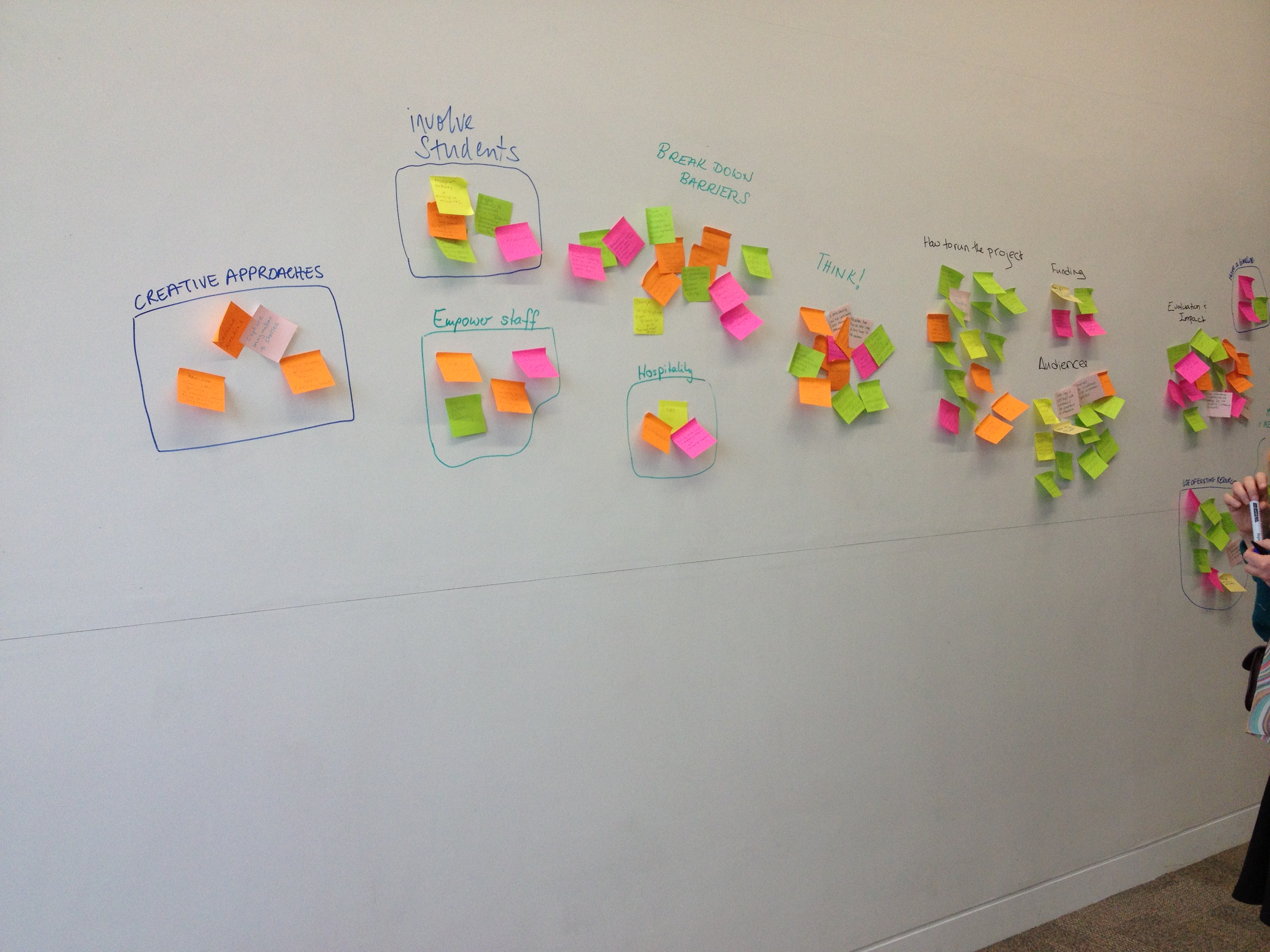
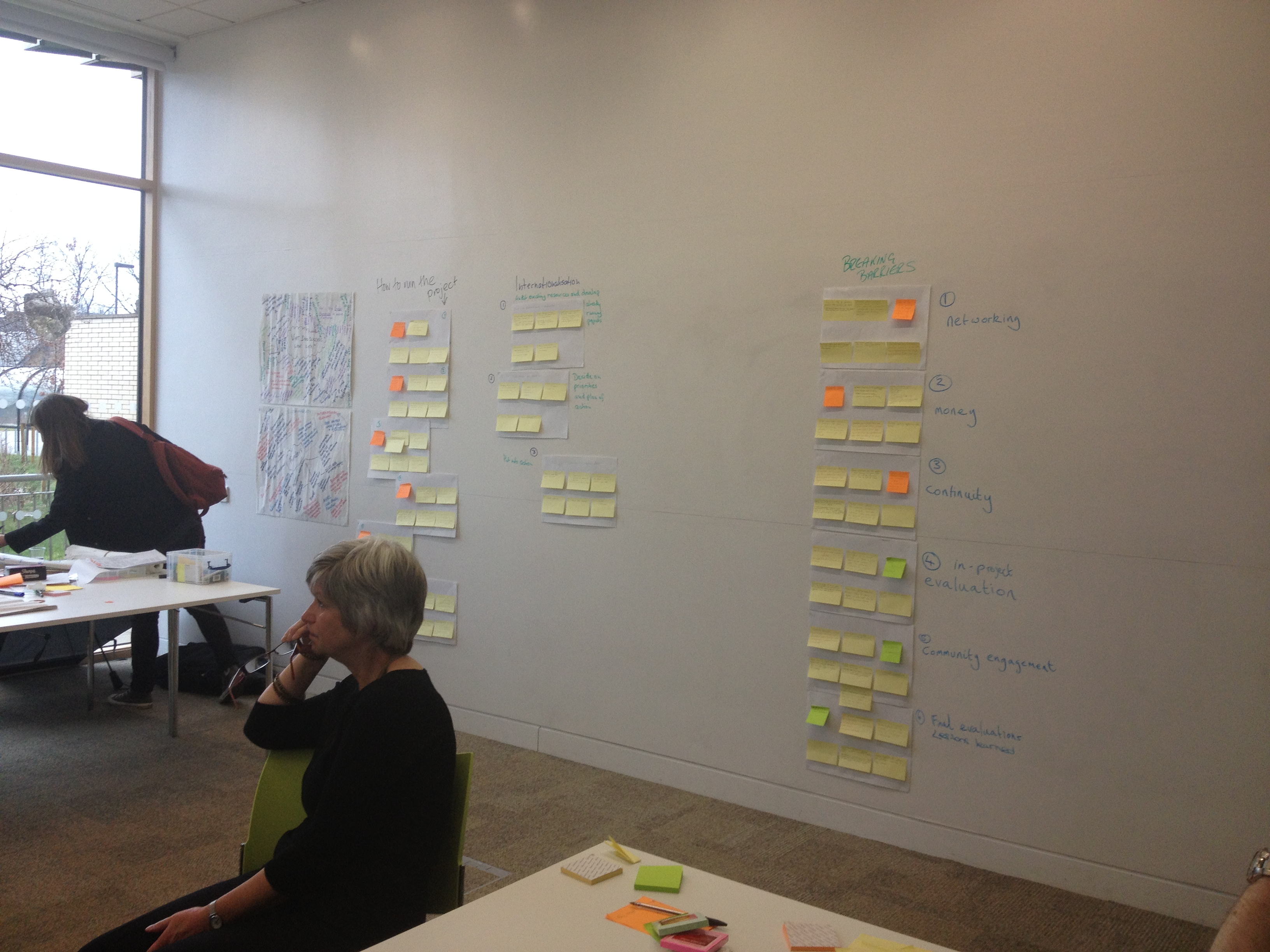
Cake: It may not be obvphotoious from this picture, but on one of the post-it notes in the ‘hospitality’ section is written the word ‘CAKE’.  This, along with all the other post-its, was part of a ‘brain dump’ exercise undertaken as part of a facilitated meeting of the Legacies of War steering group aimed at defining the next steps for the project.  The process took 3 busy very hours, moving from defining desirable outcomes for interested parties (individuals, funders and audiences, both in the flesh and on-line) through the brain-dump of achieving those ends to prioritizing aims and, via a series of specific questions, suggesting practical steps for achieving those priorities.

The final result was this:

photo (2)a rather neater arrangement of post-it notes.  ‘Cake’ did rather get lost in the shuffle, with priorities being defined as the way the project is run, locating the project in the international context of war commemoration and breaking down barriers. However a few immediate plans of action were decided upon and the process, unlike anything I have participated in before, was a fascinating experience.  I am not sure precisely how useful it would be more than very occasionally, but as a focusing exercise it certainly worked in the short term and hopefully will show results in the medium to long term as well.  And cake, we all concluded, is not a bad answer to any question.

Biscuits: Following this intense morning, four of us then headed over to the Imperial War Museum North for a meeting of regional scholars to discuss the forthcoming exhibition on the First World War in Manchester and the North West.  While the (very nice) biscuits were promoted as a principle attraction, the discussion of pretty much every aspect of the war, from recruitment and enlistment to demobilisation and disability managed to distract us from them most effectively.  The scope of the proposed exhibition is vast, covering aspects relating to both civil and military experience over the course of the entire war, with the locality serving as the focus.  As a result, I suspect the museum’s researchers got more than they perhaps bargained for in terms of suggestions of subjects to be pursued.  It will be very interesting to see how the project develops.  In the meantime, I got to take away a good deal of information about the demographics of the Manchester region c.1914 and some food for thought about population mobility in the years before the war.

Lemony pudding: These were the puddings on offer at lunch on the second day of the Social History Society conference, held at the beginning of the week.  I was only able to attend two days but those were both so full that I haven’t yet been able to fully absorb everything that I learned. Highlights were meeting Carina Peniston-Bird, with whom I had a chat over said lemony puddings, and Cath Feely, whose work on conscientious objectors’ reading in wartime is intriguing.  My top paper, though, has to be Helen Smith’s on masculinity and sexuality in northern working-class communities in the years just after the First World War with its important challenge to Joanna Bourke’s argument about male intimacy as a product of the trenches.  It reaffirmed for me the importance of work and professional identity as key to understanding masculinities, something that I need to explore more in relation to my ideas about the centrality of life cycle and maturity to these understandings as well.

So, lots to think about on all sorts of levels.  Never underestimate the power of dessert.