Oh Dear

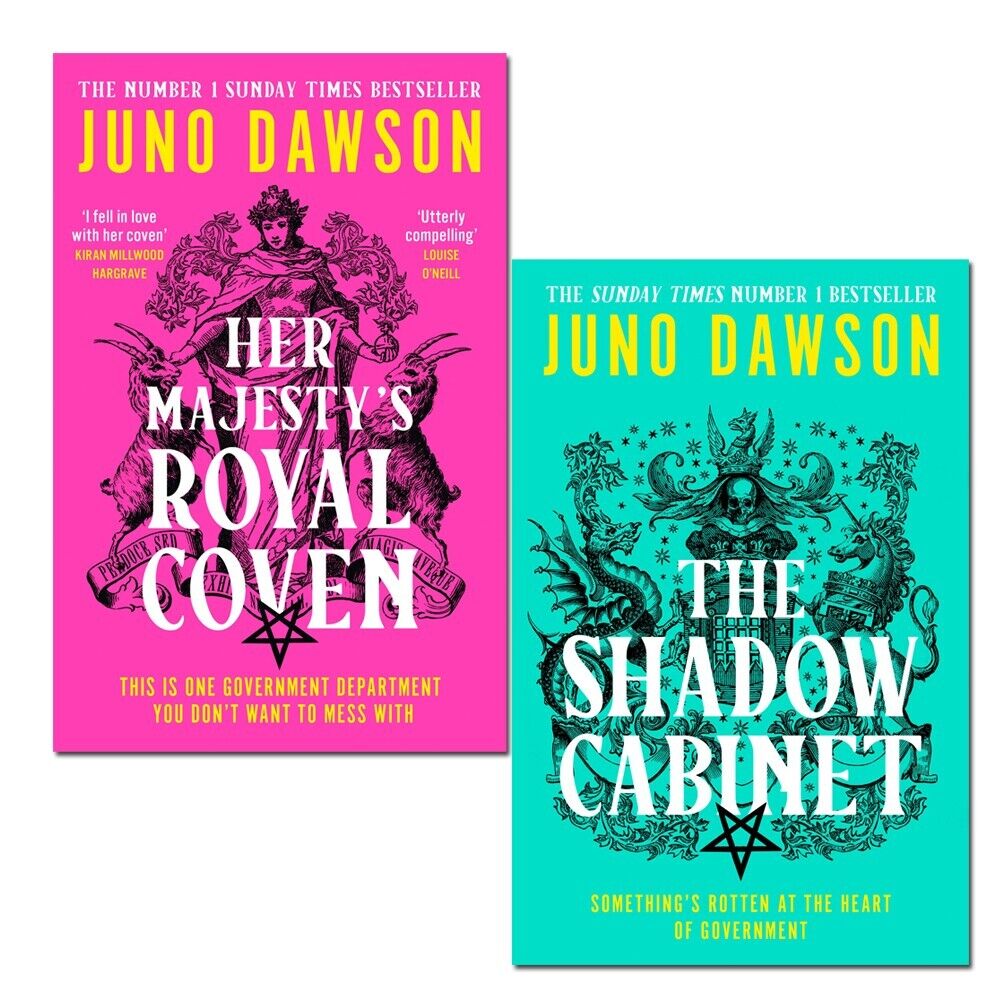
I was so looking foward to Juno Dawson’s Her Majesty’s Royal Coven. Modern witchcraft set in Hebden Bridge, which came highly recommended by both a friend whose taste I trust and the local bookstore that sold it to me? What could be better as escapist reading? In fact, I anticipated enjoying it so much that I bought the sequel before I even started the first volume and savoured my anticipation of losing myself in the West Yorkshire equivalent of Deborah Harkness’s All Souls series (recommened by another friend whose taste I trust and which I enjoy enormously).

So it is with great regret that I must inform you that Her Majesty’s Secret Coven is the lastest of my very rare ‘did not finishes’, and this was after I got over 150 pages in. Usually if I make it past page 50, I will keep going with a book, even if only out of pure bloody-mindedness. This, however, felt like too much of a slog. The characterisation was remarkably flat, particularly of the women who were portrayed as archetypes rather than indivuals. Given that this is a story predominantly about women, with a plot centring on female identity, this is a serious problem, one reinforced by a confusing plot with gaping holes in it. I spent most of the time struggling to understand what was happening or why characters were choosing to act in the ways described.

But the biggest disappointment was the aspect I had been anticipating most eagerly – the setting. As a Hebden Bridge resident, I freely admit to being an ‘offcumbden’. But the town and its surrounding villages have a unique enough personality for me to feel, even after only seven years of residence, that I know them at least a little bit. And they are definitely not the town depicted in this book. Yes, they form a small pocket of liberalism, not to say radicalism, enfolded by the Calder Valley in the more generally conservative rural West Yorkshire. And yes, the 1960s hippie vibe which is central to the town’s identity is being diluted by an influx of the professional middle classes (of which I freely admit to being one). Sitting halfway between Leeds and Manchester, even the vaguaries of Northern Rail cannot detract from the attraction of the town to commuters. But for all that, Hebden Bridge is still very much Happy Valley, not Nappy Valley. I don’t recall ever meeting a yummy mummy, as asserted in one description of a local café, and this is after five years of schoolgate attendance. Dawson appears to see Hebden Bridge as a version of Brighton in the north, which it is not. It is its own distinct place, with its own unique, often contradictory, always fascinating character, one which Dawson fails to capture.

The geography also doesn’t make sense. The book is full of descriptions of characters’ homes, but I was unable to locate any of them in my mental map of the area. The actual map that forms the frontispiece is no help, drawing as it does on the imagery of maps in fantasy novels. By the time I gave up, I found I was lost, not in the story but rather in confusion. I kept longing to find my way back tot he real world, rather than continue to make my way through a fantastical vision of the placy I call home, peopled by unreal phantasms, not people with recognisable conflicts and motivations. My recommendation is, if you want to discover the complex magic of Hebden Bridge through fiction, try the work of Sally Wainright rather than Juno Dawson. Happy Valley is on iPlayer and Riot Girls is due for broadcast this year. Or better yet, come visit, and experience this darkly enchanting place for yourself.

Catching Up

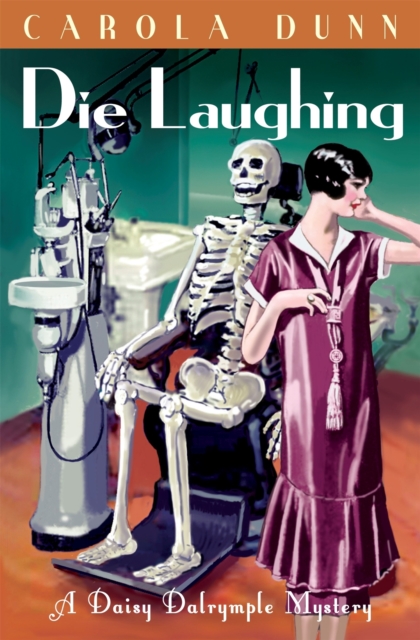
Carola Dunn, Die Laughing, 2003

Louise Penny, The Long Way Home, 2014

Louise Penny, Kingdom of the Blind, 2018

After several months (indeed years) of accumulation, over the summer I decided to make one of my periodic concerted efforts at putting a dent in my to-be-read shelf, which then stood at thirty-five books and counting. I started with wth collection of second-hand books from part way through various contemporary series that that have been recommended to me but which I have been motivated to buy unless I came across a used copy. I haven’t been entirely successful in completing this endeavour (a volumen of Sulari Gentil’s Rowland Sinclair mysteries is next on my list), but I did manage a couple of volumes from Louise Penny’s Armand Garmache series and a Daisy Dalrymple mystery by Carola Dunn.

The Dunn series is one that has been hovering at the edge of my consciousness for a number of years now. When I was reading my way through Frances Brodie’s Kate Shackleton series and Jacqueline Winspear’s Maisie Dobbs series (recommended to me by the late, great Dennis Showalter, who knew whereof he spoke), Daisy Dalrymple regularly popped up in my on-line recommendations. So it was with interest, although not necessarily great expectations, that I started Die Laughing, the tenth book in the series. Unfortunately, these expectations were definitely not exceeded. One of the blurbs on my copy states that the book is ‘For lovers of Dorothy L. Sayers’, but like so many so-called ‘cosy’ crime novels with a British interwar setting, the only Sayers-like attribute that the book has is the fact that the detective (or at least one of them) is an aristocrat (although we are told multiple times that her title is ‘only’ an honorary one).

The problem is that the novel doesn’t work as either a classic detective novel, with a focus on the puzzle element, or as the sort of social reflection that makes Sayers (and many of the other classic queens of Golden Age detective fiction) such good source material for the social historian. By splitting the detective work between an amateur who doesn’t really want to be detecting and her professional husband and his team, the novel rejects the structural formality of classic detective fiction storytelling. Sherlock Holmes explaining his reasoning to Watson and Japp or Poirot collecting the suspects in the drawing room for the unveiling of the criminal may be the stuff of cliché, but such scenes work to construct a narrative with tension by making the unravelling the work of a single intelligence. Even where the sidekick or professional assistant makes as great a contribution to that unravelling as the detective, the sharing of information needs to be integral to both the plot and laying the evidence before the reader. For a masterclass in the approach, you only have to look at the conversations between Peter and Harriet in Have His Carcase (1932), which are used to convey any facts gathered separately as well as interpret them as part of the satisfying working out of the mystery. Not so in the world of Daisy Dalrymple and Alec Fletcher where each undertakes their own investigations and the sharing of clues is perfunctory, with little reference to either the plot or the character developments

So much for the structural form of the detective story. What about the novel as a reflection of society in the interwar period? Dunn has clearly done a certain amount of research into the period, but her representation of class is clumsy to the point of farce. The middle classes are almost uniformly snobbish and racist, with the exception of Daisy’s two female friends, who are only distinguishable from each other by the fact that one is Indian (and therefore the victim of racist prejudice). The working-class characters are distinguishable by their entirely generic vernacular, with a Scots policeman apparently speaking in almost exactly the same way as a Cockney charwoman. The theme of the ‘servant problem’ is shoe-horned into the book, with little relevance to the central crime or its investigation, and drawing on debates from the late nineteenth century, rather than those being articulated in 1924. The result is that, while the reader is told multiple times that the war changed class relationships, but we are never effectively shown this. I finally lost patience with the representation of a character, introduced to late in the book to be fully fleshed out, as a Second World War-style spiv, whose service with the Army Service Corps was used as shorthand for his not having served overseas during the war. Given the the extensive work of men of this unit as motor ambulance and lorry drivers on all fighting fronts, this misrepresentation smacked, like far too much else in this book, of superficial research and lazy historical cliché.

So I will not be seeking out any more of the Dalrymple series. I am, however, more ambivalent about Penny’s Gamache series, although I can’t say I was overly enamoured of either of the two volumes I read. I know many people love this but, like Elly Griffith’s equally loved Ruth Galloway series, I found the tone too knowingly whimsical for my taste. These series are, apparently, part of a genre now marketed as ‘character-led’ mysteries (presumably as opposed to action-led thrillers) but, for me, the characters were oddly flat. The reader is told, over and over, who these people are, and even what they are thinking, but this is rarely matched by them then acting in psychologically convincing ways. The criminal in one of the stories barely registers as a character in their own right, and certainly not as the magnetic character that we are informed they are. There is also a dissonance in tone between, for instance, constant references to an aged, sweary, alcoholic poet who keeps a pet duck and is loved (inexplicably) by her neighbours, and plotlines around the distribution of carfentenil and its brutalising effects on the homeless population of Montreal, that is jarring to say the least.

Penny’s writing is good enough to make me mildly curious about how she introduced her recurring characters in the first novel in the series, Still Life (2005). However, I can’t say I feel compelled to read any more, certainly not at the moment when unregulated holiday browsing in second-hand bookshops has my to-be-read shelf to closer to forty volumes. I am glad that I finally gave these popular series a go, but equally glad that neither captured me to the extent that I will now be adding any more of their work to that shelf.

The breaking year

This end-of-year reflection was originally going to be titled ‘The Half-finished Year’, a reference not only to my ever-expanding folder of started but unfinished blog posts and the 2500 words of my next book, but also the two sweaters and three quilts that I am currently working on, as well as the unpainted front hallway and bathtub sitting in the living room that await attention when I get home. But, as I sit in a hotel room in Italy with my leg in a brace while the rest of my family is out skiing, I have come to realise that the reason that this year has been shaped so profoundly by the unfinished is because of the time that ill health has taken from me.

The year started with a minor but mortifying facial disfigurement in the form of a failed dental implant. It is ending in a broken ACL, the aforementioned brace, and uncertainty about how long recovery will take and what it will mean for all the activities and projects I have planned so far for the coming year. In between came multiple trips to the dentist, the doctor and the hospital, diagnosis of three conditions, two chronic, one temporary, the consequent prescriptions (including two attempts for the chronic conditions which resulted in distressing and painful side effects) and more blood tests than I would wish on my worst enemy.

Through all of this, I have not taken time off of work. I have continued my roles as wife and monther and have kept reassuring friends and family that I am fine, or at least managing. And in many ways I am lucky. The dental work has provided me with a successful prosthetic for the lost tooth. The three of the four medications I am taking are preventative rather than therapeutic. None of the conditions I suffer are life threatening. And while my current physical impairment is disabling, it is also temporary, even if rehabilitation is going to be counted in months at minimum, not weeks as I might wish. As someone who both works in the fields of disability and medical history, and has lived through the terminal illnesses of both parents, I know how fortunate I am that my various forms of ill health are identifiable, relatively painless and highly treatable, and that I live in a country and society where I have ready access to the care and treatment I need, as well as a support network of family and friends.

But while resilience may be an admirable quality in some ways, not least in providing a sense of continuity which is itself therapeutic, it cannot be a permanent state of being, as any old rubber band will show. Something, somewhere had to give in this year that has done its best to break me, physically and psychologically. It may not have succeeded entirely, but it does seem to have robbed me of significant amounts of time and, with it, my ability to complete projects, particularly those related to writing.

Which is not to say that this hasn’t been a year of progress in some ways. Indeed, I am managing, with this post, to publish more than one post for this blog this year, an improvement on my output for 2022. I now have a very clear idea of both the shape and content of my next book, although the form will require the sort of concentrated writing time that I definitely haven’t had this year and probably won’t in the coming year. I will even have new publications in the new year, in the form of a book chapter which fell victim to Covid delays and at least one book review. And I have managed to steek a cardigan for the first time, a terrifying technique in knitting that involves taking scissors to a piece of work knitted in the round to create an opening.

These achievements, small as they are, remind me that, unlike an old rubber band, I may be damaged but I am not yet broken. But, as I enter the new year in a damaged state, I do so with the knowledge that I cannot simply bounce back to a state of full productivity, as much as I might wish to do so. I need time and space both to heal what has broken this year and, when I am strong enough, to give my many unfinished projects the attention they deserve. So I will start this new year not with resolutions but with the hope that I will be able to find or make the time and space for convalescence and recuperation and with them the ability and courage complete some, if not all, of my half-finished projects.

I wish you all a healthy, contented and hope-fulfilled new year.

This was the year

This was the year that I was going to write every day. Just a little, to get into the habit. I failed (as this blog provides clear evidence). In fact, I have written less this year, either for work or my own amusement, than ever before. No, I do not count emails. I end the year continuing to battle what feels like ever-growing writer’s block, an unfinished article mocking me from my drafts file, while my book tantalizes me with exciting ideas that I never manage to get down on paper. I keep reminding myself that the excitement is worth the struggle – to make the time, to think hard, to find the order of words that satisfies. Maybe in the coming year I will find a way to make such reminders a reality.

This was the year I was going to run a bit further than I ran last year. Just a little, maintaining the distance I had achieved over a few more days. I failed, running just over half the distance I covered in 2021. I try to excuse myself by pointing out that I caught Covid, rapidly followed by a truly dreadful non-Covid cold. But it is an excuse; my distance was well down on the previous year by the point I fell ill. A combination of the ridiculous summer temperatures, a return to travel which saw me attend two conferences overseas and visit my family in the US three times and an insanely busy autumn term all conspired to throw me off course. All I can do is try again next year.

This was the year I achieved a significant professional milestone and have come the closest I have ever been to simply walking away from my job. The academic environment is increasingly unpleasant to work in, with the space for the aspects of the job that I love (the research, the writing) ever more squeezed by demands of bureaucracy which take no account of disciplinary norms or the level of expertise that academics bring to the job. For the moment, I am committed to my students, my colleagues, my collaborators. But I am coming to recognize that this is unsustainable for me personally and I need to find an exit strategy in the near-to-medium, rather than the distant future.

This was the year that I swam – in the North Sea, off the south coast, in rivers in Colorado and the Lake District. I swam with friends, with family, on my own. Each swim brought me a moment of solace missing from the rest of my year. I will write about them soon.

This was the year that I read less than I hoped, but what I did read was, more often than not, what I needed. Two series in particular – Sarah Moss’s trilogy of Night Waking, Bodies of Light and Sign for Lost Children, and Ali Smith’s Seasonal Quartet – spoke to me in the moment that I read them in ways they could have done at no other point in my life. My only sadness is not to have been able to share the joy of Smith’s novels with my mother, a Dickens scholar. She would have loved them. With a to-be-read shelf now topping the 30-book mark, I am determined to make more time for reading. Of all my identities, I have been a reader longest, something I perhaps forgot at points this year. I will try to remember it in the coming year.

This was the year I found the greatest joy in making and creating. Most of my projects are yet to be finished. The quilt for my niece, pieced together at a rate of 10 patchwork blocks a month still remains without its five borders, backing or sashing. A cardigan I have been working on for myself continues to grow but slowly towards the neck and the terrifying challenge of steeking. But I won first prize for both my bread and my marmalade at the village fete this year, undoubtedly my proudest achievement of the 12 months. I will continue to make time for this work in the coming year.

This has been an odd, confusing year of extremes, of weather, of emotion, of accomplishment. I end the year in as hard a place as I have ever been, but there is promise for the future. I do not know what sort of year next year will be. I can only hope there will be more writing, more running, more swimming, more reading, more making.

Wishing you and yours a happy and healthy new year.

1917 and All That

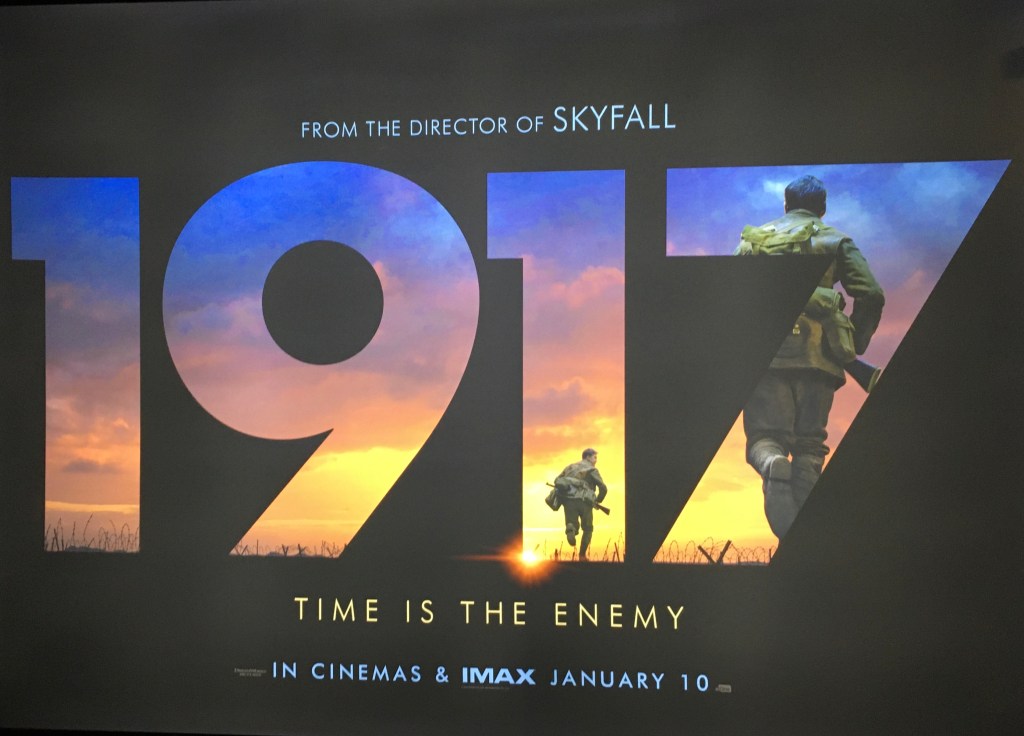
After a week of reading (and commenting on) reviews of 1917, I have finally had a chance to see it. And yes, it is good, very good. Not perfect, but very good indeed.

*Spoiler alert hereon in*

So, what works? The device of the ‘single continuous shot’ (which isn’t actually) is engaging and hugely propulsive, linking and driving the different episodes of the narrative to gripping effect. The depiction of landscape is visually impressive, particularly in its range and variety. The narrative allows for movement through a huge range of different spaces, each of which is beautifully evoked. In particular, the two transitions from the area behind the lines into the trenches, with the communication trenches rising organically from the land, are incredibly moving, while the nighttime scenes of Écoust lit by flares are, quite simply, works of art.

Some of the incidental (and not so incidental) details are lovely, and attest to the level of research undertaken. The ubiquity and size of rats, the visceral horror of crawling over the bloated bodies of the drowned, men’s ability to sleep where they drop, the importance of rumour as the way in which soldiers understood their situation, the humour they employed to wile away time, are all evocative, effective images and references which give the film a sense of emotional authenticity.

Many of secondary characterisations are also beautifully done. Impressively, while all are brief, almost none are black-and-white. Even the Germans are shown as humans with agency, neither solely evil nor solely victims. Of the recognisable cameos, while both Mark Strong and Benedict Cumberbatch are very good (the latter in particular capturing once again something ellusive about the paradoxical nature of British martial masculinity in the period), Andrew Scott’s turn as a lieutenant awaiting his relief after a long night in the lines, stands out as pure Journey’s End.

And that characterization is important for understanding what makes this film such a good film about the First World War. Because its basis is not in the history of the war, but rather in the history of its cultural representation. Yes, the script writers have read soldiers’ memoirs (and possibly also letters and diaries) as well as, I suspect, more historical analysis than they have admitted to. Yes, the costume and set designers have consulted with all the right historical consultants. But the film makers as a whole have also clearly been influenced by the films, fiction and poetry that have so profoundly shaped our understandings of the war over the past century. So, in addition to Journey’s End (1928), we get references to the visual trope of going over the top that has defined First World War films since The Battle of the Somme (1916), to the unheimlich of Wilfred Owen’s ‘Strange Meeting’ (1918), and to the final dramatic scene of Peter Weir’s Gallipoli (1981). This is a film as much about, and as rooted in, the artistic interpretation of the war as it is the war itself.

This positioning of the film does not detracted from its quality as a work of cinematic art in itself. But it does help to explain some of the problems with it, because it is not a perfect film. Yes, there are inconsistencies and inaccuracies of detail which, for someone with a deep familiarity with the war and its history, can have the effect of breaking into any suspension of disbelief. As a historian of medicine and the war, while I cheered the use of first field dressings, both to bind wounds and staunch blood, I was always going to notice the continuity error where a bandage disappears and then reappears, complete with a hastily tied knot that apparently managed to survive some pretty extreme activities. (I’m not sure what it is with continuity editors and First World War hand wounds, but referencing the disappearance and reappearance of Thomas’s hand wound in Downton Abbey was probably not the the effect they were aiming for.) And having a man put his wounded hand into a corpse without any reference to the heightened risk of infection (even when he ends up at a medical unit a day later) feels like a wasted opportunity for an otherwise striking historical detail.

As for the final scenes, while it nice to see so many stretcher bearers (not orderlies, as per the script), both regimental and RAMC, represented, did they really all have to be two to a stretcher with no harnesses? Bearer units were four to a stretcher for reasons. Equally, their negotiation of the trenches rather defies belief, particularly in the year when the British Medical Journal was publishing articles about the difficulties bearers faced in moving standard stretchers around the corners of trenches. Oh, and that medical unit? It is a dressing station, not a Casualty Clearing Station (CCS), as claimed by Major Hepburn.

Are these niggly little details which won’t affect the viewing enjoyment of those who haven’t spent nearly ten years researching the history of British medical care provision in the war? Yes, of course they are. Even as they affected my ability to suspend my disbelief, they didn’t detract from my enjoyment of the film as a film. And, if nothing else, they have given me a very good argument to present to a publisher of the need for a good accessible history on this subject. But they are not the only, or even the main reason why I call this a very good but not a great film, although the classification of a dressing station as a CCS is symptomatic of the wider problem.

That wider problem, bluntly, is the necessity for films to compress historic realities. There isn’t the time for the film to portray the slog of several hours, over relays between multiple dressing stations, that was the reality of evacuation to a CCS. So dressing stations, and the work of Field Ambulance bearers and orderlies disappear, with space and time collapsed to represent an over-simplified image of the medical evacuation process.

As I say, this won’t be a problem for the vast majority of viewers, but it isn’t a narrative issue limited to medical evacuations. Unfortunately, it also effects the relationship between the two central characters in ways that are confusing and ultimately problematic for the film itself. On the one hand, Blake and Schofield are part of the same regiment, comrades in arms under the authority of the same chain of command from their sergeant on up. They know each other and they know (a bit) about each other. On the other hand, their partnership is presented as accidental, a result of proximity as much as of intimacy. This allows their backstory to be told through their conversation, which is a useful dramatic device, but it robs the relationship of any sense of the intimacy that developed between men who shared lives in the trenches. [1] The result of this apparent lack of connection between the characters is that it undermines the emotional connection forged with the audience. Ultimately, I found myself unmoved either by Blake’s death or Schofield’s contemplation of his family photographs. The importance of these men as individuals, with emotional lives beyond their immediate surroundings, was never developed enough for me to care about them as anything other than carriers of the film’s driving adventure narrative.

This, of course, is a key difference between the time-limited fictional representation of a film and a historian’s engagement with the historical sources which underpin. Reading a collection of letters or a diary covering months and years of war can demonstrate the development of a man’s (or woman’s) character over time, but it can, at times, be incredibly dull. Much of war is extremely boring, and that is reflected in the source material. Most men who served in the war were not great stylists. Their diaries and even many of their letters home are filled with in jokes, family gossip relating to unknown individuals and endless quotidian details about what they had for dinner or how cold the weather is. Films, particularly commercial films, cannot afford to be boring in this way, and 1917 is anything but boring. The compression of the narrative into just under two hours means that choices have to be made, and in this case the choice was made to flatten characterisations for the sake of narrative propulsion. It is, I think, a valid artistic choice in this case, but it has to be acknowledged as that, an artistic choice about how to represent the war. The history, and the men who made it, are inevitably more complex and complicated than any single film can capture.

So, a very, very good film rather than a great one and one which tells us more about the way in which we remember the war than about the war itself. However, as well as enjoying the film, I remain fascinated by the way in which it is being used by reviewers to project their own ideas about the history and meaning of the war, with The Guardian characteristically identifying it a pacifist film (it isn’t) and Variety locating firmly in the history of Hollywood films. And I think it has a great deal to say about the way in which our reading of the war has evolved over time, not least over the course of the centenary period. In fact, I would suggest that this film marks a good moment for Dan Todman to update The Great War: Myth and Memory (2005) to include another generation’s worth of interpretations of the war.

So, as a historian and teacher of history, would I recommend 1917 to students of the history of the war? Only in conjunction with primary sources to illuminate and deepen understanding of its representation. Would I use it as a source for teaching the history of the memory of the war and its cultural representation in Britain? In a heartbeat. It has earned its place in the canon of great Great War fictions.

[1] Joanna Bourke, Dismembering the Male: Men’s Bodies, Britain and the Great War (London: Reaktion Books, 1996), Chapter 3.

Beginnings and Endings

Just over five years ago, I posted the first post on this blog, beginning what I thought would be a process of recording the researching and writing of a book about the men of the Royal Army Medical Corps in the First World War. Just under two weeks ago, I submitted the completed manuscript to the publisher, on the final day the university was open this calendar year. It was a climax, a culmination. But it wasn’t an ending.

There are several reasons why I say this with some confidence, about both the book and this blog. As far at the book is concerned, there is still a great deal left to do – permissions to be sought, images to be sourced, indexes to be completed – and the manuscript itself is to be sent to yet another reader. And this blog has, in the past five years, wandered into all sorts of byways unrelated to the project it was set up to chronicle.  In spite of my neglect of it over the past few months as I’ve concentrated on finishing the manuscript, it remains an important outlet for me, and I will continue to use it to chronicle the ups and downs of academic life, my new research project, my eternal struggle to create an acceptable work/life and, inevitable, a range of thoughts and responses the commemoration and memory of the First World War in British culture.

Yet, while this has been a moment of transition rather than ending, there have been points of ending and new beginnings along the way. The direct funding for this project ended two years ago. In its place, I’ve started on new (related) research , as well as gaining two new job titles. Intellectually and personally life has interwoven, overlapped, bled into itself.

Which, particularly at this time of year, doesn’t stop me looking for tidy endings and new beginnings. Even as I am aware of the chaos of books all over the floor that awaits my return to the office, along with all the projects I’ve been putting off for the past three months, I am also hoping that having given myself permission not to work for two weeks over the holiday period will give me the energy to start if not anew in January, then at least afresh.  There is the blog post I’ve been meaning to write since the summer which, with space from other deadlines, I hope to finally complete; there is the pile of books I’ve been collecting, looking for the time and space to engage with them properly.

There will, I hope, be more, and more definite endings in the coming year, with the final completion of the book. There will also, I anticipate, be beginnings – of ideas, projects, collaborations – as well as the new beginning marked by moving to a new home in the spring. All have looking forward to the near future in ways that hasn’t been true for the past couple of years.

So, at this turning of the year, I wish you all successful endings and hopeful beginnings for the new year.

Happy new year, one and all.


What I do

Over the summer I wrote a piece sort of in response to the furore surround Andrew Adonis’s attack on higher education. I returned to it this morning, after this weekend’s renewed attacks in the wake of the National Audit Office’s report on the supposed ‘lack of value’ in the higher education ‘market’. Based on what I have read and heard, in the print media, on Twitter and on national radio, I am starting to wonder, however, if it is not so much that academics aren’t very good at explaining what it is they do, as that those who enjoy pontificating on the subject don’t want to listen. Radio 4’s Today programme, for instance, managed to interview one lecturer that I heard in the entire course of a 3-hour programme focussed on the subject (a second presented Thought for the Day). Sonia Sodha’s dismissive response to Peter Mandler on Twitter is sadly symptomatic of this attitude.

Anyway, I’m sure Lord Adonis, Ms Sodha, Jo Johnson, Jeremy Vine and the editors of the Today Programme are far to busy to read what I wrote, just as I am rather too busy to repeat myself in another blog, but here it is again for anyone who might be wondering why academics are quite so angry about the implication that they have enough time to properly teach two- rather than three-year degrees. Now, if you will forgive me, I have work to do today (numbers 1, 4, 8 and 9, if you are wondering).

Jessica's avatararmsandthemedicalman

This isn’t going to be a response to the recent Andrew Adonis discussions, at least not directly.  I’ve put in my direct tuppence ‘orth on Twitter already. It is, however, going to be a response to one of the more obscure byways that the discussion trickled into over the course of the day arising out of two comments. The first, from an academic, pointed out that academics really aren’t very good at communicating what it is we actually do. Listing all the jobs we have to do in a way that can give an impression of competitive business, yes; actually communicating to non-academics what our job entails, not so much. Which was reinforced by the second, from an anonymous Twitter user who, agreeing with Adonis’s argument about the laziness and unproductiveness of academics who don’t teach during the summer, stated that academics had never done a ‘real job’.

So the…

View original post 1,256 more words

Bread and Roses

As I have said previously, poetry is currently serving as a huge source of solace and consolation, something that I feel very much in need of at this moment. But it is also enabling me to articulate my anger and defiance, particularly the two poems that follow, which have been reminding me that, whatever the next four years may bring, I am proud to be a woman, a scholar and an American.

As we come marching, marching in the beauty of the day,
A million darkened kitchens, a thousand mill lofts gray,
Are touched with all the radiance that a sudden sun discloses,
For the people hear us singing: “Bread and roses! Bread and roses!”

As we come marching, marching, we battle too for men,
For they are women’s children, and we mother them again.
Our lives shall not be sweated from birth until life closes;
Hearts starve as well as bodies; give us bread, but give us roses!

As we come marching, marching, unnumbered women dead
Go crying through our singing their ancient song of bread.
Small art and love and beauty their drudging spirits knew.
Yes, it is bread we fight for — but we fight for roses, too!

As we come marching, marching, we bring the greater days.
The rising of the women means the rising of the race.
No more the drudge and idler — ten that toil where one reposes,
But a sharing of life’s glories: Bread and roses! Bread and roses!

James Oppenheim, 1911

Still I Rise – Maya Angelou

We march on – and still we rise.

Bearing Witness

*Spoiler alert throughout*

I hadn’t intended to write this post. I have been making a very conscious effort this holiday not to do any work until today anyway, and I was planning (still am, I hope) a short post reflecting on the labours of the past year and the promises of the new one, to be written tomorrow.

But then last night, while watching the BBC’s flagship Christmas drama, The Witness for the Prosecution, as a double bill on catch up, I found my husband attempting to soothe me as I harrumphed in irritation at the First World War backstories supplied to both the Voles and John Mayhew.  Having tweeted indignantly and non-specifically about it, I feel it behooves me to explain why in more detail.

To start with, I should say that the production as a whole was beautifully shot and acted extremely well by its stellar cast. It is hard to go wrong with Andrea Riseborough or Toby Jones, and they were, as expected, exceptional.  I wasn’t so keen on the adaptation which, padded out to fill a full two hours felt baggy and lacking in tension.  Was the whole twist involving the cat (very much not part of the original) necessary or even credible?  Given the amount of time which passes between the murder and the discovery of the cat’s body, surely it wouldn’t be in such an uncorrupted state?  But that is, perhaps, a minor criticism.  The bones of Christie’s original plot were maintained, even if the twist she wrote had less impact after nearly two hours than it did in the compact half hour dramatisation that was my introduction to this story.

So I could live with this production of a classic mystery drama, with all its updated bad language and sex scenes.  It was with the First World War back stories that I found I could no longer sustain my suspension of disbelief.  To start with the second, that of the solicitor, John Mayhew, whose poor health and blood-spattered coughing underscore almost every scene he appears in.  The cough, we are told, is the result of being gassed in the war, in which he lost his son, age 17, also to gas.  In the final scenes of the drama we are informed that Mayhew lied about his son’s age in order that they could enlist together and his motivation throughout the play is ascribe to the guilt he feels that he came back while his son did not, thereby destroying his wife’s love for him.

This narrative is physiogologically unlikely, but perhaps not impossible, although Toby Jones as Mayhew looks old enough to have had lie about his own age to have been accepted for service before 1916 (when the dual enlistments must have happened if the two men ‘volunteered’ together. His eyesight, given his spectacles, would have made doing so when overages particularly difficult.)  Equally unlikely would be for them to be serving in the same unit, causing them both to become casualties of the same gas attack (as is strongly implied).  Mayhew’s son apparently learned about motor vehicles during the war, which would suggest a posting either to the Army Service Corps or the Tank Corps to me.  It is just possible that Mayhew Senior would be assigned to the ASC which, as a non-combatant unit, might take volunteers with impairments that disqualified them from combatant duties.  Even so, the chances of father and son ending up in the same unit seem slim.  Psychologically, however, this story seems nigh on impossible.  Fathers certainly supported and even encouraged their sons’ decisions to enlist, may have in some cases turned a blind eye to a teenager lying about his age, and there are examples of fathers and sons both serving, as Laura Ugolini [1] has shown, but the idea of a father supporting his son to the extent of both lying about his age and enlisting alongside him assumes a level of war enthusiasm that has been effectively undermined by historians such as Catrionna Pennell and Adrian Gregory [2].

So Mayhew’s back story is unlikely in the extreme, calling into question the attribution of his motivation to old man’s guilt, as in Owen’s Parable of the Old Man and the Young, over the loss of his son and his son’s generation.  By forcing Mayhew into the role of both guilty old man and, apparently, a witness to war, a ‘man who was there’ [3], the story ensures that he is incapable of properly representing either.

Which brings me to the second backstory, that of the Voles who, in the opening scenes of both episodes, are shown meeting in a bombed-out trench during the war, before walking hand-in-hand across a shell-pitted landscape oddly denuded of any individuals, given that this was apparently the scene of a major battle. For the military historian, this is a frustrating piece of representation.  Setting aside the question of what the hell Romaine as a woman was doing on the battlefield in the first place, somewhere that military authorities on both sides went to great lengths to ensure did not occur, the recurrent emptiness of no-man’s-land is an extremely irritating trope of contemporary televisual dramas.  Even if the battle itself was over, and night had not fallen, in which case Leonard and Romaine would have been fair game for snipers, there would still be wounded men around, as well as corpses, human and otherwise.  Desolate here does not mean empty, but presumably the scene is meant to be symbolic, as much as literal.

I hazard this suggestion on the basis of the final scene in which Leonard and Romaine appear, as they pursue Mayhew down the corridor of a luxury hotel, taunting him with their brutal success.  ‘We are what happens when you butcher the young’ says Romaine, following up her husband’s dismissal of Emily French’s murder ‘just one more life after so many’.  And it was at this point that my husband had to stop me from yelling something very rude at the television screen, because this interpretation of Christie’s story, and the relationship of the whole genre of Golden Age detective fiction to the war, is just plain wrong.  Yes, this narrative of disillusionment existed in contemporary modern novels, the ‘war books’ of the 1920s boom.  But as Rosa Maria Bracco and Alison Light have both shown [4], it was not the narrative of genre fiction, including detective fiction.

In fact, the relationship between interwar detective fiction and the war is a complex one, but the idea that the war brutalised society to the extent of making murder acceptable is, in fact, the very antithesis of the message the genre holds.  There are remarkably few interwar murderers (although rather more murder suspects) who are explicitly ex-servicemen or whose motives can be traced back to wartime experiences.  More common, indeed, are ex-service detectives (some, but not all, attempting to assuage their guilt a la Mayhew), the very people whose role in such fiction is to reassert the social order by bringing the murderer to justice.  War, like murder, may disrupt society in these narratives but in the case of murder, social order reasserts itself; civilisation and society are restored, not distorted.

The significance of this reading can, in fact, be seen in Christie’s own treatment of The Witness for the Prosecution, which she rewrote to ensure that Leonard does not get away with murder.  In this second version, Romaine stabs him as he is about to leave her for his lover, Christine.  The Law in this story remains an ass, but justice, in the classical sense, is served and Emily French’s death avenged.  No life, in interwar detective fiction, is ‘just one more death after so many’.  It isn’t until post-Second World War detective fiction (such as Marjory Allingham’s Tiger in the Smoke and Ellis Peter’s The Funeral of Figaro) that we start to see the war-brutalised ex-serviceman emerge as a hardened criminal.  By attempting to attach this narrative to the First World War, the adaptors of The Witness for the Prosecution do a disservice to both the ex-servicemen of the First World War whose main aim was to reintegrate themselves into civilian society in spite of the trauma they had suffered, and to the writers of detective fiction in the interwar years who sought, through their fictions, to make it easier for them to do so.

References:

NB: As I am not in the office, I don’t have all the notes to hand for full references for this.

[1] Laura Ugolini, Civvies: Middle-class Men on the English Home Front, 1914-1918 (Manchester University Press, 2013).

[2] Catriona Pennell, A Kingdom United: Popular Responses to the Outbreak of the First World War in Britain and Ireland (Oxford University Press, 2014); Adrian Gregory, The Last Great War: British Society and the First World War (Cambridge University Press, 2008).

[3] Samuel Hynes, The Soldiers’ Tale: Bearing Witness to Modern War (Allen Lane, 1997).

[4] Rosa Maria Bracco, Merchants of Hope: British Middlebrow Writers and the First World War, 1919-1939 (Bloomsbury, 1993); Alison Light, Forever England: Feminity, Literature and Conservatism Between the Wars (Routledge, 1991).

Who Cares? Call for Papers

Next March the Health, Medicine and Society and Women, Gender and Sexuality research clusters in the School of History at the University of Leeds will be jointly running a conference on histories of care.  There will be a conference website in due course, but as this is taking some time to set up properly, I am posting the Call for Papers here as well.

Who cares?: The Past and Present of Caring

Monday 27th – Tuesday 28th March, 2017

School of History

University of Leeds

A collaboration between the Women, Gender and Sexuality, and the Health, Medicine and Society research clusters.

Call for Papers

Deadline for Abstracts: 13th January 2017


At all stages of life, people give and receive care. Rapidly changing demographics are affecting the dynamics of care, and now more than ever, gender-based expectations of caregiving in history are being called into question. A growing emphasis on personal well-being denotes a generation that is complicating traditional notions of care.

The way care has been understood and delivered has developed across time.  Approaches to care have historically been and continue to be changed and challenged by spatial, temporal, and socio-political boundaries. This conference seeks to shed light on care within communities and across borders, exploring changes in its perception throughout history and how it intersects with different ages, cultures, and identities.

Our keynote speaker will be Professor Holly Furneaux, Cardiff University, author of Military Men of Feeling: Masculinity, Emotion and Tactility in the Crimean War (OUP, 2016).

The conference will also include a half-day workshop exploring issues associated with care in academic institutions. Through a discussion of parenthood, experiences of supporting family members, and mental health, this workshop will provide a space to explore how researchers at all stages of their academic careers care for themselves and for others. This session aims to highlight difficulties currently experienced within higher education, and identify workable ways the academe can help to ensure personal well-being, and further support staff and students in their varied roles as carers.

Submissions are now invited for 20-minute papers on subjects which may include but are not limited to:


–       Varieties of medical care

–       Gender and caregiving

–       Self-care and mental health

–       Care in the military

–       Care and the family

–       Care and the life cycle

–       End of life care

–       Care and the non-human

–       Care and marginalised communities

–       The economies of care

–       The politics of care

–       Critical care


We particularly welcome proposals from postgraduate and early career researchers.

Submission guidelines

Abstracts must be no longer than 250 words for 20-minute papers.

Please send abstracts to hisccon@leeds.ac.uk no later than 13th January 2017. Please ensure abstracts contain your name and institutional affiliation (if any).

Any general enquiries may be sent to hisccon@leeds.ac.uk