An importunate post

A little unusually, I am writing this post not as a wife, mother or historian, but rather as a daughter.

Last year I wrote a post about the medical issues facing members of my family in which I did not identify the actual people involved or their relationship to me.  Since then, things have moved on and I now feel it is right to make public the fact that two of the three people mentioned in that post are, in fact, my parents.  My father suffers from Frontotemporal Dementia (FTD), with a number of related and exacerbated physical conditions.  My mother recently found out that the ampullary cancer for which she received treatment for most of last year has returned to her lungs.  These illnesses are very different but share two similarities: 1) they are rare (in my mother’s case extremely rare) forms of wider conditions (dementia and cancer respectively and 2) while they can be controlled to a greater or lesser extent, neither is now curable.

So why go public now?  Because in this post I am asking for your help.  In this difficult period, where these illnesses, and my distance from my parents who both live in the US, have added to a number of other stresses affecting my life, one of the few things that have kept me sane is running.  I started running seriously two years ago.  Last year I ran the Leeds 10k to prove to myself that I could do it.  This year I am running the Leeds Half Marathon in aid of Cancer Research UK and Alzheimer’s Research UK.  While there is nothing that can be done at this stage to cure either of my parents, I hope the money I raise for research will, in some small way, contribute to better understanding and treatments to alleviate these devastating conditions.  Turning the relative calm I have found in my morning runs to practical purpose is the very least I can do in the circumstances.

I know we all have many claims on our purses, and many calls from charities for support.  If you can spare even a very little to support my fundraising efforts by clicking on the link below, I will be enormously grateful.

Thank you.

JESSICA DAWS’S FUNDRAISING PAGE

A Hard Year

A recent email from WordPress reminds me that it is the time of year for reflective blog posts. Having singularly failed to post a festive message last week, I am going to try to post this one, although being on a hilltop near Scarborough with intermittent internet may yet thwart my ambitions.

So, 2015. It has been, without doubt, a hard year. Much of that hardness has been straightforwardly negative. The family illnesses which I wrote about in May have defined a great deal of my year and look set to do so well into next year and beyond. On the positive side, my mother’s cancer now appears to be in remission (touch wood!) but the rapidity and intensity of the disease and its treatment will be central to how I remember and reflect on this year. Coping with that, alongside the stresses of other illnesses and the normal strains of family life – the small boy who wakes no later than 10 past 6 every morning, the four-year-old with increasingly picky eating habits – has been, as I say, hard.

Other aspects, particularly the professional aspects, have been hard in other ways. I started this year full of uncertainty, with my professional future in the balance. By mid-February, that uncertainty had been resolved in the most positive way possible, a full-time job, a large grant, bright prospects and exciting work to do on the horizon, but not without a great deal of labour and anxiety, not least in those first six weeks of the year. And that work, as exciting as it is, is itself, as I am discovering, hard in the sense that it is challenging. The challenge is not solely intellectual, but also managerial, pushing me well out of my comfort zone and asking me to take roles that often make me uncomfortable. As much as I anticipated the challenge of this aspect of the grant when applying for it, the lived experience is nonetheless still as hard if not harder than imagined.

So I have been working hard, not only getting the new project off the ground but also attempting to complete the old one. Here the hard labour has, perhaps, proved most rewarding. The concentrated writing I did over the summer has resulted in three draft chapters and a large chunk of the introduction for the book, as well as a chapter for an edited collection and a rejected journal article, as well as the wholly joyful publication of a special issue which I both edited and contributed to. With the exception of the special issue, itself the result of several years of hard work, all these pieces hold within them the promise of more hard work – editing, revising, expanding, (re)submitting. And there is more such work to be done – four book reviews, a chapter for an edited collection, an article for a special issue, a conference paper. Each endeavour will involve time, energy, thought. Each in there own way will be hard and, if I work hard enough, will also be contributions of value to my field.

So for me the definitive moment of 2015 remains one that came in the middle, in that first hot weekend of July when, in her keynote at the Modern British Studies conference in Birmingham, Catherine Hall reminded us that the work of history, if done well, especially when done well, is by its very nature hard. It requires facing hard truths and a clarity of both thought and expression that necessitates focus and energy. The demands of the research that underpin this thought also requires labour which, in turn, must be integrated into the other demands that life places on us, to earn a living, to care for our families, to nourish ourselves body and soul. But as Hall demonstrated, in act as much as speech, it is work that is worth doing because it is hard work. Here, at the end of this year, I cannot but be glad for how hard it has been, personally and professionally because that hardness and heaviness have helped me to define my sense of purpose about what I am doing and will being doing with my life for the foreseeable future.

All that being said, there is undoubtedly part of me that wishes for an easier 2016, or at least a slightly more restful one. May yours be peaceful, joyful and kind to you and yours.

A very happy new year to you all!

Taking stock

It is the last day the university is open before Christmas.  The heating is off in my office, as is the light in the hallway.  In fact, I think I am the only person left working on this floor.  So what better time to take a moment to look back and take stock of this incredibly hectic year.

IMG_1224

I had hoped to be doing this from the perspective of a clear desk, with all major projects completed, at least until the new year. Sadly, this is not to be.  I am preparing to place the fifth draft of an article which still needs a conclusion, a few more supporting quotations and a couple of hours of formatting footnotes before I can send it to the editor in my bag to take home with me.  Alongside that are a 350-page book and 48-page grant application, both of which I need to (re)familiarize myself with in preparation for two interviews early in the new year.  Oh, and then there is the grant application I need to redraft with the goal of resubmitting in early February. This will be the sixth time I have submitted this project for consideration by a funding body or grant-awarding committee.

So there is quite a lot of work still to do over the next two weeks, between the turkey and the Christmas cake and the two excited small children for whom Christmas is nothing but magic, a fact that makes it hard, sometimes, to remember just how much I have achieved over the past year.  But for all the lack of a nice tidy ending, there are definite signs of progress, not least the lovely folder that tops my document list bearing the working title of the book I will be writing next year.  The joy of the folder lies not just in its existence, but also in the fact that it contains two documents, a draft proposal and a draft introduction.  Baby steps perhaps, but concrete evidence nonetheless that this book is actually happening.  In the past 12 months it has gone from a vague promise to myself and my funding body to a clear outline and argument with a story to tell and a point to make.

And there are other concrete achievements.  The article I have been working on for the last few weeks may be tantalizingly unfinished, but the one I was working on this time last year is not only completed but has also been accepted for publication next year, marking the culmination of a project that had its inception nearly three years ago.  Slightly more abstractly, the piles of marking and course documentation, waiting to be filed following the completion of exams and second marking next month, bear witness to the time I have committed to teaching this year, time which has not only boosted both my CV and my confidence in possibly my least favourite aspect of the academic discipline, but also laid the groundwork for my forthcoming application to the Higher Education Academy for professional validation.

And then there are the abstract developments, such as the discovery that, despite two television appearances and a number of radio interviews, I am probably not cut out to be a full scale media don or public intellectual.  As much as I have enjoyed my engagement with broadcast media, particularly my interactions with the BBC as a New Generation Thinkers finalist and a World War One at Home adviser, I suspect I will always prefer blogging, whether on here or for collaborative blogs, as a form of public engagement.  Which brings me to my greatest regret of the year, the fact I have not been able to commit more time to this blog.  Too many subjects have slipped away from me as I have struggled to manage my priorities and keep some semblance of a work-life balance; too many comments have been made too late and in too much of a hurry.  I make no rash promises for doing better next year, but absence has made the heart grow fonder in this case, making me realize how important the process of blogging has become to working through my ideas.  With a little luck and slightly better management, I hope to be able to properly blog the progress of my book next year, as it goes from draft outline to completed manuscript.

Next year will, of course, be different.  As a colleague and fellow First World War historian has pointed out to me, 2014 has been a particularly hectic one for those of us who study the subject.  There have been more opportunities for undertaking innovative research and engaging with interested audiences than any of us could possibly take complete advantage of. Highlights for me have included the wealth of interesting academic conferences to choose from, including the wonderful War: An Emotional History which continues to inspire me and shape my approach to my work; the opportunity to help put together and teach a Massive Open Online Course, not something I could ever have anticipated or which I altogether enjoyed but which taught me a great deal; and the opportunity to engage with a range of interesting and inspiring artistic projects that have, once again, raised questions of the roles of historic and artistic interpretation in the process of commemoration. Low points include some frustratingly bad television, pointless and clichéd debates which failed to make full use of the real depth of historical knowledge about the war, both nationally and transnationally, that exists in Britain today, and the mind-numbing boredom that overwhelms me every time I contemplate the pointless unending discussions of the Christmas Truce which appear to have overwhelmed all else in the past weeks.  I think the high points more than balance out the low; at the very least they give me hope that there will be interesting discussions to be had in the future as we continue the centenary commemorations.

So there we have it, quite a lot of good, a bit of bad, a smattering of seriously ugly.  A year in which, however slowly, progress has been made and one in which much more has been promised but not yet achieved.  I enter the final week of the old year with a sense of incompletion but also of hope, a hope which I will desperately cling to as I face 2015 from a point of deep uncertainty and insecurity.  At present my current contract is due to come to an end in May.  I do have a very real chance of securing more funding after that (the interviews and grant applications I mentioned), although after over a year of pursuing them I am reaching exhaustion point.  I have spent so much of this year saying that I should know, one way or the other what would be happening to me by the end of the year.  It is not to be.  It will not, in my case, all be over by Christmas.  But for all that, there is hope of a positive resolution, something that would mean both immense personal achievement for me and security for my family.  So I will leave you with that sense of hope, to temper the anticipation of the hard work that will be needed if I am to have any chance of accomplishing the desired outcome.

Merry Christmas. And a hopeful, healthy, happy New Year to you all.

Images of Heroism

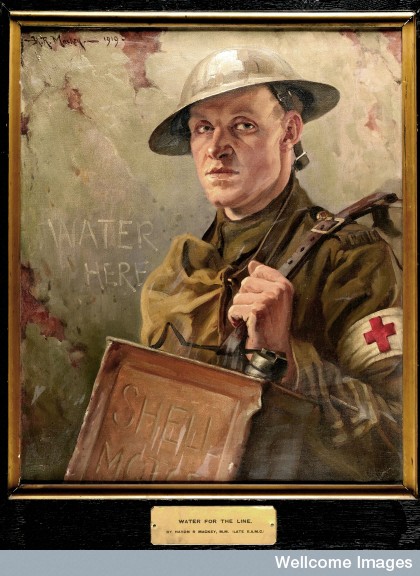
An image of an RAMC serviceman carrying water. This painting forms part of the small exhibition of images I have collated for the MOOC World War I: Changing Faces of Heroism which I am teaching on at the moment. If you would like to know more, please join the course at https://www.futurelearn.com/courses/ww1-heroism.

L0034643 World War I: an R.A.M.C. bearer supplying water to theHaydn Reynolds Mackey,

‘An R.A.M.C. bearer supplying water to the front line’, 1919

Wellcome Library, London

We interrupt this programme…

Before I start, please may I assure regular followers (hi, Mum!) that I am contemplating a post on the new seasons of Downton Abbey and Peaky Blinders and what they have to tell us about bereavement, survival and disability in the wake of the First World War.  In the meantime,  however, I will be spending the next three weeks teaching on this:

WW1_4words


Changing Face of Heroism


If you haven’t already signed up, please do so.  If you have, please let anyone you think might be interested know about it.  It is completely free to register and join and you can take the course entirely at a pace that suits you.

As part of this course, our wonderful learning mentors, Chris Phillips and Philippa Read, will, I hope, be writing guest posts for this blog on aspects of heroism relating to their research, respectively wartime transport logistics (trains and canals) and classical references in French wartime culture and memory.  This is a new approach on the part of this blog, but one that I hope will lead to contributions by other students and colleagues who work in fields related to my research.  I hope you will make them all welcome.

And a final piece of publicity. The Legacies of War seminar series got off to a strong start in its third year with an excellent paper from Professor Roy MacLeod on ‘The Scientists Go To War’.  Our next meeting takes place on Thursday, 30th October at 5:15 in the Grant Room (Michael Sadler 3.11) at the University of Leeds when Dr Richard Smith (Goldsmiths) will be speaking on ‘Recovering West Indian Memories of the First World War’. Full details can be found here.  Please do join us if you are able to. All are welcome.

Remembering Robert Fentiman

I started this month with two frantic weeks of research, paper presentation and working at the Great Yorkshire Show.  By the time the last event, a two-day conference on the emotional history of war at the British Academy, came around, I was exhausted, sick of train travel and worried that my children no longer knew who I was.  I seriously considered giving it a miss; I wasn’t giving a paper and wasn’t sure how emotional history might be significant for my work on RAMC servicemen.

However, I had booked a hotel room and paid for my train ticket, so I packed my bag and headed back to London.  And boy am I glad I went!  Not only was it a conference attended by many of the most notable historians of the cultural history of war (walking into the room where coffee was served felt a bit like seeing large parts of my PhD bibliography made flesh), but it forced me to rethink the nature of my work as a form of emotional history.  In fact, the ideas about emotional labour and the archiving of emotion that I took away from those two days have made me completely rethink the structure of the book proposal I am in the process of writing.

I still have a huge amount of work to do sorting out how my work is located in the history of emotions, but I’ve been thinking about one idea in particular over the past couple of weeks.  During the round table session which closed the conference, one point was made three times, in three different ways, namely how do we, as historians, research and write about emotions that make us feel uncomfortable.  The conference was divided into sessions on love, fear and grief.  None of these are comfortable emotions, of course, and the evoke strong reactions in us as historians and in those who read what we write.  But there are other emotions felt by participants in war that we didn’t discuss directly, skirting around or mentioning only in relation to other emotions: anger, joy, relief, pride, shame.  These are emotions that don’t necessarily fit into the narratives we want to tell ourselves about war.  They highlight the power of war not only to traumatise, creating victims of its participants, but also to brutalise, even dehumanise, the perpetrators of violence.  But they are as important a part of the historical narratives of war as an emotional experience as those easier, possibly more acceptable emotions.

Which brings me to Robert Fentiman.  Robert Fentiman is one of the central characters in Dorothy L. Sayers’s 1928 novel, The Unpleasantness at the Bellona Club. Like his brother, George, another key character, Robert served in the war.  Unlike George, who was gassed and suffers from shell shock throughout the novel, Robert, is described as ‘frightfully hearty – a regular army type.’ [1]  Indeed, he chooses to remain in the army after the war.  Throughout the novel, the differences between himself and his brother are emphasised.  Where George has a fit of hysterics upon the discovery of his grandfather’s corpse, Robert [spoiler alert], laughs with humour when recalling using the two-minute silence to hide the body in order to commit fraud. Neither is a particularly attractive character.  George is depicted as bullying his wife while Robert is described as ‘thick-skinned; the regular unimaginative Briton. I believe Robert would cheerfully go through another five years of war and think it all a very good rag. … I remember Robert, at that ghastly hole at Carency, where the whole ground was rotten with corpses–ugh!–potting those swollen great rats for a penny a time, and laughing at them. Rats. Alive and putrid with what they’d been feeding on. Oh, yes, Robert was thought a damn good soldier.’ [2]

Neither George nor Robert is particularly emblematic of how we like to construct our image of veterans of the First World War today.  As I have argued before, our culture wants to smooth out the image of shell-shock sufferer, to remove the violence and ugliness in order to create the image of a victim we can pity without qualms.  But, even in this bowdlerized form, the shell-shock sufferer retains an important place in our cultural memory, indeed an increasingly important place as the definition of shell shock expands to encompass an increasing number of men.  By comparison, we seem to have little cultural memory of the Robert Fentimans of the war, the men who went through it phlegmatically, found an acceptable niche for themselves in post-war society, and displayed little or no sentiment about publically commemorating the dead, however much they privately honoured their comrades.

Some might argue that such men did not exist, that even if they did appear to display resilience in public, the psychic wounds that war inflicted on them were repressed, to echo down the generations and that, to this extent, all men who had been under a rolling barrage, as Robert Graves and Alan Hodge asserted in 1940, suffered from shell shock. [3] Yet Graves and Hodge go on to assert that what they called shell shock was a temporary condition. The resilient, even thick-skinned war veteran was certainly a common enough cultural figure for Sayers to place him in direct, antithetical comparison to the equally emblematic shell-shock sufferer in a popular novel that sold well in the interwar years.  George and Robert Fentiman are two sides of the same coin, and would almost certainly have been recognised as such at the time, yet today we only remember one of them.

As I say, it is not easy to write about men like Robert Fentiman.  They aren’t particularly likable or sympathetic.  They do not fit into our definitions of heroes.  But these men too fought the war; they too must form part of our history.  The challenge that War: An Emotional History set me was how to write about these men whose emotions I struggle to recognise and respond to in a way that is honest and does them the honour they deserve.  I will be grappling with this over the next couple of months.  If you would like to hear how I get on, I will be giving a lecture on The Fentiman Brothers at War: Shell Shock, Emotional Resilience and the Cultural Memory of the First World War at the Freud Museum in London on 2nd October. Do join me.

[1] Dorothy L. Sayers, The Unpleasantness at the Bellona Club, New English Library Paperback edition (London: Hodder & Stoughton, 2003), 14.

[2] Sayers, 99-100.

[3] Robert Graves and Alan Hodge, The Lond Week-End: A Social History of Great Britain 1918-1939 (New Yorkk: W.W. Norton and Company, 1940), 16.

2 for 1

I realise it has been a long time since I have posted anything.  I am still writing a lot – conference papers, a journal article, an introduction and a couple of guest posts on other blogs.  I have just been gifted a bit of time today, so I am hoping there will be a new post later this morning.

In the meantime, in case you missed them, my guest posts on disability and masculinity and the medical evacuation process can be found here and here.

#writing

I haven’t been posting on here recently because I have been doing so much writing.  Quite a bit of it is still in process, but you can read some of it here.  More to come in the near future, I hope.

Some more about footnotes

Jeremy Paxman’s Britain’s Great War finished its four-part broadcast on BBC 1 last week.  Billed as the BBC’s flagship centenary programme, and the starting point for its commemorative activities, which now appear to reaching fever pitch in advance of the launch of the regional and online World War One at Home project, despite it only being February, the programme was a bit of a curate’s egg, although one that, on the whole, I enjoyed.

Four hours to cover the entire course of the First World War, principally from the perspective of the British ‘home front’, although with bits and pieces about the Western Front tucked in as well, is not a lot, and many topics were, inevitably, simplified or simply omitted.  To some extent, this doesn’t matter.  The BBC has, as it keeps informing us, over 2,500 hours of programming devoted to the war planned for the centenary years and many of the topics, including the global reach of the war, the relationships between Britain and her allies and even straightforward military history will, doubtless, be dealt with elsewhere and in more detail.

Other aspects were more troubling.  Choosing to focus, often in some detail, on particular topics ended up giving an oddly skewed impression. Shell shock and facial disfigurement, currently vying for the status of symbolic wound of the war, were by no means the only life-altering medical conditions that men survived with, yet there was no mention of disease, amputation or the long-term affects of gas.  Fronts beyond the Western Front had little impact on this narrative of war, despite their impact on the consciousness of the British population at the time. And the limiting of the discussion of the importance of letters to a brief section on the postal system and the perspective of a single officer on the process of censoring letters was, for me as someone who has worked extensively on the letters men wrote home, extremely reductive.

Which brings me to the real problem I had with the programme, which has at its hearts a fairly fundamental contradiction.  Paxman has gained many plaudits for his authoritative and, on the whole, sensitive presentation of a range of material which was new to many viewers and which reflected many of the more cutting-edge and original arguments made in recent years by academic historians.  He also interviewed a number of people, most memorably the centenarian Violet Muers, whose eye-witness account of the German bombardment of Hartlepool made for powerful television.  But not one of these interviewees was a professional historian, a deliberate decision on the part of the producers who wanted to use the programme to emphasize familial connections between the war and their audience.

This in itself is not a problem.  As programmes such as ‘Who Do You Think You Are?’ have shown, family connections to the past make for good television and are a powerful way of connecting contemporary audiences to history.  It is the attempt to combine cutting-edge historical arguments with the perspective of the interested descendent that creates issues.  Because the overall effect was to invest all the authority for the arguments made entirely in Paxman himself.  And while he is an authoritative figure, and I can well believe read widely around the subject and come to his own conclusions about what points to make, he is not, in fact, the historian who has undertaken the research that backs so many of the claims he made over the course of the programme.

Some of that research has been done by programme’s historical adviser, Adrian Gregory, who published The Last Great War (Cambridge University Press, 2008), an excellent piece of social history that is both scholarly and accessible and which I would highly recommend to anyone interested in the topic. Presumably the interested audience member would be able to pick Adrian’s name from the credits and track down his publications if they wanted to read more about the subject.  But Adrian’s is not the only original research to influence Paxman’s arguments.  David Cannadine’s The Decline and Fall of the British Aristocracy (Yale University Press, 1990), Dan Todman’s The Great War: Myth and Memory (Hambledon and London, 2005), Michael Roper’s The Secret Battle: Emotional Survival in the Great War (Manchester University Press, 2009) and, most recently of all, Laura Ugolini’s Civvies: Middle-Class Men on the English Home Front (Manchester University Press, 2013) all contributed to at least some part of the argument being made.  And these are simply the works that spring most immediately to mind, reflecting as they do my own particular research interests. With greater concentration (and rather more time at my disposal), I suspect I could compile a further reading list of recent scholarly research so extensive as to be potentially daunting to an undergraduate, let alone a curious but not obsessive Monday night television viewer.

The problem this highlights is the fact that, as there are no footnotes on television, how do professional historians (both academic and otherwise) working on the history of the First World War ensure that their work is properly acknowledged?  Many have spent a great deal of time and effort, not to mention funds, sourcing and interpreting the primary source material, as well as formulating the arguments that Paxman so authoritatively deploys.  For academic historians, this work forms the basis of their professional reputations and the intellectual capital that they deploy to make a living.  As such, that work needs to be recognised not simply by specialists but, if those arguments are going to be deployed more widely, then by all those who are making use of them.  This is not merely good manners; it is the very foundation of intellectual exchange and honesty.  But how to do this in a way that is both engaging to a broad non-specialist audience and is fair to researchers remains something that needs urgently to be discussed.  I have been mooting the idea of topic-specific further reading lists to be publicised alongside future programmes, but who compiles these and how their time is paid for remains an open question.  Equally problematic, from the perspective of engagement, is the ethics of recommending books that may have cover prices beyond not merely the interested individual but also the cash-strapped local library.  The Cambridge History of the First World War may be one of the most important recent publications on the subject, but at £90 a volume (£240 for all three), it is hardly going to have a wide circulation beyond university and other specialist libraries.

There is also the related problem in the BBC’s apparent fear of historians as specialist commentators, at least in relation to its most prominent offerings on the First World War.  While BBC 2 and BBC 4 television both seem willing to interview historians as specialists, BBC 1 so far prefers to use Paxman, Kate Adie and Dan Snow for almost all commentary related to the First World War.  Regional radio, working in partnership with the AHRC, has made extensive use of specialist historical knowledge in producing the World War One at Home project. It remains to be seen how the programme is received more widely, but as a researcher and contributor it has, to date, been a positive and highly informative experience.  Yet Woman’s Hour has run a number of features on First World War topics (including Edith Cavell and the aftermath of the war) with no input from historians, despite there being not merely experts but indeed female experts in these fields who might have added useful perspective.* And the major on-line offering, the interactive guides to various aspects of the war, are predominantly fronted by either media personalities or those with contemporary professional interests in the subject, with historical expertise usually tucked away at the end.**  This is the most public and accessible display of historical knowledge of the war that the BBC is providing, yet the role of the historian in all of this is too often hidden and unacknowledged.  This is troubling given that most historians are fundamentally communicators, interested in ensuring that other people know about the work they do and the stories that they uncover.  And many are not only presentable but are capable of learning the skills necessary to engage with a popular audience.  Indeed, in the current academic climate, with its emphasis on impact and engagement, many are not merely willing but feel compelled to do so, whether through formal media training or less formal practices including blogging.

None of this, of course, is new or specific to the centenary of the First World War, or even to the popular media.  Recent impassioned blogs by Matt Houlbrook and Lesley Hall point to the pervasiveness of the potential for mistreatment and exploitation of academics, particularly early-career researchers, by both the media and well-known established historians (and their publishers).  For historians of the First World War, however, this centenary moment presents both a challenge and an opportunity, to ensure not only that our research, in all its originality, is made accessible to a wide audience, but that we gain due credit for we have done and are doing, both those of us who choose to work directly with media outlets and those who do not.  There are no easy answers as to how we do this, but the moment to have the discussions is too opportune to be missed.

In the meantime, I will start compiling my further reading list, to be posted on here at a later date.  Please do get in touch if there is a particular volume that you think should have been cited in relation to Paxman’s programme (preferably with a note as to the bit it relates to) and I will make sure it is included.

*The special extended programme on 5th February made excellent use of Professor Joanna Bourke and Professor Maggie Andrews as commentators, but again, Kate Adie and Baroness Shirley Williams were the guests who names featured most prominently in the publicity.

**Honourable exceptions here are Gary Sheffield and Sam Willis.

Tears, idle tears

Never let it be said that the BBC’s flagship television programme marking the centenary of the First World War, Britain’s Great War, has had no impact on academic research. Following a flippant comment on Twitter, in response to Jeremy Paxman’s description of members of the British cabinet crying at the outbreak of war, I seem to have rather publicly committed myself to writing an article on British soldiers crying during the First World War.

This is actually slightly less ambitious and out of left field than it might first appear. I have a number of examples of men crying, and commenting on crying in relation to their masculine sense of self, while at the front. I am also actively looking for examples of men showing emotion through tears in hospital. These are examples of men crying as a response to fear or to pain. Following from André Loez’s article in Macleod and Purseigle (eds.), Uncovered Fields: Perspectives in War Studies (Brill, 2004), on French soldiers’ tears, I suspect there are also men who cry out of grief and relief/joy.  I would love to find more examples of these, so if anyone comes across any, please do let me know.

I have also been working my way through quite a lot of literature on the history of emotions, as I try to work out my theoretical and methodological approach to the study of masculine subjectivity, something that has definitely changed since I published my book five years ago.  This is a fascinating and complicated subject that I will be posting about at greater length in the near future.  Having a discrete, concrete project to work on that allows me to put a mass of theory into some sort of practice should be quite a useful discipline.  I have always been the sort of researcher who needs to write as she goes, if only to keep my ideas in order.

So I will keep hunting for examples of men whose stiff upper lip trembled far more often than we might believe, and work at locating them in the context of the history of emotions in wartime.  Thank you, BBC and Twitter, yet another job to add to my list!