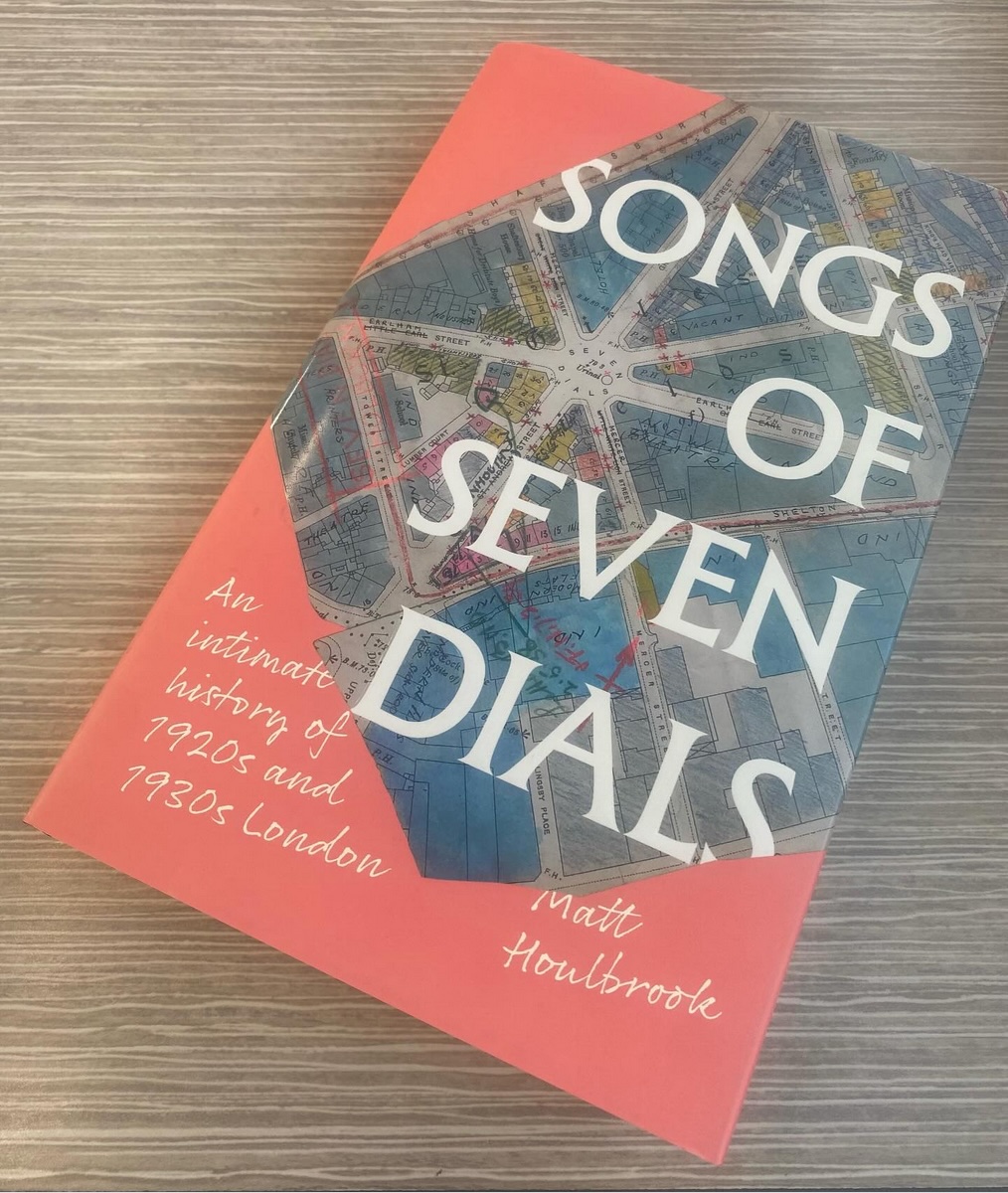
The Book I Wish I Had Written

The culture section of the Saturday edition of a major British newspaper runs a regular column in which celebrities in the arts are asked to identify subjects from their cultural life such as ‘The book I am currently reading’, ‘The instrument I wish I had learnt’ and ‘The last film that made me laugh/cry’. These lists are always fun to play along with but, while my answer to topics such as ‘My favourite piece of music’ has changed over the years, my answer to the regular question ‘The book I wish I had written’ has long remained the same: The Great War and Modern Memory by Paul Fussell.

Celebrity answers to this topic tends to be couched in terms of either a personally inspirational text or a best-seller that made the author a lot of money. In my case, the answer arises from a mixture of both. I first read The Great War and Modern Memory as a freshman, a first year undergraduate in my first semester at university. I thought at the time that I wanted to be an English major. By the end of the year, I knew that I would be a history major. This shift was only in part down to Fussell’s pivotal work of cultural history (Geoffrey Parker’s lecture on the possible role of sunspots in the development of early modern military strategy also had something to do with it), but what the book undoubtedly informed was my commitment to history that took fiction as one of its primary sources. This would shape not only my undergraduate module choices but the topic of my senior essay (an analysis of Ford Madox Ford’s Parade’s End tetralogy and R.H. Mottram’s The Spanish Farm trilogy as representations of the Western Front), but also my master’s and doctoral theses as well as almost every major work I have published since.

Of course, my view of Fussell’s work has evolved since then but that ‘heady mixture of literary criticism and cultural and historical analysis’ [1] remains deeply alluring as a point of reference not necessarily as a cultural history of the First World War, but as a pivotal moment in the cultural turn in First World War studies. As Ian Isherwood and Steven Trout argue in their excellent recent review article, ‘But It Still Goes On: Paul Fussell’s The Great War and Modern Memory at 50’, ‘the book is perhaps best approached as a an experimental study – a hybrid mixture … of  literary scholarship, cultural analysis, historical writing, and veiled autobiography.’ [2] This hybridity, if not Fussell’s argument about the centrality of irony to a Modernist paradigm shift in cultural expression, has gone on to inform the approach and ambition of major works in the field, including Samuel Hynes’ A War Imagined (1990) and Jay Winter’s Sites of Memory, Sites of Mourning (1995), as well as many of their students, among whose number I include myself. And, in ‘reigniting a debate from the late 1920s and early 1930s over literary treatments of the Great War and their portrayal of disillusionment supposedly shared by an entire generation’ [3], Fussell helped shape what we now define as the canon of British First World War literature as surely as any writer, publisher or critic of the ‘war books’ boom. We cannot understand not only how we in Britain and the US remember the First World War today, but how it is represented in contemporary cultural forms. Alice Winn’s almost constant references to Robert Graves’ Good-bye To All That in In Memoriam (2023) provides only the most recent testimony to Fussell’s historiographic influence.

It is, as Isherwood and Trout note, the representativeness of the authors selected by Fussell for analysis that lie at the heart of many of the critiques of his approach. Yet representativeness was never really the point: ‘Drawn … to highly literate, middle-class junior officers like himself (albeit members of a different army in a different war), he never intended to write a comprehensive study of British Firs World War literature or, for that matter, an exhaustive treatment of British culture before, during, and after the conflict.’ [4] But that debate, with its echoes of the critiques of Douglas Jerrold and Cyril Falls [5], highlights an issue that those of us who use fictional, semi-fictional and poetic sources in our research and analysis still grapple with today. No cultural history of the war can ever be comprehensive, either in breadth or depth, particularly when the conflict is considered in global rather than national terms. How do we choose which texts to focus on? How do we balance close reading of the symbolism of particular texts with broad claims about the culture in which they were produced and which they sought to shape?

It is here that Isherwood and Trout’s identification of the importance of autobiography to Fussell’s endeavour spoke most strongly to me. Unlike Fussell (or indeed Hynes), I am not trying to use my practice of cultural history to grapple with experiences as a former soldier. I make no claims to, as Fussell did, to sharing a bond of experience with the authors he selected for particular consideration. But I have always been aware of the extent to which my own personal preferences and youthful exposure to particular literary works has shaped the texts I have chosen to focus on (the work of Dorothy L. Sayers being the most obvious example), as well as my vulnerability to the critique levelled by Charles Carrington against Fussell, that the analysis of someone who wasn’t there can never be a true history of the war. Indeed, as a newly minted PhD, I was bluntly told by one ex-serviceman (himself too young to have served in the First World War), that my thesis on representations of wartime masculinities was worthless because I was not a man and had not myself served in the war. (My gender and age clearly trumped my nationality in this instance as my critic chose not to point out the fact that, like Fussell, I am an American.)

So I take comfort from Isherwood and Trout’s argument that ‘Fussell’s status as a cultural outsider … sharpened his insights … and emboldened him to say things that he might not have if he had been British…. [H]is distance from the war’s living memory enabled him to study the “troglodyte world” of the trenches and the mythology it produced with fresh eyes.’ [6]  Which is not to say that I necessarily take comfort from the text itself, which remains as challenging and provocative today in many ways as fifty years ago. For me today, the particular challenge of the autobiographical element is the most stimulating as I grapple with the ‘genealogical’ or ‘family history’ turn in social history, as exemplified by the work of Alison Light, Michael Roper and, most recently, Laura King. My family’s history doesn’t fit neatly with the history of the First World War, challenging cultural narratives of the war’s universality. But is this distance a handicap or a benefit? As I grapple with these questions as part of the process of writing my own book, The Great War and Modern Memory will continue to remain as much of an inspiration for my historical practice as it was when I first read it thirty years ago

[1] Ian Isherwood and Steven Trout, ‘But It Still Goes On: Paul Fussell’s The Great War and Modern Memory at 50’, The Journal of Military History, 89 (January 2025): 155-170 (160).

[2] Isherwood and Trout, ‘But It Still Goes On’, 158.

[3] Ibid., 160.

[4] Ibid., 160.

[5] Douglas Jerrold, The Lie About the War: A Note on Some Contemporary War Books (Faber & Faber, 1930); Cyril Falls, War Books: A Critical Guide (Peter Davies, Ltd, 1930)

[6] Isherwood and Trout, ‘But It Still Goes On’, 168

Accountability Revisted

Having reflected on the recovery of the past year on New Year’s Eve, the start of the new year seems a good time to revisit and report back on the plans I made a year ago. I have also updated with some plans for the coming year.

Writing:

  1. Reviews: I completed and submitted both book reviews due in early 2024, and both have been published. I now have a review (over)due that was supposed to be written by September, but I didn’t receive the book until October. This will be completed in the next couple of weeks.
  2. Conference papers: I had to pull out of the conference on military welfare history as my injured knee made travel too complicated. The paper at the Academic Archers conference was well received, and I am contemplating proposing a follow-up (although not for this year’s on-line conference, sadly). I gave papers at a different conference on military history and, joyously, at the Dorothy L. Sayers Society annual symposium and helped organise a conference on military welfare history. In the coming year, I am already scheduled to give public lectures in February, June and November, and a conference keynote in February. I am also hoping to get to Austria for the Military Welfare History Network conference and to Greece for the International Society for First World War Studies conference, although I am not sure what, if anything, I will be writing for either.
  3. The big one: The book. Definitely did not get finished this year. In fact, I have made very little progress, with the one chapter that I have worked on significantly currently is a state of chaos that terrifies me. I have done some initial work on other chapters, and do have a clearer sense of what I am trying to do, but I need more space to sit with this work than I have at the moment or am likely to until the summer at least. Work continues.
  4. And the new project: The article on ambulance drivers never materialised, but in the spring I was approached by a publisher interested in a global history of masculinity and warfare. I have written a proposal and received encouraging feedback. I will be redrafting the proposal in the coming month. Should it be accepted, writing this will be the focus of my forthcoming research leave.

Knitting:

  1. The cardigan that I started as a lockdown project still doesn’t have button bands, but I have bought the required wool from the supplier. It is next on the knitting project list. This may require another ball of wool from the supplier.
  2. Three family sweaters were all completed in 2024, although my son’s was finished in a huge rush on 27th December. Only my husband received Christmas wool this year, as he has requested a replacement sweater for one he has worn to death. I have already made a start on this and am making good progress as I still can’t ski due to the knee injury.
  3. And the new projects: I still haven’t come up with a project for the reclaimed wool from the baby blanket, but I have just offered to make a non-knitting friend a cable sweater. I will be knitting some swatches to test the gauge when I get home, and hoping she likes the colour. If not, I have a large stash of other colours, hopefully something suitable will be found. I also bought myself a copy of Margery Allingham’s Mysterious Knits (coincidentally by the same designer as my friend’s requested sweater) for my birthday and have bought myself a Christmas present of wool for one of the sweater patterns. So it looks to be a year of Kate Davies knits for me this year.

Quilting:

  1. Autumnal quilt. I have not touched this this year.
  2. Alice’s Wonderland quilt: Completed, long arm quilted, bound and given to its intended recipient. I am enormously proud of myself and of it.
  3. Aurora Stars Tricolour quilt: Last year’s new project. I haven’t quite completed the quilt top, but hope to be able to do so in the next couple of months, having just ordered the backing and binding fabrics. However, there are…
  4. The new projects: Instead of wool, this year I gave my children the materials for their quilts, a full kit for my son, a BOM for my daughter. I have also built up enough of a fabric stash to start compiling the materials needed for my nephew’s quilt top. I will have a significant period to focus on these during my period of recovery from surgery, which will hopefully happen in the spring, but we will have to see how far I get with these.

In the kitchen, the garden and the house:

As ever, the annual events of the kitchen and garden recur.

  1. Marmalade. Successfully made, in spite of my impairment. The kits for this year’s batch are on order.
  2. Germination: One of the great achievements of last year was the completion of two big house renovation projects, an update to the family bathroom and the complete redesign of the utility room and office, a project that involved replacing the roof over that part of the house. This has given us not only a lovely space to work in (with, miraculously, enough shelf space for all our books!) but also a large space for potting and germinating. As the greenhouse still doesn’t exist, this will do for now.
  3. The front bed has been dug over, although too late to plant the intended bulbs. I will be putting in shrubs, including a gift from an old family friend, in the spring, Then I need to work out what to do with all the rocks that I removed as part of the process.
  4. Plant-based baking: The cinnamon rolls never did happen. I may try again this year.
  5. And the new project: Having completed the bathroom and office space, the next challenge is redecorating the rest of the house. I am hoping my husband will get around to laying the wood floor in the living room. My goal is to paint the front hallway so that we can finally hang the artwork that is currently occupying a corner of the spare room.

As with last year, these are ambitious goals which will not be completed, but I fully intend that this year shall be different in terms of the pattern and pacing of my work across the different categories. There will be changes this year, some them scary, but all, I think, necessary to enable me to tackle the goals outlined above.

Enough is as Good as a Feast

Kate Atkinson, Human Croquet

Kate Atkinson, Normal Rules Don’t Apply

It may have been a mistake, saving my stash of Kate Atkinsons to take with me on holiday over the summer. Not because they are not wonderful; they absolutely are. Reading Human Croquet, which I did in a day, gulping it down in a way I haven’t done with a book since the height of the pandemic, was a joy, an immersion in language and characterisation and intricately intersecting plot lines that took me to another place as only a great book can.

But oh! they are so rich! Coming to the end of the book after a day spent reading like that felt a bit like getting up from the table after an overly rich meal, or waking up with a hangover. It was almost too much, to the point where I felt lethargic and slightly headachy. So following such overindulgence with more of the same may, as I say, have been a mistake. Yes, Normal Rules Don’t Apply was, as a collection of short stories, briefer and lighter, but the collection of linking characters, locations and storylines required work, the language was just as intoxicating and the emotions evoked were, if anything, even more quietly devastating.

To recover, I gave myself a palate cleanser of Georgette Heyer’s The Quiet Gentleman, which was light and funny and straightforward in terms of plotlines and the emotions aroused, although not, perhaps, overly memorable. But it did leave me slightly out of time to tackle Shrines of Gaiety, which I had been keeping to savour,before the end of our stay in the US. I was left with the choice of starting it on the plane ride home or saving it for the long weekend trip to Scotland scheduled for the week after we returned. The former option risked my staying up all night reading, followed by jetlagged exhaustion on arrival. That was how I read Life After Life, but I wouldn’t have slept on that flight anyway, In the depths of grief following my mother’s death the week before, that book saved me from going mad, a life raft in the ocean of suspended time that flying back to my family in the UK entailed. This time I anticipated no such need, just the prospect of houseguests to prepare for, making the prospect of exhaustion compounded by jetlag a less than enticing prospect.

Saving it for Scotland, meanwhile, would give me something to look forward too when my husband and son headed off to climb Ben Nevis without me, a challenge to far for my torn ACL, which had been playing up even in the slightly less strenuous context of the hills of Western Massachusetts. So that is was I decided to do, planning to balance the intensity of Atkinson’s rich literary vision of 1920s London with the anticipated jeu d’esprit of Juno Dawson’s Hebden Bridge-set witchcraft novels.

Summer Reading and Future Plans

Somehow, it is the August bank holiday weekend, and thus almost the end of summer. I am back at work (which means hundreds of emails and frantic lecture writing and lesson planning for a month before teaching starts) on Wednesday and the kids are back at school the following week. This summer seems to have gone by in a blur, over before it barely began, but it has seen two important developments, at least as far as this blog is concerned.

In the first place, I have managed to to a lot more fiction reading this summer than I have for the past couple of years. Returning to immersion in fiction as a space for relaxation and recuperation has been a joy, and I hope to carry on with this habit even as the busyness of the academic year accelerates. My-to-be read shelf has not noticeably contracted, as holiday travels have involved many bookshops and and I appear constitutionally unable to enter a bookshop without purchasing something, particularly second-hand bookshops, and there is also the list of things I want to read but haven’t quite got around (or found a good excuse) to purchase yet.

The second development of the summer was my decision (along with many others) to finally cut ties with the social media site formally know as Twitter and move my micro-blogging onto Threads, where I go by @thehistorianskitchengarden. As I originally joined Twitter to publicise this blog, in the days when there was a 180-character limit, this transition feels like a good excuse to revive and revise what I am doing on here.

My initial enrolment with Threads was due to the fact that I have an Instagram account, where I mainly post pictures of my cooking and gardening endeavours, as well as views from my morning runs and holiday walks. However, I have also been intermittently involved with the #bookstagram hashtag, primarily through posting stacks of books prompted by a theme. However, I also enjoy reading reviews of books posted on the site, and have considered posting my own, thwarted only by the incovenience of writing a detailed review on my phone keypad. Given the regularity with which I post typos due either to fat fingers or the vagaries of auto-correct as it is, attempting this on a regular basis seemed like a bad idea.

I did flirt with the idea of launching a Substack, something I may do in the future depending on the direction my writing career develops in the future, but adding an additional platform at this stage, when I already have this one at my disposal. So how I will be using this blog will change over the next few months. In addition to publicising my posts on Threads, I will be posting more (and hopefully more regular) book reviews. These will mainly be fiction, moving this site away from its focus on the First World War, although there will be some non-fiction reviews as well.

I don’t want to move entirely away from the role that this site has played as a research diary, not least because I am now working on not one but two book, a history of men and war in the modern period and a history of the returning British servicemen of the First World War. Both of these are now at the proposal stage and starting to have both argument and form. All that is lacking is sufficient time for me to write them. I will be trying to carve this out over the next year and the practice of working through ideas on this blog can only help make the process more efficient. Again, I will use Threads to help disseminate my writing, highlighting the historian as much as the kitchen and the garden of my handle.

So there will be quite a lot going on on here, I hope, and I will be updating the look of this site as part of that. There will be separate pages for the reviews and the two book projects, as well as an updated profile. There will be more photographs integrated into my posts, reflecting how I have developed my use of Threads in conjunction with Instagram. There may be some publicity for my other project, the podcast on the intersections of the First World War with popular culture, that I co-present, although I am not clear what form this will take. Finally, there will, I hope, be more scope for comment and discussion both on here and on social media, particularly relating to the book reviews. All of this may take some time, not least because, as of next week, my priority will be writing and creating the presentation slides for the eleven lectures I am due to deliver in the current term. But there will be reviews of at least some of the books I have read this summer before then, and before the start of the new year catches up to me.

Accountability

Having noted in my last post that I ended 2023 with a number of unfinish projects, I thought I would start the new year listing those that I hope to make progress with if not actually complete over the coming year. This is not a resolution (I’m possibly a bit late for that on Epiphany), but rather a hope to the point of intention.

Writing:

  1. Janaury/February: Two book reviews. I’ve read both books and have a good sense of what I want to say, but I have negotiated a bit more time for both of these as I know that I will get very little writing done once marking and postgraduate studentship applications come in in a couple of weeks.
  2. April: Two conference presentations.
    • Discussant on a panel in military welfare history as a sub-field. My contribution will be considering intersections with histories of disability and gender.
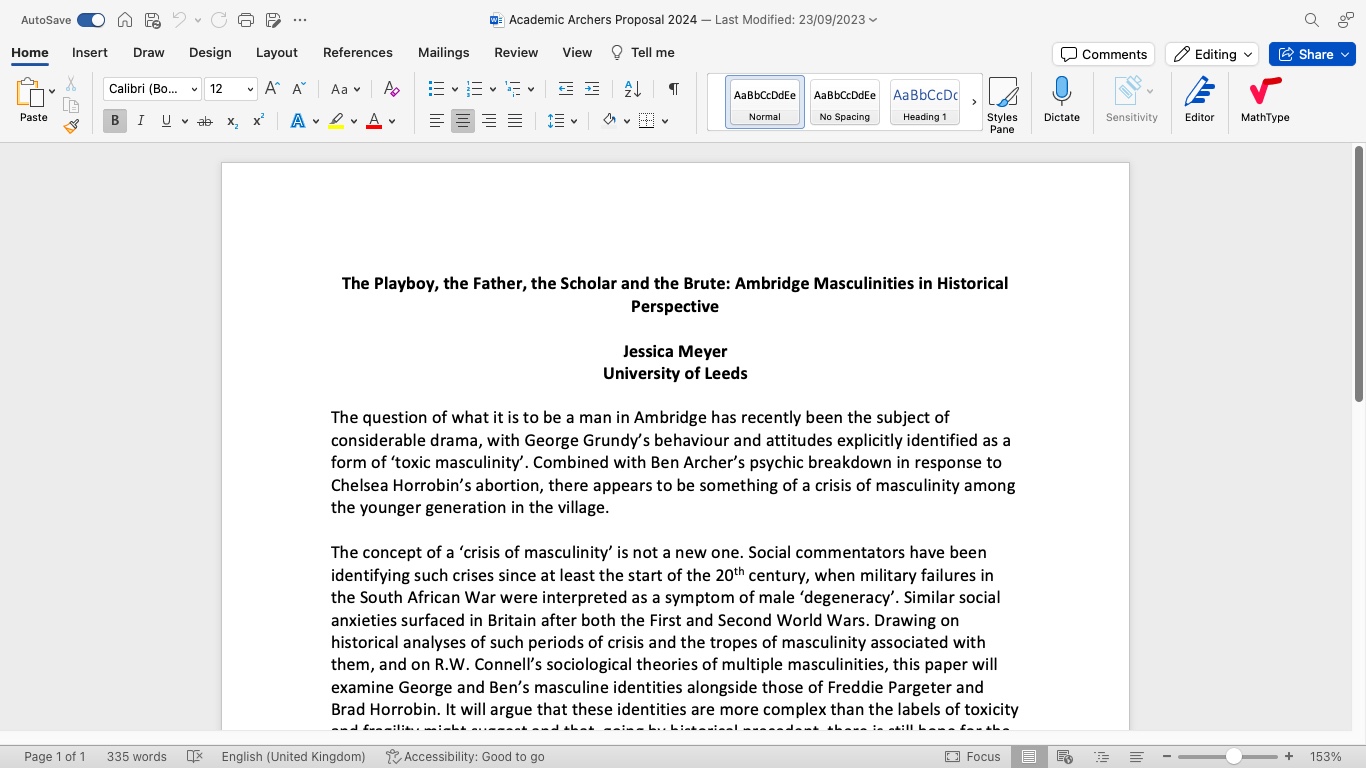
    • ‘The Playboy, the Father, the Scholar and the Brute: Ambridge Masculinities in Historical Perspective’ for the 2024 Academic Archers conference. I am very excited about this one, and can’t wait to start writing this properly. It has been a couple of years since I last attended an AA conference, which are some of the most fun out there.
  3. The big one: The book. This will definitely not get finished this year, but the goal is to end the year with at least a couple of full chapters in place, and possibly even an agent for it.
  4. And the new project: One of the books I’ve been reading for review has inspired me to think again about the status of ambulance drivers and non-combattant care-givers (or not). I think there may be a journal article in this, drawing together some of the material that I was only able to mention in passing in An Equal Burden.

Knitting:

  1. The cardigan that I started as a lockdown project. I have finally built up the courage to steek it (successfully, I think), but now have to complete the button bands and grafting. This may require another ball of wool from the supplier.
  2. Three family sweaters. Every year for Christmas I give my husband and two children the wool for a new sweater, which I then knit for them. This year I began my husband’s before Christmas, intending it for his birthday, after last year’s effort ended up far too tight in the arms and chest due to a miscalculation. However, as I have chosen an extremely complicated fair isle pattern, it is taking considerably longer than anticipated. Thankfully, the children’s sweaters should be more straight forward, so I may actually complete these before the weather gets too warm to wear them this year.
  3. And the new project: Today’s clearout of the bathroom cupboards in advance of the builders arriving tomorrow disclosed the sad fact that the baby blanket my mother made when my son was born had fallen victim moths. So I spent an hour today unravelling it, ending up with approximately six 50g balls of lovely, soft DK wool which, for sentimental reasons, I would like to make into something new. I’m not sure what yet, but all suggestions will be gratefully accepted.

Quilting:

  1. Autumnal quilt. My first full-sized bed quilt which I am very, very slowly hand quilting. Not one that I can see getting completed this year, but I would like to make more progress on it than I have done in the past 12 months.
  2. Alice’s Wonderland quilt: A Block of the Month project from Alice Caroline which I started in January 2022. All that remains is to attach the final four borders, after which I will take it to be long-arm quilted at my local quilt store. It is intended as a gift and I am not yet confident enough at hand quilting to take this aspect on (nor to do I have the time if it is to go to its recipient – currently age 4 – before they leave home for university).
  3. And the new project: Because I clearly can’t resist the siren call of the new project, I have signed up for another Alice Caroline BoM project this year. Hopefully this one will be a little bit quicker, now that I am more confident of my technique.

In the kitchen and the garden:

These are less unfinished projects from last year than annual events which come around every year. Nonetheless, they fall under the heading of projects, and very enjoyable ones, too.

  1. Marmalade. The making of this year’s batch will be made more interesting by my current temporary impairment relating to my knee injury, which requires brace and crutches and means I am only partially mobile.
  2. Germination: We still don’t have a greenhouse (a very long-term unfinished project), so some time in the next few months the window sills will start to play host to pots of seeds in anticipation of one of the summer’s main garden projects, the veg patch.
  3. The front bed: Yet another project that is now several years old. Having removed a hugely overgrown berberis, I now need to finish digging out all the stones to replant with a callicarpa and bulbs. This one, however, will have to wait until the weather improves.
  4. And the new project: For Christmas, my husband asked for and received a cookbook about plant-based baking. I may have rashly agreed to try making plant-based cinnamon rolls at some point…

As I say, I won’t complete all of these projects, but I hope to finish some and at least make progress with the rest. Whatever else it turns out to be, 2024 looks to be a busy year.

Not Doing Family History

Last week I attended the Social History Society annual conference, held this year in Essex. It was the first time I attended this conference since 2013, when it was held in Leeds and where I presented my first paper on what would eventually become An Equal Burden. This time, I presented not-quite-the-first paper on what I intend to be my next book, on the social history of demobilization after the First World War in Britain.

It was an enjoyable, if hot and exhausting, few days. The Essex Business School in built on the precepts of a tropical glass house and, despite a torrential downpour which deafened us on the first day, the humidity remained a noticeable factor throughout. And there were a lot of papers to cram in, particularly on the final day when I spent a fair amount of time dashing around the building, trying to hear as much as possible. But it was lovely to catch with old friends and colleagues, some of whom I hadn’t seen in person since well before the pandemic, and hear about exciting new research, particularly from postgraduate research students. Honor Morris and Mandy Barrie, both writing about working-class women’s experiences of feminism at either end of the 20th century, produced engaging and intriguing analyses which makes me excited to read more of their work. Clare Tebbut’s paper on a complicated story of a trans(?) marriage in the interwar years, and Jessamy Carlson’s discussion of child protection in the same period, both chimed with my own work, prompting me to rethink the significance of my arguments about the time frame of developments in the entangled relationships between the domestic and state welfare provision.

The highlight of the panels I attended, however, was the final session on Friday, when Julia Laite, Cath Feely, Laura King and Lucinda Matthews-Jones discussed their uses of their own family histories in their historical work. Separately, the four papers were fascinating studies in their own right; together, they suggest important new methodologies for those of us who work on histories of emotions, material objects and the everyday. This was, in fact, the second event on the topic that I had attended in as many weeks, following the roundtable discussion hosted by the IHR’s Contemporary British History Seminar, where Julia and Laura spoke alongside Michael Roper and Matt Houlbrook, both of whom have written or are writing histories which included consideration of their own families. That so many important historians in fields related to my own (and who I have had the honour of working with over the years) should be developing practice in this area suggests that this is an approach I need to consider exploring in my own work. Certainly listening to Cath’s discussion of the ways in which her great-grandfather’s death was mythologised through his First World War service, and how the wider historical context and her expertise as a local historian shaped her research into the story, suggested a number of questions about the returning soldier and the legacy of the First World War that I want to pursue further in my own work.

But that work won’t be through my own family history and Friday’s panel, in combination with the IHR seminar, has forced me to think about why not. After all, I have my mother’s archive, including both her own papers and the research she conducted into her parents’ histories in the final years of her life, sitting in my spare room in half a dozen boxes. Why not use them as a springboard for my discussion of 20th century domesticities, or integrate the information they contain into my analysis? No, the connections between my family’s history and the First World War are not obvious, but I am, at least in part, a historian of the everyday in time of war. There may be relevant stories of the quotidian in my own family’s experiences of the war. And, even if there are not, I do not need to be defined solely as a First World War historian for my entire career, even if this is how I predominantly see myself. Indeed, my current project is not about the war itself but about its resonance through the lives of those who lived through it throughout the rest of the 20th century. Surely there will be members of my family whose lives can help me explore the process. If not, there must be other stories they can tell of 20th century British social history, from the intimate variation on the special relationship that was my parents’ marriage to the changing nature of women’s employment across at least two generations. Why should I not think about exploring these?

And yet I still find I cannot. My mother’s archive sits in the spare room unexamined, as it has done for four and half years now. There is always something more urgent to do, either professionally or privately, than opening those boxes and exploring their contents. And the reason for this avoidance is that the emotions that such research would evoke are still too powerful for me face in order to do this work.

In the discussion session following Friday’s panel, Michael Roper asked about the role of grief in the work each of the panelists were undertaking, pointing to the ways in which his own work on his family’s history, incorporated into his new book, Afterlives of War, formed part of the process of grieving for his late father. And maybe someday I will be able to use my mother’s archive to work through my grief over losing her too early at 73. But the primary emotion I feel when contemplating those boxes and the work that they represent, both that done already by my mother and that which I would need to do to integrate them into my historical practice, is fear.

I am still working out what, precisely, I am so frightened of. It has, I am sure, something to do with the anger I still feel about my mother’s death, an anger that swells every time I read of another celebrity dying of pancreatic cancer. But there is also the fact that the history contained in the files is that of my mother as much as that of my more distant ancestors. As I noted in my own question to the panel, none of them were working directly on histories of family members more proximate than grandparents. I asked if they thought too-close generational proximity makes the work of integrating family history and academic history harder. As the discussion touched on, proximity brings into focus the fact that family histories are, in the end, emotional histories and these emotions, as Laura King argued in her paper, are a direct challenge to the idea of the pre-eminence of objectivity in professional historical practice.

I am, among other things, a historian of emotion, something I was reminded of listening to Julie-Marie Strange’s tribute to Joanna Bourke on her retirement earlier this week. I am one of the many heirs and beneficiaries to Joanna’s pioneering work in the field, which has and continues to profoundly shape the questions I ask, the sources I explore, the arguments I make. And I do not merely analyse historical emotions but engage emotionally with the past. I regularly respond to the grief of wartime loss or the anger of injustice in the treatment of the disabled or dispossessed when reading archival sources. But when asked to consider my family history, I do not know how to manage the emotions it makes (or threaten to make) me feel. Even contemplating  the boxed archive feels overwhelming and, to protect myself, I continue to turn away.

Citing Richard White’s Remembering Ahanagran, Laura spoke of the cruelty inherent in intimate histories of subjectivity and emotion which rely on the analysis of the stories that individuals tell about themselves. I am all too aware of this, having provoked fury on the part of one descendant of a man whose diaries I quoted in my first book, who felt that my interpretation was an insult to his ancestor.  This is also a point that has been made in relation to personal essayists and authors of autofiction, such as Rachel Cusk, who use (exploit, even) their intimate relationships – with parents, with partners, with children – to produce work for publication. This was a discussion that my mother herself was familiar with. Her own writing, principally her MFA dissertation, explored her complex relationship with her father, but was only written after his death. Her diaries, which she asked to be burnt without reading after her own death, almost certainly grappled with her feelings about motherhood, including reflections on her perceptions on her relationships with us, her three children. Telling the stories of interpersonal relationships, whether in the past or the present, has immense power, the power to enlighten, inspire, even comfort, but also the power to disrupt and harm.

So the fear I feel when faced with my mother’s archive is, at least in part, fear of the damage I will do – to myself and to others, not least my two siblings, my children and theirs – by trying to negotiate the boundaries between subjectivity and objectivity that the process of doing family history as an academic historian demands of us. I agree with Laura’s central argument that we need to challenge the reification of objectivity in academic history, and that family history can help us to do this. But, at least for now, I cannot participate to this methodological project through the doing of family history. I can, however, contribute through the process of thinking about and exploring the emotions that prevent me. There is, I believe, a story to tell in not doing family history as well.

A resolution

Every year since 2013 I have posted a reflective blog post at some point between Christmas and New Year. I posted throughout my chidren’s early childhoods, when Christmastime was a welter of preparation and lack of sleep. I posted through my parents’ illness and in the wake of their deaths. I posted the year I caught a stomach bug and spent much of the holiday feeling extremely sorry for myself.

But not last year. Somehow, there didn’t seem much to say last year, after a year of anxiety and restrictions, with yet another lockdown (and its attendant home-schooling-while-full-time-teaching-on-line stresses) on the horizon. And that failure to post seems to have set the tone for this past year, a year in which I have failed to write.

I don’t mean that entirely literally. I have written syllabi, reports, and many, many comments on students’ work. I have drafted an article (currently under review following a revise-and-resubmit) and wrote three new talks on my research. I even submitted a short story to a competition over the summer (it didn’t get long-listed, so no feedback). And yet it has still been a year when I have felt blocked in my writing, when nothing has flowed, when I have struggled to find my voice on the page.

It is not just that I have not posted on this blog since July 2020. Having entered the pandemic with ideas for three major pieces of writing, all of them have stalled. The proposal for the monograph based on the research from Men, Women and Care remains unwritten. I have done nothing about the trade history beyond speaking to a couple of possible literary agents. And the novel I started so blithely remains stubbornly stuck at 25,000 words.

There are, of course, good, explicable reasons for this lack of writing productivity. The above-mentioned home-schooling-plus-on-line-teaching absorbed much of the start of the year. The hybrid return to campus in the autumn, along with the resumption of my children’s extra-curricular schedules (choir, rugby, drama, riding) brought its own set of stresses and challenges. As for the summer … I’m not actually sure what happened to the summer this year. Whatever it was did not involve putting pen to paper (or fingers to keyboard).

Writing in a pandemic is hard, and I am trying my hardest to be kind to myself and not to berate myself over the lack of progress. But the fact is that reflecting on this writing block makes me feel sad and anxious in a way that is different from the sadness and anxiety I have felt (and often felt acutely) in past years.

I need to write. I need get the ideas in my head on paper (or a screen). I need to make mistakes, cross things out, find the perfect phrase, delete whole paragraphs and then rewrite them. And I have plenty to write. In addition to the monograph, trade history and novel, there is a blog post on the White Feather campaign I want to write, an article with a deadline next month and the character I have left in limbo in an incomplete AO3 story. Those three new talks should, I hope, form the basis of monograph chapters and there is a call for papers for an edited collection which could give me scope for exploring a key angle to emerge from Men, Women and Care.

So, for the first time in many years I am making a specific New Year’s resolution, one which I intend to hold myself accountable for. Every day for the next 365 days, I will write for a minimum of half an hour. It doesn’t matter what it is – a blog post, fiction, a draft chapter, a proposal. It doesn’t matter when in the day it is, although I do know I write best in the mornings. It doesn’t matter if I am working that day or on holiday, at home or traveling (as I hope to be doing come the spring). For half an hour every day I will write in the hope of getting my writing muscles working again, just as I have this past year sought to get my running muscles working again.

So there is the marker I am placing in 2022. Given the current state of the world, I have no confidence in making any predictions for what the new year may bring, but I will enter it with some hope that there will, at least, be a few more posts on this blog than last year, and maybe even a draft book (or two) by its end. I can but hope.

So I will close this piece of end-of-the-year writing by wishing you all a hopeful, health and happy new year.

Why I haven’t been posting on my blog

I had all the best intentions. I was going to post regular on my –

[‘Mummy, is my porridge ready?’ ‘No, can you get ready to do Joe Wicks, it will be ready when you are done.’ ‘Don’t want to do Joe Wicks.’ ‘You need some sort of exercise. If you don’t do Joe Wicks, I’ll have to take you for a long walk later.’ ‘Fine, I’ll do Joe Wicks but it’s so unfair. This is the worst day of my life!’ *loud stomping*]

blog. I was going to write about the links between Covid-19 and the history of wartime medicine. I was going to write about the militarisation of medical language. I –

[‘Mummy! He’s pushing me!’ ‘I’m not! She’s getting in my way!’ ‘For goodness sake! You stand there; you stand there. Face the television and watch what you are supposed to be doing!’]

was going to keep a daily diary, an outlet for my anxieties, a record of the social history of –

[‘Right, you go have a bath and you go practice your piano.’ ‘But he always has a bath first and do I have to do my piano?’ ‘I want to do my piano.’ ‘Fine. You do you piano and you have a bath.’ *5 minutes later* ‘That’s enough water! Please can you do that again – and don’t rush this time.’ *dramatic sighs all round*]

corona virus, a boon to future generations of historians.

But of course it hasn’t happened. Partly because –

[‘Are you out of the bath? Dressed? Right, come do your piano please while your brother has a bath.’ ‘No!’ ‘You need to do your piano practice.’ ‘Want to do it later.’ ‘No, you are going to do it now.’ *stomping, followed by discordant banging on the keyboard over the sound of running water*]

not a lot of what I have to say feels very original. The comparisons with the 1918 flu –

[‘Time to get out of the bath, please.’ ‘What work do I have to do?’ ‘Do I have to do writing?’ ‘I don’t understand this maths.’ Can I work in my bedroom?’ ‘Not if you are going to listen to Harry Potter while you work.’ ‘But I work better listening to things.’ ‘Mummy, is strange a noun, verb, adjective, adverb, or preposition?’ ‘Go get you dictionary and look it up.’ ‘No! Why do I have to! This is too hard! I hate you!’ ‘Are there 180 degrees in a right angle?’ ‘I can’t answer you both if you talk to me at the same time!’]

have been relentless, and the subject isn’t really my area of specialism. Discussing the resilience of medical caregivers –

[‘Can I make coffee?’ ‘Go on then.’ ‘Mummy, what does this mean?’ ‘What does what mean?’ ‘This.’ ‘Which one are you talking about? Show me.’ ‘This one!’ ‘Which of these sentences is an example of a modal verb? Hang on, let me check what a modal verb is.’ ‘Here’s your coffee, Mummy.’ ‘Thank you, sweetie.’ *spends the next five minutes wiping up spilled coffee grounds, dripped coffee and biscuit crumbs* ‘What’s for lunch?’ ‘Soup.’ ‘Don’t want soup, we always have soup, why can’t we have pasta!’ ‘Because I can’t get pasta from the shops.’ ‘It’s not fair! I never, ever get what I want and you always get what you want!’ ‘Please just get on with your work.’]

feels unnecessary with all the articulate voices of medical caregivers bearing moving witness to that resilience. Yes, there will come a time to –

[‘I’ve finished my worksheets.’ ‘Have you done BBC Bitesize?’ ‘But the internet isn’t working.’ *checks internet connection* ‘Yes, it is, you just have to wait for the page to load.’ ‘Stupid computer! I hate you! – Oh, now it’s working.’]

unpick the meaning of heroism as it has been applied to key workers, but I’m not sure that it has come yet. And as for my own stresses and strains –

[‘I’m hungry!’ ‘Fine, I’ll get lunch. Can someone lay the table, please?’ *I lay the table* ‘If you’ve finished, can you put your dishes in the dish washer, please?’ ‘Do I have to? She’s not doing it!’ ‘She will do it when she finishes her fruit.’ *dramatic sighs* *I clear my dishes, wash up the cooking utensils, wipe down the table*]

I’m certainly not the only parent struggling to balance working from home, home school and keep my family fed and exercised. I am not the only –

[‘What do I do now?’ ‘Have you done Duolingo? Typesy?’ ‘Yes, yes.’ ‘Please can you tidy your room? Yes, you can listen to Harry Potter.’ ‘Where’s Dad?’ ‘He’s in the office, recording a lecture. Please don’t go in there – did you hear what I said? What are those things attached to the side of your head?!’ ‘Ears?’ ‘Well – use them!’]

struggling with anxiety about how to support my children’s mental and emotional health when they can’t see their friends, when I don’t know if they will be able to go back to school this year, when plans to visit family, both in the UK and in the US are indefinitely on hold.

And then there is the fact –

[‘I’ll take them for a bike ride.’ ‘Great. Have fun.’ ‘Mum, Dad’s taking us for a bike ride.’ ‘Yes, he told me, have fun.’ ‘Mummy, we’re going on a bike ride.’ ‘Yes, I know.’ ‘Where’s my helmet?’ ‘Where are my shoes?’ ‘I need socks, don’t I?’ ‘Do you really want to cycle in that skirt?’ ‘Have you seen the bike shed key?’ ]

that I am still at work. I am fortunate in not having had to scramble to put teaching on-line the way many of my colleagues have, but I have been supporting post-graduate students –

[‘Has the mail come?’ ‘I haven’t seen the mail man since you last checked the mail ten minutes ago.’ ‘I’m going to check anyway to see if my Beano has come.’]

who are anxious about funding, who can’t access vital archives, who are on the verge of submitting their dissertations and facing the prospect of remote vivas. I am still revising –

[‘What do I do now? I’m bored.’ ‘Why don’t you read a book? No, not one of your Beanos.’ ‘I don’t know what to read!’ ‘Fine, let’s go to your room to see if we can find something in the dozens of books on the bookshelf.’]

a REF impact case study, still working with a colleague to get the manuscript of a long-standing edited collection submitted to the publisher, still supervising –

[‘Mummy – he pushed me off the swing!’ ‘Mummy – she won’t let me have a turn on the swing!’ *sounds of conflict from the garden*]

my funded research project (although making very slow progress with any of the actual research myself). So I’m not getting very much writing –

[‘Can I watch television?’ ‘In five minutes.’ ‘But, Mum – !’ ‘Five minutes!’ ‘Mum, can I watch television?’ ‘Okay, okay, fine, watch television.’]

done, not even the book proposals I’m supposed to be writing, let alone anything else. Which is why I haven’t posted much on this blog.

[‘Mum, what’s for dinner? I’m hungry!’]

Writing/Not Writing

It is 3rd November. For the past week, I have been traveling with my children along the eastern seaboard of the US, visiting family members, including two very new additions in the form of my nephew and honourary niece. It has been a lovely, if exhausting half term, although I will admit that I am looking forward to spending some time away from my own children after ten days constantly in their company.

Being November, it is also both NaNoWriMo (National Novel Writing Month) and AcWriMo (Academic Writing Month). My Twitter feed is consequently full of friends, acquaintances and stranger posting their daily word counts, preparation spreadsheets, planned chapter breakdowns and research goals. As in previous years, these glimpses of others’ creative processes are inspiring and seductive. They also make me extremely jealous.

I would love to dedicate myself to a month-long writing marathon. It isn’t as if I don’t have plenty write, academic and otherwise. And I have been making some progress with all three academic projects, plus the two (yes, there is now a second) pieces of fiction that insist on intruding themselves into my creative brain space. But making the time and space to write every for a month? Ay, there’s the rub.

One AcWriMo video on YouTube offers to teach you ‘how to bend space and time to your will this November! Or, failing that, strategies to make all this writing fit into the life that you actually have, not the one you think you should have.’ Which sounds perfect, but I’m not sure that being on the road across three cities in ten days with two primary-school-age children and five bags is quite the real life the presenter had in mind. Even if I had the room to sit and write once the children were asleep (generally impossible in a shared hotel room with the lights switched out), I simply have not had the mental capacity to do anything other than switch off at the end of the day. And while we do arrive home tomorrow (hopefully to a car waiting for us at the train station and meal cooked by my husband) the combination of jetlag and all the stuff that will need catching up on after a week off work make carving out writing space on a daily basis a challenge I simply don’t think I am up to.

And yet here I am writing this. Nor has this trip been an entire void when it comes to making progress on various writing projects. A discussion with my sister-in-law has made me determined to actually complete the piece of fiction that I have made a 7,500-word start on, however long it takes. An afternoon walk around the monuments in DC in glorious autumn sunshine resulted in my finally working out what the Men, Women and Care book is going to be about, even if planning the actually outline was interspersed with tangential discourses on American history for the edification of my son. And the seven-hour train ride that we are currently embarked on as the first stage of our journey home looks to be providing a good opportunity to write not only this but also a bit more of the chapter on improvisation for the trade book on the RAMC that I am still determined to try to get an agent for.

So I many not have set pen to paper for the first two days of November. My chances of completing 50,000 words of fiction in the next three-and-a-bit weeks are slim-to-none, much as I would love to do so. And I will continue to produce my academic writing fueled by deadline-induced panic rather than the allocation of dedicated time on a daily basis. Maybe NaNoWriMo or AcWriMo will happen for me next year. I am sure that I will have things to write when they roll around again. In the meantime, if you are taking up the challenge of either (or both) this year, I wish you the best of luck and may the words (and the hours) be kind to you.

Three books (and counting)

My children finished school for the academic year today. Universities have been celebrating graduations. Emails about induction week are starting to circulate. It must be the start of the summer holidays.

This summer, in between childcare duties, I have several projects to work on – a couple of applications, two articles to (re)write, a very overdue book review, some engagement events to prep for. But my main goal, as I keep telling people, is working out what my next book is going to be about. And the problem I have (which is a nice one to have, but no less problematic for that) is an embarrassment of riches. I have three possibilities but probably only the mental space and energy to concentrate on one of them. They are as follows:

1) The book I need to write. This is the book I have promised the funders that I would produce from the Men, Women and Care project. It is a book about disability, masculinity, temporality and the life cycle; about care giving, emotions and gender; about the history of the welfare state, the family and the role of the individual in negotiating the spaces where the two overlap. It will be a very academic book, a book which will use words like ‘temporality’, ‘hegemony’ and even, if today’s reading is anything to go by, even ‘phenomenology’. It is a book that may, eventually becoming the articulation of the most significant intervention I will ever make into the historiography of masculinities and the First World War. At the moment, it is unfocused and under-researched.

2) The book I have promised myself I will write. In January, I tweeted that my resolution for the year was to write the ‘trade’ version of my recent academic book on the history of the RAMC in the First World War. This one, I have done the research on. I also have a chapter and a half in draft, about five different plans of chapter breakdowns and a great deal of excellent advice from colleagues about how to approach this project. What I don’t have, yet, is either a clear, saleable thesis, or a proper strategy for finding myself an agent, which is very much the next thing I need to do to get this off the ground.

3) The book I want to write. For years now I have been talking about doing a project on the representation of trauma in detective fiction – and I still want to do it, not least so I can write properly Ellis Peters’ George Felse novels. But, after talking about the project for so long without actually doing anything about it, I am starting to think there may be a less academic, more experimental book that I need to write first, about Golden Age detective fiction and contemporary novels set in the Golden Age, how both use images of and references to the First World War and what the differences between these two forms of the genre can tell us about gender, memory and commemoration. I’m pretty sure I have the argument for this one, and I find myself writing bits and pieces at odd intervals, but I also need to dedicate a lot more time to (re)reading the works of Jacqueline Winspear, Frances Brody, Kerry Greenwood, as well as some of the more obscure members of the Detection Club if this is going to be the book I really want it to be.

So those are my options, three projects, all of which require time commitment in different ways. Alongside the continuing work needed for the final year of Men, Women and Care, the teaching and administration I’ve agreed to undertake and my family commitments, there is barely room for one of them, let alone all three! So I am looking for advice: which one of these do I prioritise this summer?

(And the ‘and counting’? That would be the book I dream of writing – the detective novel in the style of Dorothy L. Sayers, with a plot based around an ex-servicemen’s association and post-war battlefield pilgrimages. Some day…)