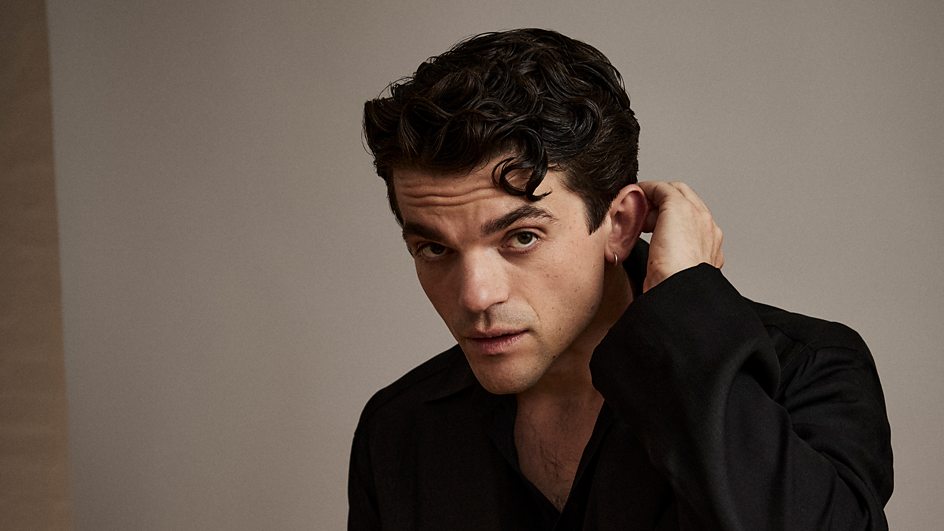
I appear to be having a week of being distracted from the writing I should be doing by bright shiny topics, mainly to do with detective fiction. So today, instead of posting an insightful critique of social histories of the interwar period, I am writing about my response to the news that Edward Bluemel will be playing Poirot in the new Mammoth Productions adaptations to be broadcast on the BBC and Britbox in the coming year.
Let me start by saying that I adore Edward Bluemel. Watching his Shakespeare opposite Ncuti Gatwa’s Kit Marlowe in Born With Teeth from the front row was one of my all-time most memorable theatrical experiences. And he was, in my opinion, one of the better things about the recent Netflix adaptation of Agatha Christie’s Seven Dials Mystery. As well as clearly having the time of his life in the part of Jimmy Thesiger, his face has an indefinable quality (shared with Benedict Cumberbatch) that suits historical dramas set in the early-to-mid twentieth century.
Which should make him a good choice for this role. But (and of course there is a but) I have a serious reservation about this bit of casting, because Poirot presents a particular problem for an actor, one that only David Suchet has ever managed to tackle successfully. Of all Christie’s characters, Poirot is the one with the fullest, most distinctive physical description. The moustaches and mincing walk (achieved by Suchet via a coin clenched between his buttocks, apparently) are probably the two most famous, but in Christie’s writing the most commonly noted is a different one – Poirot’s famous egg-shaped head.
As I say, only Suchet has ever come close to representing this aspect of Poirot. Kenneth Branagh simply ignored it in favour of excessive facial hair, only one of the many problems with his representation. Even Peter Ustinov, as wonderful as his Poirot was, didn’t quite capture the ovate nature of the great detective’s appearance. Jowly is not the same thing as egg-shaped. As for Bluemel, in spite of that 1920s-1950s facial quality, his beautifully chiselled cheekbones and jaw line put him out of the running, even as a young Poirot (as he is apparently being cast). There is no way that that chin will ever age into ‘egg-shaped’.
Which brings me to my second reservation about the announcement. According to the announcement in Variety, ‘Hercule’ is being ‘Touted as an “intimate study of Hercule the man and an epic portrait of Britain between the wars”.’ Which is a bit confusing, given that Bluemel is 33, rather than middle-aged-to-elderly as the retired Poirot is usually depicted. An inter-war London setting suggests that this is not going to be an origin story, simply filling in the background that Christie didn’t dramatize herself. While the amount of background Christie gave her famous Belgian is limited, she did provide enough detail to make such an interwar setting for a younger Poirot historically puzzling. How does a young Belgian man end up in London at the end of the First World War? Was he a refugee (as Poirot is in the books)? If so, why did he not stay to defend is country as most young Belgian men did in 1914? Or perhaps he was evacuated as wounded later, but then why didn’t he return to Belgium after the war to help rebuild the nation? Most refugees wanted nothing more than to return home, and by the end of the war much of the initial welcome they had received had cooled considerably. (Pip Williams’ The Bookbinder of Jericho (2023) dramatizes this beautifully.) Christie’s backstory for Poirot may be sketchy (and her timeline which has him still alive in the 1970s beyond the bounds of credulity), but it does have rather more historical coherence than I fear the television programme is going to have.
Does this matter? This is, after all, a popular cultural reinterpretation of genre, even if one that has, over the years, had enormous global spread and therefore influence. Well, yes, if like me you think of fiction (and popular fiction in particular) as a valid historical source. In my opinion, detective novels are a particularly good source of social history detail, so much so that I once taught an entire module on interwar social history using the novels of Dorothy L. Sayers and am currently planning a history of the world wars in Britain using Golden Age detective fiction as my source base. The details – of dress, behaviour, objects, attitudes – that detective stories rely on to unravel their plots are deeply rooted in the historical moment in which they are set, so much so that Henry Wade opens Lonely Magdalen (1940) with an apology for a missing landscape marker on Hampstead Heath which existed when he was writing in the novel in 1939, but which was removed at the outbreak of war. This is particularly true of war-set novels (Margery Allingham’s Traitor’s Purse (1940), Nicholas Blake’s Minute for Murder (1947) and E.C. Lorac’s Murder by Matchlight (1945) simply would not function outside their Second World War contexts), but also applies to most other Golden Age novels which tend to be dated by, if nothing else, then the communication technologies which enable alibis to be made or broken.
This is not to suggest that such mysteries (or their detective protagonists) can’t be relocated to different time periods successfully. The wild success of Sherlock (2010-2017) is evidence of this. But the setting has to have temporal coherence to give any sense of verisimilitude. By changing Poirot’s age without changing the time period in which Christie first imagined him, that historical plausibility, which grew from the original stories being written in the moment rather than projected into an imagined past, is lost. And with it, I fear, goes cultural recognition of historical context. How many of those who watch ‘Hercule’ will simply accept the authenticity of a young male Belgian refugee, thereby losing the memory of the complex and contested status of these refugees throughout the war? Poirot himself has the potential to be reimagined in all sorts of ways (including with a pointed chin) but the history of the moment in which he was first imagined and created does (and should) not.
Which is to say that I will watch ‘Hercule’ when it is broadcast, although possibly with clenched teeth in an effort not to yell at the television. And then I will go back and read the books and think about what they have to tell us about the history of the First World War, yet more distraction from the books I am supposed to be writing…

