Second-hand Goods

Caroline Dunford, A Death in the Hospital

I have a very bad habit of picking up any novel with a First World War or immediate post-war setting when I come across them in a second-hand book sale. My husband grumbles about my bringing yet more books into the house while, in my heart of hearts, I know that, more likely than not, I will spend most of the time I am reading them getting annoyed by inauthentic, not to say inaccurate, portrayals of the war which rely heavily on clichés. Yet I carry on doing it, in part in forlorn hope that I may encounter an original (and thus enjoyable) new author or series, and in part to remind myself of all the pitfalls to avoid when writing my own war-set fictions.

As painful as most of these are to read, in general I find there is enough to them, in terms of plot, characterisation or, very occasionally, setting, to keep me reading until the final pages. Certainly, I did manage to do this with Carola Dunn’s Die Laughing, in spite of its many short comings, and with Sulari Gentil’s A Few Right Thinking Men, which erred to much towards the thriller side of crime fiction for my taste, as including random fictional press clippings in a way that I found deeply confusing and off-putting. However, this cannot be said for my most recent acquisition, Caroline Dunford’s A Death in the Hospital (2020), which I picked up for 50 p. at our local National Trust property second-hand bookstall and which I abandoned about a quarter of the way through.

I had been vaguely hopeful about this novel, the 15th book in the Euphemia Martin series, which appears to still be going strong, with A Death at Christmas due out this year. After all, the war hospital setting was right up my street in terms of areas of historical interest, although this did risk a more than usual number of snorts at clichés about VADs and misuse of the term ‘field hospital’. What I didn’t expect, however, was a historical setting so inaccurate as to suggest that Dunford is not even familiar with Vera Brittain’s Testament of Youth, let alone any less ubiquitous representation of the British military medical services in the war. It was at the point where a hospital where the central character had gone undercover as a trainee nurse (not, apparently a VAD, although it remained entirely unclear what the character who made this distinction thought a VAD role entailed) was described as the first hospital of its type ‘since the Boer War or possibly the Crimean War’ that I gave up entirely. For the setting to have any meaning or interest, I did need to have evidence of some basic plausibility for the institution that formed that setting, including the awareness that the auxiliary hospital (which I think was what this one was supposed to be) was only one type of medical institution in Britain during the war. As well as the permanent military hospitals which treated the Regular army throughout the second half of the 19th and into the 20th century, at the outbreak of war, military hospitals were rapidly set up across Britain, usually in commandeered institutions. Where country houses were donated, these became auxiliary units, specialising in rehabilitation after initial treatment at a general hospital. The institution in A Death in the Hospital did not seem like any of these.

Which brings me to the second aspect that precluded my enjoyment of this book. In addition to the ahistorical setting, the question of timing made any suspension of disbelief I might have had impossible. The novel is, apparently, set in August 1914. Even if we assume that the book starts at the end of the month, in at most three weeks there has, apparently, been time for some sort of voluntary hospital to be set up and filled with wounded servicemen including at least one volunteer servicemen, although he just may have been a Territorial. It is also strongly implied that the military effort had achieved statis along the Western Front, although this wasn’t the case until the winter of 1914. In other words, the author attempts to invoke the war as historical context through clichés that ignore the somewhat atypical reality of the opening months of the war. This sort of telescoping of events is not just bad writing, it is terrible history.

I do like to think that I have a pretty high tolerance for inauthenticity in genre fiction set in the First World War, of which there is a remarkable amount. Yes, as I say, I do grumble about inappropriate uses of terms like ‘field hospital’ and conscientious objector, or assumptions about the incidence and understanding of executions and shellshock. But while reiterating worn tropes is boring and, for a historian, frustrating, I am aware that I bring a level of specialist knowledge to reading this type of fiction which gives me an unfair perspective. Where there is some evidence of basic historical research, some attempt to get to grips with the historic specificity of the world being depicted, I can usually suspend enough disbelief to at least finish the book. Here there was no evidence of any historicization, with events, ideas and innovations from at least three major conflicts mashed together in an ahistorical mess labelled ‘The First World War’ in a completely implausible time frame. It is the sort of historical fiction that makes me wish there were a way to certify an author’s credentials as a historical research before they are allowed to publish. Indeed, the only excuse for this sort of book, in my view, is the case it makes through absence for history, including that which informs creative products (films, television, art and games as well as literature) as an intellectual discipline that requires skill and rigour, not just a vague idea that the past is another country which might make for a romantic setting.

So A Death in the Hospital will return to the second-hand book sale table via my local charity shop, where I should clearly have left it in the first place.

Unreal City

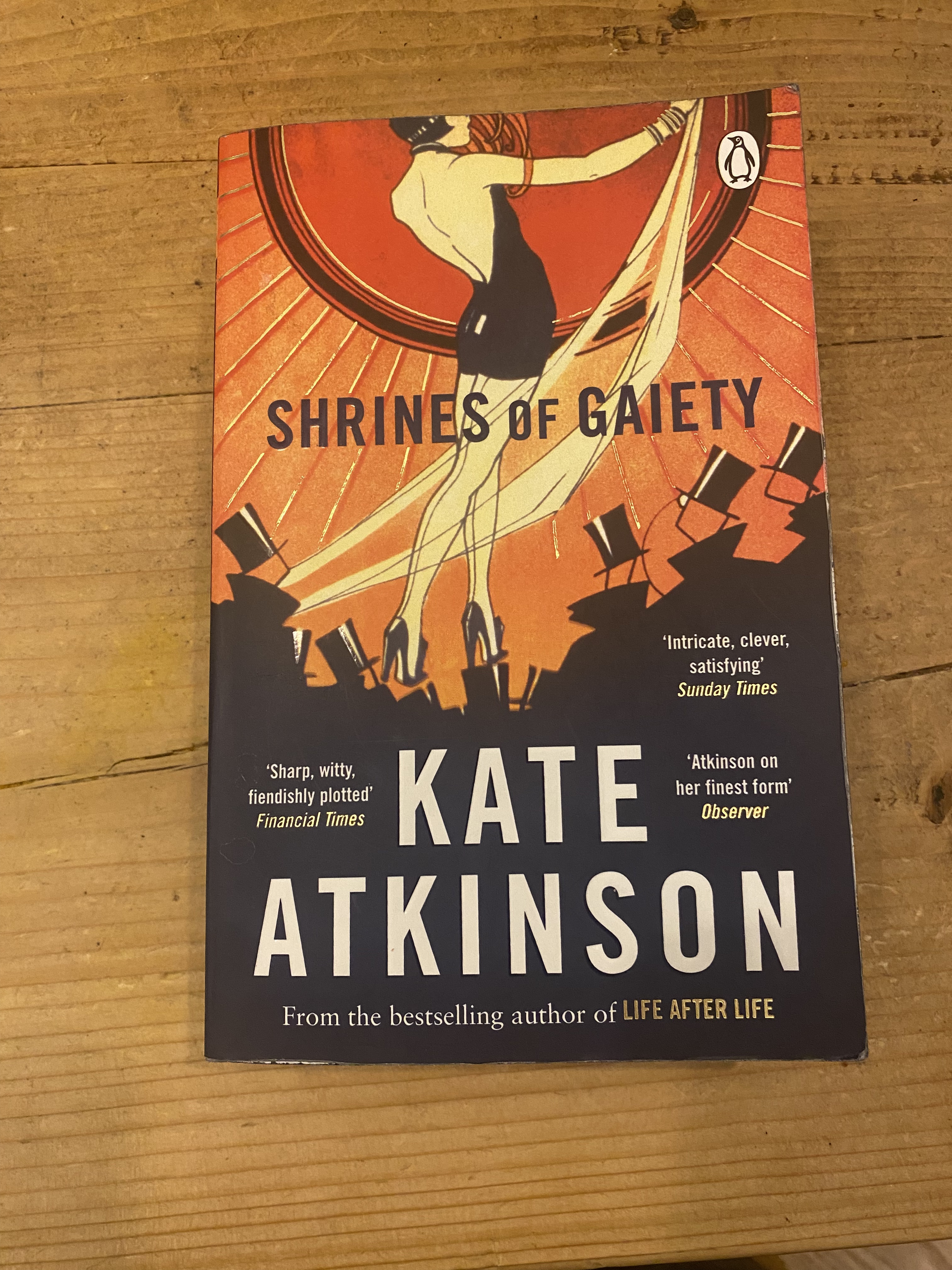
Kate Atkinson, Shrines of Gaiety

Having swallowed down Human Croquet and Normal Rules Don’t Apply in a gulp, I took a bit more time over Shrines of Gaiety, which is probably a good thing.  I enjoyed it – I think it is probably impossible for Atkinson to write a book that I don’t find totally immersive and enjoyable to read – but, in retrospect, I’m not sure it was as entirely wonderful as I had hoped. I don’t really expect anything to live up to the wonder of A God in Ruins, a book which speaks to so much that I love, am interested in and have dedicated my intellectual life to, or Life After Life, a literary and imaginative life raft which I clung to in the days after my mother died. But his is a book that had the potential to speak to me as strongly as either of these, a story of a time and people who are, in part, the subject of the (non-fiction) book I am writing at the moment, as well as being crime fiction-adjacent, touching on another of my great passions.

And there certainly were elements of this book that I loved. Nellie Coker, Gwendolen Keeling and Freda Murgatroyd (what a name!) are all wonderful creations – rich, complex, engaging women whose attitudes and actions I could deplore and root for in equal measure. I also loved the character of Niven Coker, a man shaped but not defined (except perhaps in the eyes of others) by his experiences of war. The ambiguity of the ending of his and Gwendolen’s story, so typical of Atkinson’s play with multiple narratives and possible outcomes, was one of the great pleasures of the novel for me.

And yet… And yet… I did not love this book the way I loved even Transmission, a novel that I know many critics struggled with. The problem for me was two-fold. In the first place, there were too many characters and storylines introduced, with the result that several of the plots and characters felt underdeveloped. Ramsey Coker in particular, who gets a considerable amount of space in the book, never came fully alive for me, and I never truly believed in his (strategically important) relationship with Freda. Similarly, the murdered girls whose disappearance I think is intended to be a central plot device, merged into one in my mind, which was a problem given the centrality of the moral imperative that drives Inspector Frobisher’s desire to name them individually. And to leave one major plot strand (the disappearance of Florence Ingram) entirely unexplained may be considered artistic license. For there to be a second (the murder of Vivian Quinn) feels like authorial carelessness.

Secondly, and relatedly, the book is weakened by the attempt to coral all 73 characters and their interlinking storylines into small a social and geographic space. There are any number of coincidences – Frobisher’s presence on the bridge when Freda goes into the river, Freda and Florence rooming in the house of the abortionist employed by Maddox, Niven Coker passing by when Gwendolen is mugged. One of these would work to help drive the plot but, like the unexplained plot points, their accumulation over the course of the novel feels contrived. The appearance of Gertie Bridges as a deus ex machina and virtual twin of a central character feels particularly in artistic, violating as it does the tenth of Ronald Knox’s commandments of detective fiction for the period. Having invoked Eliot and his unreal city, the imagery of the nameless crowd flowing over London Bridge, undone by death, is undermined by the boundaries these coincidences put in place.

Ultimately, then, this in really a novel about the aftermath and legacy of the First World War as I had hoped. The decadence of the clubland setting, with its corrupt police, violent gangsters and privileged patrons, could belong as easily to the fin de siècle, with Wilde rather than Eliot as muse. The experience of the horrors of war are part but not the entirety of the life the characters, something which does ring true, particularly in the case of Niven, but this raises questions about Atkinson’s stated inspiration for the novel, as discussed in the Author’s Note. Unlike her Second World War novels, which do so brilliantly, this one fails to fully capture the uniqueness of the historical moment of its setting. Possibly this is a specific problem of the interwar period, which does seem to have a certain ubiquity in historical novels, although Sarah Waters undoubtedly managed to capture the unique flavour of changing times and social mores in the period in The Paying Guest.

None of which is to say that I don’t recommend Shrines of Gaiety. Anything by Atkinson is worth reading and Nellie Coker is far too good a character to refuse introduction to. I am very glad I met her, and her elder son. But this novel won’t haunt me the way that A God in Ruins and Behind the Scenes at the Museum do, enriching my life and scholarship in the process. However, this slight disappointment certainly won’t keep me for eagerly anticipating the paperback publication of Death at the Sign of the Rook, Atkinson’s latest (and apparently last) Jackson Brodie detective novel, an homage to Golden Age detective fiction. I live in hope that it manages to capture the feeling of the interwar – this elusive, infuriating, enthralling period that continues to fascinate me as both a historian and reader of fiction. I do so in the certainty that even if it does not, it will still, like Shrines of Gaiety, be a great read.

Why Am I Here?

A couple of recent comments, both on here and via e-mail, have caused me to start thinking a bit more seriously about the point of this blog. Over the past few months I have commented fairly extensively on manifestations of First World War history in the wider culture and a bit less on my own particular field of research. What was originally intended as a space for me to work out ideas relating to the history of non-commissioned members of the RAMC during the war has become a rather more general First World War blog.

I have to admit, this makes me a bit nervous. There are an awful lot of First World War buffs (in the most general sense of those interested in the war, not just pure military history obsessives) out there, and this blog is never going to be able to cater for all interests and I won’t even begin to try. I worry, however, that I spend an awful lot of time defining myself negatively as a historian. I am NOT a military historian (although I do know an increasing amount of military history as I get to grips with the complex systems of evacuation employed by the RAMC during the war). I CANNOT identify specific uniforms not am I likely to be able to help with queries about genealogical research (although I may be able to point people in the right direction). I am NOT a transnationalist and my knowledge of the non-British experience of the war is woeful, although I am hoping this will change in the not-to-distant future.

So where do all these negatives leave Arms and the Medical Man? Well, there are still plenty of positives, I hope.  I AM a cultural historian of warfare. I DO know a great deal about popular literature and the war, and an increasing amount about the medical history of the war.  I AM a gender historian which helps me locate my studies of the war in the narrative of the nineteenth and twentieth centuries.

I still hope to use it as a space to work out my ideas, especially now that I am starting to have more primary material to work with. I am in the Wellcome archive this week, discovering just how little there is on the work of the nursing orderly, something I am going to have to think hard about as I am due to give a paper on that very subject in two months time. And, as the centenary gets ever closer, I will carry on discussing representations of the war in British popular culture. That aspect of this blog has been the source of the greatest amount and potentially the most fruitful discussion so far. And while creating a forum for discussion about the war was not necessarily my main purpose in starting out with this blog, if that is a role that it fills (in a civilized manner, naturally) then far be it from me to resist!

On which note, here is an article that was doing the rounds last week, in case you haven’t seen it. Encouraging to have the problems of commemoration voiced by such an authoritative source, although I am not sure where we go from here. More discussion, then.

Looking Ahead

Happy New Year! I hope you have all had very merry and happy holiday seasons. Mine was lovely, marred only by sickness which struck on Boxing Day and has affected one or other member of my household ever since. Still, sore throats notwithstanding, we KBO.

Today is my first back at work since the holidays, although given the silence in the corridors, most of my colleagues have decided that this half a week is a bit pointless and have sensibly stayed away. With only one day in the office, I have mainly been concentrating on clearing my desk in preparation for the new year and, having almost succeeded (there is one proposal still to draft that is proving so intractable that I think yet another cup of tea will be needed to crack it), I thought this would a good opportunity to take a look ahead at what 2013 has to offer.

Firstly we have a great line-up of speakers for the Legacies of War seminar series. Final confirmation of titles is pending (and the full list will be posted in a week or so), but Adrian Gregory and Santanu Das have both agreed to speak, on ‘Did God Survive the Somme’ (!) and on ‘India, Empire and the First World War’. Both should be fascinating.

Before then I will be heading off to London, to the Wellcome Library where I will be on the hunt for memories of and about medical orderlies. Having had my proposal on the experiences of orderlies accepted for the Social History Society’s annual conference in March (see here for details), I am now looking for material to support the conclusions I have been drawing from reading Ward Muir’s Observations of an Orderly.  There is at least one orderly memoir at the Wellcome, plus a long list of potential manuscript sources, so it will be a busy.  I am also hoping to attend the IHR conference on open access, The Finch Report, open access and the historical community while I am there (there is a waiting list).

Also coming up is a meeting at the Imperial War Museum North for academics across the North of England to discuss plans for the centenary commemorations and I will be taking the opportunity to go round the ‘Saving Lives’ exhibition while I am there.

There are also a couple of long term plans that are starting to take shape – workshop for the autumn on the history of medicine and warfare, a journal special issue that I have been putting together for years now that hopefully will find a suitable home this year, plans for a primary school class on First World War medicine that may or may not include an accurate reproduction of a stretcher and work with some of the All Our Stories projects relating to Leeds hospitals during the war that have received funding.

And in the interim there will be reading and writing – lots of both.  There is the article on voluntary medical services and their relation to the military that I have been trying to write for a couple of months now, and the stack of books on the Territorial Army sitting seductively on my desk which will, hopefully, inform it.  There is the aforementioned conference paper on medical orderlies and the related research.  There is a beautiful (literally – the cover image is gorgeous) book from Ashgate to review.  And there is the ever-growing reading list, not including the ten books sitting disconsolate on my ‘to read’ shelf awaiting my attention.

So all in all it looks as if this will be a very busy and hopefully productive year in the annals of Arms and the Medical Man.  I will, of course, keep you updated as I go along.  I hope you enjoy the ride as much as I think I will.

A Final Parade

Yes, I know it is over a week since the final episode of Parade’s End was broadcast.  I won’t go into the reasons why I haven’t had a chance to see it before this weekend, except to say that infant sleep patterns were definitely involved.  But I did, finally, watch it, so here are my concluding thoughts on programme.

Let me start by saying that I thought they did a pretty decent job of the trench scenes.  The scene in the dugout with the C.O. was particularly brilliant, capturing the surreality of the war that I think has tended to get lost in more recent representations of the war.  Since Blackadder Goes Forth the tendency has been to merge surreality and satire – the war is mad therefore we must mock it.  This was just pure surreality, without point or purpose, and all the more moving for it.

There was one major source of irritation for me, however, and that was the depiction of the stretcher bearers who appeared twice, once with an empty stretcher, once with an injured man on board.  In both instances the stretcher was carried by two men, one at each end, the typical image of stretcher bearers in the war, you might say.  Except it must be born in mind that First World War stretchers were immensely heavy objects made of wood and canvass, not the lighter metal ones that were used in later conflicts.  They were a struggle to carry empty; loaded with the dead weight of an injured man, usually wearing his heavy clothing and gear, they needed a minimum of four men (one at each corner) and in heavy going like Ypres in 1917 required six.  In fact, as George Swindell, an R.A.M.C. stretcher bearer, noted on several occasions in his memoirs, untrained bearers (those not in the R.A.M.C.) almost always carried six to a stretcher because they didn’t have the practice and training to do so more efficiently.  In the front line, stretchers would be carried by regimental bearers, infantry men told off for stretcher duty from front line to Regimental Aid Post (RAP), rather than R.A.M.C. bearers who generally carried men from the RAP to the Casualty Clearing Station (CCS).  So in Parade’s End there should have been at least two and most probably four additional bearers for that loaded stretcher for authenticity.  Now that directors seem to be more willing to show the trenches as angled rather than straight, I am starting a new campaign to get them to employ the appropriate number of bearers in their films!

Despite the bearer problem there were brilliant moments in this episode. The scene describing Tietjens, McKechnie and Perowne going up to the line was a masterclass in succinct and spot-on dramatic adaptation, and Roger Allam’s face at the very end, when Sylvia propositions General Campion was perfection.  Allam has been a revelation throughout, and this moment was beautifully done.

I did, however, have some broader reservations.  I’m not sure the final scene worked.  It was too slow and the music too sentimental to capture the sheer joy and relief that book evokes.  There is a tendency to forget  that, behind the lines, the reactions of many, particularly the young, to the Armistice were euphoric, even bacchanalian in some instances. (Dan Todman has an excellent discussion of this, and its cultural impact, in The Great War: Myth and Memory (Hambledon & London: 2005)). Ford captures the immense sense of release beautifully in the final pages of A Man Could Stand Up -. Stoppard and White, I think, lost some of that by sexing the scene up and slowing it down.

I am also in two minds over the wisdom of the decision of simply eliminating The Last Post from the adaptation.  Given Ford’s own later reservations about the novel, and the immense difficulties that I imagine would be involved in adapting the most difficult of the four novels, it probably does make sense.  But I was genuinely sad to say goodbye to Christopher and Valentine at this point in their story.  It did feel a little incomplete.

So, in the end, an excellent adaptation beautifully acted but with some problems inherent to any dramatic adaptation of a superb set of novels.  Now I just have to make the time to reread the books…

Do I dare?

I don’t normally watch Who Do You Think You Are? unless I have a particular interest in the person investigating their past (so Nigella Lawson, Jeremy Irons, Patrick Stewart and not many more).  But tomorrow night’s show features Hugh Dennis (the Dennis of Punt and Dennis and one of the creators of Radio 4’s The Now Show, a weekly favourite in our household.)  According to the previews, he will exploring the First World War experience of his grandfathers, one a former miner who was commissioned, the other a survivor of an attack that decimated his battalion.  A clip of the programme can be found here.

Normally I would be very interested in watching this, but at least one preview I have read quotes Dennis as saying ‘It was just a sort of muddy, bloody, horrifying mess.  I’m glad now understand the landscape.  I have a better feeling for what it was like and how awful it was.  I now understand entirely why neither of my grandfathers wanted to talk about the war.  It was unremitting in its awfulness.’  This is as clear a description of ‘mud, blood and futility’ view of the war as you could hope to find.  As someone who has spent most of her career arguing that this view of the war is a very limited one and that most men who fought had a more complex and nuanced view of their experiences, just reading this is enough to send my blood pressure up.  At the same time, one quotation from one preview is probably not enough evidence to go on (although I do also have the evidence of popular British television’s previous form in its portrayal of war experience).

So the question is, do I watch the programme and risk annoying my husband by shouting at the television by doing so?  Or do I give it a miss for the sake of domestic harmony and potentially fail to challenge my own prejudices about programmes about the war? What to do?