In which I go multimedia

It has taken some time (copyright queries now all answered) but the podcast of my talk to the Legacies of War seminar series is now available:

I admit that I have only listened to a few seconds of it, but the editor assures me that it sounds okay.  If you enjoy it, please check out some of the other talks from the series which can be found here.


Possibly an angry post

Yesterday the Guardian published this letter.  I am currently at a conference about shell shock but, in between discussing post-traumatic cultures, I have been trying to work out why it has annoyed me so much.  The following are my conclusions; forgive me if they get a bit heated.

My main reason for annoyance lies, I think, in two aspects of the letter.  The first is the apparent belief that those engaged professionally with and in the arts (as the majority of the signatories are) have a particular authority to speak about the horror of war.  I may be wrong; it may be that these were just celebrity names associated with Stop the War, although this still begs the question of where they get their authority to speak so definitely about the war and its meaning for commemorative purposes.  Nonetheless, I cannot help feeling that some, such as Michael Morpurgo, are using their status as creators of cultural expression which use the war as subject matter to give themselves authority to pronounce on the ‘truth’ about the war, drawing on the tradition of the First World War cannon.  This tradition in British culture privileges particular narratives based on what is artistically valued, seeing the poetry in the pity as the overriding truth of the war.  Now, I have nothing against Wilfred Owen, other than his ubiquity, and much of his poetry is beautiful and moving, but his poetry is not the sole truth of the war, however artistically important it may be.  Equally, those engaged in the arts have no greater access to the truth of the war as a historical event to be commemorated than politicians, former generals or any other group with interest in said events.

The second infuriating aspect of the letter is the dichotomy it sets up between national commemoration and the promotion of international peace and understanding through a focus on its futility and devastation.  Such attempts to impose a contemporary political narrative on the commemorations feels like a betrayal of the men who fought.  (This, incidentally, applies equally to attempts to portray the war as a locus of contemporary national identity, which this letter accuses David Cameron of doing.)  There were certainly plenty of voices calling for international peace both at the start and in the wake of war.  Equally there were many who saw the war as a fight for national survival agains the threat of Prussian militarism.  And there were many who, in fighting for King and Country, were simply fighting to preserve the sanctity of the small part of that nation that they called home. Far more men enlisted in the belief that they were defending democracy, however limited that democracy might seem from a 21st century perspective, than we tend to given them credit for.  Many survived the war, just as many did not. Some were disillusioned by their experience; many incorporated it into their life stories and carried on, changed but not destroyed by war.  To deny any this is to deny those who gave voice to these sentiments, as a huge number did, the validity of their beliefs and does their memory a huge disservice.

As I say, I do not think that a commemoration of the war as a moment of great national unity is any more valid.  There was great resistance to war on many levels and from many people whose experiences of war have equal right to be commemorated.  So what do I want from the commemorations of the next four years?  For a start, a depoliticisation, an acknowledgement of the multiplicity of experience that was fundamental to total warfare, experience that ran the entire spectrum from absolutist conscientious objection to the rabble rousing of John Bull.  All form part of the history of the war that is to be commemorated; none should be ignored because it does not sit comfortably with our contemporary political narratives, be they national or global. Please let these commemorations be about the war as a whole, and all who were involved in it, not solely about those whose experiences support a contemporary sound bite.

Library time

So, another hiatus in posting here while I have done battle with my next conference paper, this one on representations of shell shock as immaturity across 20th century British popular culture.  It is the third paper I have written on the subject.  Every time I write the proposal for the paper I think what a brilliant idea it is; every time I actually sit down to write the paper itself I find myself doing vicious intellectual battle and wondering how I could think there was any mileage in the concept at all.  Still, I must be doing something right as both the previous tilts at this particular windmill have been published. And this is a conference paper, so I am going to leave it intentionally (honest, guv!) rough in the hope of getting useful feedback.  Given that the conference is being attended by what feels like all the world-class historians of shell shock available, this could be either a very good (or very, very bad) idea.  We will see. I am going to write the second draft next week.

This seemingly endless struggle has been interspersed with some work more directly related to what I am paid to do.  I spent a fabulous week in the Army Medical Services Museum (about which I intend to write a much longer blog shortly) and gave a paper to the Legacies of War seminar series. (Like the majority of those papers, it will be on-line soon here.)  This was another rough draft and the feedback was immensely useful so I am hopeful that, when I actually get around to rewriting and expanding the paper, there will be some hope of publishing it.

Library Shoot 58 (2)I also spent a really enjoyable Saturday morning in Special Collections, working with writers from Snowgoose.  Legacies of War is working with writers from the project to research a series of monologues based on the civilian experiences of the First World War in Leeds which will be performed on camera and available for festivals, as an educational tool and to view on-line.  The Saturday session I helped facilitate was an opportunity to introduce the writers, who were unfamiliar with working in historical archives, to the holdings of the Liddle Collection.  The Liddle catalogue is something of a mystery, even to professional historians with archival experience.  Add to that the complexities of copyright law and queries over the reproduction of images and the potential for intimidation is quite high.  So it was a complete joy to help this group quite literally get their hands on original documents and objects. Library Shoot 42 Library Shoot 24 (2)An hour in and everyone was engrossed in their research, a sight I found remarkably rewarding.  It was also a pleasure to be able to offer advice to someone whose research interest is likely to take her beyond Special Collections and into the city archives and other resources that I am not familiar with.  Helping someone to plot the map for a research journey is almost as exciting as plotting your own, I discover.

Library Shoot 53 (2)

My work for Research for Community Heritage has, to date, been somewhat confusing and occasionally unnerving but the interactions with the community research groups have, as this last experience exemplifies, been enormously rewarding in unexpected ways.  (On a similar note, some work I have done with Headingley LitFest has made me view Park Square in Leeds in an entirely new light.)  There are aspects of the project that make an unanswerable case for community engagement by the academy. More thought needs to be given about the ways in which such engagement integrates with other academic responsibilities, especially for early careers researchers, but the engagement itself offers enormous potential rewards for all involved.

(Photo credit: All photographs are by Laura Whitaker of www.definingbeauty.co.uk)

Blowing my own trumpet

The following bit of advertising feels a bit awkward, as it is for my own paper, but the next meeting of the University of Leeds Legacies of War Seminar will take place on Thursday, 25th April at 5:15 in Room 3.11 Michael Sadler Building.  I will be talking about the conflicts between a desire for masculine adventure and religious principles among the founders of the Friends’ Ambulance Unit.  All welcome.

Jessica Meyer

Entering the Women’s Room

About a month ago, I added my profile to The Women’s Room, an on-line resource connecting women’s expertise with the media.  I also started following them on Twitter where guest tweeters host the account at different times each day.  The result has been a number of interesting questions being asked, ranging from experiences of sexism in the workplace (and how it was handled) to favourite female singer/songwriter, questions which encouraged me (along with many other followers) to engage in conversation.

The result was interesting.  Since I have started following the account I have not only picked up several new Twitter followers but also engaged in long discussions about both my current research and other subjects/passions/areas of expertise.  I have sent an article I wrote to two people who would not have otherwise come across it and have been invited to contribute to a blog.  And I have learned an awful lot – about intersectionality, media representations of women and female singer/songwriters, among other topics.  Basically, my horizons have been broadened in a number of ways: this is social media networking at its best.

What really got me thinking, however, was the fact that all the people I was making direct connections with (although not all the people involved in the more general discussions) were women. And this is also true of another community I belong to, this one within Facebook, which is one of mothers of young children.  Here too I have engaged in a number of horizon-broadening debates and discussions.  It has also provided immense support at moments of parenting crisis and a space in which to discuss the bodily functions of small children that no one but another mother wants to hear about – ever.

Now, not all my networks are so dominantly (or indeed, exclusively) female. Both on line and in real life I interact regularly with men who challenge, engage and advise me.  Yet is the predominantly female networks (again, in real life as well as on line) that have inspired my best ideas, helped me forge the most useful connections and, ultimately, been the greatest assistance in my construction (so far) of both my personal and professional identities.

In one way, this is encouraging.  I am enough of a feminist to believe in the ability of the sisterhood to empower women, so to see practical application in my own life feels like vindication.  At the same time, I worry about the potential for self-segregation.  Yes, as a woman I need and am grateful for the support and the challenge of other women in a male-dominated world.  But I am the mother of a son; I write about historical constructions of masculinity in the context of war.  I need the expertise and engagement of men as well, and hopefully I can offer a unique perspective in return.

So here is my challenge to myself as I develop my networks, on line and in person, personal and professional: to keep on engaging successfully with networks like the Women’s Room and my parenting forum while working to ensure that my engagement with other communities is as fruitful. If I can succeed, I might just get this whole social media thing cracked.

The Village, Part 1

So I started watching The Village last night, Peter Moffat’s new drama about a northern rural village over the course of the twentieth century.  It began, when else, in the summer of 1914 (I am waiting for a course-of-the-twentieth-century drama that has the courage to begin with either the death of Victoria or the end of the Boer War!) although it managed to avoid most of the First World War clichés by the simple expedient of ending the episode with the departure of the first draft of volunteers.

There were some lovely moments.  John Simm’s shame at the generosity (or patronage) of his neighbour in face of his drunken aggression, the dismissal of the unpleasant schoolmaster from the recruitment station for being too short, the use of a recruiting poster that was not the (anachronistic) Kitchener. The implication that Bert’s older brother enlists in order to escape from a life of subservience and drudgery, rather than from war enthusiasm was a particular pleasure.  But overall the whole left me feeling uncomfortable.  It has been sold as the anti-Downton Abbey, a dose of working-class reality in opposition to Julian Fellowes’s soft focus nostalgia for the upper classes and noblesse oblige.  And there were certainly very few positive views of the upper classes, although the middle class (as represented by the nicer, taller schoolmaster and the vicar’s suffragette daughter) came off best.  But in making the daughter of the local squire a sexually predatory halfwit, her mother a vicious snob and promoter of (literally) Victorian gender values and the squire himself a physically damaged recluse who forces his staff to turn their back on him when he passes, the caricature seems to have swung too far in the other direction. Nor did the working classes come off as any more real.  Even with the skills of actors such as Simm and Maxine Peake, they never really gained more depth than ‘violent, drunken failed farmer’, ‘put-upon wife’ and ‘naive country girl’.

And then there was the focus on sex.  Yes, the story is being told from the perspective of a 12-year-old boy, so such a focus can be justified.  But did we really need quite so many scenes of voyeurism and sexual innuendo, culminating in a scene straight out of Lady Chatterley’s Lover?  The whole thing felt extremely Lawrentian, in fact, which coming from me is not particularly high praise.  I do like some of Lawrence’s poetry (Snake is something of a favourite) but as a portrayer of class and sexual relationships in his fiction, I have always found him unconvincing.  Or at least no more convincing than Fellowes’s historical world view.

Can there, then, be no middle way in how the past is portrayed in contemporary television drama?  Are we condemned to see history either in terms of soft-focus nostalgia or sex-and-violence grimness?  Parade’s End might point in another direction, having a satirical bite to its vision of the upper and upper-middle classes at war, although Ford’s portrayal of working class characters verges on the sentimental.  And it was, of course, an adaptation of contemporaneous fiction rather than a contemporary fictionalization of history, a point which rather supports my on-going argument that the fictions of the past have as much to teach us about the times they were created in as any facts.

In short, I don’t know.  I will carry on watching The Village, at least for the moment, but I will need a lot more convincing that this is the correct and necessary riposte to national and international obsession with Downton.

Cake, biscuits and lemony pudding

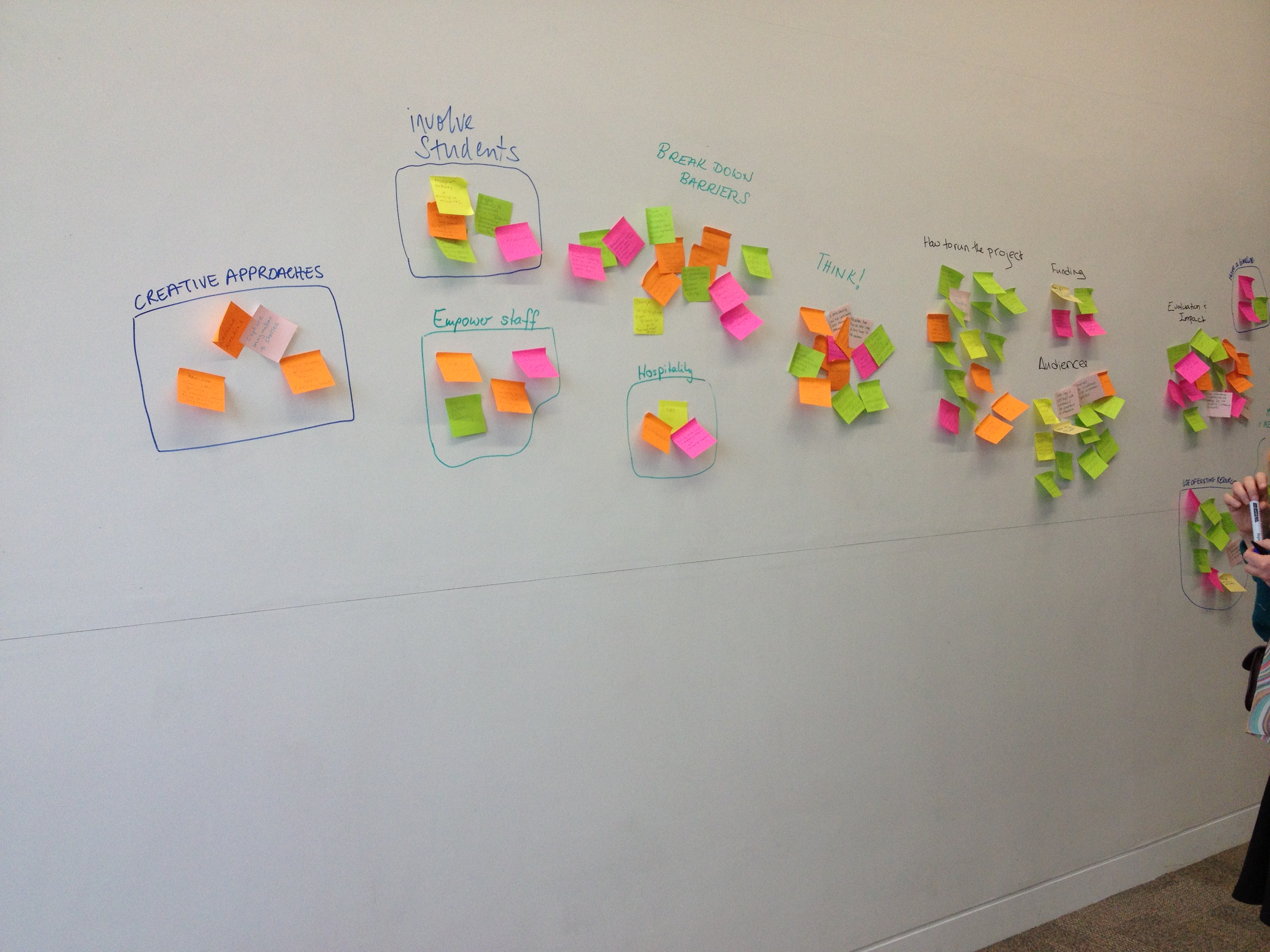
Cake: It may not be obvphotoious from this picture, but on one of the post-it notes in the ‘hospitality’ section is written the word ‘CAKE’.  This, along with all the other post-its, was part of a ‘brain dump’ exercise undertaken as part of a facilitated meeting of the Legacies of War steering group aimed at defining the next steps for the project.  The process took 3 busy very hours, moving from defining desirable outcomes for interested parties (individuals, funders and audiences, both in the flesh and on-line) through the brain-dump of achieving those ends to prioritizing aims and, via a series of specific questions, suggesting practical steps for achieving those priorities.

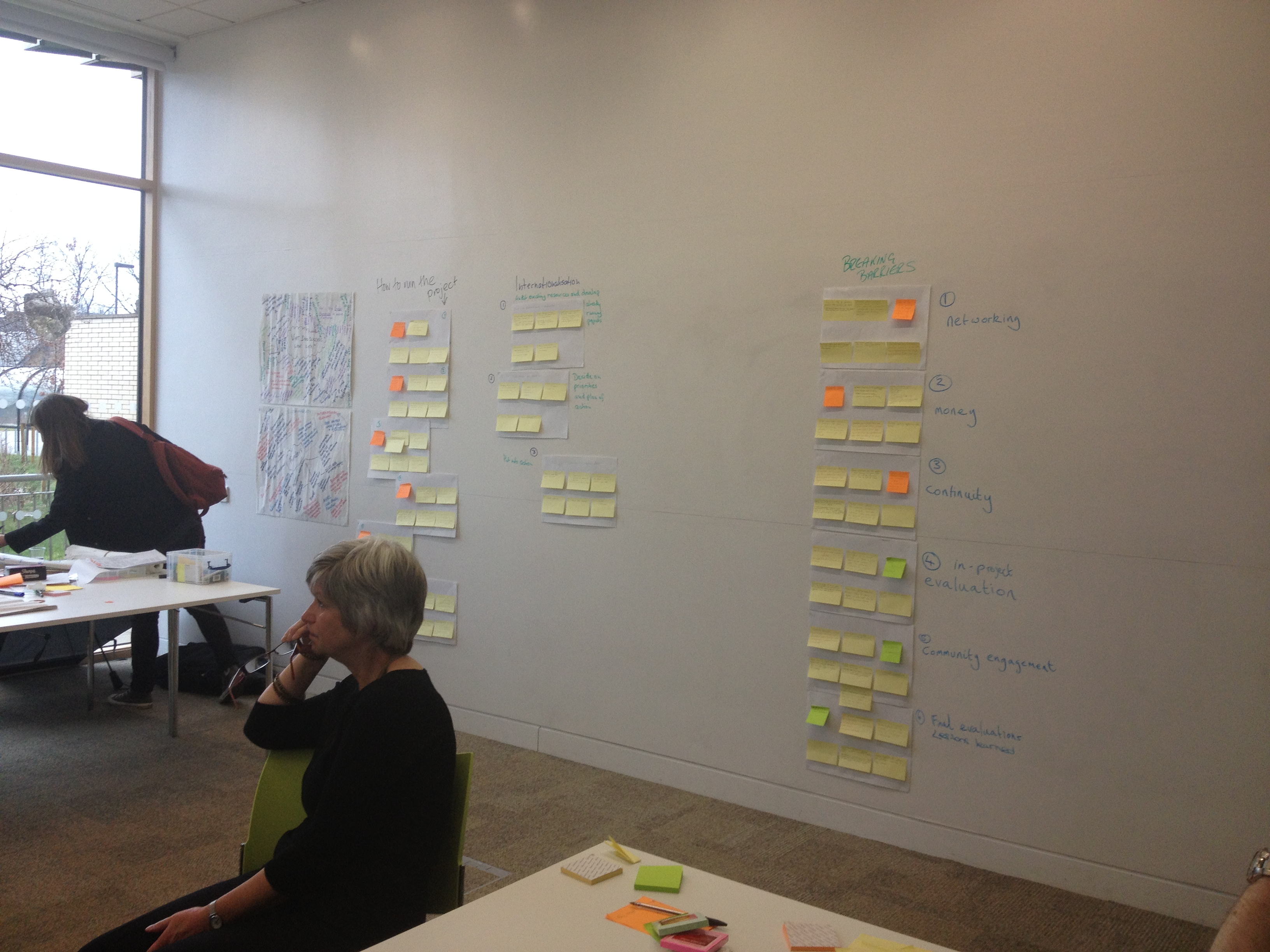
The final result was this:

photo (2)a rather neater arrangement of post-it notes.  ‘Cake’ did rather get lost in the shuffle, with priorities being defined as the way the project is run, locating the project in the international context of war commemoration and breaking down barriers. However a few immediate plans of action were decided upon and the process, unlike anything I have participated in before, was a fascinating experience.  I am not sure precisely how useful it would be more than very occasionally, but as a focusing exercise it certainly worked in the short term and hopefully will show results in the medium to long term as well.  And cake, we all concluded, is not a bad answer to any question.

Biscuits: Following this intense morning, four of us then headed over to the Imperial War Museum North for a meeting of regional scholars to discuss the forthcoming exhibition on the First World War in Manchester and the North West.  While the (very nice) biscuits were promoted as a principle attraction, the discussion of pretty much every aspect of the war, from recruitment and enlistment to demobilisation and disability managed to distract us from them most effectively.  The scope of the proposed exhibition is vast, covering aspects relating to both civil and military experience over the course of the entire war, with the locality serving as the focus.  As a result, I suspect the museum’s researchers got more than they perhaps bargained for in terms of suggestions of subjects to be pursued.  It will be very interesting to see how the project develops.  In the meantime, I got to take away a good deal of information about the demographics of the Manchester region c.1914 and some food for thought about population mobility in the years before the war.

Lemony pudding: These were the puddings on offer at lunch on the second day of the Social History Society conference, held at the beginning of the week.  I was only able to attend two days but those were both so full that I haven’t yet been able to fully absorb everything that I learned. Highlights were meeting Carina Peniston-Bird, with whom I had a chat over said lemony puddings, and Cath Feely, whose work on conscientious objectors’ reading in wartime is intriguing.  My top paper, though, has to be Helen Smith’s on masculinity and sexuality in northern working-class communities in the years just after the First World War with its important challenge to Joanna Bourke’s argument about male intimacy as a product of the trenches.  It reaffirmed for me the importance of work and professional identity as key to understanding masculinities, something that I need to explore more in relation to my ideas about the centrality of life cycle and maturity to these understandings as well.

So, lots to think about on all sorts of levels.  Never underestimate the power of dessert.

The historian wants a wife

It does seem appropriate that my son’s current favourite nursery rhyme is ‘The farmer wants a wife’, as that is precisely how I was feeling at 9:00 pm last night.

The background: my husband left yesterday for a week-long conference/collaboration exercise in France (not Sweden) yesterday afternoon.  In about an hour I will be heading downstairs to register for the Social History Society conference where I am giving a paper tomorrow morning.  This will be my first conference paper in about 5 years (I have given seminar papers, but the audiences have been fairly small), and the first on my new research.  I am terrified (not helped by the fact that the paper appears to be coming in five minutes too long).  On top of this, I now have a month to write two further 20-minute papers on two entirely different topics, and I am in the process of applying for funding and advertising a workshop.  Work is busy at the moment, to put it mildly.

So while my husband battled with a delayed flight and the language barrier of speaking minimal French, I spent yesterday evening doing the following: cooking dinner, feeding dinner to both children accompanied by my son’s interminable monologue which rather gets in the way of eating, getting both children undressed, bathed, redressed in night clothes, milk drunk, teeth brushed, stories read and into bed, putting on a load of washing, cleaning up the dinner table, washing the dishes and hoovering the floor.  I then managed to read through my conference paper (still coming in too long), tried to edit it down and read half an article.  At which point I realised my son was still awake (at gone 9) so I went and confiscated his globe, to much complaint.

Now, this isn’t a complaint about my husband’s relatively easy life.  For a start, it isn’t that easy as he hates travelling and the weather has made it more complicated and stressful than it need be.  Plus, when he is at home he pulls his weight on the domestic front (he does all the laundry for a start) and he will find himself in my position, trying to juggle domestic duties with paid employment, in a few weeks when I go on yet another trip to a distant archive. Rather I want to record my personal experience of a very old observation, to whit, that someone who works outside of the home, whatever their sex, needs domestic assistance if they are to do their paid job and run their home properly.  And I don’t just mean help with the cleaning or the childcare, but rather holistic assistance with household management. In other words, a housekeeper or, indeed, a housewife.  As I say, this is not new.  Many professional women have, over the years, argued that they need a wife in the home as much as a secretary at work to enable them to keep all the balls they juggle personally and professionally in the air. Some feminists have argued that domestic labour should be paid for and valued as highly as any other, given the support it provides to the smooth running of the economy.  And, indeed, the work of the housewife as a support to her husband’s career has, increasingly, been acknowledged in recent divorce settlements of self-made men in Britain. But coming from a home where domestic duties fall on both partners relatively evenly, as does the support given to both our outside jobs, this week looks set to be a valuable reiteration of the importance of the partnership I have with my husband in maintaining an even keel, both domestically and professionally.

In addition to a renewed realisation of the importance of the keeper of the home to productive employment outside it, my admiration for single parents has also reached one of its periodic peaks. I discovered this morning, for example, that we have half a tank of petrol in the car, so now I have to think about where to find a petrol station with pay-at-the-pump facilities because I will have both children in the car whenever I am driving this week. This is precisely the sort of detail that having a partner or assistant to share the burden of domestic tasks (if not take them over entirely) ensures is not forgotten.  We are at the start of the week.  I am just hoping that the end of it doesn’t find me and my children sitting by the side of the road somewhere between home and the university, desperately seeking assistance with moving a petrol-less car!

So what conclusions can I draw from my labours?  Nothing very original.  I know there are plenty of households with far more demands on their time and energy and far fewer resources than I can call upon.  But as the British government finds itself in the midst of debate over how to support working women through childcare subsidies it is perhaps worth reiterating that domestic labour is both time-consuming and vital.  It extends beyond being with children in their early years to ensuring the comfort, health and well-being of all members of a family, whatever shape that family may take, nurturing the energies and abilities of both of the economic producers of the present and of the future, as well as the comfort and happiness of citizens of all ages.  It needs to be valued as a public good, rather than dismissed as a private arrangement.  Debates over childcare are a start, but only a start and not a terribly helpful one if they alienate those who provide the domestic labour.

Now, what did I do with my daughter’s clean clothes for nursery?

AHRC ‘Connected Communities’ Showcase: 12th March, 2013

I have been spending the last several weeks frantically writing, something that may come as a bit of a surprise to any regular readers out there.  At the beginning of February I realized that I had three months to write three conference and/or seminar papers, plus several planning documents, so I have had to get my head down.  The results of my industry are drafts of a variety of things, including a call for papers that you will be seeing a lot more of in the future, I suspect.

In between writing and the general demands of family life, however, I also seem to have spent a great deal of time in London, mainly in relation to the AHRC and HLF-funded Research for Community Heritage project that I am now a postdoctoral research fellow for (this is in addition to my Wellcome fellowship which is on-going).  The project is part of phase two of the AHRC’s Connected Communities programme which is funding some 200 projects bringing together community groups and academic institutions in a variety of ways.  After a session on public engagement for postdoctoral fellows which I attended last week, this week I found myself in London again for a showcase event which allowed me to get a much better sense of the breadth of the programme, as well as bringing me into contact with an extraordinary range of highly engaged (and engaging) individuals.

The day started with a series of short presentations from representatives of the AHRC and the programme’s leadership fellows, followed by a key note address from David Willetts, the Minister of State for Universities and Science.  This sought to emphasize the importance he, as minister, placed on humanities and social science research which he believed to be a ‘bold, significant, world-class participant in UK research’.  He also labelled as ‘unfair’ the impression that the humanities had less connection with the wider world than the sciences.  I couldn’t help feeling there was an element of the lady protesting too much with this. Should the government really need to reassure arts and humanities researchers that they are just as important as all the big scientists and their funding, ring-fenced with funding for the sciences was safe?  If so, it must be down to the impression given by the policies and pronouncements of said government.  The message was also rather undermined by the answer given to a question from the floor about how arts and humanities researchers might influence policy, to the effect that ministers might be accessed via the chief scientist of each department.  Apparently this included social scientists.  I am not sure this was of much comfort to various groups whose excellent work in the arts, often in collaboration, was on display.

The bulk of the remainder of the day was an opportunity to explore the projects whose work was showcased around the venue and participate in breakout sessions.  I missed the session which involved weaving small circlets but did go to a showing of the Imperial War Museum’s film ‘Whose Remembrance?’, based on their on-going project into the black and colonial history of the world wars.  This was fascinating, not only because it tied so beautifully into last week’s Legacies of War seminar from Santanu Das, but also because of the questions it raised about how communities can be encouraged to engage with archives which, all too often they feel excluded from by institutional gate-keepers.  Given that communities are often the very sources that these archives spring from, this is something that needs to be tackled, something that I hope to contribute to through my work with groups involved in Research for Community Heritage.  Making sure that the Liddle and Bamji Collections here at Leeds are better known and fully exploited by all interested communities has suddenly become a very important part of what I am trying to do.  And I was very excited to make the acquaintance of  Cliff Pereira who worked on the Bamji Collection when it was still held in Sidcup.  My one reservation about the session was the rather London-centric nature of the discussion of archival resources.  Given the community-based nature of the research that Connected Communities supports, local and regional archives and their accessibility to community groups really needs to form part of the discussion.

Outside the breakout sessions there were 30-odd stands presenting information about a huge variety of projects.  Many involved mapping and I had long and potentially fruitful discussions with researchers from Birmingham and Bristol about how to present images and information relating to historical geography in an interesting and accessible way.  I ended the day with a fascinating conversation with Paul Crawford from University of Nottingham about health versus medical humanities which gave me some exciting new ideas about how to frame aspects of my own research.  The focus on community activity and expertise within healthcare implicit in health humanities is something that chimes with my long-term interests in the role of families in supporting disabled service personnel.

The formal schedule concluded with round-table discussion about how the Connected Communities project  could evolve in order to achieve ends that will include, as hoped by Keri Facer, one of the programme’s leadership fellows, a change in how universities approach and structure research in the arts and humanities.  Few definite conclusions were reached, but points were raised about interactions with other funding bodies, the need for spaces to share failures and discuss difficulties as well as celebrate achievements, international connections between communities, how resources can be made visible and accessible and, again, that question of how the research being undertaken might affect public policy.

All in all, it was a stimulating, if exhausting day (not helped by the cancellation of my train ‘due to technical failure’ which made it that much longer).  Quite apart from all the ideas generated for the various research projects I am engaged with, and the potential for at least one, if not two, new sources of funding for the Legacies of War project, it was my first experiment with live tweeting a professional event.  I am still not sure I have worked out how to do it.  I certainly wouldn’t want to try at an academic conference as I think I might do injustice to a denser, more complex argument simply through lack of proper concentration.  And I owe a huge apology to my friends and family who, through the linking of my twitter feed and Facebook page, were subjected to a stream of posts of little or no interest outside my professional sphere.  Yet again the question of the work/life balance raises its ugly head in the most unexpected places.

Santanu Das on India, Empire and the First World War

The next Legacies of War seminar will take place on 7th March at 5:00 pm in Michael Sadler Building, Room 3.11:

Santanu Das