Uncertain and Afraid

I sit down to write this at a quarter past eight (GMT) on New Year’s Eve. As has become my habit, since I started this blog, I want to take the opportunity to pause, as so many others do at this time of year, and assess all that has passed since I last wrote such a post. Like many of those others, this time I will also be reflecting on the changes the past ten years have wrought. While I know pedants will point out that the new decade doesn’t start until 2021, as a mathematician’s wife I believe in the reality and power of zero, and the the changing of the third as well as the fourth digit of the year seems a good moment to plant a marker in time.

Over the past six years, I have written about hard years, and harder ones. I have written about poetry, both that which has accompanied me since childhood and that which I have discovered more recently. I have written of my family and of my work, of triumphs and of troubles. I have tried, throughout, to write with hope. I hope this evening that, despite the title of this post, I can continue that tradition.

So, how has the last decade been for me? Hard is probably the right word for it. In January 2010 I was the married mother of a young son with a PhD but no career. My first book had been published for just under a year. I lived in a rented house without a garden in a city that, after two and half years, I was starting to learn to call home. I had a loving family, many of them far away. I was teaching myself to bake bread and trying, for the first time since I was an undergraduate, to write fiction. I wasn’t sure where I was going or what I was doing.

In the intervening years I have had my second child (a daughter) and written my second book. I have found and forged an academic career, winning two significant grants and moving from an ‘early career academic’ to a mid-career one. I have developed new skills as a teacher and public speaker. With my husband, I have bought two houses and sold one, both with gardens. I no longer live (although I still work) in the same city, but feel that yes, I have come home. I have gained a niece and a nephew (as well as an honourary niece and a goddaughter); I have lost both my parents. I have learned to cope with long-term illness in those I love best. I no longer bake bread but have become very good at preserving, particularly marmalade and sloe gin. I am teaching myself to quilt and am trying, for the first time in a decade, to write fiction. I sleep less and run (and shout) more. Robert Frost and W.H. Auden are still my favourite poets.

So where does this leave me, on the cusp of the new decade, one which many people are hailing as holding the possibility of being the new ‘Roaring Twenties’? As a historian of that decade, I can’t but be ambivalent about such predictions. The Twenties, after all, were, for many, a decade marked as much by violence, displacement, disability, poverty, joblessness and illness as by bootleg gin, jazz and art deco styling. This was the decade of the British General Strike and the art of Otto Dix, of the Irish War of Independence (and associated Civil War) and the Scopes Monkey Trial. And there are enough echoes in both the politics and public discourse of the present to make me feel wary. Like Auden, writing about the following decade, I cannot help but feel ‘uncertain and afraid/ As the clever hopes expire / Of a low, dishonest decade.’ [1]

This sense of uncertainty and fear is reflected in my feelings about my personal life. This coming year will see the end of the funding for my current project. I need to write up that research in some form(s) and work out what the next project is, and while I have some ideas for both, ideas which excite and enthuse me, I don’t have the energy I did a decade ago. I look back on the woman that I was and wonder how I could have achieved so much in such a short space of time. I can’t do that again, nor anything like it.

As I say, I still love my subject. I want to read and to write and to teach and to talk about it. But I cannot do it in the way I have been. Grief, and family life, and private passions have become part of my being in a way they weren’t a decade ago. I am still learning how to live with the weight they bring, the space they occupy as a professional historian.

So looking forward, for me I am not sure that the Twenties will roar. Instead, they will be slower, perhaps more considered, a time of conserving energy and prioritizing passions, of learning how to give of myself without losing myself. There will be more reading, and more writing, but probably more fiction and less history. There will, I hope, be a lot of gardening and cooking (although not immediately, as we are on the verge of ripping out and replacing our kitchen, an act weighted with a symbolic mixture of hope and frustration). There will be friends and family, new and old, near and far.

I don’t know if those ambitions and expectations are as hopeful as those I have looked forward to in earlier years, but they are what I have to fortify myself against exhaustion, uncertainty and fear. However modest or ambitious, I hope your own hopes for the coming year and years are fortifying and fulfilling.

Wishing you a very happy new year, one and all.

[1] W. H. Auden, ‘September 1st, 1939’, lines 3-5.

The Past is Personal

IMG_4813‘What do you think?’

It is a cold, wet morning in October last year and I am standing in an old Jewish cemetery in Hackney, looking at a newly unveiled sign, formed out of an old steel beam. On the plaque are etched the words:

Here lie Helena and Lehmann Glückstein.

Matriarch and patriarch of the family,

who founded the catering firm J. Lyons

and the tobacco retailer Salmon & Gluckstein

Whose legacy was:

Find a safe place. Love your family and friends.

Give back to society. Savour the good things.

Tell your story.

Pass it on.

What do I think? To be honest, I don’t know what to think. I am experiencing one of the worst weekends of my life. A carefully constructed complex of plans – to visit family, meet up with one of my mother’s oldest friends, attend this unveiling and deliver a keynote address – had all but foundered on the shoal of sudden family illness which had sent me pelting back from Doncaster to Hebden Bridge for a night, before trying again, with a revised schedule, the next day.

So here I am. My toes are freezing and I am fathoms deep in grief for my mother who had died two months before. She is the one who should have been here. This bit of family history was her project, the words on the memorial one of the last things we know that she heard, read out by my sister so that she could give her approval. I am here as her representative, and trying to express what she would have thought about this – the ceremony, the memorial – are beyond my ability to articulate or even, I realise, comprehend.

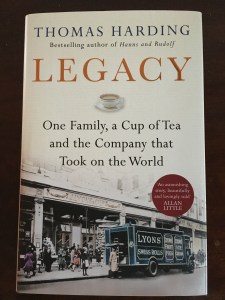
But if I am here to stand in for my mother, I am also here in my own right, both as a descendant of Helena and Lehmann, and as one of two professional historians present. The other is my interlocutor, Thomas Harding, my third cousin and the prime mover of this memorial project and the gathering we are at. He is also the author of the book, Legacy: One Family, a Cup of Tea and the Company that Took on the World, which was the original basis for both.

Nine months later, after the birth of my niece and nephew in the US, after the second memorial celebrating my mother’s life, after grief has had a chance to work its way into my heart and become part of my day-to-day life, I will read the book.  It will take me several weeks, read in gulps and dribbles between my commitments to work and childcare.

And what do I think of the book?

I’m still not quite sure I know. I cannot make the judgement as to whether or not it is an informative, perceptive, well-written history; I simply do not have that objectivity and, purely based on accepted professional ethics, I shouldn’t be reviewing it as all, as I, along with my siblings, appear in the acknowledgements. With my professional hat on, there are definite quibbles (is it really fair to quote an Orwell essay published in 1952 to illustrate a description of the Trocadero in 1897?), but this is a very different sort of history form that which I have written to date. As I try to write a more general ‘trade’ history of my own research, seeing how it can be done is extremely useful. And yes, I learned a huge amount, much of it absolutely fascinating, about the history of J. Lyons & Co. and its place in the social history of nineteenth and twentieth century Britain, as well as about the personal relations within the family. If the sign of a good book is the need to share it with others, then the many, many snippets and interesting facts I read aloud to my husband in bed in the evenings stand as testament to this one’s quality.

But in the end, I cannot read this book as I would any other history, academic or trade. It is, after all, the history of my family, or at least a partial history. As Thomas notes in the conclusion, the Salmon and Glückstein dynasties have, over the generations, developed an extraordinary number of off-shoots and ramifications, ranging across the globe. The impossibility of writing a comprehensive history of a family which contained 12 siblings in each of two generations and 14 in another (even if many didn’t survive childhood) means that strategies are needed to tell the family history of a family business empire. The one that Thomas has chosen is to focus on the lives and work of five men who form his own ancestry, Sam Salmon (his grandfather), Sir Isidore Salmon (his great-grandfather), Monte Gluckstein (his great-great uncle), Samuel Gluckstein (his great-great-great grandfather) and Lehmann Gluckstëin (Samuel’s father and the family patriarch).

In many ways, this strategy makes sense. Samuel was the entrepreneur behind the founding of Salmon & Gluckstein, Monte the moving force in turning the family firm into the empire that was J. Lyons and Co., Isidore the great example of the family’s assimilation into the British Establishment, Sam clearly Thomas’s closest personal tie to the family history as a remembered and clearly loved grandfather. For me, however, it was frustrating on two counts. Firstly, it left me with many questions about my own branch of the family.  Through my mother, I am descended from Julia Gluckstein, Samuel’s daughter, mother of Kitty, Isidore’s wife, and twin sister of Lena, herself Isidore’s mother (there is a notable tendency for cousins to marry in this generation of the family). Julia married Abraham Abrahams who, we are told in passing, drank whiskey, even in the mornings, and could be violent. This is not a comfortable history, but one I feel I should know more about than this book has (or perhaps can) give me.

Which relates to the second, larger source of frustration. While Julia and Abraham’s story is mentioned only in passing, as the context of Kitty and Isidore’s relationship, it becomes patently obvious throughout the sections on Monte that Julia’s twin, Lena, had a significant, not to say vital, role in the success and expansion of Salmon & Gluckstein. Lena is only the most obvious example because, although Thomas has chosen to focus on the men, the story of Salmon & Gluckstein, of J. Lyons, of ‘The Fund’ set up to share the profits across the family, is the story of women. It is the story of Helena, the family matriarch; it is the story of Lena, who managed the tobacconist business while her brother developed the catering firm; it is the story of Gluck, the gender non-conforming lesbian artist who flits in and out of the narrative across the twentieth century; it is the story of all the women of the family who were never allowed access to the ‘The Fund’ in their own right, with their dowries controlled by their fathers and brothers throughout the twentieth century; it is the story of Belinda, Thomas’s mother, whose voice provides much of the witness of later generations of the family.  Thomas acknowledges all this, but there remains a story to be told about these women themselves, rather than as part of a story structured around men.

But in the end, the telling of the story transcended these concerns for me. At its heart, as Thomas argues, it is a story of belonging, of finding a place in the world, in society, in a family, even if that place isn’t always secure or comfortable. The loss of my mother, with all its accompanying psychic dislocation, the selling of her apartment, which cut the last physical tie to the city of my birth, had shaken my sense of belonging – to Britain, to Yorkshire, to the academic community. But through this book I was able to at least start to find it again.

It was not just that Legacy introduced me to the history of my family in more depth and detail than I had known before (I had no idea of the important role the company had played in the development of ice cream as a leisure product in Britain). It was also, in part, my mother’s legacy to me, my siblings and our children. In the years before she died, she had, along with her cousin Susan, become deeply involved in researching the history of the family. Through Susan, she had been introduced to Thomas and had become involved in their plans for the memorial to Helena and Lehmann. That scene of her listening to the words of the memorial with us, her three children, gathered around her, is captured in the final pages of the book.

As a professional historian, I long resisted the tug of family history, proud as I have always been of its richness. I am still resisting, in many ways, telling myself that it can wait until the next book, the next project, the next grant application is complete. But now the years of research undertaken by my mother – the family trees which spread widthways across living room floors, the folders of letters, the books on nineteenth century catering – sit in three boxes in my office. My son has developed a passionate interest in the subject, asking to read the book. One day, and soon I suspect, I am going to have to open those boxes. They are going to become part of where I belong, professionally as well as personally.

So, as a historian, what do I think? I think that Thomas was right in the dedication he made in the copy of the book he gave to me and my siblings and, above all, in the words he chose for Helena and Lehmann’s memorial.

The past is personal. Tell your story. Pass it on.

Because Remembrance is more than an Act

The Unknown Soldier


When a delegate visits a foreign country,

He brings a crown of flowers for the grave of the Unknown Soldier.


If tomorrow, a delegate came to my country and asked me:

Where is the grave of the Unknown Soldier?


I would say: Sir,

At the bank of every stream

Under the dome of every mosque

At the doorstep of every house

Every church

Every cave

Under the boulder of every mountain

Under the branches of every garden in this country

Over every inch of earth

Under every yard of sky,

Don’t be afraid, bow your head, and there set down your crown of flowers.

Abdulla Pashew

This poem forms the epigraph to my brother’s book of photographs of Kurdistan: Sebastian Meyer, Under Every Yard of Sky, Red Hook Editions, 2019.

Writing/Not Writing

It is 3rd November. For the past week, I have been traveling with my children along the eastern seaboard of the US, visiting family members, including two very new additions in the form of my nephew and honourary niece. It has been a lovely, if exhausting half term, although I will admit that I am looking forward to spending some time away from my own children after ten days constantly in their company.

Being November, it is also both NaNoWriMo (National Novel Writing Month) and AcWriMo (Academic Writing Month). My Twitter feed is consequently full of friends, acquaintances and stranger posting their daily word counts, preparation spreadsheets, planned chapter breakdowns and research goals. As in previous years, these glimpses of others’ creative processes are inspiring and seductive. They also make me extremely jealous.

I would love to dedicate myself to a month-long writing marathon. It isn’t as if I don’t have plenty write, academic and otherwise. And I have been making some progress with all three academic projects, plus the two (yes, there is now a second) pieces of fiction that insist on intruding themselves into my creative brain space. But making the time and space to write every for a month? Ay, there’s the rub.

One AcWriMo video on YouTube offers to teach you ‘how to bend space and time to your will this November! Or, failing that, strategies to make all this writing fit into the life that you actually have, not the one you think you should have.’ Which sounds perfect, but I’m not sure that being on the road across three cities in ten days with two primary-school-age children and five bags is quite the real life the presenter had in mind. Even if I had the room to sit and write once the children were asleep (generally impossible in a shared hotel room with the lights switched out), I simply have not had the mental capacity to do anything other than switch off at the end of the day. And while we do arrive home tomorrow (hopefully to a car waiting for us at the train station and meal cooked by my husband) the combination of jetlag and all the stuff that will need catching up on after a week off work make carving out writing space on a daily basis a challenge I simply don’t think I am up to.

And yet here I am writing this. Nor has this trip been an entire void when it comes to making progress on various writing projects. A discussion with my sister-in-law has made me determined to actually complete the piece of fiction that I have made a 7,500-word start on, however long it takes. An afternoon walk around the monuments in DC in glorious autumn sunshine resulted in my finally working out what the Men, Women and Care book is going to be about, even if planning the actually outline was interspersed with tangential discourses on American history for the edification of my son. And the seven-hour train ride that we are currently embarked on as the first stage of our journey home looks to be providing a good opportunity to write not only this but also a bit more of the chapter on improvisation for the trade book on the RAMC that I am still determined to try to get an agent for.

So I many not have set pen to paper for the first two days of November. My chances of completing 50,000 words of fiction in the next three-and-a-bit weeks are slim-to-none, much as I would love to do so. And I will continue to produce my academic writing fueled by deadline-induced panic rather than the allocation of dedicated time on a daily basis. Maybe NaNoWriMo or AcWriMo will happen for me next year. I am sure that I will have things to write when they roll around again. In the meantime, if you are taking up the challenge of either (or both) this year, I wish you the best of luck and may the words (and the hours) be kind to you.

The Return of Downton Abbey

DowntonAbbey2019PosterI went to see Downton Abbey, the film, last night. Well, I had to, didn’t I, given that I have written about it with enough seriousness that I am seriously considering including my article on the television programme as part of my REF submission slate? And yes, I enjoyed it, a couple of hours of beautiful costumes and historical and dramatic silliness.

But goodness me, what a shaggy dog story of a narrative! Branson alone had three different plots – a Boys’ Own Paper adventure, a Mills & Boon romance and an encounter with Princess Mary that was so underdeveloped that it’s origins and significance were completely obscure. Given that pretty much every one of the major characters, both upstairs and downstairs, had their own plot lines (sometimes multiple), encompassing pregnancy (wanted and unwanted), illness, power struggles, theft and sexual jealousy, there really was far too much going on. There was also, particularly towards the end, some extremely heavy-handed special pleading for the significance of the aristocracy to national life which felt out of time. It was, as David Cannadine has argued, ‘the period since the Second World War [which] has seen the almost total disintegratin of patrician high society’. [1] I don’t believe that Lady Mary would have needed telling by anyone that the Big House formed the centre of community life c.1927.

There were other moments where, as so often with Downton, I found it hard to sustain my suspension of historical disbelief. The relationship between Princess Mary and Lord Lascelles was one, principally because, for all the focus on the King and Queen’s anxiety about their daughter and her relationship, the characters were entirely undeveloped. I don’t know enough royal history to comment on how accurate even this superficial representation of their relationship might be in relation to the historical record. However, the dramatic arc made no sort of psychological sense purely in terms of the portrayal of the characters as human beings.

The storyline that really had me yelling at the screen (internally at least, so as not to spoil the enjoyment of my viewing companions who had kindly included me on their evening out), however, was that involving, yet again, Thomas Barrow. I have noted before how Barrow’s identity as a gay man in an era when sexual activity between men was illegal and subject to prosecution has been used by the programme to obscure more interesting histories of medicine and war disability. This time, this identity was given a social, rather than a medical, storyline to make a plea for tolerance of difference in sexuality that was framed as modern beyond the scope of 1920s imagination. Yet just because sex between men was illegal in interwar Britain does not mean that it was either unimaginable or unknown at the time. Barrow’s naive wonder at the all-male dance club that he is taken to suggests a life entirely sheltered from same-sex encounters. Yet we know that he served as a soldier during the war, when the sight of men dancing together would not have been either unknown or particular shocking in male dominated spaces of rest and relaxation. Nor, indeed, as Helen Smith has pointed out, would Barrow have had to have left Yorkshire to encounter the idea of sex between men as part of a range of expressions of sexual desire (although the club itself appears to be a less likely phenomenon to be found in a city like York). As Smith notes:

Encounters took place all over the region, and were not limited to large towns and cities. … Away from work, men met in pubs, cafes, toilets, urinals and the street, often with the purpose of sex in mind. However, the north differed from London, as well as from large American cities such as New York and San Francisco, in that these venues of sex and socialisation did not become linked to form a distinct and often visible subculture. These examples of sex between men still operated under the veil of discretion and privacy … and this ensured that venues where men could meet other men for sex remained part of the wider landscape of working-class social life and entertainment. [2]

Smith’s argument is mainly concerned with working-class men in industrial occupations in the region. Working in domestic service in a rural location may have isolated Barrow, but I can’t quite believe that, at his time of life, he would be as innocent as he is portrayed here.

None of which is to suggest that I didn’t enjoy the film, not least because one of the pleasures of watching Downton for me has always been the opportunity to pick historical holes in the plot and presentation. But there were also incidental pleasures: drooling over the costumes, particularly the hats and tiaras, the former of which has inspired me to branch out from my collection of cloches to search for a) something like Lady Mary’s feminine pseudo-Homburg and b) an a-symetrical number as modeled by the incomparable Dowager Duchess of Grantham; the joy of  Maggie Smith out-act everyone else on screen with the mere lift of an eyebrow; watching Smith, Penelope Wilton and Imelda Staunton enjoying themselves doing what they love so well. And there were the cultural references, intended or not, which kept me amused throughout. From the visual reference of The Night Mail in the opening sequence through the BOP and Mills & Boon plots involving Branson already noted to the undeniable overtones of Bertie Wooster’s morning-after recollections in the raid on the nightclub, Julian Fellowes once again plundered the culture of interwar Britain for his ideas and images. There was even a bit of Laurel and Hardy slapstick in Mrs Patmore’s subversion of Mr Wilson.

So, yes, I enjoyed myself. The film ticks all the boxes I wanted it to – luscious visuals, good, comforting acting by familiar faces, some good, if rather obvious jokes, and just enough historical anachronism to keep me nicely irritated. I’m not sure I would recommend it as such, but I am glad to have seen it.

[1] David Cannadine, The Decline and Fall of the British Aristocracy (New York: Anchor Books, 1992), p.691.

[2] Helen Smith, Masculinity, Class and Same-Sex Desire in Industrial England, 1895-1957 (Basingstoke: Palgrave Macmillan, 2015), p.154.

Doing History in Public Again

IMG_4460I was on television last night. If you follow me on Twitter, then you will probably have seen this already. Given that I was speaking to Daniel Radcliffe for Who Do You Think You Are?, both I and my department were quite keen to publicise this event.  Since the broadcast, there has been quite a lot more interest, and some very interesting discussions about historical research for factual television, letters from women to soldiers during the First World War, and the significance of the Commonwealth War Graves cemetery at Dud Corner. In other words, this bit of academic public engagement, me bringing my historical expertise to bear on a popular subject in a very public forum, went as well as I could have hoped when my meeting with Dan was filmed back in May.

What has made this experience slightly ironic, however, is the coincidence of the publication of an article in The Economist late last week. Entitled The study of history is in decline in Britain’, it argues that historians (by which the author, ‘Bagehot’, means academic historians) ‘increasingly devote themselves to subjects other than great matters of state: the history of the marginal rather than the powerful, the poor rather than the rich, everyday life rather than Parliament. These fashions were a valuable corrective to an old-school history that focused almost exclusively on the deeds of white men, particularly politicians. But they have gone too far. … What were once lively new ideas have degenerated into tired orthodoxies, while vital areas of the past, such as constitutional and military affairs, are all but ignored.’ While some historians, the author graciously acknowledges, do ‘demonstrate a genius for bringing their subject alive’, they are, he claims, either not in academic posts or ‘face brickbats and backbiting from their fellow professionals’. Military history, according to the author, is catered for entirely by non-academic historians. Academics he (an educated guess at the gender of the author) argues ‘need to escape from their intellectual caves and start paying more attention to big subjects such as the history of politics, power and nation-states.’

Now, I make no claims to having a genius for bringing my subject to life but, like all my colleagues doing our best to work with the current impact agenda, I am fully aware of the dangers of ‘learning more and more about less and less, producing narrow PhDs and turning them into monographs and academic articles, in the hamster-wheel pursuit of tenure and promotion.’ I don’t want to speak only to other historians, which is precisely why I jumped at the chance to appear on a nationally broadcast, BAFTA-winning programme which, for the first time in its history, was touching on a subject about which I had written a book.  I hope and believe that my enthusiasm for the subject and the relevance of the type of document I was exploring with Dan came across, even if there wasn’t time or space for our discussion of the references to the Easter Uprising that occur in one letter, or the contemporary political significance of separation allowances as a form of proto-welfare benefit. Similarly, I hope and believe that the public lectures I gave on the ranks and work of RAMC throughout the First World War centenary and the variety of resources I helped produce for schools on the medical history of the war helped to both nurture public interest in history as a subject and inform debate over the relevance of the past to the social challenges of the present.

The problem isn’t that academic historians don’t do public history. We do, in far more ways than publishing books or appearing on television, as I have noted previously. Nor is it that we ignore war, politics or power structures by focusing on ‘marginal’ subjects. Social and cultural histories simply provide another way of looking at war, politics, economics, diplomacy. Indeed, the interrogation power structures are their very fabric, not their antithesis. I would strongly recommend Dr Daniel Todman’s (QMUL) acclaimed two-volume social history of the Second World War to Bagehot’s attention to see what I mean.

Rather, the problem is that public history is a different discipline from academic history. Doing both well is possible for a single individual, but it is hard and time-consuming, especially when added to the other expectations of teaching, administration, pastoral care and grant capture that are expected of academics today.  I am becoming increasingly aware of just how different and difficult a discipline it is as I work to turn my academic research into a ‘trade’ book for wider public consumption (although even in its academic form it is free of charge to download, and I have been honoured to have it recommended as a useful resource for GCSE teacing). Even if I succeed in doing so, I doubt that the ultimate product will have anything like the breadth of impact that 5 minutes of speaking with the man who played Harry Potter about some of the work I did for my PhD and turned into an academic monograph has had. But that isn’t going to stop me trying because I am historian, even if one who happens to work in an academic job. And I believe from my experience in engaging with the public that people are interested in listening to these stories of those on the margins, including those on the margins in wartime, and hearing what they have to say about the world they lived in and how it shaped the world in which we live in today, even if Bagehot does not.

Three books (and counting)

My children finished school for the academic year today. Universities have been celebrating graduations. Emails about induction week are starting to circulate. It must be the start of the summer holidays.

This summer, in between childcare duties, I have several projects to work on – a couple of applications, two articles to (re)write, a very overdue book review, some engagement events to prep for. But my main goal, as I keep telling people, is working out what my next book is going to be about. And the problem I have (which is a nice one to have, but no less problematic for that) is an embarrassment of riches. I have three possibilities but probably only the mental space and energy to concentrate on one of them. They are as follows:

1) The book I need to write. This is the book I have promised the funders that I would produce from the Men, Women and Care project. It is a book about disability, masculinity, temporality and the life cycle; about care giving, emotions and gender; about the history of the welfare state, the family and the role of the individual in negotiating the spaces where the two overlap. It will be a very academic book, a book which will use words like ‘temporality’, ‘hegemony’ and even, if today’s reading is anything to go by, even ‘phenomenology’. It is a book that may, eventually becoming the articulation of the most significant intervention I will ever make into the historiography of masculinities and the First World War. At the moment, it is unfocused and under-researched.

2) The book I have promised myself I will write. In January, I tweeted that my resolution for the year was to write the ‘trade’ version of my recent academic book on the history of the RAMC in the First World War. This one, I have done the research on. I also have a chapter and a half in draft, about five different plans of chapter breakdowns and a great deal of excellent advice from colleagues about how to approach this project. What I don’t have, yet, is either a clear, saleable thesis, or a proper strategy for finding myself an agent, which is very much the next thing I need to do to get this off the ground.

3) The book I want to write. For years now I have been talking about doing a project on the representation of trauma in detective fiction – and I still want to do it, not least so I can write properly Ellis Peters’ George Felse novels. But, after talking about the project for so long without actually doing anything about it, I am starting to think there may be a less academic, more experimental book that I need to write first, about Golden Age detective fiction and contemporary novels set in the Golden Age, how both use images of and references to the First World War and what the differences between these two forms of the genre can tell us about gender, memory and commemoration. I’m pretty sure I have the argument for this one, and I find myself writing bits and pieces at odd intervals, but I also need to dedicate a lot more time to (re)reading the works of Jacqueline Winspear, Frances Brody, Kerry Greenwood, as well as some of the more obscure members of the Detection Club if this is going to be the book I really want it to be.

So those are my options, three projects, all of which require time commitment in different ways. Alongside the continuing work needed for the final year of Men, Women and Care, the teaching and administration I’ve agreed to undertake and my family commitments, there is barely room for one of them, let alone all three! So I am looking for advice: which one of these do I prioritise this summer?

(And the ‘and counting’? That would be the book I dream of writing – the detective novel in the style of Dorothy L. Sayers, with a plot based around an ex-servicemen’s association and post-war battlefield pilgrimages. Some day…)

Letters from the Past

It has been a long time since my last post. There is no specific reason. Life has remained busy, but not significantly busier than any other period in the years since I started this blog. But it has been harder to write, not just blog posts but everything – book reviews, articles, conference presentations, even emails. With the official publication of An Equal Burden in February, the pressure to write regularly has been lessened, and there has also been the on-going challenge of dealing with the emotions around my mother’s death.

The second of these has, I think, had the more profound impact on my failure to write here. In the first place, Mum was integral to this blog from the moment I set it up; from the start, she was my imagined audience, the person I so often wrote for. It was her voice in my ear telling me that my use of language was too academic, advising me to write shorter, clearer sentences, reminding to proofread multiple times before publishing. But there have also been other emotions that have arisen every time I have thought about writing here, relating to the points where my private and professional life intersect. Prime among these have been regret that Mum didn’t live long enough to see the book published – although she did get to see proofs of the cover – and guilt about how, as a social historian, I dealt with a very small part of my mother’s legacy.

It feels as if it is probably too late celebrate the book publication on here. There will be a formal launch in September (if I can ever pin down a suitable venue!) which may provide another opportunity. But, after several months of saying that I need to tell and reflexively explore the story of how I failed as a historian when clearing my mother’s apartment, this feels like the right time to do so, and, in doing so, start to revivify this blog.

So, the story. Mum died at the end of August 2018 in New York City. Both my siblings and I were at her side but both my sister (who lives in Colorado) had family and professional claims on us that meant we needed to return home soon after. There was no funeral but we made plans for a memorial service in the city in November, with my sister and I staying on for a week afterwards to help clear Mum’s apartment in preparation for its sale.

That week was, without question, one of the hardest of my life. We had moved to the apartment when I was 18 months old. It was the only childhood home my siblings had known, as well as being the place my mother drew her final breath. It had been renovated to suit her taste and was filled to the brim with her things – not only over 6,000 books but a lifetime’s collection of cooking equipment, bedding, family photographs and writings. There was all the medication from her final illness, but also all the audiotapes we had listened to on car rides as children, as well as enough stationary to keep a small company going for several years.

It took the three of us, supported by my brother- and sister-in-law, the full week to sort and clear the bulk of it. The most exhausting elements were the photographs and writings that my mother had stored in cupboards and boxes all over the house, sometimes in multiple copies. Either through a historical instinct to archive and preserve, or because I am naturally more sentimental, I chose to keep a larger number photographs and many of the papers relating to my mother’s education and professional life (although my brother has her computer hard drive, copied onto multiple external drives, a process which in itself took most of the week). I also took the bulk of the family archive, the documents relating to my mother’s parents and grandparents, including all the material she had collected researching her family’s history in her final years.

It was on the final day, the day my sister and her husband were flying out, the day before I was leaving to return to the UK, that it happened. I was going through the last few storage boxes in Mum’s bedroom that, somehow, hadn’t yet been looked at. Most contained books related to her teaching and additional copies of essays from her Master’s Degree course at Columbia. The books would be donated; the papers could be destroyed. But, right at the end, I cam across the two boxes of letters. The first was easy enough to deal with as it contained her correspondence with my father over the course of their courtship and marriage; those would come with me as part of her archive. The second also contained letters, but this time in many, and often unfamiliar, handwritings. Some were from names I knew; others were apparent strangers. It took me a moment to realise that this was the correspondence my mother had received as a young Englishwoman living in New York in the years before not only the internet but even inexpensive international telephony. They were letters from friends about her life and theirs, full of news and names, most of which meant little to me.

For several minutes I sat looking at this collection. I couldn’t face going through it to see what should be kept and what discarded. I could have simply decided to bring it home with me, along with all the rest of the family papers, to put off the task to another day. But could I ever face it? Or I could have brought it home to keep unsorted, preserving these scraps of source material for someone else to examine. Yet so much of the material was from people I did not know even in terms of their relationship with my mother, rendering the letters themselves without meaning. Did I have the space to house these documents. I did not have the capacity, either emotional or physical to deal with them.

Yet I also found I did not have the emotional capacity to destroy them. I am a social and cultural historian. Letters, and personal letters in particular, are the lifeblood of my research. I can sit for days in archives reading just the sort of daily minutiae my mother’s letters contained about total strangers, sifting the in jokes and family gossip for words and phrases that illuminate their lives and experiences. My mother’s letters might, just might, be of equal value to some other, more dispassionate, reader, some day. Shredding them would destroy that capacity for ever – and even if I could have found an archive willing to take them, arranging this in the 24 hours I had left in the country would have been a logistic impossibility.

In the end, the only response I had to this dilemma was the instinctive one of the exhausted child – I fled to the room I had been sleeping in (my brother’s old bedroom), shut the door and howled. My sister, packing cleaning products in the kitchen next door, heard me and came to find out what was going on. I tried to explain through my tears, failed, and begged her to deal with the box. I couldn’t. More practical and less sentimental than I am, as well as a nurse by training and profession, she promptly shred them.

So the letters are gone, but as this post indicates, they haunt me still. As a daughter, I couldn’t give them space, either physically or emotionally. I know this now as clearly as I did that day in November. As a historian, I will always feel guilt that I was unable to do so. Some day a historian will write the quotidian history of transatlantic relations in the late 20th century, and I will wonder what they might have learned from that box of letters, that little bit of lost history.

What have I learned from this experience?  Nine months on I’m still not quite sure. That the materiality and emotionality of archives touches not just the creator of the sources and the historian examining it, but potentially anyone who encounters them in the process of their conservation, perhaps. Certainly I will return to the archives with a renewed respect for all those who, in the midst of mourning, found the capacity to preserve the past simply for the sake of that preservation.

In the meantime, five boxes and two folders of family history, including my father’s letters, sit in front of me as I write this. My ten-year-old son has, since his grandmother’s death, become fascinated by finding out more about his heritage. I have promised him we can open the boxes and start exploring them together this summer. Hopefully, as both a daughter and a mother, I can find the strength and courage to make good this promise.

Counting the War Injured

Cross-posted from the Men, Women and Care blog:

In a Twitter discussion sparked by the BBC’s screening of Peter Jackson’s ‘They Shall Not Grow Old’ in November, Greg Jenner quoted the statistic that nearly 90% of British servicemen returned home and that half of these were injured. The first statistic didn’t worry me. 88% is the generally accepted rate of survival for the conflict, although it appears high in the context of a cultural narrative which emphasises the death and destruction of the war above all else. The second figure, however, was not one I recognised from my research into disable ex-servicemen of the conflict, so I asked Greg where he had got his figures from, as my own estimate is that about 30% of men returned from service did so suffering from illness or injury. What resulted was a conversation that, as I noted at the time, was one I wasn’t in a position to engage in properly, given that I was lying in bed, attempting to tweet on my iPad after a very long day listening to my son sing in choir at a large-scale Remembrance Service. This, then, is my attempt to think through the issues raised by Greg’s tweet, and my querying of it.

To start with the problem, which is that I believe 50% of all men returning from the war as injured to be an overestimate.  Greg’s figure, which comes from the Imperial War Museums and has been cited by a number of historians over the years, is based on the official Statistics of the Military Effort of the British Empire During the Great War: 1914-1920. The summary table of the ‘Total per cent of Battle Casualties and Deaths’, which is tabulated by theatre, gives the rate as 5 casualties to every 9 men sent out to France, 2 to every 9 men sent to the Dardanelles, 2 to every 12.5 men sent to Mesopotamia and smaller ratios for other theatres, including Salonika, East Africa, Egypt and Italy. In percentage terms, this works out at 56% for France, 23% for the Dardanelles, 16% for Mesopotamia and smaller percentages for other theatres. The total percentage of casualties across all theatres has not been calculated, although the History of the Great War Based on Official Documents: Medical Services: Casualties and Medical Statistics of the Great War states that ‘the total numbers affected by war service, in the sense of death or some form of war disablement for which State compensation was given, may be estimated at approximately 2,414,000 or 40.2 per cent. of those who served.’[1]

There are some problems with these figures, however. First, figures from the Statistics of the British War Effort include casualties not only from Britain but from the colonies and dominions as well. The statistics cannot, therefore, be considered reliable in discussions of the effect of casualty numbers on British society alone. They force us to think about Britain as a colonial actor in this period, but do make local and regional analyses much harder.

Second, the inclusion deaths in the count of battle casualties makes it much harder to evaluate how many men returned from the war injured or ill. If we could calculate the total percentage of casualties due to death, injury and illness across all theatres, we could subtract the accepted 12% mortality rate that is the generally accepted figure for the British armed forces. But we don’t have that figure. The percentage of battle casualties does distinguish between ‘killed and died’, ‘wounded’ and ‘missing and prisoners’ for each theatre, but specifically excludes casualties due to sickness. The medical services statistics, meanwhile, only counts those in acknowledged as ill or wounded by the Ministry of Pensions, not all those who became casualties during the war.

This raises the question of what is meant by casualty even when deaths are discounted from the numbers. I have focussed on the word injury throughout my discussion so far, reflecting the omission of the sick from the official calculations. But men did not become casualties only through injury, that is damage caused by accident or attack. Many casualties, particularly in the Middle East, were the result of illnesses, including those which could persist long after demobilisation, such as malaria or the rather general ‘debility’, or physical weakness resulting from other illness. [2] Some illnesses, perhaps most notability heart conditions, were the result of aggravation of pre-existing conditions by the experience of war, conditions that had either been missed in hurried medical inspections [3] or had been dismissed as not severe enough to affect a man’s service in light of the ever-increasing military demands for manpower. To say that these men returned from the war suffering from injuries would be inaccurate, yet they undoubtedly returned from the war suffering from physical consequences of their service, whether attributable to or aggravated by it.

Sickness rates are analysed in the official statistics, as part of the wastage rates. Also tabulated under ‘wastage’ are statistics relating to multiple injuries. A single injury does not equate to a single man injured. Because of the military priority for manpower, the work of the medical services aimed at conserving manpower through not only the treatment of wounded men but also their rehabilitation for return to active service where possible. Wounded men were thus often recycled through the military medical system, some multiple times for multiple injuries. This repetition and overlap is at least partially captured in the statistics, but not in a way that makes clear how this affected the headline figure.

Finally, there is the problem of the invisible injury and underdiagnosis in the casualty rates as defined by the official statistics. The most obvious example of this is, of course, psychological traumas which are generally accepted as being underdiagnosed by the British military medical authorities throughout the war, in part due to the social stigma attached to such traumas and in part due to lack of medical understanding of the conditions. (These two things are, of course, related.) It is worth noting, however, that underdiagnosed invisible injury also includes conditions such as hearing loss, where diagnosis had to be based on highly subjective observations. The existence of both invisible injury and the stigma attached to it has led several historians, most notably Jay Winter, in a lecture at the British Academy in 2014, to suggest that might higher numbers of men suffered from disabling traumas than is reflected in official statistics. While the statistics do, undoubtedly, underestimate the number of men so injured in war, the methodology used to arrive at the figure of 25% quoted by Jay remains somewhat opaque.

Nonetheless, it is possible that the numbers of invisibly injured undiagnosed and therefore uncounted in the official statistics cancels out the overcounting of individual men who suffered multiple injuries and illnesses. There is no way, from the statistics available, to demonstrate this, so that 50% feels like a guess rather than solid estimate. Which brings us to the figure that I have been using in my research, also drawn from the official statistics, this time those relating to the men in receipt of some sort of support from the Ministry of Pensions up to 31st March, 1930. This figure is given as 1,664,000 or 27.7% of those who served. [4] Based on the mortality rate of 12%, this gives a figure of 31.5% of those who returned from the war suffering from an attributable illness or injury sufficiently serious enough to warrant a pension or gratuity.

Again, we have to qualify what is being counted here. Men in receipt of either a gratuity or pension from the Ministry of Pensions could do so for either an illness or an injury, so they cannot be described solely as injured men. To receive support they had to show that the illness or injury was either attributable or aggravated by the war, with aggravated conditions often disallowed for support. Other exclusions included injuries caused by carelessness or those deemed to be self-inflicted. Then there is the issue of self-reporting. Pension had to be applied for; ill or wounded servicemen were not automatically assessed for them, although Article 9 of the Pensions Bill gave them the right to apply for a pension following discharge if attributability or aggravation could be demonstrated.  Some men did not apply for a war pension because they had sufficient income not to need additional support; other viewed any sort of state support as associated with the heavily stigmatised aid of the New Poor Law and the workhouse, or else as a form of dependence that was at odds with their subjective sense of self as independent male breadwinners. Of course, the willingness to define oneself as disabled by war might change over time and with circumstances. A wound or illness might deteriorate; financial circumstances might change for the worse. A man reluctant to apply for a pension in 1919 might feel he had no other option in 1927, although he might have a harder time proving attributability at that distance from the point of illness or injury.[5]

So just over 30% of men returning from the war injured or ill is almost certainly an underestimate, but by as much as 20% or 1,056,400 men?  Even in the circumstances, that seems too big a margin of error to me. So I would conclude, not very helpfully, perhaps, that the actual figure falls somewhere between the two, probably more than the 1.7 million men noted by the official statistics but not as many as 2.7 million. If we wanted to talk in round figures, about 2 million men would seem as close a guestimate as can be made on the figures currently available.  According to the Office for National Statistics, the UK population in 1929 was estimated at 45.7 million. Disabled ex-servicemen, it can therefore be argued, made up approximately 4.5% of the British population. But this figure comes, as we have seen, with all sorts of qualifications.

In his statistical examination of casualty records, Those We Forget (2014), David Noonan is sharply critical of the statistical methodologies of all the official histories of the war efforts of Britain and her Dominions. Noonan has attempted a statistical revision of the Australian official record. A similar exercise has yet to be carried out in relation to the British armed services from the First World War, although, in comparison to Noonan, who used the well-preserved embarkation records of Australian First World War servicemen for his re-evaluation, historians of the British armed forces face greater difficulties due to the loss of relevant documentation over the years. Nonetheless, it behoves us to treat the statistics of the war effort, official or otherwise, with critical care. As I hope this post has demonstrated, quantitative analysis can throw up a range of interesting nuances in relation to questions about the social impact of mortality, survival and illness, even if the numbers can’t answer our questions as clearly or easily as we might hope.


[1] T.J. Mitchell and G. M. Smith, History of the Great War Based on Official Documents: Medical Services: Casualties and Medical Statistics of the Great War (Imperial War Museum, 1997; originally released 1931), p.315.

[2] David Noonan, in his statistical analysis of Australian casualty records, defines debility as a euphemism for psychological trauma in the records. There is, however, no evidence that this was, in fact, how it was used at the time.

[3] See J.M. Winter The Great War and the British People (Basingstoke: Macmillan Eduction, 1985), pp.48-64.

[4] Mitchell and Smith, Medical Services, p.315.

[5] This discrepancy can, perhaps, be seen in the estimate of the the International Labour Office of 1.7 million British ex-servicemen suffering from war-attributable disability in 1921, a year after the official statistics recorded 1.4 million men being granted a pension or gratuity for war-atributable disability. ‘Studies and Reports: The Compulsory Employment of Disabled Men’, Series E, no.2, International Labour Office (Geneva, 1921), p.2. I am indebted to Bethany Rowley for providing me with this figure and reference.

A harder year

Three years ago, I posted an end-of-year reflection entitled ‘A Hard Year’. That year was, indeed, a hard year, as were the two years that came after, filled as they were with the stresses of family illnesses and the labour of writing my book and getting a large project off the ground. None of these, however, can bear comparison with this year, a year that will forever be marked by the terrifying speed with which my mother’s cancer accelerated, the intensity of helping care for her in the final month of her life and the grief induced by her death and the emotional aftermath of commemorating her and clearing her apartment, the home I grew up in, of a lifetime of objects and memories. Nothing could prepare me for facing how hard this would be; that I have survived this year with my marriage intact, my children alive and thriving and my relationships with my family and friends (particularly my two wonderful siblings) more or less intact is a source of wonder and amazement.

Because this year was never solely about loss, grief and mourning. There has been a great deal of happiness, joy, even plain old contentment, from my brother’s wedding through hot summer days spent clearing the garden to one of the happiest Christmas Days I have had in several years. Moving to a house that I grow to love more with each day (in spite of the daunting amount of work that needs doing to it) in a community that has been immensely welcoming has been the biggest source of happiness, even if it has made getting to and from work considerably more complicated.

You may have noticed by now that all of the things I have mentioned as shaping and defining my year have been those associated with my private, rather than my professional life, and this isn’t only because my professional life has increasingly been circumscribed by commuting and the incompetence of Northern Rail. Professionally, this has felt very much like a holding year, albeit one in which I published an article and completed the editing, copy-editing and other production matter on my book. I have worked on various bits of writing, presented at a couple of conferences, explored the possibilities of future intellectual enquiry, manage the project I am currently engaged on. But any accomplishments of the year have been acheived by those with whom it is my pleasure and privilege to work – students completing milestones in their research, colleagues completing books, my post-doc organising a successful and rightfully praised conference as part of Men, Women and Care project.

This has felt okay, even necessary – a moment taken to recalibrate at the end of one venture, the middle of another and the very faint possibility of the beginning of a third. It will provide, I hope, the basis of consolidating the gains made and putting into practice ideas which have been given some time to germinate, particularly around the direction of the International Society for First World War Studies. But if it has meant that my personal life has been the most dominant force in shaping my memories of this year, this professional breath has also provided the space to make some unexpected connections between intense personal experiences and my professional historical understanding.

As I wrote previously, caring for my mother allowed me to make a more profound connection, both intellectual and emotional, with the historical work of caring undertaken historically by women in the home, the sort of care which is going to be the subject of my next book. But, since my son has started singing in a church choir a half hour drive from our home, requiring me to act as a ferrying service, I have found myself attending church regularly. While this hasn’t altered my personal belief or relationship to faith, it has given me time to reflect, sitting under the regimental monument listing all the great engagements of the First World War, on the place of faith and worship in the lives of those I study. The routine and rhythm of the cycle of services, the music created by voice and organ, the ceremony and ceremonial may not have brought me closer to God, but may have brought me closer to my historical subjects in whose lives faith played so much greater a regular part than it does in British society today. It is something I am struggling to articulate, although I hope to do so in a blog on Sarah Phelps’s adaptation of The ABC Murders for BBC1 in the next couple of weeks.

There will be other blog posts, too, in the new year, as well as other work to be done, not least the continued population of the Men, Women and Care database, which is already throwing up interesting material. There will be stresses and strains (other family illnesses are ongoing and my son will be applying for secondary school places come the autumn). And there will be much to celebrate, both professionally and personally. The book’s official release date is 7th February, to be followed in short order by the expected arrival of two new babies in the family.  There is the house to work on, friendships to nurture, ideas to pursue.  It has been another hard year, the hardest yet, and one that I will never forget. But there is a new year to come with all its fears and promises.  May yours be filled with more of the latter than the former.

Happy New Year.