Cake, biscuits and lemony pudding

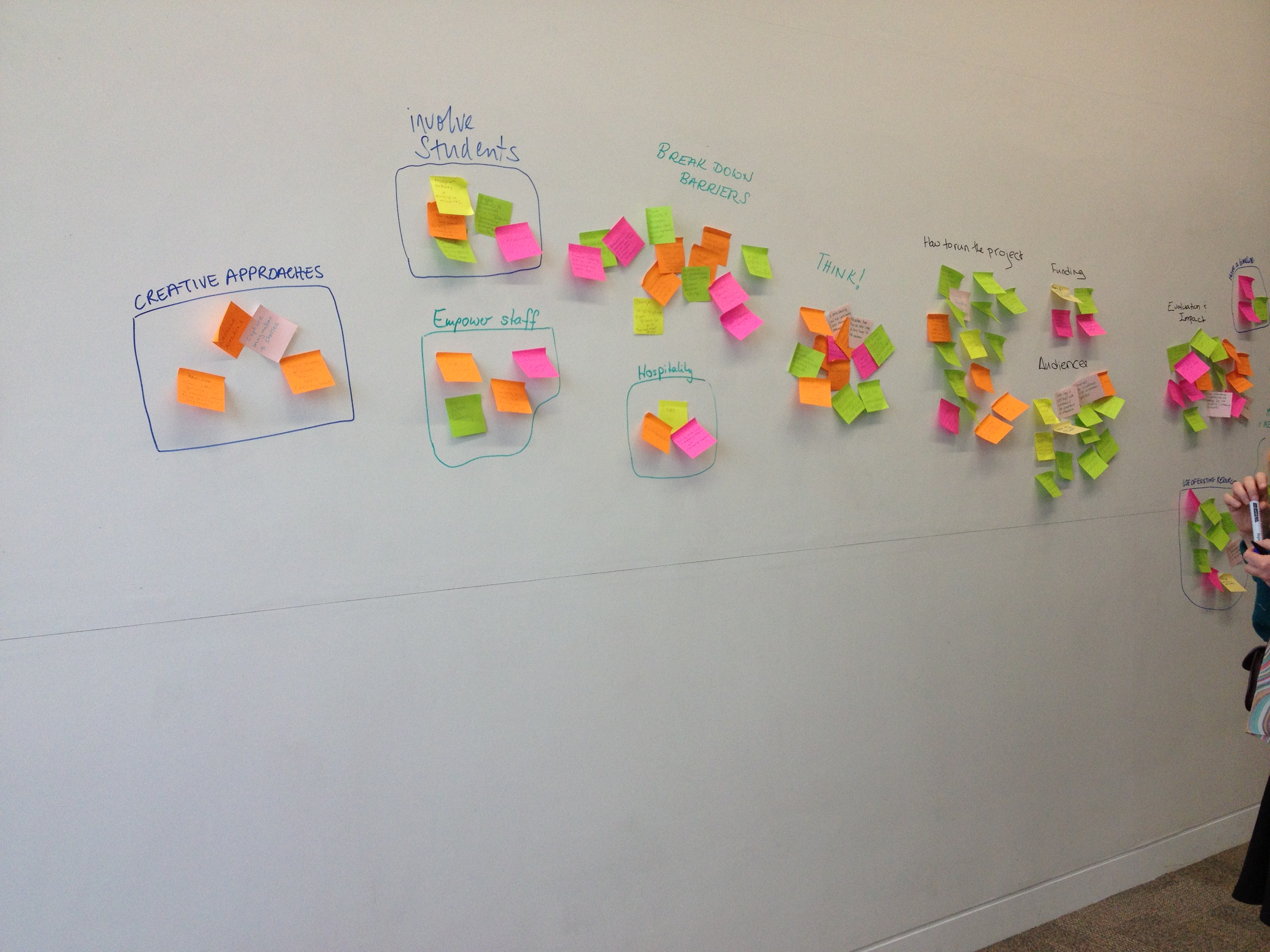
Cake: It may not be obvphotoious from this picture, but on one of the post-it notes in the ‘hospitality’ section is written the word ‘CAKE’.  This, along with all the other post-its, was part of a ‘brain dump’ exercise undertaken as part of a facilitated meeting of the Legacies of War steering group aimed at defining the next steps for the project.  The process took 3 busy very hours, moving from defining desirable outcomes for interested parties (individuals, funders and audiences, both in the flesh and on-line) through the brain-dump of achieving those ends to prioritizing aims and, via a series of specific questions, suggesting practical steps for achieving those priorities.

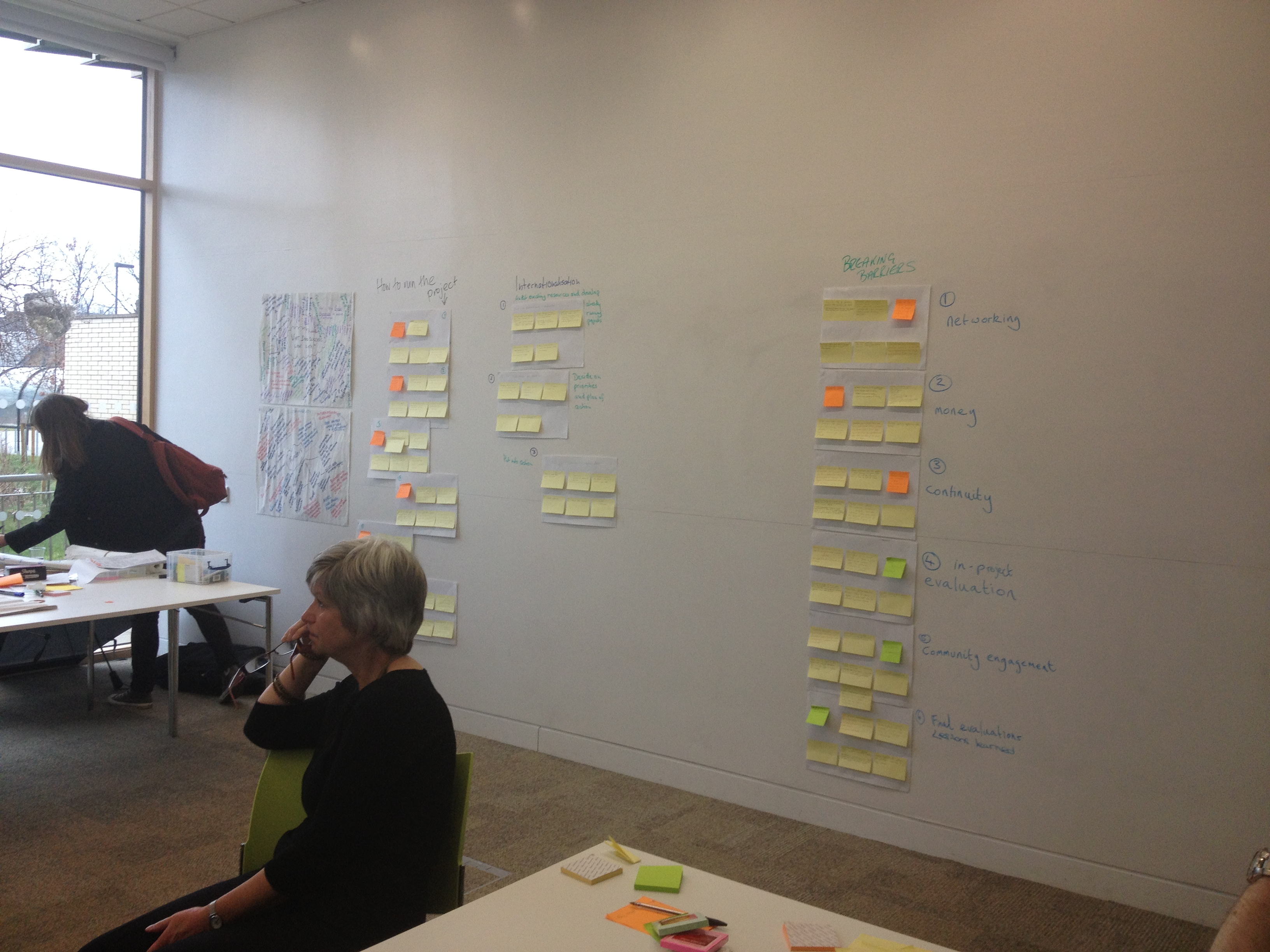
The final result was this:

photo (2)a rather neater arrangement of post-it notes.  ‘Cake’ did rather get lost in the shuffle, with priorities being defined as the way the project is run, locating the project in the international context of war commemoration and breaking down barriers. However a few immediate plans of action were decided upon and the process, unlike anything I have participated in before, was a fascinating experience.  I am not sure precisely how useful it would be more than very occasionally, but as a focusing exercise it certainly worked in the short term and hopefully will show results in the medium to long term as well.  And cake, we all concluded, is not a bad answer to any question.

Biscuits: Following this intense morning, four of us then headed over to the Imperial War Museum North for a meeting of regional scholars to discuss the forthcoming exhibition on the First World War in Manchester and the North West.  While the (very nice) biscuits were promoted as a principle attraction, the discussion of pretty much every aspect of the war, from recruitment and enlistment to demobilisation and disability managed to distract us from them most effectively.  The scope of the proposed exhibition is vast, covering aspects relating to both civil and military experience over the course of the entire war, with the locality serving as the focus.  As a result, I suspect the museum’s researchers got more than they perhaps bargained for in terms of suggestions of subjects to be pursued.  It will be very interesting to see how the project develops.  In the meantime, I got to take away a good deal of information about the demographics of the Manchester region c.1914 and some food for thought about population mobility in the years before the war.

Lemony pudding: These were the puddings on offer at lunch on the second day of the Social History Society conference, held at the beginning of the week.  I was only able to attend two days but those were both so full that I haven’t yet been able to fully absorb everything that I learned. Highlights were meeting Carina Peniston-Bird, with whom I had a chat over said lemony puddings, and Cath Feely, whose work on conscientious objectors’ reading in wartime is intriguing.  My top paper, though, has to be Helen Smith’s on masculinity and sexuality in northern working-class communities in the years just after the First World War with its important challenge to Joanna Bourke’s argument about male intimacy as a product of the trenches.  It reaffirmed for me the importance of work and professional identity as key to understanding masculinities, something that I need to explore more in relation to my ideas about the centrality of life cycle and maturity to these understandings as well.

So, lots to think about on all sorts of levels.  Never underestimate the power of dessert.

The historian wants a wife

It does seem appropriate that my son’s current favourite nursery rhyme is ‘The farmer wants a wife’, as that is precisely how I was feeling at 9:00 pm last night.

The background: my husband left yesterday for a week-long conference/collaboration exercise in France (not Sweden) yesterday afternoon.  In about an hour I will be heading downstairs to register for the Social History Society conference where I am giving a paper tomorrow morning.  This will be my first conference paper in about 5 years (I have given seminar papers, but the audiences have been fairly small), and the first on my new research.  I am terrified (not helped by the fact that the paper appears to be coming in five minutes too long).  On top of this, I now have a month to write two further 20-minute papers on two entirely different topics, and I am in the process of applying for funding and advertising a workshop.  Work is busy at the moment, to put it mildly.

So while my husband battled with a delayed flight and the language barrier of speaking minimal French, I spent yesterday evening doing the following: cooking dinner, feeding dinner to both children accompanied by my son’s interminable monologue which rather gets in the way of eating, getting both children undressed, bathed, redressed in night clothes, milk drunk, teeth brushed, stories read and into bed, putting on a load of washing, cleaning up the dinner table, washing the dishes and hoovering the floor.  I then managed to read through my conference paper (still coming in too long), tried to edit it down and read half an article.  At which point I realised my son was still awake (at gone 9) so I went and confiscated his globe, to much complaint.

Now, this isn’t a complaint about my husband’s relatively easy life.  For a start, it isn’t that easy as he hates travelling and the weather has made it more complicated and stressful than it need be.  Plus, when he is at home he pulls his weight on the domestic front (he does all the laundry for a start) and he will find himself in my position, trying to juggle domestic duties with paid employment, in a few weeks when I go on yet another trip to a distant archive. Rather I want to record my personal experience of a very old observation, to whit, that someone who works outside of the home, whatever their sex, needs domestic assistance if they are to do their paid job and run their home properly.  And I don’t just mean help with the cleaning or the childcare, but rather holistic assistance with household management. In other words, a housekeeper or, indeed, a housewife.  As I say, this is not new.  Many professional women have, over the years, argued that they need a wife in the home as much as a secretary at work to enable them to keep all the balls they juggle personally and professionally in the air. Some feminists have argued that domestic labour should be paid for and valued as highly as any other, given the support it provides to the smooth running of the economy.  And, indeed, the work of the housewife as a support to her husband’s career has, increasingly, been acknowledged in recent divorce settlements of self-made men in Britain. But coming from a home where domestic duties fall on both partners relatively evenly, as does the support given to both our outside jobs, this week looks set to be a valuable reiteration of the importance of the partnership I have with my husband in maintaining an even keel, both domestically and professionally.

In addition to a renewed realisation of the importance of the keeper of the home to productive employment outside it, my admiration for single parents has also reached one of its periodic peaks. I discovered this morning, for example, that we have half a tank of petrol in the car, so now I have to think about where to find a petrol station with pay-at-the-pump facilities because I will have both children in the car whenever I am driving this week. This is precisely the sort of detail that having a partner or assistant to share the burden of domestic tasks (if not take them over entirely) ensures is not forgotten.  We are at the start of the week.  I am just hoping that the end of it doesn’t find me and my children sitting by the side of the road somewhere between home and the university, desperately seeking assistance with moving a petrol-less car!

So what conclusions can I draw from my labours?  Nothing very original.  I know there are plenty of households with far more demands on their time and energy and far fewer resources than I can call upon.  But as the British government finds itself in the midst of debate over how to support working women through childcare subsidies it is perhaps worth reiterating that domestic labour is both time-consuming and vital.  It extends beyond being with children in their early years to ensuring the comfort, health and well-being of all members of a family, whatever shape that family may take, nurturing the energies and abilities of both of the economic producers of the present and of the future, as well as the comfort and happiness of citizens of all ages.  It needs to be valued as a public good, rather than dismissed as a private arrangement.  Debates over childcare are a start, but only a start and not a terribly helpful one if they alienate those who provide the domestic labour.

Now, what did I do with my daughter’s clean clothes for nursery?

AHRC ‘Connected Communities’ Showcase: 12th March, 2013

I have been spending the last several weeks frantically writing, something that may come as a bit of a surprise to any regular readers out there.  At the beginning of February I realized that I had three months to write three conference and/or seminar papers, plus several planning documents, so I have had to get my head down.  The results of my industry are drafts of a variety of things, including a call for papers that you will be seeing a lot more of in the future, I suspect.

In between writing and the general demands of family life, however, I also seem to have spent a great deal of time in London, mainly in relation to the AHRC and HLF-funded Research for Community Heritage project that I am now a postdoctoral research fellow for (this is in addition to my Wellcome fellowship which is on-going).  The project is part of phase two of the AHRC’s Connected Communities programme which is funding some 200 projects bringing together community groups and academic institutions in a variety of ways.  After a session on public engagement for postdoctoral fellows which I attended last week, this week I found myself in London again for a showcase event which allowed me to get a much better sense of the breadth of the programme, as well as bringing me into contact with an extraordinary range of highly engaged (and engaging) individuals.

The day started with a series of short presentations from representatives of the AHRC and the programme’s leadership fellows, followed by a key note address from David Willetts, the Minister of State for Universities and Science.  This sought to emphasize the importance he, as minister, placed on humanities and social science research which he believed to be a ‘bold, significant, world-class participant in UK research’.  He also labelled as ‘unfair’ the impression that the humanities had less connection with the wider world than the sciences.  I couldn’t help feeling there was an element of the lady protesting too much with this. Should the government really need to reassure arts and humanities researchers that they are just as important as all the big scientists and their funding, ring-fenced with funding for the sciences was safe?  If so, it must be down to the impression given by the policies and pronouncements of said government.  The message was also rather undermined by the answer given to a question from the floor about how arts and humanities researchers might influence policy, to the effect that ministers might be accessed via the chief scientist of each department.  Apparently this included social scientists.  I am not sure this was of much comfort to various groups whose excellent work in the arts, often in collaboration, was on display.

The bulk of the remainder of the day was an opportunity to explore the projects whose work was showcased around the venue and participate in breakout sessions.  I missed the session which involved weaving small circlets but did go to a showing of the Imperial War Museum’s film ‘Whose Remembrance?’, based on their on-going project into the black and colonial history of the world wars.  This was fascinating, not only because it tied so beautifully into last week’s Legacies of War seminar from Santanu Das, but also because of the questions it raised about how communities can be encouraged to engage with archives which, all too often they feel excluded from by institutional gate-keepers.  Given that communities are often the very sources that these archives spring from, this is something that needs to be tackled, something that I hope to contribute to through my work with groups involved in Research for Community Heritage.  Making sure that the Liddle and Bamji Collections here at Leeds are better known and fully exploited by all interested communities has suddenly become a very important part of what I am trying to do.  And I was very excited to make the acquaintance of  Cliff Pereira who worked on the Bamji Collection when it was still held in Sidcup.  My one reservation about the session was the rather London-centric nature of the discussion of archival resources.  Given the community-based nature of the research that Connected Communities supports, local and regional archives and their accessibility to community groups really needs to form part of the discussion.

Outside the breakout sessions there were 30-odd stands presenting information about a huge variety of projects.  Many involved mapping and I had long and potentially fruitful discussions with researchers from Birmingham and Bristol about how to present images and information relating to historical geography in an interesting and accessible way.  I ended the day with a fascinating conversation with Paul Crawford from University of Nottingham about health versus medical humanities which gave me some exciting new ideas about how to frame aspects of my own research.  The focus on community activity and expertise within healthcare implicit in health humanities is something that chimes with my long-term interests in the role of families in supporting disabled service personnel.

The formal schedule concluded with round-table discussion about how the Connected Communities project  could evolve in order to achieve ends that will include, as hoped by Keri Facer, one of the programme’s leadership fellows, a change in how universities approach and structure research in the arts and humanities.  Few definite conclusions were reached, but points were raised about interactions with other funding bodies, the need for spaces to share failures and discuss difficulties as well as celebrate achievements, international connections between communities, how resources can be made visible and accessible and, again, that question of how the research being undertaken might affect public policy.

All in all, it was a stimulating, if exhausting day (not helped by the cancellation of my train ‘due to technical failure’ which made it that much longer).  Quite apart from all the ideas generated for the various research projects I am engaged with, and the potential for at least one, if not two, new sources of funding for the Legacies of War project, it was my first experiment with live tweeting a professional event.  I am still not sure I have worked out how to do it.  I certainly wouldn’t want to try at an academic conference as I think I might do injustice to a denser, more complex argument simply through lack of proper concentration.  And I owe a huge apology to my friends and family who, through the linking of my twitter feed and Facebook page, were subjected to a stream of posts of little or no interest outside my professional sphere.  Yet again the question of the work/life balance raises its ugly head in the most unexpected places.

Santanu Das on India, Empire and the First World War

The next Legacies of War seminar will take place on 7th March at 5:00 pm in Michael Sadler Building, Room 3.11:

Santanu Das

Catching up

Last week my husband and I sat down and updated our diaries and (more importantly) the family wall planner for the rest of the year, or at least until November.  A household that consists of two academics and two young children poses some challenges when it comes to attending conferences, seminars and the like.  Remarkably, we seem to be doing quite well, with only one major conflict where both of us are due to speak at different events at the same time.  Fortunately, mine is the Social History Society Conference which takes place in Leeds this year, so I will have skip the evening events to look after the children while my husband swans off to, well, Sweden. (I would be a lot more resentful if it was the South of France, but that isn’t until later in the year.)

Seeing all my commitments written down (bar the yet-to-be scheduled meetings and the workshop I haven’t confirmed funding for but which hopefully will take place in October) has brought home to me just how much writing I have to do.  With a rising sense of panic, I realise that I am giving three conference papers this year, on three different subjects, only one of which I have spoken on before.  The fact that the first of these is the one based most firmly in my primary research topic and will be the first time I have presented at a society’s general annual conference since speaking at the IHR’s Anglo-American conference in the final year of my PhD, getting on for eight years ago, does not help matters.  Last week I found myself facing a blank page, in a state of complete and utter academic paralysis.

This was not helped by the fact that, along with realising just how much work I had set myself to do, I was also put into contact at that time with Dr Emily Mayhew, who is currently working on a narrative history of stretcher bearers during the war.  Her work sounds fascinating and will, quite rightly, introduce the public to this all-too-often forgotten group of servicemen, which is rather what I hoped my work was going to do.  Having also found out that Amanda Vickery will be presenting a new radio series on gender and disability, a subject central to my research since I began it, I started to panic about being seriously behind the curve.  For the first time in my career I began to wonder if my years’ maternity leave, wonderful as it was, might have been a bad idea.

Fortunately, at this point one I had what I can only describe as a stroke of luck, or rather several small strokes.  In rapid succession I discovered that there are copies of the Gazette of the 3rd London General Hospital in the Bamji Collection here at Leeds as well as in the Wellcome Library and, via an unrelated Twitter conversation, began following Sue Light who blogs about the Happy Hospital, as the 3rd London General was known.  The name comes from the title given by Ward Muir, one of the hospital’s orderlies, to his second collection of columns and vignettes, published in 1918.  (His first, and better-known collection, Observations of an Orderly, was published in 1916 and is now available print on demand.)  Co-incidentally, and in my third small stroke of good fortune, I was reading this volume, and worrying that my forthcoming paper was going to be overly weighted to the 3rd London General, when I came across the following:

‘the case of two of our orderlies, both privates, whose sons are officers: these youths will have to be saluted and Sirred if by any chance they ever turn up here as patients and are waited on by their fathers.’

This one sentence contains so much of what my work is about: rank and authority, maturity and age, medical and combat roles.  All at once I was excited again about not only my forthcoming conference paper, despite the narrower-than-desired focus, but also about my project as a whole.  If this is what the experiences of one (very articulate) orderly in one (slightly unusual) hospital have to offer, the potential for unpacking a great deal more about the masculinity of men serving in these roles is still there.  And while the work of Dr Mayhew and Liana Markovich, who is writing on Australian stretcher bearers, will do much to open up the subject of these remarkable men, there is still so much to say about them in relation to courage under fire, the bearing of arms in warfare and the strength necessary to be a soldier.  In fact, I have started toying with the idea of a definition of masculine courage in wartime as endurance of danger in direct and explicit contrast to armed attack. (This will need a lot more work, but given the disproportionate number of medals awarded to RAMC personnel there does seem some basis for exploring this further.)

So I may not have caught up with my year off, or even with my schedule for the next month (the conference paper has yet to be written), but I have come out of the dip in research energy which, along with my fear, was holding me back.  Now to turn my new-found engagement into a decent paper…

From the archives

I have had now had over a week to assimilate the material I gathered from my week in the Wellcome Library and very useful it is turning out to be too.  Of course, I called up a four-volume collection of magazines from the 5th London General Hospital in Wandsworth at 10:30 on my final morning which are filled with stories of hospital life, etchings by C.R.W. Nevinson, who happened to serve as an orderly there until 1915, and the most amazing series of cartoons starring the figure of ‘The Orderlim’ (as opposed to the ‘Orderlette’, female orderlies who were drafted in to replace some male orderlies in 1915).  I was only able to finish about a quarter of the collection, so now I am panting to get back, something that unfortunately won’t happen until the summer at the earliest.

There was a lot more material as well, including the memoirs of two nursing orderlies which were slightly unexpected as they were listed in the catalogue as ‘Field Ambulance stretcher bearers’.  Similarly a man who was initially enlisted as a nursing orderly trained for work with a sanitary unit before embarking for Egypt, a vital role, but one that made for rather dull reading in his diary records of the repetitive disinfection of ambulance train carriages.  I was struck by the extent of this category slippage, which presents me with something of a problem.

The slippage, I suspect, exists not only within roles of within the RAMC but also between combat and non-combat roles. Non-commissioned servicemen in the RAMC were subject to regular comb-outs throughout the war, especially as the manpower shortages grew more acute from 1917.  In the other direction, combat servicemen whose injuries left them at a lower medical classification could find themselves assigned to non-combatant (including medical) roles.  So for many individuals combatant and non-combatant roles both formed part of their service, something that is going to complicate my analysis.  It will also, I suspect, make it harder for me to track down relevant archives as I imagine that most catalogue listings will give precedence to any combat role taken, at whatever stage in the individual’s service.  I will just have to hope for as much good fortune with the archive as I had at the Wellcome!

Talking about Mary Beard…

So I have spent quite a lot of time this past weekend thinking about the controversy that has surrounded Mary Beard for the past couple of weeks.  For those who are unaware of it, Mary Beard is a professor of Classics at Cambridge and public intellectual.  A couple of weeks ago she appeared on Question Time, a current affairs programme in which a panel of politicians, journalists and others discuss questions posed by the audience.  Guests are often chosen for their potential conflict, although this being the BBC, said conflict rarely gets beyond eloquent (and not-so-eloquent) disagreement and polite put-downs.  The most controversial guest on the night in question was Nigel Farage, leader of UKIP, a political party that wants Britain to leave the European Union and generally dislikes what it sees as an influx of immigrants from Eastern Europe consequent to that membership.

I didn’t actually watch the programme (the frustration of yelling at the television on a regular basis is not worth whatever intellectual gain I might make from hearing opinions spoken that generally appear in other media anyway), but apparently a question was asked relating to the effects of immigration on Boston in Lincolnshire, to which Professor Beard responded quoting a report that viewed such impact as positive.  The debate that this provoked extended from the programme itself to many other media, including a large number of extremely rude tweets and e-mails directed at Professor Beard.  Many of these were, according to Professor Beard’s own account on her blog A Don’s Life, either withdrawn or led to more polite forms of debate, but significant forms of abuse remained, including the posts on a website, Don’t Get Me Started (which has since been closed).  As Professor Beard herself explains, this abuse was vicious and graphically sexual in nature, having little relation to the topic involved and everything to do with Professor Beard’s appearance and identity as a woman.

I followed the controversy via newspaper articles (which picked up the story fairly quickly) and through Twitter, where I follow Professor Beard.  In addition to a number of interesting contributions from other women in the public sphere who have been at the receiving end of such abuse, both from the relevant website and other quarters, there have been a number of retweets of some of the abusive comments addressed to the professor.  One of these was to the effect that she should grow some balls because she was in the public eye and therefore abuse was only to be expected when she voiced unpopular opinions.  The irony of the suggestion that Professor Beard acquire male genitalia in order to protect her from abuse directed at her primarily because, as a woman, she lacks said physical attributes struck me strongly enough that I posted a reply to that effect.  It was not a particularly witty tweet and, beyond a rather incoherent response from the original commenter to the effect that David Starkey and Simon Schama showed more dignity by not talking about being abused for their views, it sunk more or less without a trace.

What set me thinking, however, was the fact that, while it took me only a couple of minutes to compose my tweet, it took me a good 15-20 minutes to decide to actually post it in a public forum.  As I say, it wasn’t particularly clever or insightful, but nor was it abusive or even unkind.  It was simply a rather sarcastic contribution to an ongoing public discussion.  Yet I was worried about posting it and, I have realised, that that worry derives in part from the fact that I am a woman.

As a published author, I have received my share of green-pen correspondence.  Fortunately they have taken the old-fashioned form of letters signed by a named individual who even gave their address.  They were extremely personal about my intellectual capabilities, which was quite upsetting, but never strayed into more personal territory, beyond the suggestion (which I have heard a number of times now) that as a woman I cannot possibly understand what it was like to be a (male) soldier in wartime.  I was fortunate to receive strong support from my editor at the time and, while very upsetting, I never felt threatened.

What Professor Beard, and many other women who speak out in the public sphere of popular media, have suffered is of another order.  The abuse is explicitly sexual and often both implicitly and explicitly violent.  What is for me the most worrying aspect are the number of threats I have read about directed towards the families of these women, including their children.  Like the sexual threats and commentary, there appears to be no equivalent aimed at men who participate in public discussion.

Which means that, as the mother of young children, I am uncomfortably aware that publishing an opinion in public may not only put me at risk of the sort of sexual commentary and threat that no individual, whatever their opinion, should be subject to, but may also lay my children open to threats of violence through absolutely no fault of their own.  This terrifies me, as it should anyone who values democracy, discussion and freedom of speech.  At the same time, as an historian working in a field that is of considerable (and soon to be increasing) public interest, I want my voice to be heard, even if the stories I have to tell may not be the ones everyone wants to hear.  Although nowhere near as eminent as Professor Beard and the many other courageous women who carry on contributing to civilised discourse in face of irrelevant abuse, I need to find the courage to carry on speaking out in public, to refuse to be silenced.

So I am glad I posted that tweet, however silly and sarcastic.  And I will carry on putting forward my views in the hopes that some day the voices of reasonable argument will drown out the abuse and threats of those who would seek to silence us, women and men alike.

Publicity

A couple of publicity (self and otherwise) notices.

The University of Leeds Legacies of War seminar series is delighted to announce that Professor Adrian Gregory will be giving the first paper of the new term on Thursday, 7th February at 5:00 in Michael Sadler Room 3.11.  He will be speaking on the topic of ‘Did God Survive the Somme?’  All are welcome.

Adrian GregoryMy review of Leo van Bergen’s Before My Helpless Sight: Suffering, Dying and Military Medicine on the Western Front, 1914-1918 appears in the latest edition of First World War Studies which also includes several interesting-looking articles.  I should be reading about the establishment of the Territorial Army in Britain, but I think I may take break and read about Old Etonians, demographics and eugenics instead, courtesy of Richard Carr and Bradley W. Hart.

A letter to Simon Russell Beale

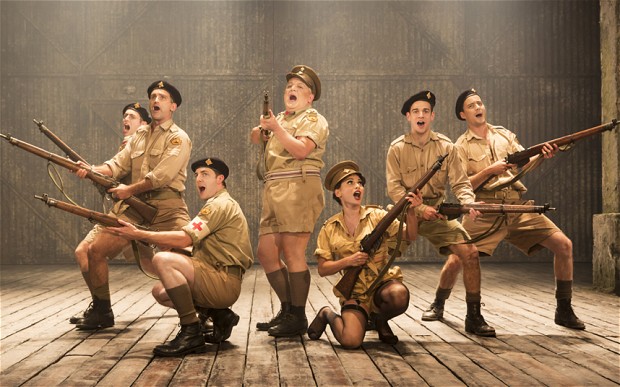
privateson-parades_2423627bDear Mr Russell Beale,

First of all, please allow me to apologize for making such a complete idiot of myself when I saw you on Friday evening before the performance of Privates of Parade. In the first instance, it was extremely rude of me to stare at you so long and so idiotically while you enjoyed your cigarette at the stage door. Secondly, when you had the civility to say hello, for me to mutter something incomprehensible and slink off in the other direction was beyond impolite. My only excuse is that, at that stage, I did not have anything I could have said to you that would not have been more than the burblings of a long-term fan.

In all honesty, I do wish our encounter had taken place a few hours later, after I had had the privilege of seeing your hugely enjoyable performance as Terri Dennis. As a theatrical experience it was, as the reviews have said, enormously enjoyable, courageous, full of energy and life and wit. But writing as a historian of gender and warfare your performance,along with that of all the rest of the cast and Michael Grandage’s highly accomplished direction, offered a great deal of food for thought as well.

The story the play tells is, of course, one about the achievement of masculine maturity, both sexual and emotional, in a theatre (in all its many meanings) of conflict. As Steven says in the final scene, he has become a man thanks to his experiences in SADUSEA, specifically, rather than in the military more generally. But what I found far more fascinating was Terri’s attainment of a conventional masculine identity at the end, one defined not by his military status, which is so successfully undermined throughout by the campness of his demeanour, but through his marriage and impending (surrogate) fatherhood, a narrative emphasized by the modulation you brought to that closing scene.

For me, that was the most powerful theme of the entire evening, the importance of the domestic and of home to the identity of all the men involved. The scene in which letters home are opened and read is the first in which their characters become fully defined, as sons and husbands, and throughout it is through their domestic ties, former, potential, respectable and subversive, that the characters developed. Dennis’s own story of domestic tragedy was profoundly moving, a lovely counterpoint to his eventual domestic ‘respectability’.

Not that these were the only themes: the role of uniform and costume in defining masculinity, the transient power of wounding and disability in creating heroic identities and the appalling things that conflict does to warp both men and women were all powerfully evoked. In the end, I had so much to say that, had I seen you again I probably would have been no more coherent than I was on our first encounter. So all I can do is say thank you, to you and the rest of the cast, for creating a theatrical performance that had so many profound echoes of my own work and which forced me to think critically about questions of sexuality and emotion. And again to ask your forgiveness for one tongue-tied long-term fan who remains

Yours very sincerely,

Jessica Meyer

Why Am I Here?

A couple of recent comments, both on here and via e-mail, have caused me to start thinking a bit more seriously about the point of this blog. Over the past few months I have commented fairly extensively on manifestations of First World War history in the wider culture and a bit less on my own particular field of research. What was originally intended as a space for me to work out ideas relating to the history of non-commissioned members of the RAMC during the war has become a rather more general First World War blog.

I have to admit, this makes me a bit nervous. There are an awful lot of First World War buffs (in the most general sense of those interested in the war, not just pure military history obsessives) out there, and this blog is never going to be able to cater for all interests and I won’t even begin to try. I worry, however, that I spend an awful lot of time defining myself negatively as a historian. I am NOT a military historian (although I do know an increasing amount of military history as I get to grips with the complex systems of evacuation employed by the RAMC during the war). I CANNOT identify specific uniforms not am I likely to be able to help with queries about genealogical research (although I may be able to point people in the right direction). I am NOT a transnationalist and my knowledge of the non-British experience of the war is woeful, although I am hoping this will change in the not-to-distant future.

So where do all these negatives leave Arms and the Medical Man? Well, there are still plenty of positives, I hope.  I AM a cultural historian of warfare. I DO know a great deal about popular literature and the war, and an increasing amount about the medical history of the war.  I AM a gender historian which helps me locate my studies of the war in the narrative of the nineteenth and twentieth centuries.

I still hope to use it as a space to work out my ideas, especially now that I am starting to have more primary material to work with. I am in the Wellcome archive this week, discovering just how little there is on the work of the nursing orderly, something I am going to have to think hard about as I am due to give a paper on that very subject in two months time. And, as the centenary gets ever closer, I will carry on discussing representations of the war in British popular culture. That aspect of this blog has been the source of the greatest amount and potentially the most fruitful discussion so far. And while creating a forum for discussion about the war was not necessarily my main purpose in starting out with this blog, if that is a role that it fills (in a civilized manner, naturally) then far be it from me to resist!

On which note, here is an article that was doing the rounds last week, in case you haven’t seen it. Encouraging to have the problems of commemoration voiced by such an authoritative source, although I am not sure where we go from here. More discussion, then.