Taking Stock

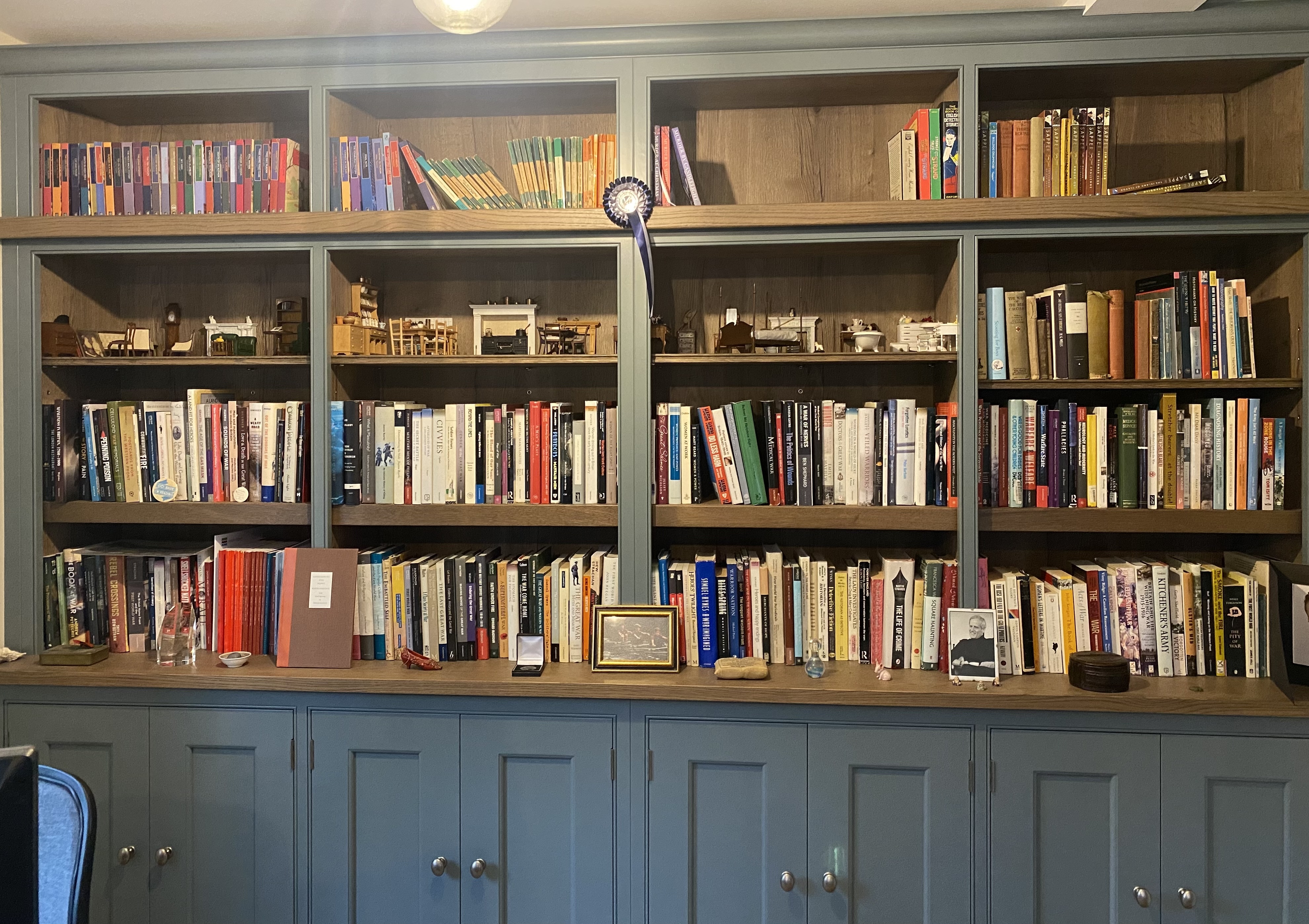
It has taken a week, but I have finally unpacked all the boxes of books and papers and accumulated office accessories that I acquired over 15 years at Leeds. So now that I am fully installed in my home office, it seemed like a good time to enumerate the projects I have underway and planned, and what I hope to acheive in the next 18 months.

Men of War: A Modern History

Under contract with Polity Press, with the manuscript due in 2028, I currently have aproximately 10,000 words of a very, very messy draft of Chapter One and a detailed outline of all eight chapters. The goal is to have a completed first draft by the end of the calendar year. I anticipate this being a complete mess, with the aim of a serious edit the following year.

The Return of the Soldier: British First World War Veterans and the Making of Twentieth Century Britain

This one is now on is fourth or possibly fifth subtitle as my ideas have shifted through the drafting process. I currently have between 3,000 and 5,000 words drafted for three of the five chapters, with a plan for a conference paper for the fourth chapter in the works. These will then form the cores around which I will build the longer chapter, with a full draft of ‘Return Home’ next on the agenda so that I can send it out to publishers and agents for consideration. The goal is to have a contract for this one by the end of the year.

The Return of the Soldier: British First World War Ex-Servicemen and the Making of the Twentieth Century

This project is now on its fourth or fifth subtitle, but, after far too long, I think I finally have a central thesis and a sense of the voice for this book. I also have 3,000 to 5,000 words for three of the five body chapters, with plans for a conference paper that will give me another 3,000 words for the fourth. These will go on to form the cores of the longer chapters. What I don’t currently have is a publisher so, in addition to the conference paper, my next step will be to write up the chapter on ‘Returning Home’ for submission to publishers and agents. The goal is to have a contract for this book by the end of the year.

A chapter on the ethics of doing disability history, accepted subject to minor ammendments.

This is due in two weeks, so is currently at the top of my priority list.

An 8,000-10,000 word chapter on front-line battlefield medical care.

I still need to check with the editor what the temporal and geographic scope of the expected chapter is. Submission in June.

A history of Golden Age detective fiction and the two world wars.

I can’t really let myself commit to this one until I have the two on-going book projects much nearer completion, but I do want to get a proper proposal off to an agent. This is the one that has the most potential as a trade history, I think. Certainly, everyone I have mentioned it to has been very enthusiastic and encouraging. In the grand tradition of writing procrastination, this is, of course, the book I want to write at the moment.

The novel

I keep telling myself that this one is just for fun, that I have to prioritise the non-fiction because that is my bread-and-butter and where I am more likely to publish successfully. Really, I need to stop researching this one and just get on with writing it.

This blog

I am hoping to post on here once a week, but I am also aware that doing so risks taking writing time away from other projects. Indeed, this post has taken two days to write in what is an exceptionally busy week of family responsibilities and pre-existing commitments. So while a weekly post will be my goal, I will need to reassess this if either of the book projects start to suffer. In which spirit, I had better stop writing about writing, and get on with actually completing that chapter on ethics!

The Recovering Year

I started 2024 in a hotel room in Italy in a full-leg brace, unable to walk. I am ending it in a hotel room in Colorado, still unable to ski and with an aching arm due to what I think may be tennis elbow. In between, I have swum 5 kilometers very slowly, spent more time in hospital than I really wanted, failed to make significant progress with my book projects and lost the ability to sleep through the night.

So no, 2024 has not been an easy year. Much of it has felt wildly out of balance with long periods when I felt like the Red Queen in Alice in Through the Looking-Glass, running very fast to remain in one place offset by some blissful periods of doing very little other than reading Georgette Heyer novels. But it has been a year of recovery. This recovery has been physical. I am now back on both feet and even running again. It has taken a lot of physiotherapy on my ham string to get me there, with a lot more in prospect as I am now due to have surgery to repair my ACL in the spring.

But there have been other things that I have recovered as well this year. One of them, thanks in part to those period of reading Heyer (among others), is my enjoyment of reading for its own sake. I never fully lost this, but this year I recovered the ability to read for pleasure without feeling guilty about all the other things I could or should be doing with the time. As the year has progressed, I have found more time for reading outside of holiday periods. This has been a gift, helping me to restore some of that balance that I have lost over the past few years.

The other thing I have recovered, somewhat to my surprise, is my desire to write. Granted, I have done less writing for the books than I might have hoped. But in the final third of the year I wrote 60,000 words of lectures, an intense and oddly energizing project, particularly in retrospect. I wrote, and started to rewrite a book proposal, and wrote and submitted an ultimately unsuccessful fellowship application. Combined with the reviews I have been writing for this site (which I will post in the new year), I have started to feel as if I have found my voice again after a prolonged period of not being sure if I had anything to say, if I had the ability to say it, or if anyone would listen if I did.

Those doubts do still assail me, particularly at 2 am and in relation to the big book project. The process of recovery is not complete, any more than the process of recovery for my knee is. It may never be, fully, but here, at the end of 2024, it does feel at least that I can see the direction I need to head. The current level of imbalance is unsustainable, just as the continuing instability of my knee is for the sort of life I want to live. There will have to be some big changes in the coming year to ensure that my recovery, physical and psychological, continues. These still feel a bit tentative. I am waiting for the exact date of my surgery and my other plans will have to wait until after that, probably for the second half of the year. But changes there will be in 2025, that I can promise.

So here is to the recovered year just gone and a year of change and progress to come. Wishing you and yours all health and happiness for whatever the new year may bring.

Enough is as Good as a Feast

Kate Atkinson, Human Croquet

Kate Atkinson, Normal Rules Don’t Apply

It may have been a mistake, saving my stash of Kate Atkinsons to take with me on holiday over the summer. Not because they are not wonderful; they absolutely are. Reading Human Croquet, which I did in a day, gulping it down in a way I haven’t done with a book since the height of the pandemic, was a joy, an immersion in language and characterisation and intricately intersecting plot lines that took me to another place as only a great book can.

But oh! they are so rich! Coming to the end of the book after a day spent reading like that felt a bit like getting up from the table after an overly rich meal, or waking up with a hangover. It was almost too much, to the point where I felt lethargic and slightly headachy. So following such overindulgence with more of the same may, as I say, have been a mistake. Yes, Normal Rules Don’t Apply was, as a collection of short stories, briefer and lighter, but the collection of linking characters, locations and storylines required work, the language was just as intoxicating and the emotions evoked were, if anything, even more quietly devastating.

To recover, I gave myself a palate cleanser of Georgette Heyer’s The Quiet Gentleman, which was light and funny and straightforward in terms of plotlines and the emotions aroused, although not, perhaps, overly memorable. But it did leave me slightly out of time to tackle Shrines of Gaiety, which I had been keeping to savour,before the end of our stay in the US. I was left with the choice of starting it on the plane ride home or saving it for the long weekend trip to Scotland scheduled for the week after we returned. The former option risked my staying up all night reading, followed by jetlagged exhaustion on arrival. That was how I read Life After Life, but I wouldn’t have slept on that flight anyway, In the depths of grief following my mother’s death the week before, that book saved me from going mad, a life raft in the ocean of suspended time that flying back to my family in the UK entailed. This time I anticipated no such need, just the prospect of houseguests to prepare for, making the prospect of exhaustion compounded by jetlag a less than enticing prospect.

Saving it for Scotland, meanwhile, would give me something to look forward too when my husband and son headed off to climb Ben Nevis without me, a challenge to far for my torn ACL, which had been playing up even in the slightly less strenuous context of the hills of Western Massachusetts. So that is was I decided to do, planning to balance the intensity of Atkinson’s rich literary vision of 1920s London with the anticipated jeu d’esprit of Juno Dawson’s Hebden Bridge-set witchcraft novels.

Accountability

Having noted in my last post that I ended 2023 with a number of unfinish projects, I thought I would start the new year listing those that I hope to make progress with if not actually complete over the coming year. This is not a resolution (I’m possibly a bit late for that on Epiphany), but rather a hope to the point of intention.

Writing:

  1. Janaury/February: Two book reviews. I’ve read both books and have a good sense of what I want to say, but I have negotiated a bit more time for both of these as I know that I will get very little writing done once marking and postgraduate studentship applications come in in a couple of weeks.
  2. April: Two conference presentations.
    • Discussant on a panel in military welfare history as a sub-field. My contribution will be considering intersections with histories of disability and gender.
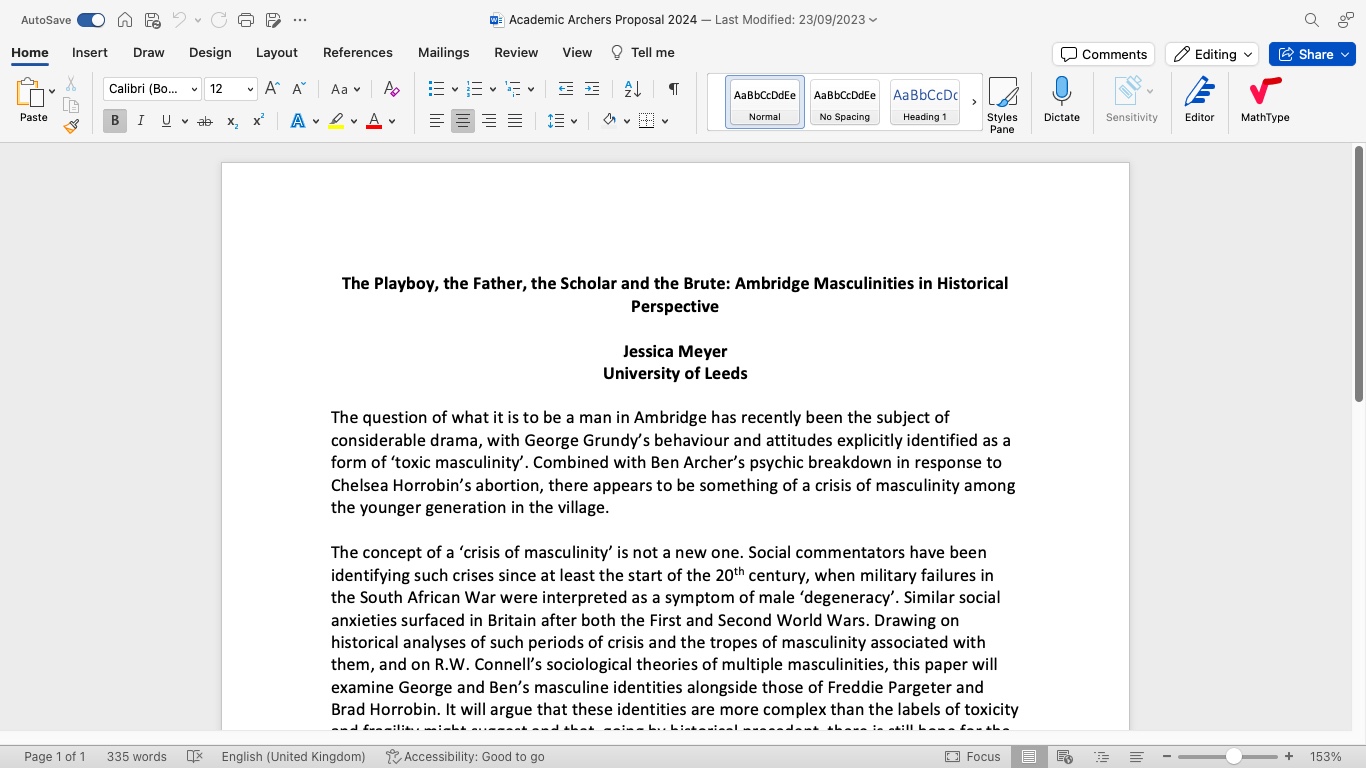
    • ‘The Playboy, the Father, the Scholar and the Brute: Ambridge Masculinities in Historical Perspective’ for the 2024 Academic Archers conference. I am very excited about this one, and can’t wait to start writing this properly. It has been a couple of years since I last attended an AA conference, which are some of the most fun out there.
  3. The big one: The book. This will definitely not get finished this year, but the goal is to end the year with at least a couple of full chapters in place, and possibly even an agent for it.
  4. And the new project: One of the books I’ve been reading for review has inspired me to think again about the status of ambulance drivers and non-combattant care-givers (or not). I think there may be a journal article in this, drawing together some of the material that I was only able to mention in passing in An Equal Burden.

Knitting:

  1. The cardigan that I started as a lockdown project. I have finally built up the courage to steek it (successfully, I think), but now have to complete the button bands and grafting. This may require another ball of wool from the supplier.
  2. Three family sweaters. Every year for Christmas I give my husband and two children the wool for a new sweater, which I then knit for them. This year I began my husband’s before Christmas, intending it for his birthday, after last year’s effort ended up far too tight in the arms and chest due to a miscalculation. However, as I have chosen an extremely complicated fair isle pattern, it is taking considerably longer than anticipated. Thankfully, the children’s sweaters should be more straight forward, so I may actually complete these before the weather gets too warm to wear them this year.
  3. And the new project: Today’s clearout of the bathroom cupboards in advance of the builders arriving tomorrow disclosed the sad fact that the baby blanket my mother made when my son was born had fallen victim moths. So I spent an hour today unravelling it, ending up with approximately six 50g balls of lovely, soft DK wool which, for sentimental reasons, I would like to make into something new. I’m not sure what yet, but all suggestions will be gratefully accepted.

Quilting:

  1. Autumnal quilt. My first full-sized bed quilt which I am very, very slowly hand quilting. Not one that I can see getting completed this year, but I would like to make more progress on it than I have done in the past 12 months.
  2. Alice’s Wonderland quilt: A Block of the Month project from Alice Caroline which I started in January 2022. All that remains is to attach the final four borders, after which I will take it to be long-arm quilted at my local quilt store. It is intended as a gift and I am not yet confident enough at hand quilting to take this aspect on (nor to do I have the time if it is to go to its recipient – currently age 4 – before they leave home for university).
  3. And the new project: Because I clearly can’t resist the siren call of the new project, I have signed up for another Alice Caroline BoM project this year. Hopefully this one will be a little bit quicker, now that I am more confident of my technique.

In the kitchen and the garden:

These are less unfinished projects from last year than annual events which come around every year. Nonetheless, they fall under the heading of projects, and very enjoyable ones, too.

  1. Marmalade. The making of this year’s batch will be made more interesting by my current temporary impairment relating to my knee injury, which requires brace and crutches and means I am only partially mobile.
  2. Germination: We still don’t have a greenhouse (a very long-term unfinished project), so some time in the next few months the window sills will start to play host to pots of seeds in anticipation of one of the summer’s main garden projects, the veg patch.
  3. The front bed: Yet another project that is now several years old. Having removed a hugely overgrown berberis, I now need to finish digging out all the stones to replant with a callicarpa and bulbs. This one, however, will have to wait until the weather improves.
  4. And the new project: For Christmas, my husband asked for and received a cookbook about plant-based baking. I may have rashly agreed to try making plant-based cinnamon rolls at some point…

As I say, I won’t complete all of these projects, but I hope to finish some and at least make progress with the rest. Whatever else it turns out to be, 2024 looks to be a busy year.

A resolution

Every year since 2013 I have posted a reflective blog post at some point between Christmas and New Year. I posted throughout my chidren’s early childhoods, when Christmastime was a welter of preparation and lack of sleep. I posted through my parents’ illness and in the wake of their deaths. I posted the year I caught a stomach bug and spent much of the holiday feeling extremely sorry for myself.

But not last year. Somehow, there didn’t seem much to say last year, after a year of anxiety and restrictions, with yet another lockdown (and its attendant home-schooling-while-full-time-teaching-on-line stresses) on the horizon. And that failure to post seems to have set the tone for this past year, a year in which I have failed to write.

I don’t mean that entirely literally. I have written syllabi, reports, and many, many comments on students’ work. I have drafted an article (currently under review following a revise-and-resubmit) and wrote three new talks on my research. I even submitted a short story to a competition over the summer (it didn’t get long-listed, so no feedback). And yet it has still been a year when I have felt blocked in my writing, when nothing has flowed, when I have struggled to find my voice on the page.

It is not just that I have not posted on this blog since July 2020. Having entered the pandemic with ideas for three major pieces of writing, all of them have stalled. The proposal for the monograph based on the research from Men, Women and Care remains unwritten. I have done nothing about the trade history beyond speaking to a couple of possible literary agents. And the novel I started so blithely remains stubbornly stuck at 25,000 words.

There are, of course, good, explicable reasons for this lack of writing productivity. The above-mentioned home-schooling-plus-on-line-teaching absorbed much of the start of the year. The hybrid return to campus in the autumn, along with the resumption of my children’s extra-curricular schedules (choir, rugby, drama, riding) brought its own set of stresses and challenges. As for the summer … I’m not actually sure what happened to the summer this year. Whatever it was did not involve putting pen to paper (or fingers to keyboard).

Writing in a pandemic is hard, and I am trying my hardest to be kind to myself and not to berate myself over the lack of progress. But the fact is that reflecting on this writing block makes me feel sad and anxious in a way that is different from the sadness and anxiety I have felt (and often felt acutely) in past years.

I need to write. I need get the ideas in my head on paper (or a screen). I need to make mistakes, cross things out, find the perfect phrase, delete whole paragraphs and then rewrite them. And I have plenty to write. In addition to the monograph, trade history and novel, there is a blog post on the White Feather campaign I want to write, an article with a deadline next month and the character I have left in limbo in an incomplete AO3 story. Those three new talks should, I hope, form the basis of monograph chapters and there is a call for papers for an edited collection which could give me scope for exploring a key angle to emerge from Men, Women and Care.

So, for the first time in many years I am making a specific New Year’s resolution, one which I intend to hold myself accountable for. Every day for the next 365 days, I will write for a minimum of half an hour. It doesn’t matter what it is – a blog post, fiction, a draft chapter, a proposal. It doesn’t matter when in the day it is, although I do know I write best in the mornings. It doesn’t matter if I am working that day or on holiday, at home or traveling (as I hope to be doing come the spring). For half an hour every day I will write in the hope of getting my writing muscles working again, just as I have this past year sought to get my running muscles working again.

So there is the marker I am placing in 2022. Given the current state of the world, I have no confidence in making any predictions for what the new year may bring, but I will enter it with some hope that there will, at least, be a few more posts on this blog than last year, and maybe even a draft book (or two) by its end. I can but hope.

So I will close this piece of end-of-the-year writing by wishing you all a hopeful, health and happy new year.

Why I haven’t been posting on my blog

I had all the best intentions. I was going to post regular on my –

[‘Mummy, is my porridge ready?’ ‘No, can you get ready to do Joe Wicks, it will be ready when you are done.’ ‘Don’t want to do Joe Wicks.’ ‘You need some sort of exercise. If you don’t do Joe Wicks, I’ll have to take you for a long walk later.’ ‘Fine, I’ll do Joe Wicks but it’s so unfair. This is the worst day of my life!’ *loud stomping*]

blog. I was going to write about the links between Covid-19 and the history of wartime medicine. I was going to write about the militarisation of medical language. I –

[‘Mummy! He’s pushing me!’ ‘I’m not! She’s getting in my way!’ ‘For goodness sake! You stand there; you stand there. Face the television and watch what you are supposed to be doing!’]

was going to keep a daily diary, an outlet for my anxieties, a record of the social history of –

[‘Right, you go have a bath and you go practice your piano.’ ‘But he always has a bath first and do I have to do my piano?’ ‘I want to do my piano.’ ‘Fine. You do you piano and you have a bath.’ *5 minutes later* ‘That’s enough water! Please can you do that again – and don’t rush this time.’ *dramatic sighs all round*]

corona virus, a boon to future generations of historians.

But of course it hasn’t happened. Partly because –

[‘Are you out of the bath? Dressed? Right, come do your piano please while your brother has a bath.’ ‘No!’ ‘You need to do your piano practice.’ ‘Want to do it later.’ ‘No, you are going to do it now.’ *stomping, followed by discordant banging on the keyboard over the sound of running water*]

not a lot of what I have to say feels very original. The comparisons with the 1918 flu –

[‘Time to get out of the bath, please.’ ‘What work do I have to do?’ ‘Do I have to do writing?’ ‘I don’t understand this maths.’ Can I work in my bedroom?’ ‘Not if you are going to listen to Harry Potter while you work.’ ‘But I work better listening to things.’ ‘Mummy, is strange a noun, verb, adjective, adverb, or preposition?’ ‘Go get you dictionary and look it up.’ ‘No! Why do I have to! This is too hard! I hate you!’ ‘Are there 180 degrees in a right angle?’ ‘I can’t answer you both if you talk to me at the same time!’]

have been relentless, and the subject isn’t really my area of specialism. Discussing the resilience of medical caregivers –

[‘Can I make coffee?’ ‘Go on then.’ ‘Mummy, what does this mean?’ ‘What does what mean?’ ‘This.’ ‘Which one are you talking about? Show me.’ ‘This one!’ ‘Which of these sentences is an example of a modal verb? Hang on, let me check what a modal verb is.’ ‘Here’s your coffee, Mummy.’ ‘Thank you, sweetie.’ *spends the next five minutes wiping up spilled coffee grounds, dripped coffee and biscuit crumbs* ‘What’s for lunch?’ ‘Soup.’ ‘Don’t want soup, we always have soup, why can’t we have pasta!’ ‘Because I can’t get pasta from the shops.’ ‘It’s not fair! I never, ever get what I want and you always get what you want!’ ‘Please just get on with your work.’]

feels unnecessary with all the articulate voices of medical caregivers bearing moving witness to that resilience. Yes, there will come a time to –

[‘I’ve finished my worksheets.’ ‘Have you done BBC Bitesize?’ ‘But the internet isn’t working.’ *checks internet connection* ‘Yes, it is, you just have to wait for the page to load.’ ‘Stupid computer! I hate you! – Oh, now it’s working.’]

unpick the meaning of heroism as it has been applied to key workers, but I’m not sure that it has come yet. And as for my own stresses and strains –

[‘I’m hungry!’ ‘Fine, I’ll get lunch. Can someone lay the table, please?’ *I lay the table* ‘If you’ve finished, can you put your dishes in the dish washer, please?’ ‘Do I have to? She’s not doing it!’ ‘She will do it when she finishes her fruit.’ *dramatic sighs* *I clear my dishes, wash up the cooking utensils, wipe down the table*]

I’m certainly not the only parent struggling to balance working from home, home school and keep my family fed and exercised. I am not the only –

[‘What do I do now?’ ‘Have you done Duolingo? Typesy?’ ‘Yes, yes.’ ‘Please can you tidy your room? Yes, you can listen to Harry Potter.’ ‘Where’s Dad?’ ‘He’s in the office, recording a lecture. Please don’t go in there – did you hear what I said? What are those things attached to the side of your head?!’ ‘Ears?’ ‘Well – use them!’]

struggling with anxiety about how to support my children’s mental and emotional health when they can’t see their friends, when I don’t know if they will be able to go back to school this year, when plans to visit family, both in the UK and in the US are indefinitely on hold.

And then there is the fact –

[‘I’ll take them for a bike ride.’ ‘Great. Have fun.’ ‘Mum, Dad’s taking us for a bike ride.’ ‘Yes, he told me, have fun.’ ‘Mummy, we’re going on a bike ride.’ ‘Yes, I know.’ ‘Where’s my helmet?’ ‘Where are my shoes?’ ‘I need socks, don’t I?’ ‘Do you really want to cycle in that skirt?’ ‘Have you seen the bike shed key?’ ]

that I am still at work. I am fortunate in not having had to scramble to put teaching on-line the way many of my colleagues have, but I have been supporting post-graduate students –

[‘Has the mail come?’ ‘I haven’t seen the mail man since you last checked the mail ten minutes ago.’ ‘I’m going to check anyway to see if my Beano has come.’]

who are anxious about funding, who can’t access vital archives, who are on the verge of submitting their dissertations and facing the prospect of remote vivas. I am still revising –

[‘What do I do now? I’m bored.’ ‘Why don’t you read a book? No, not one of your Beanos.’ ‘I don’t know what to read!’ ‘Fine, let’s go to your room to see if we can find something in the dozens of books on the bookshelf.’]

a REF impact case study, still working with a colleague to get the manuscript of a long-standing edited collection submitted to the publisher, still supervising –

[‘Mummy – he pushed me off the swing!’ ‘Mummy – she won’t let me have a turn on the swing!’ *sounds of conflict from the garden*]

my funded research project (although making very slow progress with any of the actual research myself). So I’m not getting very much writing –

[‘Can I watch television?’ ‘In five minutes.’ ‘But, Mum – !’ ‘Five minutes!’ ‘Mum, can I watch television?’ ‘Okay, okay, fine, watch television.’]

done, not even the book proposals I’m supposed to be writing, let alone anything else. Which is why I haven’t posted much on this blog.

[‘Mum, what’s for dinner? I’m hungry!’]

Three books (and counting)

My children finished school for the academic year today. Universities have been celebrating graduations. Emails about induction week are starting to circulate. It must be the start of the summer holidays.

This summer, in between childcare duties, I have several projects to work on – a couple of applications, two articles to (re)write, a very overdue book review, some engagement events to prep for. But my main goal, as I keep telling people, is working out what my next book is going to be about. And the problem I have (which is a nice one to have, but no less problematic for that) is an embarrassment of riches. I have three possibilities but probably only the mental space and energy to concentrate on one of them. They are as follows:

1) The book I need to write. This is the book I have promised the funders that I would produce from the Men, Women and Care project. It is a book about disability, masculinity, temporality and the life cycle; about care giving, emotions and gender; about the history of the welfare state, the family and the role of the individual in negotiating the spaces where the two overlap. It will be a very academic book, a book which will use words like ‘temporality’, ‘hegemony’ and even, if today’s reading is anything to go by, even ‘phenomenology’. It is a book that may, eventually becoming the articulation of the most significant intervention I will ever make into the historiography of masculinities and the First World War. At the moment, it is unfocused and under-researched.

2) The book I have promised myself I will write. In January, I tweeted that my resolution for the year was to write the ‘trade’ version of my recent academic book on the history of the RAMC in the First World War. This one, I have done the research on. I also have a chapter and a half in draft, about five different plans of chapter breakdowns and a great deal of excellent advice from colleagues about how to approach this project. What I don’t have, yet, is either a clear, saleable thesis, or a proper strategy for finding myself an agent, which is very much the next thing I need to do to get this off the ground.

3) The book I want to write. For years now I have been talking about doing a project on the representation of trauma in detective fiction – and I still want to do it, not least so I can write properly Ellis Peters’ George Felse novels. But, after talking about the project for so long without actually doing anything about it, I am starting to think there may be a less academic, more experimental book that I need to write first, about Golden Age detective fiction and contemporary novels set in the Golden Age, how both use images of and references to the First World War and what the differences between these two forms of the genre can tell us about gender, memory and commemoration. I’m pretty sure I have the argument for this one, and I find myself writing bits and pieces at odd intervals, but I also need to dedicate a lot more time to (re)reading the works of Jacqueline Winspear, Frances Brody, Kerry Greenwood, as well as some of the more obscure members of the Detection Club if this is going to be the book I really want it to be.

So those are my options, three projects, all of which require time commitment in different ways. Alongside the continuing work needed for the final year of Men, Women and Care, the teaching and administration I’ve agreed to undertake and my family commitments, there is barely room for one of them, let alone all three! So I am looking for advice: which one of these do I prioritise this summer?

(And the ‘and counting’? That would be the book I dream of writing – the detective novel in the style of Dorothy L. Sayers, with a plot based around an ex-servicemen’s association and post-war battlefield pilgrimages. Some day…)

What I do

This isn’t going to be a response to the recent Andrew Adonis discussions, at least not directly.  I’ve put in my direct tuppence ‘orth on Twitter already. It is, however, going to be a response to one of the more obscure byways that the discussion trickled into over the course of the day arising out of two comments. The first, from an academic, pointed out that academics really aren’t very good at communicating what it is we actually do. Listing all the jobs we have to do in a way that can give an impression of competitive business, yes; actually communicating to non-academics what our job entails, not so much. Which was reinforced by the second, from an anonymous Twitter user who, agreeing with Adonis’s argument about the laziness and unproductiveness of academics who don’t teach during the summer, stated that academics had never done a ‘real job’.

So the following is my attempt to explain what it is about my work that feels like a ‘real job’, one that bears comparison with other white collar professional and service jobs which form a significant chunk of the British economy.  It comes with all sorts of caveats, to whit:

  • This is a reflection of my own experiences. Other academics do other things in different proportions. It reflects the stage I am in the academic life cycle and my own rather original route to a permanent position in academia. It reflects that I am on a research contract and hold an external research grant.
  • I am not attempting to engage in competitive busyness with this list. It is a list of roles I do or have done. I don’t do them all at once, although there have definitely been occasions when I have attempted to multi-task too much, at the expense of my own health and happiness, and those around me.  I am still working my way towards a work-life balance that works for me.
  • There is an important case to be made for ensuring that academics have the necessary space for reflection, about research, teaching, public engagement and everything else that we are asked to do. This is not the case I am making, but it is an important one.

All that being said, this then is what my job as a senior lecturer with an external grant entails:

  1. I teach. Not in the same way as a school teacher (primary or secondary) teaches, but I spend time in a classroom communicating my subject to students and I have done almost every teaching semester of every year since 2015 (plus for two years in 2005 and 2006 when I was on temporary contracts). This involves devising modules, creating reading lists and ensuring that the works they contain are available to students (in conjunction with library professionals), organising assessments (essay questions, exams, oral presentations, research portfolios, posters), assessing, marking, providing feedback, writing and delivering lectures, preparing and delivering seminars, identifying or creating materials to use for in-class analysis and discussion.  For postgraduate students (PhD and MA) whose dissertations I supervise, I offer regular one-to-one or two-to-one (we co-supervise PhD students) supervisions, a minimum of ten supervisions per student per year.  I prepare for these by reading students’ work in advance, up to a complete thesis draft for PhD students approaching submission.
  2. I write grant bids. These are of various sizes, from £70 to cover the permission costs of some images from an internal research fund to over £1 million for a five-year externally funded grant. I do this with the support of our research office, who can advise on what needs to be or can be included in the budget, and of my colleagues, who give their time to read and comment on my drafts. But I am the one writing and rewriting, devising and justifying the budget and, in some cases, presenting the project to an interview panel.
  3. I manage budgets. Again, various sizes, from £500 pa to organise events for a research cluster to that £1 million+ over five years. Again, I have support from the university finance office, but I sign off on my team’s expenses; I am the one with the calculator, working out how much we can afford to spend on that unexpected piece of equipment, and justifying it in the subsequent report; and it will be my name in the frame when the project is audited.
  4. I manage people. It is my responsibility to make sure that members of my team not only contribute appropriately to the overall project but also achieve career development goals of various types (successfully completing their PhD; securing a publishing contract/post-project position/etc.) I need to make sure that they work together as a team and that they thrive as individuals.
  5. I am involved in recruitment. I write job specs, sit on short-listing committees and have even chaired interview panels. I help recruit undergraduates by contributing to open days in various ways.
  6. I am a publicist. I present on my project at conferences, design and present posters, populate project websites.  Yes, I use the university’s WordPress template, but it is still my responsibility to provide content and ensure it is kept updated.
  7. I organise events – seminars, conferences, public lectures.This involves fund raising, scheduling, sorting out the room booking, publicity, travel and accommodation. I usually do this in collaboration with others, but I have organised a few on my own.
  8. I research. This means reading books.  It also, in my case, means identifying relevant archives, traveling to them, exploring them and collecting and recording relevant information, if any. I don’t have a PA, so I arrange this myself within the spending limits dictated by the university. I am incredibly fortunate to be on a research grant that provides me with a budget to do this. I then sort through the information I have collected and reflect on it, working out what argument it enables me to develop.  I read other scholars whose work provides the context to which that argument will contribute something original.
  9. I write.  I construct sentences, paragraphs, chapters. I try to make them coherent, engaging, literate. I need them to convey an original and convincing argument that will contribute to knowledge and/or methodology in my field. Again, I am indebted to colleagues who read and comment on drafts, making my writing better. I write proposals to convince publishers that what I am writing/have written is worth publishing and can be sold. I revise and edit. I source images and get permission to use them and other copyrighted materials. I copy edit. I index.  Some of this can be contracted out, but at a price, one that, to date, I have not been a position to pay.

This, then, is the labour I undertake as an academic, or rather most of it.  I haven’t touched on the work I do that comes under academic service – sitting on committees, writing book reviews, acting as membership secretary to scholarly society – or public engagement – delivering public lectures, working with museum curators and artists, replying to email queries from people who have found my name on the internet and want to know more about what their great-uncle experienced as a member of the RAMC in First World War.  But this is the bulk of what I am paid to do for 37.5 hours a week, for 48 weeks a year. Those hours are not organised in a shift pattern; I am allowed to do them flexibly, so I can take an extended lunch break and then work on the evenings and weekends. It is a privilege that I try hard not to abuse and, like almost every academic I know, I end up working more hours in any given week (particularly weeks where assessments are due) and I rarely take my full entitlement of annual leave.  Outside of those hours I commute, do my best to raise my children, sustain my marriage, support my parents, nurture friendships, enjoy a few of hobbies (knitting, gardening, hill walking and running in my case).  I spend more time than I like on hold to utility companies sorting out bills and cursing my self-assessment tax return (yes, I know I need to employ an accountant).  It is not shift work or manual labour, but it feels like a real job to me, one that I value and through which I aim to provide value to others. It is what I do.

Working in Mud Time

I am on strike today.  As a member of the UCU, I am neither manning an open day drop-in session nor attending a classification meeting in an attempt to get across to university management that the gender pay gap in academic salaries (over £7500 at Leeds) and the ever-increasing casualisation of academic labour (51% on temporary contracts at Leeds) are things that really matter and need to be addressed to ensure sustainability of the sector.  To my third-year students, I apologise. You have worked hard and deserve to have your scholarly achievements properly ratified and acknowledged.  But nothing can take away from these achievements and, if we collectively learned anything from studying men and masculinities in Britain in the nineteenth and twentieth centuries, it is that gender hegemonies need to be challenged at all levels.  To prospective students, I am sorry if you feel if you had a wasted journey, but there will still be time for you to judge for yourselves if Leeds is the right place for you to study, knowing that it can only be a better place to do so if those who are teaching you are fairly rewarded for their labour and don’t suffer from the vagaries of job insecurity.

So instead of sitting in foyers and meeting rooms, I am sitting in the garden typing this.  As urged by my union rep, I am staying away from the university, not answering emails, not preparing for next week’s Somme 100 commemoration events, or the talk I am giving in mid-July, or reading applications for the two jobs that I am on the shortlisting panels for.  But on the table beside me is the chapter of my book which I am going to spend the afternoon editing in preparation for sending it to a publisher for consideration.

But surely that is doing academic work, you say.  This book is Research, the result of work done as an employee of the university (and only able to be done because I was a university employee).  If published in good time and of sufficient quality it will be submitted for the REF, by which the university as my employer will be judged.  Working on it today is, must be, strike breaking.

Which is one way of looking at it, but there is, inevitably another perspective.  Because this book as a product of my labour is mine and not my employers, however much my colleagues might have contributed, however important an office and official email were for getting the research done.  All books are, as Matt Houlbrook has noted, co-written or collaborations, but once published this book will be in my name.  It will be my calling card for the rest of my life.  If I leave the university, I will take that credit with me to wherever I go next.  The value of the book as a product accrues to me (and to my putative publisher) not to my employer.

It can be easy to forget this fact under the pressure of meeting deadlines and hitting targets.  It is even easier to forget, in the welter of work created by teaching and public engagement, that writing this book, shaping my original research into a form that communicates both the data and my analysis of it clearly , accurately and engagingly, is what I do best and why I do what I do.  I was able to come back to academia because of good fortune and the support of others, but I chose to come back because  I could not not write history and doing so in an academic setting made the most sense.  While working in publishing I spent large parts of my ‘leisure’ editing a collection of essays, writing articles and finishing my first book.  Writing history wasn’t my job, but it was my work, and it will remain so whatever paid employment I have in the future.

Such a sense of vocation is not uncommon in academia and it is, of course, dangerously exploitable by employers who use can use it to excuse poor rates of pay and exploitative contracts.  Yet just because it can be used this way does not mean it can be denied either.  To fail to acknowledge love of one’s work, to view its value solely as reflected by the pay levels and working conditions it attracts is to cede the value of the labour to the paymaster.

So this afternoon, after months of attempting to fit my writing around all my other work, both paid and unpaid, I will be reclaiming the value of my work not for my employer but for me, because this is who I am and this is what I do.  The same applies to the work of my colleagues; our work has value for the university but also for us and it deserves to be acknowledged as something more than the purely instrumental.  Fair pay and working conditions would be a decent place to start, although only a start.

Serendiptously, I reread Robert Frost’s poem ‘Two Tramps in Mud Time’ this morning (I was sidetracked in my hunt for ‘Mending Walls’ in an attempt to demonstrate the dangers of quoting out of context in political debate).  Frost’s eloquent anthem to the joys of manual labour (and Vermont weather) acknowledges the priority of claims to work for pay over labouring for love but nonetheless concludes:

But yield who will to their separation

My object in living is to unite

My avocation and my vocation

As my two eyes make one in sight.

Only where love and need are one,

And the work is play for mortal stakes,

Is the deed ever really done

For Heaven and the future’s sake.

In giving into the impulse of love on a day when the claims of need are being so strongly asserted, I am seeking, like Frost, not to dismiss the priority of that need but rather to unite with it in hope for a better future.

Easing into the new year

Due to a teacher training day at my son’s school, today is my first day back at my desk since the Christmas holidays.  After two and a half weeks of combined childcare and hosting family, this comes as something of a relief, despite the fact that a misremembered date has left me with a book chapter to complete in less than a month.  In fact, January is going to be pretty writing intensive, with a couple of book reviews due at the same time, as well as my sole New Year’s resolution, to draft or redraft a chapter a month until I get my book completed and sent to a publisher.

SherlockOn the theory that writing breeds writing, I am going to embark on this rigorous schedule with a blog post about … the New Year’s Day episode of Sherlock (BBC1). (Beware spoilers from here on in.) I don’t even really have the excuse of doing this with my historian’s hat on.  I make no pretensions to being a proper Victorianist, but I am, alongside my First World War expertise, a historian of popular culture with a specialism in detective fiction and it is as such that am going to make so bold as to comment.

I am also, of course, a gender historian so let me start off by saying that, as far as the ‘mansplaining’ debate which convulsed portions of Twitter in the wake of this episode, I agree entirely with Camilla Ulleland Hoel, who articulates why this is not an example of men silencing women far more eloquently than I can.  I do, however, take one slight issue with her reading of the episode, and that is in her comments on the ‘the pointy hats of Ku Klux Klan (in order to create an echo, I assume, to the orange pips story)’.  Because I am fairly sure that the entire set up to the scene was not a gratuitous KKK reference, but rather one to the 1985 film The Young Sherlock Holmes, directed by Barry Levinson, a film which, aged 12, frightened me into nightmares for months (no, I was not very sophisticated and rather too imaginative for my own good).

And that is what I loved about the episode.  Yes, there were the many, many references to the Sherlock canon.  But there were also the references to the much wider field of Sherlockiana, including Watson’s suggestion for ‘The Monstrous Regiment’ as a potential title for the episode, one that has already been used by Laurie R. King as the title for one of her Mary Russell and Sherlock Holmes series, an explicitly feminist reworking of the tradition.  And then there was the plot, not simply a metafictional phantasmagoria but also a spoof on Anthony Schaffer’s Sleuth (1970), itself part of a long line of spoofs on the detective fiction tradition, which Conan Doyle arguable founded, stretching back through the entire 20th century.

I picked up three references, but I am sure there were many, many more which I missed, given that it is some years since I have been properly involved with Sherlockiana and the field has developed hugely since then (a couple more can be found here).  My guess is that most of these conceits were the contribution of Mark Gatiss rather than Steven Moffat.  Gatiss’s writing, whether on Sherlock, Dr Who or the ridiculously clever clever and very funny Lucifer Box series, always gives me the disquieting if rather pleasing sense that here is a man who shares my somewhat obscure frame of reference when it comes to popular culture.  Which probably just means that my very limited and specialised frame of reference also happens to be a very small subset of his far, far larger one.  This is a man, after all, who, as Hoel points out, is as happy incorporating a Victorian music hall stage trick into his plots as he is with referencing semi-obscure mid-to-late 20th century plays and novels.

The delight of all this to me, beyond the comfortable smugness that comes from feeling that I am getting the joke, is the reinforcement it gives to my own belief in the importance of the history of popular culture, including low- and middle-brow material that is all to often dismissed as culturally worthless.  This is in part because it tells us something about the time in which such cultural production was created, always useful for a historian, but also, often, because if forms part of a much longer tradition, allowing us to read change and continuity across time.  Sherlock itself embodies this duality and, in this episode, made it the very conceit on which the plot was built. Itself a hugely popular element of contemporary popular culture, it nonetheless lays explicit claim to the timelessness of Conan Doyle’s creation.  By tipping its hat to the long tradition in Anglo-American culture of riffing on that creation in ways which illuminate different historical moments, it located itself within that linear tradition and made its own bid for immortality. Now there is metafiction and self-referentiality for you!