Easing into the new year

Due to a teacher training day at my son’s school, today is my first day back at my desk since the Christmas holidays.  After two and a half weeks of combined childcare and hosting family, this comes as something of a relief, despite the fact that a misremembered date has left me with a book chapter to complete in less than a month.  In fact, January is going to be pretty writing intensive, with a couple of book reviews due at the same time, as well as my sole New Year’s resolution, to draft or redraft a chapter a month until I get my book completed and sent to a publisher.

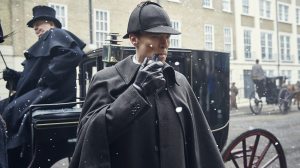
SherlockOn the theory that writing breeds writing, I am going to embark on this rigorous schedule with a blog post about … the New Year’s Day episode of Sherlock (BBC1). (Beware spoilers from here on in.) I don’t even really have the excuse of doing this with my historian’s hat on.  I make no pretensions to being a proper Victorianist, but I am, alongside my First World War expertise, a historian of popular culture with a specialism in detective fiction and it is as such that am going to make so bold as to comment.

I am also, of course, a gender historian so let me start off by saying that, as far as the ‘mansplaining’ debate which convulsed portions of Twitter in the wake of this episode, I agree entirely with Camilla Ulleland Hoel, who articulates why this is not an example of men silencing women far more eloquently than I can.  I do, however, take one slight issue with her reading of the episode, and that is in her comments on the ‘the pointy hats of Ku Klux Klan (in order to create an echo, I assume, to the orange pips story)’.  Because I am fairly sure that the entire set up to the scene was not a gratuitous KKK reference, but rather one to the 1985 film The Young Sherlock Holmes, directed by Barry Levinson, a film which, aged 12, frightened me into nightmares for months (no, I was not very sophisticated and rather too imaginative for my own good).

And that is what I loved about the episode.  Yes, there were the many, many references to the Sherlock canon.  But there were also the references to the much wider field of Sherlockiana, including Watson’s suggestion for ‘The Monstrous Regiment’ as a potential title for the episode, one that has already been used by Laurie R. King as the title for one of her Mary Russell and Sherlock Holmes series, an explicitly feminist reworking of the tradition.  And then there was the plot, not simply a metafictional phantasmagoria but also a spoof on Anthony Schaffer’s Sleuth (1970), itself part of a long line of spoofs on the detective fiction tradition, which Conan Doyle arguable founded, stretching back through the entire 20th century.

I picked up three references, but I am sure there were many, many more which I missed, given that it is some years since I have been properly involved with Sherlockiana and the field has developed hugely since then (a couple more can be found here).  My guess is that most of these conceits were the contribution of Mark Gatiss rather than Steven Moffat.  Gatiss’s writing, whether on Sherlock, Dr Who or the ridiculously clever clever and very funny Lucifer Box series, always gives me the disquieting if rather pleasing sense that here is a man who shares my somewhat obscure frame of reference when it comes to popular culture.  Which probably just means that my very limited and specialised frame of reference also happens to be a very small subset of his far, far larger one.  This is a man, after all, who, as Hoel points out, is as happy incorporating a Victorian music hall stage trick into his plots as he is with referencing semi-obscure mid-to-late 20th century plays and novels.

The delight of all this to me, beyond the comfortable smugness that comes from feeling that I am getting the joke, is the reinforcement it gives to my own belief in the importance of the history of popular culture, including low- and middle-brow material that is all to often dismissed as culturally worthless.  This is in part because it tells us something about the time in which such cultural production was created, always useful for a historian, but also, often, because if forms part of a much longer tradition, allowing us to read change and continuity across time.  Sherlock itself embodies this duality and, in this episode, made it the very conceit on which the plot was built. Itself a hugely popular element of contemporary popular culture, it nonetheless lays explicit claim to the timelessness of Conan Doyle’s creation.  By tipping its hat to the long tradition in Anglo-American culture of riffing on that creation in ways which illuminate different historical moments, it located itself within that linear tradition and made its own bid for immortality. Now there is metafiction and self-referentiality for you!

Enduring War: A review

So I am currently in London, part way through the first of a mad pair of weeks encompassing a meeting, two conferences, a couple of days in the archives and two days with the BBC at the Great Yorkshire Show. To ease myself in, I began Monday morning with a wander around the Enduring War exhibition at the British Library.

This is an ambitious exhibition, given the size of the space it occupies. Divided in to six sections, from the ‘The Call to Arms’ to ‘Grief and Memory’, the exhibition not only tries to tell a complete story of the war, but as a contributing partner in the Europeana 1914-1918 project, attempts to do it from an international perspective. Inevitably, some things are missed, while others are under-analysed. For instance, the caption to one photograph ends with the statement ‘There was an increase in Protestant church attendance in Britain in the first weeks of the war but, for a number of reasons, this was not sustained.’ There is no indication as to possible reasons why church attendance was not sustained, leaving this viewer with a sense of incompleteness.

In fact, the section on ‘Faith Under Fire’ is possibly the least satisfactory of the six. The claim about the prevalence of protective charms and rituals is never really demonstrated, in part because the use of the library’s resources places limits on what is available for display. The original manuscript of Ruper Brooke’s ‘The Soldier’ in the first section is extraordinarily moving, but there is no equivalent of, say, Adolphus, the mascot who has become the face of the Liddle Collection at the University of Leeds. Excellent use is made of posters, particularly in illustrating the Russian perspective, and the use of ANZAC trench journals makes a double point with an elegant lightness of touch. Nonetheless, the material on display does not consistently feel capable of carrying the full breadth of the story that the exhibition is attempting to tell. Indeed, so broad is the narrative that it isn’t always evident what the curators understood by the exhibition’s subtitle, ‘Grief, Grit and Humour’.  All three elements are addressed episodically but don’t really feel as if they are the central thread of a coherent narrative.

Having entered the exhibition from the side, and followed the chronological path to the dead end around a corner in the separate space that houses the section on ‘Grief and Morning’, I ended my visit by deliberately walking back around to look at the audiovisual displays at the front entrance. And here the exhibition managed to produce what was for me its most powerful and moving display through its series of video booths of montages of postcards from the front, the accompanying audio just the messages scrawled on each one. Very simple, yet entirely mesmeric, the displays demonstrate the art of the everyday that, as much as the war poets, artists and musicians whose work is, once again, presented throughout the exhibition, defined the First World War as a profound cultural experience in Britain and across Europe.

‘Men whose minds the dead have ravished’

A new public sculpture was unveiled in Seaham, Co. Durham on 29th May.  Entitled 1101, the piece, by the sculptor Ray Lonsdale, shows a 9.5 foot soldier in First World War uniform sitting at rest and is intended to reflect a moment of contemplation in the immediate aftermath of the conflict.  It is also, apparently, supposed to represent ‘what is now known as Post Traumatic Street Syndrome [sic] (PTSD) which many faced as they returned from the battlefields.’ [1]  Even ignoring the typos, this interpretation worries me for two reasons.

The first has to do with the fact that I don’t think we should retrospectively diagnose soldiers of the First World War with a psychiatric condition which was not fully defined until 1980 and which remains contentious today.  This is not to say that First World War servicemen didn’t suffer from psychological wounds; many most certainly did.  But, as I have explained in more detail here, shell shock (and or indeed hysteria, neurasthenia, disordered action of the heart or any of the other names given to psychological disability during and after the war) is not same thing as PTSD.

Setting the question of labeling aside, however, I still have serious reservations about this work of art as a representation of psychological war disability, whatever name we give it.  It shows the soldier as calm, contemplative, tired perhaps, maybe even sad, but seemingly in control of body and mind. There can be few adjectives further from the experiences of shell-shocked servicemen, as depicted in the literature and art of the time, than ‘calm’, ‘contemplative’ or ‘controlled’.  These were men whose bodies jerked and twitched, who woke screaming from nightmares, who leaped violently at sudden noises, who stuttered, struggled physically to overcome hysterical mutism or groped blindly through hysterical blindness. They had lost control of both mind and body, a condition that was fearful both to experience and behold. These men were not calm or contemplative about their condition.

The pain of psychological wounding comes across viscerally in some of the great literature and art of the period.  Wilfred Owen’s ‘Mental Cases’ is powerfully physical in its description and the disgust and pity it evokes.  The art of Otto Dix is agonizing to look at.

Dix Shell Shock 127-otto-dix-verwundeter-map-der-krieg-jpgThe viewer recoils from the pain and violence of the images.  This is how psychological disability was experienced by many First World War servicemen and those who lived with them – as pain, fear, disgust and violence. To represent the condition through a generic image of a soldier, as something calm and totalizing, runs the risk of whitewashing from history the individual subjective pain suffered by many that made their condition as disabling as any physical wound or amputation.  Too many shell-shocked ex-servicemen suffered stigma and poor treatment throughout their lives.  I would hate to see the very real pain they suffered written out of history because it is too painful for us to contemplate today.
[1] ‘New World War One statue for Seaham seafront’, Sunderland Echo, 22nd May, 2014, http://www.sunderlandecho.com/what-s-on/new-world-war-one-statue-for-seaham-seafront-1-6630051, last accessed 25th June, 2014.

Calm down, dear, it’s only a drama!

We are now three weeks into the six-week run of The Crimson Field, BBC 1’s Sunday night drama set in a First World War ‘field hospital’ ‘somewhere in France’.  The quotation marks around ‘field hospital’ may give some indication as to my opinion of the programme.  It is one of a number of small inaccuracies that, like lice in a uniform, have been driving me (and a number of other historians of British medical care in the First World War) a bit nuts.

In fact, ‘field hospital’ was a term used very little after the Boer War.  I have come across a Territorial medical unit which used the term in relation to the hospital where they trained recruits before they were sent overseas as a field hospital, but the hospitals along the lines of communication were, by 1916, when The Crimson Field is ostensibly set, known as either Casualty Clearing Stations (what would formerly have been referred to as field hospitals) or Stationary or Base Hospitals (of which this appears to be one).

Is this sort of criticism too nit-picky?  Certainly, one of the reactions on Twitter to this type of comment (which I have been making a fair amount of over the past three weeks) has been ‘It isn’t a history lesson, it’s a drama!’ with the implication that criticizing the historical accuracy of the depiction is both unfair and detracts from others’ pleasure in watching.  Essentially, this reaction is a version of ‘If you have nothing nice to say, don’t say it.’

At one level, this is fair enough.  The Crimson Field is a drama rather than a history lesson, and I don’t have any problem with cosy Sunday evening historical dramas.  I actually have a soft spot (as well as remarkably high tolerance for a historian) for such dramas, having recently enjoyed The Musketeers and Call the Midwife, and even, once I had properly suspended disbelief, still relish a good episode of Downton Abbey.  But the BBC itself is creating a block to the sort of suspension of disbelief that I have achieved with Downton by attempting to locate The Crimson Field within its own narrative of historical commemoration.  The programme is part of the ‘World War One’ season and there are regular tweets and links to related factual content on the BBC’s website.  In other words, the BBC is presenting this as both drama and history, even though they are getting quite a lot of that history wrong.

Which brings me to the other reason I have problems with the ‘It’s drama, not history’ criticism.  Because a great deal of my criticism actually is of the programme as a drama.  Having started out quite well, introducing several strong female characters with the potential to develop into interesting individuals opening up new perspectives on the popular understanding of the First World War, the dramatic arc has all too rapidly declined into a series of mythic clichés enacted by stock figures who simply represent modern ideas rather than having any real personality, historic or otherwise.  As Amanda Vickery has pointed out, the plot predominantly involves the imposition of 21st-century ideas and concerns on characters placed rather than fully located in 1916. It is unsurprising, therefore, that the drama feels clichéd and inauthentic as it tries to crowbar issues of class, race and sexuality into story lines that use endless accusations of cowardice as a shorthand for reactions to the horrors of war or attempts to deal with the complicated question of Irish politics in part of one sixty-minute episode.  In other words, The Crimson Field is not only poor history, but also not very good drama, by whatever standards you judge it.

So why do I keep watching?  Why not give it up as a bad job and let those who are enjoying the drama enjoy it in peace?  Two reasons, one superficial, one (I hope) rather less so.  The superficial reason is that, whatever the quality of the drama, the casting is, on the whole, very good.  It is not simply that I would watch Hermione Norris and Suranne Jones in pretty much anything they appeared in, however terrible, but also that they are good enough to bring depth to their parts.  Norris, in particular, has created a believably restrained and awe-inspiring matron, thankfully setting off the bizarre characterization of the hospital CO as a weak and deeply un-awe-inspiring figure.  I will probably keep watching to the end for her alone.

There is, however, a more important reason for why I will keep watching and, for that matter, keep tweeting as I do so.  It might be described as the ‘teachable moment’ excuse, to use a truly abominable American phrase.  Because I am trying to do is not merely criticize for the sake of finding fault, but to explain, insofar as 140 characters lets me, what my research has taught me about the historic reality of medical care in the First World War.  I can not only complain about the representation of a shell shock sufferer in the first episode, but also point out that he would most likely have been treated in isolation for the sake of general morale. Nor is the process only one way.  So far, questions I have had or points I have made have led to interesting discussions of how laundry was done at Base hospitals and the date at which female radiographers began working overseas.  I have thus learned something indirectly from the programme as well as, I hope, giving a little more historic depth to the understanding of a few viewers.

There is also an element of ‘Know thy enemy’ to this.  Yes, I despaired when the one fully-formed orderly character was revealed to be gay in the most historically unlikely of circumstances.  But this particular bit of trite 21st-century plot does provide an opportunity to explain that, while the masculinity of medical orderlies might be (and often was) impugned, it was, as far as I have been able to uncover, never in terms of suspect or criminal sexuality, but rather in terms of age and physical health.  Homosexuality as a pathology affecting war service was an accusation more commonly (although still not very often) leveled at men who failed to enlist or were diagnosed with shell shock, another symptom of an inherent physical and moral insufficiency which signified male degeneracy.  Exploring these distinctions in masculinity is a key element of my research project; finding and exploiting the opportunities to disseminate my research and analysis more widely, in whatever unlikely form, is thus part of my professional remit.  In other words, I watch and critique because it is my job.

This is, of course, fundamentally the same defense for using Blackadder as a teaching tool about the history of the First World War.  The drama or comedy is the starting point, not the destination, and they probably have  more to tell us about the social and cultural context in which they have been created than about the historic realities of the period that they represent.  Using them in this way is not always comfortable.  For historians it means tackling popular historical misconceptions head on and sitting through the itchy discomfort of historically inaccurate dramas to find out what, exactly, has been portrayed and how.  For non-historians who wish to engage, it can mean having assumptions and beliefs punctured and deflated. At the very least, it means being forced out of a comfortable Sunday night of suspended disbelief.  Not everyone wants to spend their Sunday evening leisure engaging critically with what they are watching, and that of course is their prerogative. No one has to either watch and critique or read critical commentary if they choose not to. But I have to admit to enjoy bringing my practice of critical analysis to The Crimson Field of a Sunday, so I will carry on. And maybe in doing so I can also make a not very good drama at least a slightly better history lesson.

Peaky Blinders and the Ubiquity of Poetry

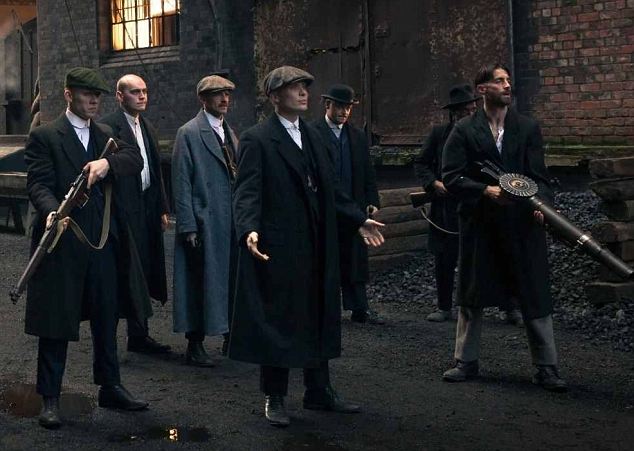
Peaky Blinders gang in Stanley DockA quick disclaimer to begin with.  I do not propose to get involved in the debate over the accuracy of the Brummie accent in Peaky Blinders, the stylish interwar gangland drama broadcast on BBC2 earlier this month, that exercised a number of tweeters.  As someone whose accent hovers around the oddly mid-Atlantic, and has, mortifyingly, once been compared to that of Lloyd Grossman, I am in no position to make any comment on anyone’s accent. Nor is this post is not going to be, strictly speaking, a historical critique of the drama.  I am not a historian of crime and that sort of critique has been done already by those who are, notably Heather Shore in this blog post.

That being said, as a historian of the First World War, I was always going to be interested in a drama set in the war’s immediate aftermath, and there were an unsurprising number of references to the conflict.  The only one I took real issue with was the incitement to strike in the first episode, where men’s war service was used as a reason for striking.  Now, the injustices of the failure to find a land fit for heroes on demobilization was certainly a cause of labour unrest in the 1920s. What was less convincing was the purported date, 1919.  I find it hard to imagine that a significant number of working-class men had been demobilized, rehired and were already prepared to strike at that date.  More plausibly these men would have been on the verge of riot in a camp in France, chafing at the delays in demobilization.

Such quibbles aside, Peaky Blinders wore its war context relatively lightly.  There was the inevitable victim of shell shock, although shooting such a man with pig’s brains at close range is a form of aversion therapy is a treatment I have yet to come across in the medical literature.  The references to the role of women, most obviously in the form of the redoubtable Aunt Polly (Helen McCrory) as the mainstay of the family business in wartime, were nicely done.  And it was interesting to note that the inevitable flashbacks to war experience were set in the tunnels, a trope of war that seems to be increasingly popular at the moment, as if Paul Fussell’s metaphor of the trogolodyte world can only now be properly understood if represented literally.  (Something similar seems to be happening with facial disfigurement, which appears to be overtaking shell shock as the metaphoric wound of the war.)

But it was only in the final episode that I felt I was being beaten about the head by the fact that this was a post-war drama and that war experience was at the heart of character’s attitudes and actions.  That it should be so is no surprise.  This was the episode where the Peaky Blinders, under the command of their wartime leader, Tommy Shelby (Cillian Murphy), went into defensive battle against Billy Kimber (the fantastically spivvy  Charlie Creed-Miles) armed with that key weapon of First World War battles (at least in the popular imagination), a machine gun.  The references were inevitable.

What interested me, however, was that extent to which the images of the battle referenced war poetry as much as military history.  This started early on, when Aunt Polly told Grace (Annabelle Wallis), that Tommy had thrown his medals into the cut.  Siegfried Sassoon allegedly throwing his MC into the Mersey is the obvious precedent.  This is followed by Tommy’s extended meditation on living in the present in the moments before he and his comrades going into battle, a meditation intercut not with the earlier images of the fighting in the tunnels of France that made up his flashbacks, but memories of making love to Grace the night before.  As I watched I found myself quoting from Alan Seeger’s ‘I Have a Rendevous with Death’:

God knows ’twere better to be deep

Pillowed in silk and scented down,

Where love throbs out in blissful sleep,

Pulse nigh to pulse, and breath to breath,

Where hushed awakenings are dear…

But I’ve a rendezvous with Death

At midnight in some flaming town,

When Spring trips north again this year,

And I to my pledged word am true,

I shall not fail that rendezvous.[i]

Then there is Ada Shelby’s appearance, in widow’s weeds and pushing her infant son in a pram (an extraordinary image that I want to think about further in terms of what it says about domesticity and respectability), bringing to mind ‘the pallor of girls’ brows’ that was, for Wilfred Owen, the pall of young men dying in battle.  And finally, in the culminating moment of battle, when Tommy Shelby single-handedly kills Billy Kimber, I thought I saw a look of recognition pass across Murphy’s. By this time I was so attuned to potential poetic references that all I could think was ‘Oh, Strange Meeting, of course’.

Now, I have no way of knowing if Murphy read any Wilfred Owen when researching the part of Tommy Shelby, or if the director Otto Bathurst is familiar with ‘I Have a Rendevous with Death’, not one of the better-known poems of the war, though it should be.  My associations may simply be an over-sensitivity on my part to any poetic reference in relation to the war, an unfortunate aftereffect of studying the war and its culture for too long.  But the fact that the references are there, even only subconsciously, tells me something about the power of these poems to speak down the generations in their representations of an emotional truth about war, violence and its aftermath.  Dramatically, this is how our culture understands the war and its aftermath, the images that it associates with this bit of history.

This is a fact that those of us who argue that there is far more to the war than ‘the mud, the blood, the endless poetry’ must come to terms with in our attempts to convey what else history has to tell us about the First World War.  That there are emotional as well as historic truths to be acknowledged.  The continued power of war poetry is that it taps into the sense of being ‘of all time’, speaking as powerfully to us today as it did to those who read it when it was first composed and published.  This does not make it the only narrative of the war, but it does make it a significant one.  And if we stay attuned to these references, in whatever unlikely scenario they pop up, not only will we be able learn more about the place of the First World War within our cultural heritage, but we may also have an excuse to quote some very moving and beautiful poetry.


[i] Alan Seeger, ‘I have a rendezvous with death’, http://www.poets.org/viewmedia.php/prmMID/19396, last accessed 28/10/2013, 15-24.

The Wipers Times (belatedly)

A couple of months ago, I tweeted this in response to the publicity surrounding a new television drama co-scripted by Ian Hislop and starring Michael Palin as a First World War general. That drama was The Wipers Times, which has now been broadcast, several weeks ago, and I can only apologise for the delay caused by pressure of work which means it is no longer available on iPlayer for anyone in Britain who may have missed it.

As the comments on my original tweet forshadowed, I am forced to eat my words because, as a historical drama, it was, I thought, very good indeed, mainly because it didn’t attempt to represent itself as historical realism.  Rather it adopted the tone of the trench journal which was its subject to represent the war as seen by the Wipers Times.  Here I want to particularly commend Ben Daniels as a stereotypical brass hat blowhard, the very stereotype I was so concerned about, played to the point of exquisite caricature, beautifully illustrating the way in which trench journals such as the Wipers Times satirized the absurdist situation in which the men who created them found themselves.  Far more than the music hall interludes, with their nods to ‘Oh, What a Lovely War’ and the excesses of cabaret culture, Daniels’s performance (and that of the more sympathetic figure played by Michael Palin) illustrated how our view of the war has been distorted by a tendency to define all wartime behaviours in black and white terms.  No one in reality could be either so blindingly stupid or so wittily sympathetic as the characters these two actors portrayed. Only as satire do they make sense.

In general, all the performances were excellent, although Emilia Fox’s role as a loving wife was more or less superfluous.  And my only potential historical criticism relates to some mumbling on the part of Julian Rhind-Tutt who made what I assume was meant to be ‘red tabs’ (staff officers) sound suspiciously like ‘red hats’ (military policemen), an entirely different, if equally loathed group of authority figures.  But it was a good drama and, for the first third, very funny indeed.  After that the humour became repetitive, and the shift of focus almost exclusively to the officers meant a loss of the voices of the ordinary soldier.  While the tone towards these men was generally condescending, mocking the ignorance and unsophistication of the young British working class man, this was an accurate reflection of the language used by many trench journals which were as class-bound as so much else in British culture during the war.

The increasing staleness of the humour as the drama continued may seem like a criticism, but it is not.  It too is an accurate reflection of trench journalism.  For anyone who has spent any time reading such journals, and those produced in prisoner of war camps and hospitals, this growing staleness is all too familiar. It reflects the fact that (pace all those television reviewers who referred to the public school humour of the publication) these publications represented the humour not of the upper-middle classes (although this was well represented) as much as that of the institution.  The result is a predominance of in-jokes which, to the outsider who is not caught in the institutional setting, be it a hospital, a prison or a military unit under orders, seem either inexplicable or dull.  The trajectory of the drama captured this beautifully, with the only duff note being the uncharacteristic injection of sentimentality and 20/20 ‘foresight’ in the scenes depicting Fred Roberts, the originator and editor of the Wipers Times, at home with his wife on leave.

In the end, it was not the drama itself which troubled me as a First World War historian, but the response of television critics after its broadcast, an number of whom implied that the Wipers Times was worthy of note because it dramatised the viewpoint of a unique publication and, as such, stands as a necessary corrective to more sombre commemorations of the war.  In fact, as I have suggested, it was one of a number of such publications which treated the trials and tribulations of warfare (including serious injury and the loss of liberty) as subjects of humour and absurdity.  Some 800 such journals have been collected by Cambridge University Library.  Nor was it only periodicals that adopted this tone.  Herman Cyril McNeile, better known as ‘Sapper’, wrote a number of short stories which were published for propaganda and recruitment purposes by The Daily Mail, which also adopted an amused, flippant tone in their descriptions of life at war.  For anyone interested in the subject, I highly recommend George Simmers’s excellent essay on facetiousness in wartime and post-war writing (which does a far better job of teasing out the class dimensions of this literature than I have done here).  And for anyone want to read more institutional war time journals, Sue Light’s blog of the Gazette of the 3rd London General Hospital, Ward Muir’s Happy Hospital, gives an excellent idea of what can be found in that extraordinary organ, including contributions from C.R.W Nevinson, later a war artist, and Stephen Baghot de la Bere, the cartoonist.  Nor were British the only servicemen to produce trench journals.  Stéphane Audoin-Rouzeau’s Men at war, 1914-1918 : national sentiment and trench journalism in France during the First World War(translated by Helen McPhail) and Robert L. Nelson’s German Soldier Newspapers of the First World War present a transnational picture of bottom-up morale building during the war.

So The Wipers Times ended up not only proving itself an enjoyable drama, but also the source of considerable reflection on popular understandings of the war. While reviews of the programme expose some of the limits of public knowledge, my previewing comment exposed the limits of my own.  It provoked a very interesting discussion with the historical adviser to the programme on the limitations inevitable with creating drama out of history, particularly on the sort of budgets provided by the BBC.  I am now training myself not to complain about the misrepresentation of roles until I consider how a limited cast is being deployed to cope with sheer lack of numbers, and not to judge a popular television programme by its publicity.

Publicity

A couple of publicity (self and otherwise) notices.

The University of Leeds Legacies of War seminar series is delighted to announce that Professor Adrian Gregory will be giving the first paper of the new term on Thursday, 7th February at 5:00 in Michael Sadler Room 3.11.  He will be speaking on the topic of ‘Did God Survive the Somme?’  All are welcome.

Adrian GregoryMy review of Leo van Bergen’s Before My Helpless Sight: Suffering, Dying and Military Medicine on the Western Front, 1914-1918 appears in the latest edition of First World War Studies which also includes several interesting-looking articles.  I should be reading about the establishment of the Territorial Army in Britain, but I think I may take break and read about Old Etonians, demographics and eugenics instead, courtesy of Richard Carr and Bradley W. Hart.

A letter to Simon Russell Beale

privateson-parades_2423627bDear Mr Russell Beale,

First of all, please allow me to apologize for making such a complete idiot of myself when I saw you on Friday evening before the performance of Privates of Parade. In the first instance, it was extremely rude of me to stare at you so long and so idiotically while you enjoyed your cigarette at the stage door. Secondly, when you had the civility to say hello, for me to mutter something incomprehensible and slink off in the other direction was beyond impolite. My only excuse is that, at that stage, I did not have anything I could have said to you that would not have been more than the burblings of a long-term fan.

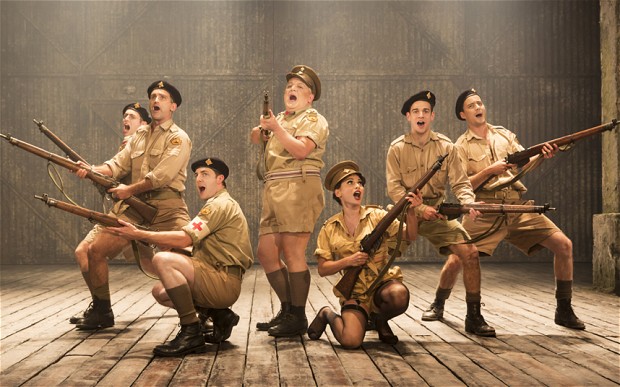
In all honesty, I do wish our encounter had taken place a few hours later, after I had had the privilege of seeing your hugely enjoyable performance as Terri Dennis. As a theatrical experience it was, as the reviews have said, enormously enjoyable, courageous, full of energy and life and wit. But writing as a historian of gender and warfare your performance,along with that of all the rest of the cast and Michael Grandage’s highly accomplished direction, offered a great deal of food for thought as well.

The story the play tells is, of course, one about the achievement of masculine maturity, both sexual and emotional, in a theatre (in all its many meanings) of conflict. As Steven says in the final scene, he has become a man thanks to his experiences in SADUSEA, specifically, rather than in the military more generally. But what I found far more fascinating was Terri’s attainment of a conventional masculine identity at the end, one defined not by his military status, which is so successfully undermined throughout by the campness of his demeanour, but through his marriage and impending (surrogate) fatherhood, a narrative emphasized by the modulation you brought to that closing scene.

For me, that was the most powerful theme of the entire evening, the importance of the domestic and of home to the identity of all the men involved. The scene in which letters home are opened and read is the first in which their characters become fully defined, as sons and husbands, and throughout it is through their domestic ties, former, potential, respectable and subversive, that the characters developed. Dennis’s own story of domestic tragedy was profoundly moving, a lovely counterpoint to his eventual domestic ‘respectability’.

Not that these were the only themes: the role of uniform and costume in defining masculinity, the transient power of wounding and disability in creating heroic identities and the appalling things that conflict does to warp both men and women were all powerfully evoked. In the end, I had so much to say that, had I seen you again I probably would have been no more coherent than I was on our first encounter. So all I can do is say thank you, to you and the rest of the cast, for creating a theatrical performance that had so many profound echoes of my own work and which forced me to think critically about questions of sexuality and emotion. And again to ask your forgiveness for one tongue-tied long-term fan who remains

Yours very sincerely,

Jessica Meyer

Looking Ahead

Happy New Year! I hope you have all had very merry and happy holiday seasons. Mine was lovely, marred only by sickness which struck on Boxing Day and has affected one or other member of my household ever since. Still, sore throats notwithstanding, we KBO.

Today is my first back at work since the holidays, although given the silence in the corridors, most of my colleagues have decided that this half a week is a bit pointless and have sensibly stayed away. With only one day in the office, I have mainly been concentrating on clearing my desk in preparation for the new year and, having almost succeeded (there is one proposal still to draft that is proving so intractable that I think yet another cup of tea will be needed to crack it), I thought this would a good opportunity to take a look ahead at what 2013 has to offer.

Firstly we have a great line-up of speakers for the Legacies of War seminar series. Final confirmation of titles is pending (and the full list will be posted in a week or so), but Adrian Gregory and Santanu Das have both agreed to speak, on ‘Did God Survive the Somme’ (!) and on ‘India, Empire and the First World War’. Both should be fascinating.

Before then I will be heading off to London, to the Wellcome Library where I will be on the hunt for memories of and about medical orderlies. Having had my proposal on the experiences of orderlies accepted for the Social History Society’s annual conference in March (see here for details), I am now looking for material to support the conclusions I have been drawing from reading Ward Muir’s Observations of an Orderly.  There is at least one orderly memoir at the Wellcome, plus a long list of potential manuscript sources, so it will be a busy.  I am also hoping to attend the IHR conference on open access, The Finch Report, open access and the historical community while I am there (there is a waiting list).

Also coming up is a meeting at the Imperial War Museum North for academics across the North of England to discuss plans for the centenary commemorations and I will be taking the opportunity to go round the ‘Saving Lives’ exhibition while I am there.

There are also a couple of long term plans that are starting to take shape – workshop for the autumn on the history of medicine and warfare, a journal special issue that I have been putting together for years now that hopefully will find a suitable home this year, plans for a primary school class on First World War medicine that may or may not include an accurate reproduction of a stretcher and work with some of the All Our Stories projects relating to Leeds hospitals during the war that have received funding.

And in the interim there will be reading and writing – lots of both.  There is the article on voluntary medical services and their relation to the military that I have been trying to write for a couple of months now, and the stack of books on the Territorial Army sitting seductively on my desk which will, hopefully, inform it.  There is the aforementioned conference paper on medical orderlies and the related research.  There is a beautiful (literally – the cover image is gorgeous) book from Ashgate to review.  And there is the ever-growing reading list, not including the ten books sitting disconsolate on my ‘to read’ shelf awaiting my attention.

So all in all it looks as if this will be a very busy and hopefully productive year in the annals of Arms and the Medical Man.  I will, of course, keep you updated as I go along.  I hope you enjoy the ride as much as I think I will.

Critical Ramblings

After a week in the archive last week I have been reading a few articles in an attempt to get a bit more into the correct mindset before writing my own.  With one exception, none have been directly related to my research (there isn’t a whole lot out there as far as I can make out) but two were articles that I have been meaning to read for some time as they have been cited in many other things that I have read.  The experience was enlightening, although possibly not in the ways the authors intended.

The first of these was actually a chapter in a collection of essays, Ilana Bet-El’s ‘Men and Soldiers: British Conscripts, Concepts of Masculinity, and the Great War’ in Billie Melman’s Borderlines: Genders and Identities in War and Peace 1870-1930 (Routledge, 1998). Bet-El’s argument is that British popular memory of First World War soldiers as men is dominated by the Myth of Volunteer (her capitals) at the expense of the masculine experiences of conscripts who, in fact, made up the majority of service personnel over the course of the war. While Bet-El certainly has a point, she does fall into the trap of ascribing too much meaning to the way in which a man became a soldier, the very criticism she has of the civilian population at the time, who she sees as being out of touch with the realities of warfare.  Thus the experiences of maleness in wartime as one of endurance and survival which she ascribes exclusively to conscripts surely applies as much to the experiences of volunteers once they were in the front line as to those of conscripts.  She also doesn’t play entirely fair with her sources, using public propaganda posters in relation to volunteers but personal documents when discussing conscripts.  This does bring new sources into the debate, but it is rather a case of comparing apples and oranges.

My notes on Bet-El’s articles are thus full of exclamation points and pointed asides about her claims, many of which I disagree with.  What is encouraging, however, is the date of the article.  Having wondered why she was using such a monolithic definition of masculinity (and one that tended to over-emphasize the importance sexuality, although this was clearly in response to the historiographic context she was arguing against), I went back and checked the dates and realized that almost all the more interesting and subtle analysis of masculinity and the First World War had been published after this article.  So John Tosh’s discussion of domestic masculinity and its relation to adventure and, even more significant, his analysis of ‘manliness’ as opposed to ‘masculinity’, and Joanna Bourke and Michael Roper’s work on male emotions in wartime has all been published in the past decade and a half, which is before you consider the reconsiderations of war enthusiasm, recruitment and citizenship that have also appeared.  That the field has developed so much, and introduced so many complex and interesting questions to the debate is very exciting and encouraging for those of us who are trying to take the work further.

Mentioning Mike Roper brings me two the second article which has been raising my blood pressure, Tracey Loughran’s ‘Shell Shock, Trauma, and the First World War: The Making of a Diagnosis and Its Histories’ in the Journal of the History of Medicine and Allied Sciences (Vol. 67, no 1, 2010, pp.94-119), which cites The Secret Battle extensively.  Again, this is an article I have been meaning to read for a while and it was definitely worth the wait.  I think Loughran’s argument about the need to locate understandings and diagnosis of shell shock in the wider intellectual context of the early twentieth century is spot-on and I am looking forward to her book on the subject which is tantalizingly in production.  What I was less convinced by was her argument for a middle way approach between those who locate an emotional truth of the war in art and literature and what she refers to as the ‘myth and memory’ school of historians who locate that truth in ‘the widest possible range of documents, representing the widest possible range of people’, citing Dan Todman’s The Great War: Myth and Memory.  I think this is a bit of a misrepresentation of the myth and memory argument which certainly isn’t about the weight of sheer numbers.  It is primarily about the very thing Loughran herself is interested in, context, and providing a counter-balance to what might be described as a hegemonic understanding of the war based on a relatively small number of sources.  Certain stories about the war have great prominence – the war poets, men shot at dawn, most recently men with facial injuries.  Trying to tell the stories of other groups, not necessarily larger but equally relevant and representative, can be difficult, especially if those stories appear to contradict the ’emotional truths’ of the better known groups. Understanding how those particular groups came to dominate the historic narrative isn’t everything, but it can help to make the case for why stories about conscripted men or those suffering abdominal wounds or those whose psyches were resilient or adaptable enough that they didn’t display symptoms that could be defined as shell shock are also worth hearing.  Yes, there must also be an ’empathetic imagining of a subject’ in order to ask ‘questions with a human meaning, which ultimately makes the practice of history worthwhile.’  But that empathy is not necessarily precluded by casting a critical eye over how particular stories come to resonate so strongly, any more than the ability to be historically accurate is precluded by the fictional form.
So, that is rather a long-winded way of me getting some first impressions and criticisms off my chest.  Working on a long-term independent project, it can be difficult to find an outlet for such ideas and critiques.  Articles are not, in themselves, subject to book reviews, and I cannot write full reviews for everything I read in any case.  But in the absence of a reading group or seminar series in which to express my ideas, this blog must serve instead as an outlet and record.  Which is, of course, the point.